No, it’s not safe to leave a toaster oven on unattended — and that’s true whether you’re running a 10-minute toast cycle or a 2-hour slow roast. Toaster ovens reach internal temperatures of 300°F to 500°F (149°C to 260°C), and their compact size means heating elements sit just inches from food, racks, and any stray crumbs that have built up over time. Unlike a microwave, which heats food using non-ionizing radiation and stops the moment you open the door, a toaster oven contains exposed glowing elements that can ignite grease splatter or debris with no warning at all.
Safety First: Toaster ovens generate surface temperatures exceeding 400°F on the glass door and exterior housing. Never leave one running in a room you can’t monitor — grease fires and ignited crumbs can develop within minutes. Keep a working smoke detector within 10 feet of your cooking area, never store items on top of the unit, and unplug it when not in use. If you see smoke, do not open the door immediately; cut the power first and let it cool.
Quick Facts: Toaster Oven Safety At a Glance
- Toaster oven heating elements glow at roughly 1,000°F–1,400°F even when the interior thermostat is set to only 350°F
- The CPSC has linked toaster ovens to hundreds of residential fires annually — crumb tray buildup is the most common cause
- Microwaves do not produce open heat elements and are statistically far safer to leave unattended for short periods
- Glass doors on toaster ovens can reach 300°F+ externally — a serious burn risk, especially around kids or pets
- A dirty crumb tray can catch fire in under 3 minutes at 450°F — cleaning after every 3–4 uses is the single highest-impact habit you can build
What Actually Happens Inside a Toaster Oven When You Walk Away
I’ll be honest — I walked away from my Breville Smart Oven during a batch of garlic bread once. Set it to 375°F, broil mode, figured I’d be back in two minutes. I was not back in two minutes. By the time I got back, the bread wasn’t on fire, but it was fully carbonized and the smoke detector was doing its best. That’s a mild outcome. The more serious scenario involves grease.
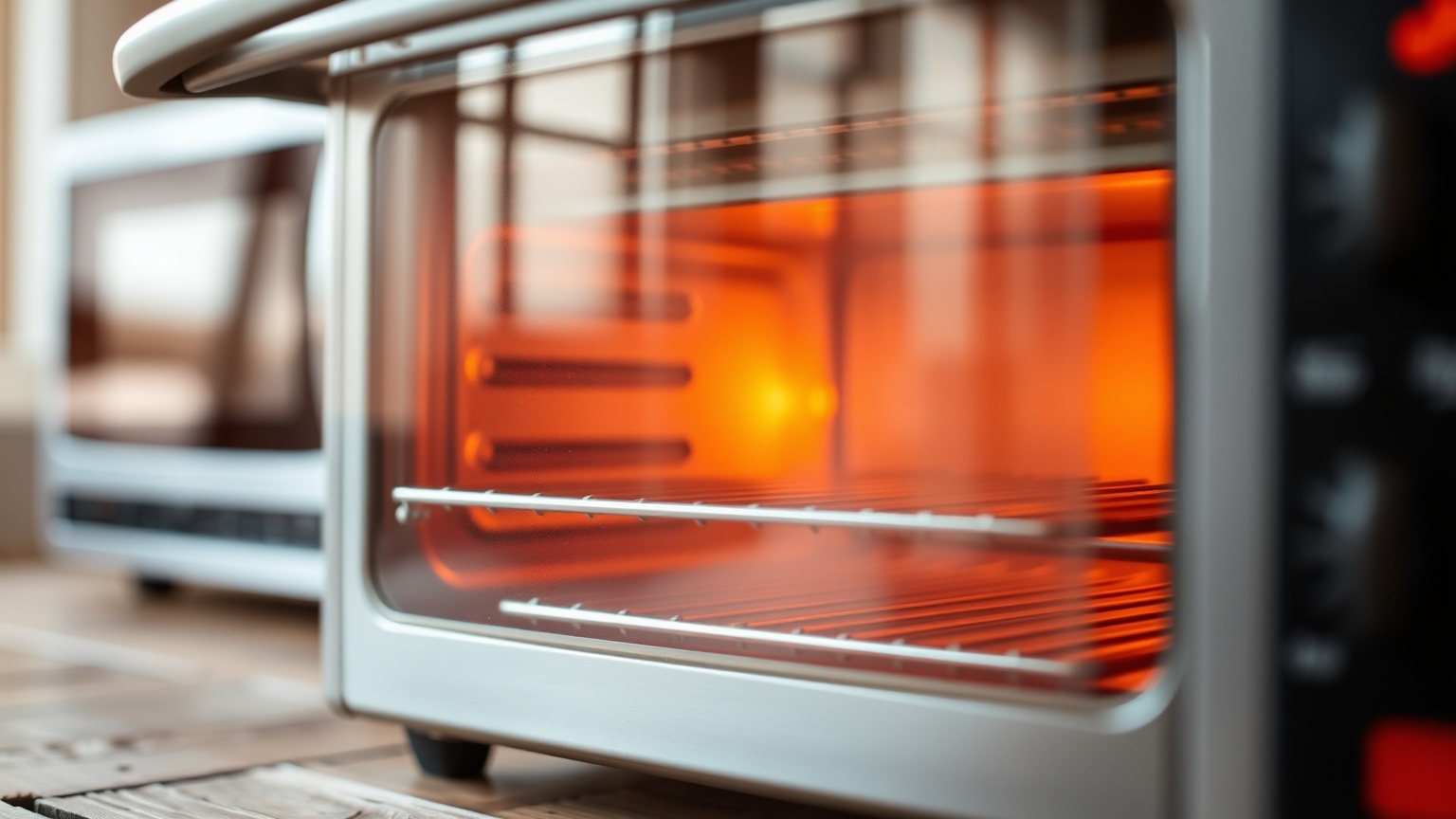
Here’s what’s actually going on mechanically. The heating elements — those coiled nichrome rods you see at the top and bottom — glow somewhere between 1,000°F and 1,400°F during active heating cycles. The interior thermostat cuts power to the elements once the cavity air reaches your set temperature, but the elements themselves cycle on and off repeatedly throughout the cook. Every time they switch back on, they’re hot enough to ignite grease droplets, paper, or accumulated crumbs almost instantly.
The compact cavity is the bigger issue, honestly. A standard full-size kitchen oven has roughly 4–5 cubic feet of interior space. Most countertop toaster ovens have 0.5 to 1.5 cubic feet. That means dripping fat from a chicken thigh, for instance, can land directly on a lower heating element rather than falling harmlessly to a distant oven floor. I’ve seen it happen. It’s not subtle.
Toaster Oven vs. Microwave: The Real Risk Comparison
People treat these two appliances as rough equivalents. They’re not. The risk profiles are genuinely different, and it’s worth understanding why before you decide one is “basically fine” to leave running.
| Feature | Toaster Oven | Microwave |
|---|---|---|
| Heat source | Exposed glowing elements (1,000–1,400°F) | Microwave radiation (no open flame or element) |
| Typical wattage | 1,200–1,800W | 700–1,200W |
| Max interior temp | Up to 500°F (260°C) | Not applicable (heats food, not air) |
| External surface temp during use | 200–400°F on glass door | Typically under 120°F externally |
| Fire ignition risk from food debris | High — crumbs and grease can ignite on elements | Low — sparking possible but rare without metal |
| Auto-shutoff feature | Timer-based; not all models have auto-off | Usually stops automatically when timer ends |
| Safe to leave unattended? | No — not recommended | Generally yes, for short cycles |
Microwaves can cause problems — putting metal in one, or overheating liquids to the point of superheating, are real issues. But the mechanism is fundamentally different. There’s no open element to ignite grease. The magnetron shuts off when the timer ends. You’re not managing 400°F surface temperatures on the outside of the unit.
A toaster oven, by contrast, stays hot long after the cycle ends. The glass door on my unit still reads over 200°F five minutes after I’ve pulled the food out. That’s a burn risk that lingers in a way a microwave’s simply doesn’t.
The Specific Scenarios Where Risk Goes Up Dramatically
Broil Mode
Broiling means the top element stays on continuously, rather than cycling. It’s running at full heat the entire time. Most recipes call for 3–10 minutes under the broiler, which sounds short — but unattended, that’s plenty of time for cheese to drip, catch, and smoke. I only use broil mode when I’m standing right there, eyes on the food. No exceptions.
Fatty or Greasy Foods
Bacon, chicken skin, sausages — anything with significant fat content is a legitimately higher-risk item to cook in a toaster oven. The fat renders out and drips. In a small cavity, it lands near or on the lower element. I always use a toaster oven baking pan with a rack when cooking fatty proteins, which catches most of the drip and keeps it away from the elements. Still — I stay nearby.
A Dirty Crumb Tray
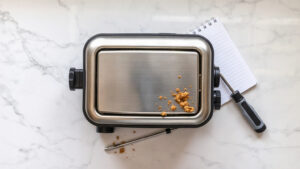
This is the edge case most safety guides skip over: what’s in the crumb tray matters as much as what you’re currently cooking. Old crumbs, accumulated grease, a forgotten sesame seed from last Tuesday’s bagel — all of it is dry, carbon-rich fuel sitting directly below the lower heating element. At 450°F, that can go from “smoldering” to “small fire” faster than you’d expect. Pull the crumb tray and clean it every few uses. It takes 45 seconds.
Overnight or Extended Cooks (the Edge Case Most Articles Miss)
Some forum threads suggest using a toaster oven on a very low setting — say, 170°F–200°F — to slow-cook ribs or pulled pork while you’re at work or asleep. The logic being that low heat means low risk. But here’s what that argument ignores: even at 170°F, the elements still cycle on and off. They still reach 1,000°F+ during those brief on-cycles. And you’re talking 6–8 hours of unsupervised operation. If anything fails — a thermostat that sticks, a short in the cycling relay, grease that accumulated from a previous cook — there’s nobody there to catch it early. I wouldn’t do it. A slow cooker (proper Crock-Pot style) is genuinely designed for extended unattended use. A toaster oven is not.
Practical Steps That Actually Reduce Risk
If you’re going to use a toaster oven — and you should, they’re fantastic — here’s how to do it with your eyes open.
- Clean the crumb tray after every 3–4 uses minimum. This is the single most impactful habit. A clean tray reduces ignition risk more than almost any other factor.
- Keep at least 4 inches of clearance on all sides. The sides and top of the unit get genuinely hot. Cabinets above the unit, a bread bag sitting too close, a dish towel draped nearby — all of these are problems I’ve seen in real kitchens.
- Use a proper rack or pan for drip-prone foods. A stainless toaster oven wire rack with a drip pan underneath is your best friend for anything fatty.
- Don’t use foil to line the crumb tray. It restricts airflow, can interfere with the heating element, and some manufacturers explicitly void the warranty if you do it. I know it seems like a good idea. It’s not.
- Buy a model with auto-shutoff. Not all toaster ovens have it. If yours doesn’t, consider upgrading. Check out the best mini toaster ovens — several solid options have this feature built in.
- Position the unit away from curtains, paper towels, and anything flammable. This sounds obvious. It’s still the cause of a significant number of kitchen fires every year.
For more on using your toaster oven safely for specific cooking tasks, my guide on reheating food in a toaster oven covers temperature settings and timing in more detail. And if you’re curious about how heating element temperatures compare across appliance types, the breakdown of how hot a toaster gets is worth a look.
The U.S. Consumer Product Safety Commission consistently lists countertop cooking appliances — toaster ovens specifically — among the leading causes of residential kitchen fires. That’s not alarmism. It’s just useful context.
What About Leaving It Plugged In When You’re Not Using It?
This is a separate question from leaving it on, but it’s worth addressing because people conflate the two. Leaving a toaster oven plugged in but off is generally fine — there’s minimal standby draw, and unless there’s a wiring fault, it’s not going to spontaneously activate. That said, I unplug mine after every use. Old habit. Takes two seconds, eliminates any residual risk, and honestly the cord has a satisfying weight to it that makes it feel like a deliberate end to the cooking session. Slightly irrational, but there it is.
The real risk with “plugged in but off” is if the unit has a faulty thermostat or relay that fails in the “on” position. Rare. But possible. If your toaster oven is old, used frequently, and has never been serviced, that’s worth keeping in mind. The Food Network’s kitchen safety guidelines recommend unplugging small appliances when not in use, and I think that’s reasonable advice rather than paranoia.
The Bottom Line
Toaster ovens are genuinely useful kitchen appliances. I use mine several times a week and I’m not about to stop. But “safe to leave unattended” isn’t really the right framing. The question is more: what’s the consequence if something goes wrong while you’re not watching? With a toaster oven, that consequence can be serious — and it can escalate faster than you’d expect.
Stay nearby when it’s running. Clean the crumb tray. Keep clutter away from the unit. Buy one with auto-shutoff if yours doesn’t have it. None of this is complicated. It’s just the boring, practical stuff that actually prevents fires.
And don’t do the overnight rib cook in a toaster oven. Get a slow cooker. I promise it’s worth it.
Frequently Asked Questions
Is it safe to leave a toaster oven on while you sleep?
No — leaving a toaster oven running overnight is a significant fire risk that most safety experts and appliance manufacturers advise against. Even at low temperatures, the heating elements cycle on and off at extreme heat, and there’s no one awake to respond if something ignites. If you need extended low-heat cooking, a proper slow cooker is designed for exactly that use case.
How hot does a toaster oven get on the outside?
The glass door on most toaster ovens reaches 200°F–400°F during normal operation, depending on the set temperature and the model. The exterior housing sides can hit 150°F–250°F. These are genuine burn temperatures — not warm-to-the-touch, but hot enough to cause a second-degree burn in under a second of contact.
Is it safe to leave a toaster oven plugged in when not in use?
Leaving a toaster oven plugged in but switched off carries very low risk under normal circumstances. However, units with faulty thermostats or aging wiring components can occasionally fail in a way that causes unintended heating. Unplugging after each use eliminates that residual risk entirely and is the habit most fire safety organizations recommend.
Can a toaster oven catch fire?
Yes, and it happens more often than people expect. The most common cause is accumulated crumbs and grease in the crumb tray or on the lower heating element, which can ignite when the element cycles on. Grease from fatty foods dripping directly onto the element is the second most common cause. Regular cleaning and using a drip pan for fatty foods are the most effective preventive measures.
Is a toaster oven safer than a microwave to leave running?
Is a toaster oven safer than a microwave to leave running?
Microwaves are considerably safer to leave running unattended for short periods than toaster ovens. Microwaves use radiation to heat food without an exposed element, stop automatically when the timer ends, and have much lower external surface temperatures. Toaster ovens use open heating elements that can ignite grease or debris, stay hot long after cooking, and don’t always auto-shutoff when the cycle ends.

Written by
Emma founded Toastera to turn vague appliance advice into clear, researched, safety-first guidance on toasters and toaster ovens.
Free: the Toaster Oven Cheat Sheet
Get the printable cheat sheet (temps, cook times & safety tips) plus new recipes. No spam, unsubscribe anytime.