To convert an oven casserole recipe to an air fryer, reduce the temperature by 25°F and cut the cook time by roughly 20–25%. Air fryers circulate hot air directly and aggressively around the food, so they cook faster and brown more efficiently than a conventional oven. For most covered casseroles, expect to check for doneness about 15 minutes earlier than the original recipe suggests.
Safety First: Air fryers and toaster ovens reach extremely high temperatures — the basket, tray, and interior walls can cause serious burns on contact. Always use heat-resistant oven mitts when removing casserole dishes, never use glass bakeware that isn’t labeled oven-safe to at least 400°F (many standard glass dishes can crack under rapid air fryer heat), and never leave a hot appliance unattended when cooking dense, liquid-heavy dishes that could bubble over onto heating elements.
Key Takeaways
- Drop oven temperature by 25°F when switching to an air fryer (e.g., 350°F oven → 325°F air fryer)
- Reduce cook time by 20–25% — a 60-minute oven casserole typically takes 45–48 minutes in an air fryer
- Covered casseroles retain moisture well in an air fryer; uncovered ones can dry out faster than you’d expect
- Always check internal temperature with a probe thermometer rather than relying purely on timing
- Dish size matters — a casserole that fills the pan edge-to-edge will cook slower than one with space around it
Why Air Fryers Cook Casseroles Differently
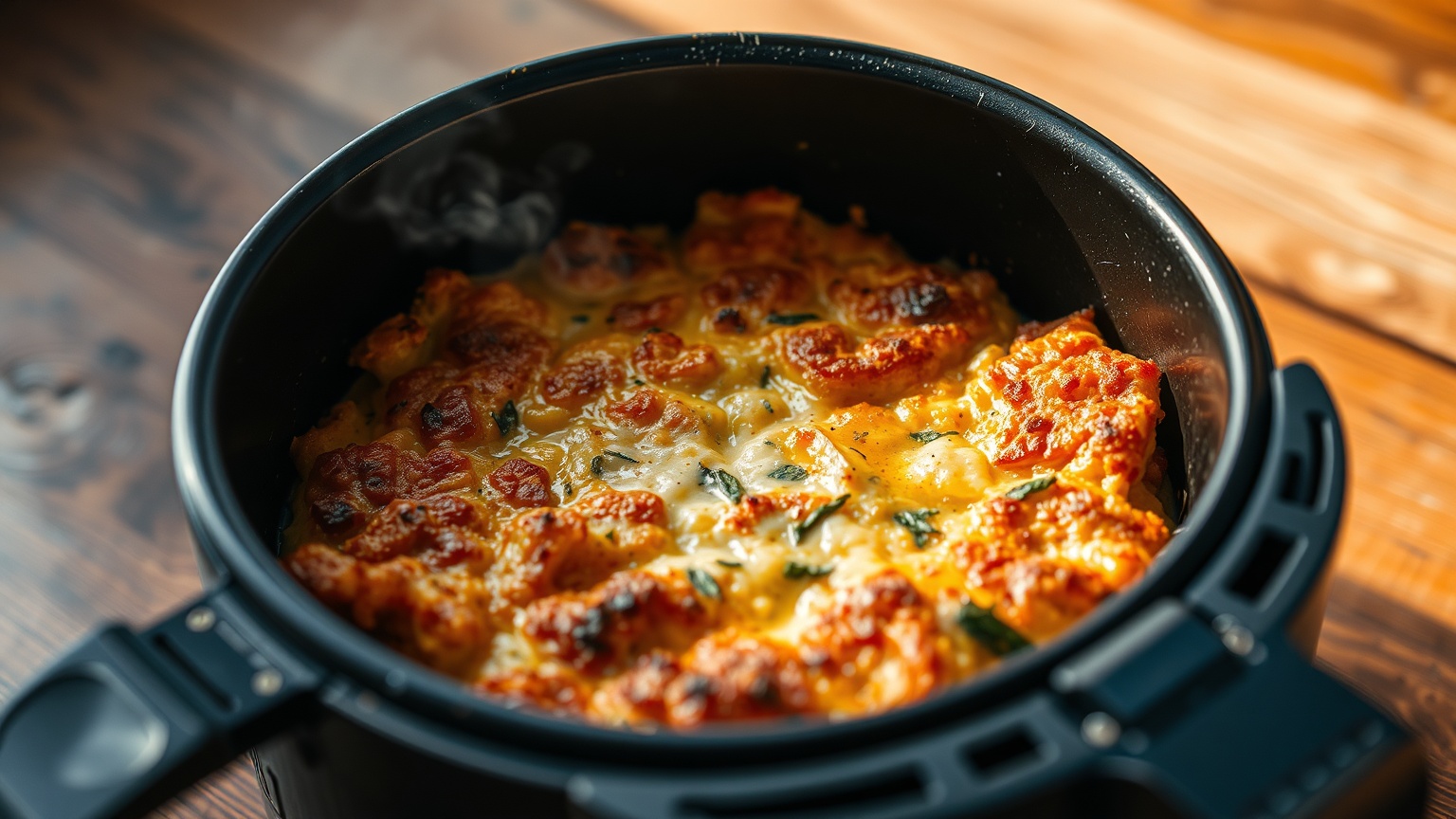
A conventional oven heats the air inside a large cavity and relies partly on radiant heat from the walls. It’s a relatively gentle, passive process. An air fryer is basically a small, very powerful convection oven — the fan runs hard, the cavity is tiny, and hot air is hitting your food from all directions at once. That changes everything about timing.
The size difference is the part people underestimate. Your home oven might have 4–5 cubic feet of interior space. A typical countertop air fryer has maybe 4–6 quarts — under a cubic foot. Same wattage (often 1500–1800W), tiny space. It heats up fast and recovers temperature fast. That’s why the 25°F reduction matters: without it, the outside of your casserole can overcook before the center catches up.
I learned this the hard way with a chicken and rice casserole. Used the same temperature as my oven recipe. The top was golden and gorgeous. The rice in the middle was still crunchy. Not my finest moment. After that, I started treating every air fryer casserole conversion as its own small experiment — which sounds annoying, but honestly only requires one or two test runs to dial in.
The Conversion Formula: Temperature and Time
Here’s what I actually use. It’s not complicated, but the specifics matter.
Temperature Adjustment
Subtract 25°F from whatever your oven recipe calls for. If the recipe says 375°F, set your air fryer to 350°F. If it says 400°F — common for crispy-topped casseroles like mac and cheese — drop it to 375°F. That 25-degree buffer prevents the surface from burning before the interior is cooked through.
One exception: if you’re finishing a casserole uncovered for a crispy top in the last few minutes, you can bump back up to the original temperature for just those final 3–5 minutes. Works well for breadcrumb toppings.
Time Adjustment
Cut the original cook time by 20–25%. Then start checking earlier than that. Always.
Here’s the math in practice: a casserole that bakes for 45 minutes in the oven should be checked at about 33–36 minutes in the air fryer. A 60-minute casserole? Check at 45 minutes. A 90-minute slow-baked casserole (think lasagna) — check around 68–70 minutes.
Don’t just open the lid and guess, though. Use a probe thermometer. Most fully-cooked casseroles with meat should hit 165°F internally, per USDA food safety guidelines. Vegetable or pasta-only casseroles are done when the center is hot (around 165–175°F works as a target) and any cheese is fully melted with no raw-dough texture.
Oven-to-Air Fryer Casserole Conversion Chart
I put this table together based on my own testing and standard convection conversion math. It covers the temperatures most casserole recipes use.
| Oven Temp | Oven Time | Air Fryer Temp | Air Fryer Time (Approx.) | Notes |
|---|---|---|---|---|
| 325°F | 90 min | 300°F | 68–72 min | Dense casseroles, covered |
| 350°F | 60 min | 325°F | 45–48 min | Most standard casseroles |
| 350°F | 45 min | 325°F | 34–36 min | Check at 30 min |
| 375°F | 45 min | 350°F | 34–36 min | Casseroles with crispy tops |
| 375°F | 30 min | 350°F | 22–25 min | Shallow or smaller dishes |
| 400°F | 30 min | 375°F | 22–24 min | Mac and cheese, au gratin |
| 400°F | 45 min | 375°F | 33–36 min | Uncover last 5 min for crust |
These are starting points, not guarantees. Your specific air fryer model, the dish material, and how full it is all shift the timing somewhat. A probe thermometer is genuinely the most useful tool you can have for this.
Dish Choice, Foil, and Other Practical Details
This is where most conversion guides stop short. The dish you use changes the outcome significantly.
What Bakeware Actually Works
Dark metal pans absorb heat faster — expect the bottom to cook more aggressively. Light-colored aluminum or stainless are more forgiving. Ceramic is slower to heat but holds heat well, so it can compensate if you give it a few extra minutes. Glass is fine IF it’s tempered and rated for high heat (Pyrex, for example), but I’ve seen people crack cheap glass dishes in air fryers because the heat change is so rapid. I personally avoid glass in the air fryer unless I’m very confident in the dish’s rating.
The pan needs to actually fit in your air fryer basket or on the rack. Sounds obvious. It’s not — I once tried to wedge a 9×9 ceramic dish into a 5.8-quart basket that physically did not accommodate it. Measure your air fryer interior before you commit to a dish. You can find air fryer-compatible casserole pans that are specifically sized for this.
Covered vs. Uncovered
Most casserole recipes call for covering with foil for the bulk of cooking, then uncovering to brown the top. That approach works perfectly in an air fryer — maybe even better, since the fan accelerates browning once the foil comes off. Keep the foil on for 80% of the cook time, remove it for the last few minutes. Watch it closely at that point because the top can go from pale to overdone in two or three minutes in an air fryer. It’s faster than you think.
One thing: if you’re using foil, don’t let it hang over the sides of the dish loosely. The fan can blow it against the heating element. Tuck it down or use a pan with a lid if you have one.
Moisture Management
Air fryers are drying. That’s usually a feature — but for casseroles, it can mean your dish comes out a little drier than the oven version. A few things help: add a splash more liquid to the recipe (an extra 2–3 tablespoons of broth is usually enough), keep the dish covered longer, and don’t skip the rest period after cooking. Letting a casserole sit for 5 minutes off-heat lets the liquid redistribute. This is good advice for oven casseroles too, honestly.
Edge Cases Worth Knowing About
Most guides cover the basics and call it done. A few situations genuinely trip people up.
Frozen Casseroles
If you’re cooking a casserole straight from frozen, the standard 20–25% time reduction no longer applies. Frozen casseroles need more time, not less — even in an air fryer. Start with the oven time at a straight conversion (no reduction), cook covered at 325°F, and use your thermometer to confirm doneness. Trying to rush a frozen casserole by cranking the heat almost always results in a hot exterior and cold middle. I’ve been there.
Very Deep or Very Dense Casseroles
A 3-inch deep lasagna is not the same as a shallow vegetable gratin. Deep casseroles with dense ingredients (like ground meat, potatoes, or layers of pasta) need more time for heat to penetrate. For anything over 2.5 inches deep, I’d reduce the time by only 15% instead of 20–25%, and check with a thermometer inserted in the very center. The edges will always cook faster — that’s just physics in a small circulating-air environment.
Casseroles with Dairy-Heavy Toppings
Cheese and cream-based toppings bubble and brown aggressively in an air fryer. If your casserole has a lot of cheese on top, add it later in the cooking process — about two-thirds of the way through — rather than at the start. Otherwise you get a cheese crust that’s overcooked while the inside is still catching up. Serious Eats has a good write-up on casserole layering technique that’s useful background here.
Using a Toaster Oven vs. a Basket Air Fryer
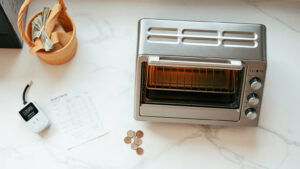
If you’re using a toaster oven with an air fry setting rather than a standalone basket-style air fryer, the conversion is slightly different. Toaster ovens have more interior space, so they behave a little more like a conventional oven. You might only need to reduce time by 15% instead of 25%, and the temperature adjustment can stay at 25°F. I’ve tested this with a few different models — check out our roundup of the best mini toaster ovens if you’re still deciding which appliance to use. Also relevant: our notes on reheating food in a toaster oven, since reheating a casserole follows similar conversion logic.
A Few Things I Always Do Now
After converting probably two dozen casserole recipes, here’s what’s become automatic for me:
- Preheat the air fryer for 3–5 minutes before putting the dish in. It makes a difference in how evenly things cook.
- Set a timer for 10 minutes before the converted time and physically look at the dish — not just check the temp.
- Add a small amount of extra liquid (usually broth) to any casserole with starch or rice, since those absorb more moisture in the dry air fryer environment.
- Use a proper rack or trivet if the dish needs to be elevated for airflow underneath.
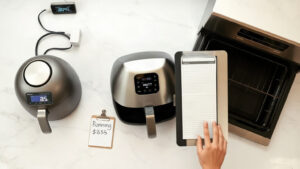
- Write down what worked the first time. I have a little notebook next to my air fryer with times and temps per recipe. Embarrassingly useful.
Final Thoughts
Converting a casserole recipe to the air fryer isn’t magic, but it does require paying attention — especially the first time you make a particular dish. The 25°F temperature drop and 20–25% time reduction are solid starting points, but they’re not a substitute for checking early and using a thermometer. The edge cases matter more than most guides admit: frozen vs. thawed, deep vs. shallow, covered vs. not. Once you’ve run a recipe once and noted what worked, the second time is easy.
Honestly, I’ve come to prefer air fryer casseroles for weeknight cooking. Faster, crispier tops, and I don’t have to heat up a massive oven for a dish that serves four. It’s a reasonable trade-off, as long as you manage the moisture and don’t walk away from the thing when the foil comes off.
Frequently Asked Questions
How do you convert oven casserole cook time to air fryer?
Reduce the oven temperature by 25°F and cut the cook time by 20–25%. A casserole that bakes at 350°F for 60 minutes in the oven should be cooked at 325°F for about 45–48 minutes in the air fryer. Always check for doneness early and use a probe thermometer to confirm the center has reached 165°F.
Can you cook a casserole dish in an air fryer?
Yes, as long as the dish fits inside the air fryer and is made from oven-safe material — metal, ceramic, or tempered glass rated for high heat. Check that your dish fits before you start cooking; many standard 9×13 casserole dishes are too large for most basket-style air fryers. Smaller, deeper dishes work better in basket models.
Does air fryer cook faster than a regular oven?
Yes, typically 20–25% faster for most casseroles and baked dishes. The speed comes from the concentrated heat in a small cavity and the aggressive fan that circulates air directly around the food. This is why you need to reduce both temperature and time when converting recipes.
Should casseroles be covered when cooking in an air fryer?
Cover the casserole with foil for most of the cook time to retain moisture, then remove the cover for the last 5–8 minutes to brown the top. If you skip the cover entirely, the casserole can dry out. If you use foil, tuck the edges down so the air fryer fan doesn’t blow it loose against the heating element.
What temperature do you air fry a frozen casserole?
Cook a frozen casserole at 300–325°F and don’t reduce the time — use the original oven time as your starting point, or even add a few minutes. Frozen casseroles need longer to thaw and heat through, so the standard 20–25% time reduction doesn’t apply. Always verify the center temperature with a thermometer before serving.

Written by
Emma founded Toastera to turn vague appliance advice into clear, researched, safety-first guidance on toasters and toaster ovens.
Free: the Toaster Oven Cheat Sheet
Get the printable cheat sheet (temps, cook times & safety tips) plus new recipes. No spam, unsubscribe anytime.