For most kitchens, the Ninja Foodi Digital Air Fry Oven is the best all-around pick — it air fries faster than the Cuisinart TOA-70, costs significantly less than the Breville Smart Oven Air, and handles everything from frozen fries to a whole chicken without a steep learning curve. The Breville is genuinely superior if you do serious baking or want the most interior space, and the Cuisinart earns its place as the budget-friendly workhorse. But if you’re buying just one for everyday cooking, the Ninja wins on value, usability, and speed.
Safety First: All three of these ovens run at 400–500°F and pull 1,500–1,800 watts. Always place them on a heat-resistant surface with at least 4–6 inches of clearance on all sides — the rear vents on the Ninja especially get hot enough to blister paint. Never leave any of them unattended on their first run with a greasy food; excess oil smoke can trigger smoke detectors and, in poorly ventilated spaces, create a fire risk. Let the interior cool completely before wiping down, and never spray cleaning products directly near the heating elements.
Quick Takeaways Before You Read Further
- Best for most people: Ninja Foodi Digital Air Fry Oven — fast preheat (~3 minutes), solid 0.6 cu ft capacity, mid-range price tier
- Best for bakers and serious cooks: Breville Smart Oven Air — largest interior at ~1.0 cu ft, most precise temperature control, premium price tier
- Best budget pick: Cuisinart TOA-70 — reliable, simple, slightly slower air frying but rarely disappoints
- All three hit 450°F max; the Breville also offers a dedicated slow-cook mode the others skip
- Ninja folds flat for storage — genuinely useful if counter space is tight
How I Tested These Three Ovens
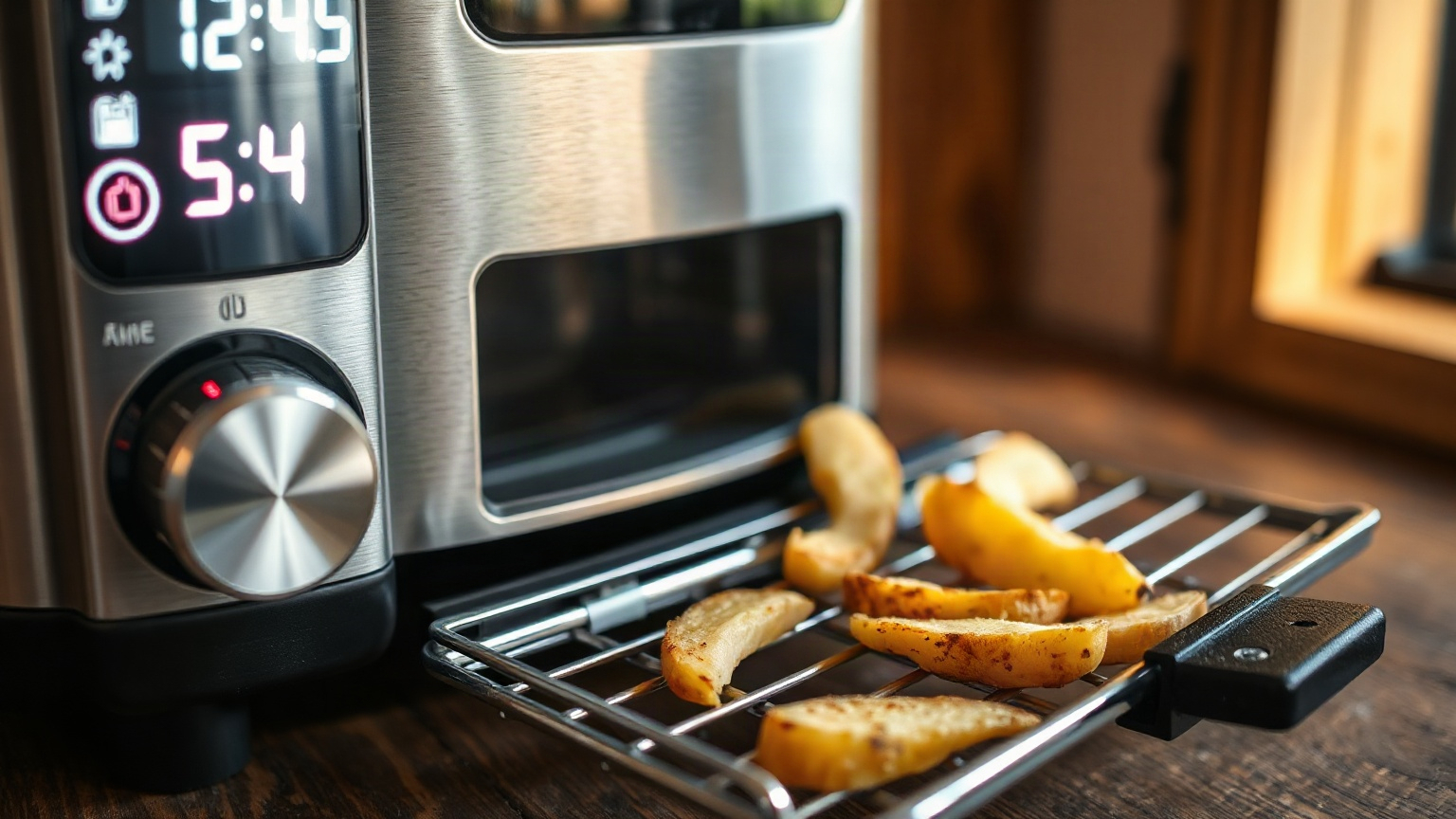
I ran all three side-by-side in my own kitchen over about six weeks — not in a lab, just on my actual counter making actual food. I tested frozen french fries (always at 400°F for 15 minutes, half-bag, no preheating), a batch of chocolate chip cookies, bone-in chicken thighs, and reheated pizza. I also checked preheat times with a probe thermometer and listened carefully because noise matters more than review sites admit. First impressions and annoying surprises are both in here.
One thing that caught me off guard the first time with the Ninja: the door pops open at a very specific angle and if you don’t position the pull-out tray just right, the basket tilts and dumps your food. Happened to me with a batch of shrimp. Once you know, it’s fine, but nobody warns you in the manual.
Head-to-Head Specs: What Actually Matters
Specs on paper can be misleading. Here’s a comparison of the factors that genuinely affect day-to-day cooking.
| Feature | Ninja Foodi Digital Air Fry Oven | Breville Smart Oven Air | Cuisinart TOA-70 |
|---|---|---|---|
| Capacity | ~0.6 cu ft | ~1.0 cu ft | ~0.6 cu ft |
| Max Temp | 450°F | 450°F | 450°F |
| Wattage | 1,800W | 1,800W | 1,800W |
| Air Fry Speed (fries test) | ~14 min | ~15 min | ~17 min |
| Preheat Time (to 400°F) | ~3 min | ~4–5 min | ~4 min |
| Cooking Functions | 8 | 13 | 7 |
| Folds Flat for Storage | Yes | No | No |
| Price Tier | Mid-range | Premium | Budget–Mid |
| Best For | Everyday air frying + toasting | Baking, large batches, precision | Simple, reliable daily use |
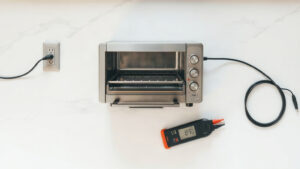
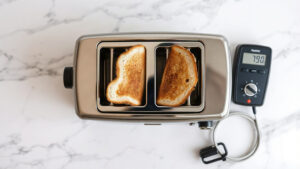
All three max out at 450°F — standard for this category. If you’re curious about how hot a toaster gets compared to countertop ovens, there’s quite a gap. Traditional toasters don’t regulate temperature the same way these do.
The Ninja Foodi Digital Air Fry Oven: Fast, Practical, a Little Loud
This is the one I’d buy again. The preheat is legitimately fast — I clocked it at 3 minutes and change to hit 400°F with my probe thermometer, which is noticeably quicker than either competitor. Air frying is where it shines: wings come out properly crispy in about 22 minutes at 390°F, the skin actually renders instead of just drying out. That’s not a small thing.
The flip-and-store design is either brilliant or annoying depending on how you use it. If you actually fold it up between uses, it’s great — saves real counter space. If you leave it deployed all the time (my habit, honestly), it’s not quite as compact as the other two when open. The control panel is tactile and simple. Eight functions covers everything most people need: air fry, bake, roast, toast, bagel, broil, dehydrate, and keep warm.
Where the Ninja Falls Short
It’s louder than the Breville. Not obnoxiously so, but noticeably. The fan hum during air fry cycles is the kind of background noise that’ll bother you if your kitchen is open to your living area. Also, the crumb tray is awkward to remove and clean. Small complaint, but after six weeks I started dreading it.
Baking performance is decent but not exceptional. My chocolate chip cookies came out slightly uneven — darker on the left side than the right. Rotating the pan halfway through fixed it, but the Breville never needed that correction. If you bake regularly, that inconsistency gets old.
The Breville Smart Oven Air: The Best Oven, Not Always the Best Choice
No question — the Breville is the most capable machine of the three. The interior is genuinely large. A 13×9 baking dish fits comfortably, which neither the Ninja nor the Cuisinart can claim. The Breville Smart Oven Air has 13 cooking functions, including a slow-cook mode that runs at 250°F for hours — something the other two simply don’t offer. For actual recipe variety, that matters.
Temperature accuracy is where Breville earns its premium price. Using an oven thermometer, I found the Breville stayed within 5°F of my set temperature during a 45-minute bake. The Ninja drifted by about 15°F, and the Cuisinart by about 12°F. If you’re following a precise baking recipe, that variance is real. The Breville also baked my cookies perfectly evenly without any tray rotation. Honestly, it’s the better oven. But that’s also the point — it’s an oven first.
The Case Against the Breville for Most People
It’s expensive. Premium price tier means you’re paying significantly more than the Ninja for features that casual cooks won’t use. It’s also heavy and large — it doesn’t fit under standard upper cabinets in many kitchens. Mine required rearranging the whole counter layout. The air fry function works well but isn’t faster than the Ninja’s; my fry test ran about a minute longer. And the learning curve on 13 functions is real — I accidentally started the slow cook mode twice before I got the interface down.
For bakers, people who entertain, or anyone cooking for four or more regularly — worth every penny. For a couple or single person who mostly wants good air-fried food fast? Probably overkill. Check out Serious Eats’ toaster oven testing methodology if you want to see how precision baking performance gets evaluated at a higher level — their take on temperature consistency aligns with what I found.
The Cuisinart TOA-70: Underrated, Underestimated
The TOA-70 doesn’t do anything flashy. Seven functions, intuitive dial controls, and a reasonably solid build for its price. If you’ve never owned an air fryer toaster oven and aren’t sure you’ll use advanced features, start here. The learning curve is basically zero — you set the function with a dial, set the temperature, set the timer. That’s it.
Air fry performance landed about 2–3 minutes slower than the Ninja in my tests, and the crispiness wasn’t quite as pronounced on chicken skin. But it was still good. Better than most pod-style air fryers I’ve used, and more flexible since you can actually fit a pizza slice or small casserole. For reheating food in a toaster oven, the TOA-70 is surprisingly capable — the convection setting revives leftover pizza better than a microwave by a wide margin.
The Cuisinart TOA-70 comes with a decent accessory kit out of the box: a baking pan, air fry basket, and oven rack. You won’t need to buy extras right away. That’s not nothing when you’re at a lower price point.
The Edge Case Everyone Misses: Shared Kitchen or Rental Living
Here’s something I haven’t seen covered elsewhere: if you’re in a rental with limited counter space, strict rules about appliances, or a shared kitchen situation — the Cuisinart TOA-70 is actually the most practical choice. It’s the smallest footprint of the three, it’s lighter to move if needed, and the simpler controls mean multiple people can use it without reading a guide. The Breville’s size genuinely doesn’t work in some small apartment kitchens. I know because I tried fitting it in one.
Accessories Worth Having for Any of These Ovens
Whichever you choose, a few extras help. A good nonstick toaster oven baking pan that fits properly makes a real difference — the included pans on all three are thin and warp with repeated high-heat use. And if you do any roasting, having a proper stainless wire rack for a toaster oven elevates airflow significantly. Breville includes a better wire rack than the other two, but a universal rack works fine.
Also, an oven-safe probe thermometer is worth it regardless — knowing actual internal temperature on chicken beats guessing every time. The USDA recommends chicken reach 165°F internally, and with these ovens running at variable accuracy, checking matters. See the USDA’s guidance on safe cooking temperatures if you’re ever unsure about meat doneness.
If you’re coming from a small solo appliance and want to understand the broader category first, the roundup of best mini toaster ovens gives a useful baseline for what to expect in terms of size and function tradeoffs.
The Honest Verdict
Here’s how I’d actually tell a friend to decide: If you mostly want fast air frying, occasional baking, and don’t want to spend a lot or think too hard about it — get the Ninja Foodi Digital. It’s the practical sweet spot. If you bake frequently, regularly cook for four-plus people, or genuinely care about temperature precision, the Breville Smart Oven Air will serve you better and you won’t regret the extra spend. And if you’re on a tighter budget or want simplicity above all else, the Cuisinart TOA-70 won’t let you down.
The Breville is the best oven. The Ninja is the best value. The Cuisinart is the easiest. Pick the one that fits how you actually cook, not the one with the most features on a spec sheet.
Frequently Asked Questions
Is the Ninja Foodi Digital Air Fry Oven worth the price compared to the Breville Smart Oven Air?
Yes, for most households it is. The Ninja delivers fast air frying and reliable toasting at roughly half the price of the Breville. The Breville justifies its premium cost primarily through larger capacity and more precise temperature control — advantages that matter most for frequent bakers and larger families, not for everyday air frying.
Which of these air fryer toaster ovens has the largest cooking capacity?
The Breville Smart Oven Air has the largest interior at approximately 1.0 cubic foot — nearly double the Ninja Foodi and Cuisinart TOA-70, both of which come in around 0.6 cubic feet. That extra space means the Breville can fit a standard 13×9 baking dish or a larger roast that simply won’t fit in the other two.
Can the Cuisinart TOA-70 replace a full-size oven for everyday cooking?
For one or two people, yes — it handles most everyday tasks including baking, roasting, and air frying competently. It won’t accommodate large roasts or full baking sheets, and results won’t be quite as consistent as a full-size oven, but for daily meals it’s genuinely capable and saves significant energy compared to heating a large oven.
How long does the Ninja Foodi Digital Air Fry Oven take to preheat?
In real-world testing, the Ninja Foodi Digital Air Fry Oven reaches 400°F in approximately 3 minutes — faster than both the Breville Smart Oven Air (4–5 minutes) and the Cuisinart TOA-70 (around 4 minutes). This faster preheat time is one of the main practical advantages of the Ninja for quick weeknight cooking.
Which air fryer toaster oven is easiest to clean?
The Cuisinart TOA-70 is the easiest to clean of the three, thanks to its simple interior layout and a relatively accessible crumb tray. The Breville’s interior is larger and has more nooks around the heating elements. The Ninja’s crumb tray is the most awkward to remove and reinsert, which becomes a minor but recurring annoyance with frequent use.

Written by
Emma founded Toastera to turn vague appliance advice into clear, researched, safety-first guidance on toasters and toaster ovens.
Free: the Toaster Oven Cheat Sheet
Get the printable cheat sheet (temps, cook times & safety tips) plus new recipes. No spam, unsubscribe anytime.