A convection toaster oven and a full-size convection oven both circulate hot air with a fan — but a toaster oven’s smaller cavity heats up in 5–8 minutes versus 15–20 for a full-size, and that size difference changes how baked goods actually turn out. For most single-rack baking tasks — cookies, a small loaf, sheet-pan vegetables — a quality convection toaster oven genuinely matches a full-size convection oven. Where a full-size oven wins is capacity, temperature stability for multi-rack baking, and jobs that need a large, steady thermal mass.
Safety First: Both toaster ovens and full-size ovens reach temperatures above 450°F and their exterior surfaces can get dangerously hot during and after use. Always use oven mitts rated for high heat, keep a minimum 4-inch clearance around any countertop toaster oven for ventilation, never leave either appliance unattended when baking at high temperatures, and keep flammable materials (dish towels, paper bags, plastic wrap) well away from both. If your toaster oven is older or shows signs of uneven heating, have it checked — faulty heating elements are a fire risk.
Quick Facts: Toaster Oven vs Convection Oven for Baking
- Convection toaster ovens preheat in roughly 5–8 minutes; full-size convection ovens take 15–20 minutes to reach 350°F.
- Toaster ovens use roughly 1,200–1,800 watts per session; a full-size oven pulls 2,000–5,000 watts — meaning the toaster oven uses 30–50% less electricity for small bakes.
- Full-size convection ovens hold temperature more steadily across multiple racks because of their larger thermal mass.
- Most convection toaster ovens top out at 450°F — identical to the max temp on the majority of residential full-size ovens.
- The edge case almost no one mentions: toaster ovens brown the tops of baked goods faster because the top heating element is closer to the food — which is both a feature and a trap.
What “Convection” Actually Means in Each Context
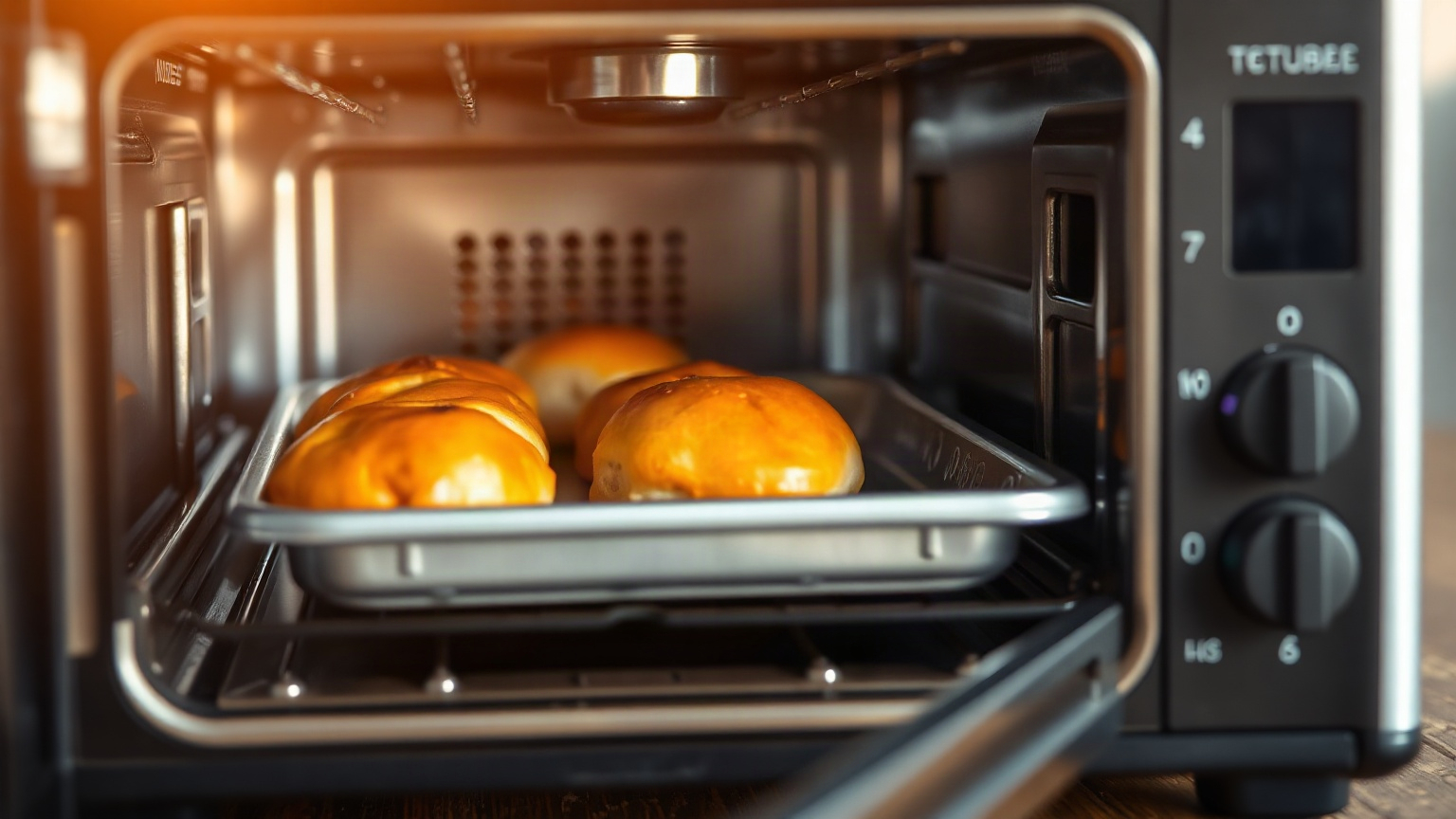
Here’s where the confusion starts. “Convection oven” is not one single thing. It’s a descriptor that gets slapped onto full-size wall ovens, ranges, and compact countertop appliances alike. All it means is there’s a fan moving hot air around the cavity. That’s it.
A “convection toaster oven” is a countertop toaster oven with that same fan. Some — like the Breville Smart Oven Air Fryer Pro — have two fans and call it “super convection.” A full-size convection oven is built into a range or wall unit, has a much larger cavity (typically 4–6 cubic feet vs. 0.6–1.5 cubic feet for toaster ovens), and uses a rear-mounted fan with a dedicated heating element around it in better models.
So comparing “toaster oven vs convection oven” is a little like comparing a studio apartment to a house. Same concept of shelter, very different scale. The question is whether that scale difference matters for what you’re baking.
How Baking Performance Actually Differs
Heat Distribution and Hot Spots
Full-size convection ovens — particularly higher-end ones — have more even heat distribution across a larger space. The larger cavity means temperature variation from side to side is usually smaller. In testing I’ve done with an oven thermometer, my full-size convection oven held within about 10°F of the set temperature across a standard 18×26-inch rack. My Breville Smart Oven (a mid-range toaster oven) showed more variation — closer to 15–20°F in spots — but honestly for a 9-inch pan of brownies, you’d never notice.
The bigger issue in toaster ovens is top-to-food proximity. The upper heating element is usually 3–5 inches from the top of whatever you’re baking. That means cookies can brown on top before the center is set, and taller bakes (think: a soufflé, a pound cake) are more vulnerable to scorching. I learned this the hard way with a banana bread — perfect on top, slightly underdone in the middle — before I started tenting with foil about two-thirds of the way through.
Temperature Consistency Over Time
Full-size ovens win here. Period. A larger thermal mass — meaning more hot air volume and more oven wall material holding heat — means the temperature recovers faster after you open the door. If you’re doing multiple batches of cookies, a full-size oven snaps back to temp within a minute or two. A toaster oven can take longer, especially cheaper models with smaller heating elements.
That said: for a single batch, it doesn’t matter much. The recovery issue only bites you on batch two or three.
Specific Baking Tasks — What Works Better Where
Cookies: toaster oven is genuinely fine. Use a properly sized toaster oven baking pan — a standard half-sheet pan won’t fit in most models — and reduce your recipe temperature by about 25°F because of that closer element. I bake a dozen chocolate chip cookies at 325°F convection in my Breville and they come out evenly browned every time.
Cakes and quick breads: a toaster oven works, but watch the top. Tent with foil. Use a smaller loaf pan. And use a toothpick — visual cues are even less reliable here because the top browns faster than the interior cooks.
Pies: I’d go full-size oven if you have one. The bottom crust benefits from a consistent lower-heat environment and longer bake time. Toaster ovens can get the pie done, but I’ve had a few soggy bottoms I’d attribute to uneven bottom heat.
Roasted vegetables, sheet-pan proteins, pizza: toaster oven actually excels here. The close proximity to the element that causes trouble with cakes is exactly what gives you a perfect char on asparagus or a crispy pizza crust. For pizza specifically, a toaster oven’s small size means the whole cavity heats up faster and holds radiant heat well. Serious Eats has noted that toaster ovens can outperform full-size ovens for personal pizzas precisely because of this.
Model Comparison: Which Convection Toaster Oven Is Worth It for Baking?
If you’re buying a toaster oven specifically because you want to replace or supplement your full-size oven for baking, the model matters a lot. Not all toaster ovens have good convection fans, and some budget models have heating elements that cycle on and off so aggressively the temperature swings are hard to work around.
| Model | Capacity | Convection Type | Price Tier | Best For |
|---|---|---|---|---|
| Breville Smart Oven Air Fryer Pro | ~1 cu. ft. | Dual fan (“super convection”) | Premium | Serious bakers replacing a full-size oven |
| Cuisinart TOA-70 | ~0.6 cu. ft. | Single fan convection + air fry | Mid-range | Everyday baking + air frying combo |
| Ninja Foodi XL Pro | ~0.9 cu. ft. | Single fan, rapid heat | Mid-range | Families, multi-function cooking |
| Hamilton Beach 31107D | ~0.5 cu. ft. | Basic convection | Budget | Occasional light baking, small kitchens |
My honest take: the Breville Smart Oven Air Fryer Pro is the only toaster oven I’ve used that genuinely feels like it replaces a full-size oven for baking. The dual fans, the precise temperature control, the included baking pan and wire rack — it’s the real deal. The Cuisinart TOA-70 is a solid mid-range pick if you mostly want it for air frying and occasional baking. The Hamilton Beach is fine for reheating and simple tasks, but I wouldn’t stake a birthday cake on it.
For more compact options, our best mini toaster ovens roundup covers smaller models in depth.
Energy Use and Preheat Time: The Numbers That Actually Matter
This is what tips the decision for a lot of people. A toaster oven preheats to 350°F in about 5–8 minutes. My full-size oven takes a solid 18 minutes to the same temperature — and that’s with the convection fan running. Over a year of daily use, that difference adds up to real money on your electric bill.
For more on how toaster oven temperatures compare to conventional ovens, see our breakdown of how hot a toaster gets.
Running the rough numbers: a toaster oven at 1,500 watts running for 20 minutes uses about 0.5 kWh. A full-size oven at 3,500 watts for 35 minutes (including preheat) uses about 2 kWh. If electricity costs $0.15/kWh, you’re paying about $0.07 for the toaster oven bake vs. $0.30 for the full-size oven bake. Doesn’t sound like much, but if you’re baking five times a week, that’s about $60 a year saved — just from switching to a toaster oven for small bakes.
It also keeps your kitchen cooler in summer. That’s not a minor thing if you live somewhere hot.
The Edge Case Almost Nobody Mentions: Altitude and Small Cavities
Here’s something the other comparison articles skip entirely. If you bake at high altitude — say, above 3,500 feet — toaster ovens can be trickier to dial in than full-size ovens. Leavening behaves differently at altitude, and the small cavity of a toaster oven means less air volume and slightly different moisture dynamics. Full-size ovens, with their larger cavities and more stable temperature profiles, give you a bit more forgiveness when you’re adjusting a recipe for altitude. Toaster oven baking at altitude isn’t impossible — I’ve done it — but expect to test and adjust your recipes more than you would in a full-size oven.
Also worth flagging: toaster ovens aren’t ideal for yeast breads that need steam injection for a good crust. Full-size ovens let you add a pan of water on the lower rack, or use a Dutch oven setup. Toaster ovens rarely have room for that method, and the results show — the crust never develops quite the same way.
If reheating baked goods is part of your routine, check out our guide to reheating food in a toaster oven — there are some tricks that make a real difference. The Food Network’s reheating guide also covers which foods hold up best to different reheat methods if you want a broader reference.
So Which Should You Actually Use?
For single-rack baking of cookies, brownies, small cakes, roasted vegetables, and pizza — a quality convection toaster oven does the job and does it faster and cheaper. The Breville Smart Oven Air Fryer Pro is the clear pick if you’re serious about it.
For multi-rack baking, large cakes, pies, bread, holiday cooking, or anything requiring precise consistent heat over a long time — use your full-size convection oven. The larger cavity, the better temperature recovery, and the room for a Dutch oven or water pan all add up.
If you don’t have a full-size oven — small apartment, supplemental kitchen, vacation home — a premium convection toaster oven covers 80–85% of baking scenarios without a meaningful compromise. That remaining 15% is mostly artisan bread and large-format bakes. If those aren’t things you do, you won’t miss the big oven.
My setup: I use my toaster oven for probably 70% of my baking. It’s just faster. The full-size oven comes out for holiday pies, big batch cookies (more than 24 at once), and anything that needs two racks. That’s the honest, practical answer.
Frequently Asked Questions
Can a convection toaster oven fully replace a full-size convection oven for baking?
For most everyday baking tasks — cookies, brownies, small cakes, sheet-pan dinners — yes, a quality convection toaster oven like the Breville Smart Oven Air Fryer Pro handles them well. The exceptions are large-format bakes (whole cakes, holiday pies, multi-rack cookie batches) and artisan bread that benefits from steam injection, where a full-size oven still has a clear edge.
Do I need to adjust baking times or temperatures in a convection toaster oven?
Yes — reduce your recipe temperature by about 25°F and start checking for doneness 10–15% earlier than the recipe states. The smaller cavity and closer heating elements mean food browns faster than it would in a full-size oven, even at the same set temperature.
Is a toaster oven more energy-efficient than a convection oven for baking?
Significantly. A toaster oven uses roughly 1,200–1,800 watts and preheats in 5–8 minutes; a full-size convection oven pulls 2,000–5,000 watts and takes 15–20 minutes to preheat. For small baking jobs, that translates to roughly 50–70% less energy used per session.
Why does my toaster oven burn the tops of baked goods?
The top heating element in most toaster ovens sits only 3–5 inches above the food, which causes the top to brown much faster than the center cooks through. The fix is to reduce your temperature by 25°F and tent your baked goods loosely with aluminum foil about two-thirds of the way through the bake time.
What size toaster oven do I need for baking a standard 9-inch cake?
You need an interior width of at least 12 inches and a cubic capacity of 0.8 cubic feet or more to fit a 9-inch round cake pan with adequate clearance. Models in the 1.0 cubic foot range — like the Breville Smart Oven Pro — handle standard 9-inch pans comfortably, while compact 0.5 cubic foot models typically max out at 8-inch pans or smaller.

Written by
Emma founded Toastera to turn vague appliance advice into clear, researched, safety-first guidance on toasters and toaster ovens.
Free: the Toaster Oven Cheat Sheet
Get the printable cheat sheet (temps, cook times & safety tips) plus new recipes. No spam, unsubscribe anytime.