A full-size convection oven and a toaster oven set to the same temperature will not cook food in the same amount of time — and the toaster oven often wins on speed, especially for smaller portions. The smaller cavity heats up faster, loses less thermal energy, and recovers temperature quickly after you open the door. That said, if both units have a convection fan running, the gap narrows considerably, and the full-size oven may actually pull ahead on larger, denser foods.
Safety First: Both convection ovens and toaster ovens reach temperatures between 400–500°F and retain intense heat in their walls, racks, and pans long after the unit shuts off. Always use oven mitts rated for high heat, never leave either appliance unattended during extended cooking, and keep flammable materials — dish towels, paper, plastic — well clear of the vents. Toaster ovens in particular radiate significant heat from the exterior casing.
Quick Facts: Convection Oven vs. Toaster Oven Speed
- A toaster oven typically preheats to 375°F in 5–8 minutes. A full-size convection oven usually takes 15–20 minutes for the same target temp.
- Convection fans (in either type of oven) reduce cook times by roughly 20–25% compared to non-fan modes at the same set temperature.
- For foods under about 2 lbs, a toaster oven at 375°F frequently beats a full-size convection oven at 375°F purely because of faster preheat and lower thermal mass.
- For large roasts or full sheet pans, the full-size convection oven overtakes the toaster oven — it has more consistent airflow across a larger cooking surface.
- Most modern toaster ovens 1,200–1,800 watts; most full-size convection ovens pull 2,400–5,000 watts — but wattage alone doesn’t tell you how fast food actually cooks.
Why Oven Size Changes Everything About Cooking Speed
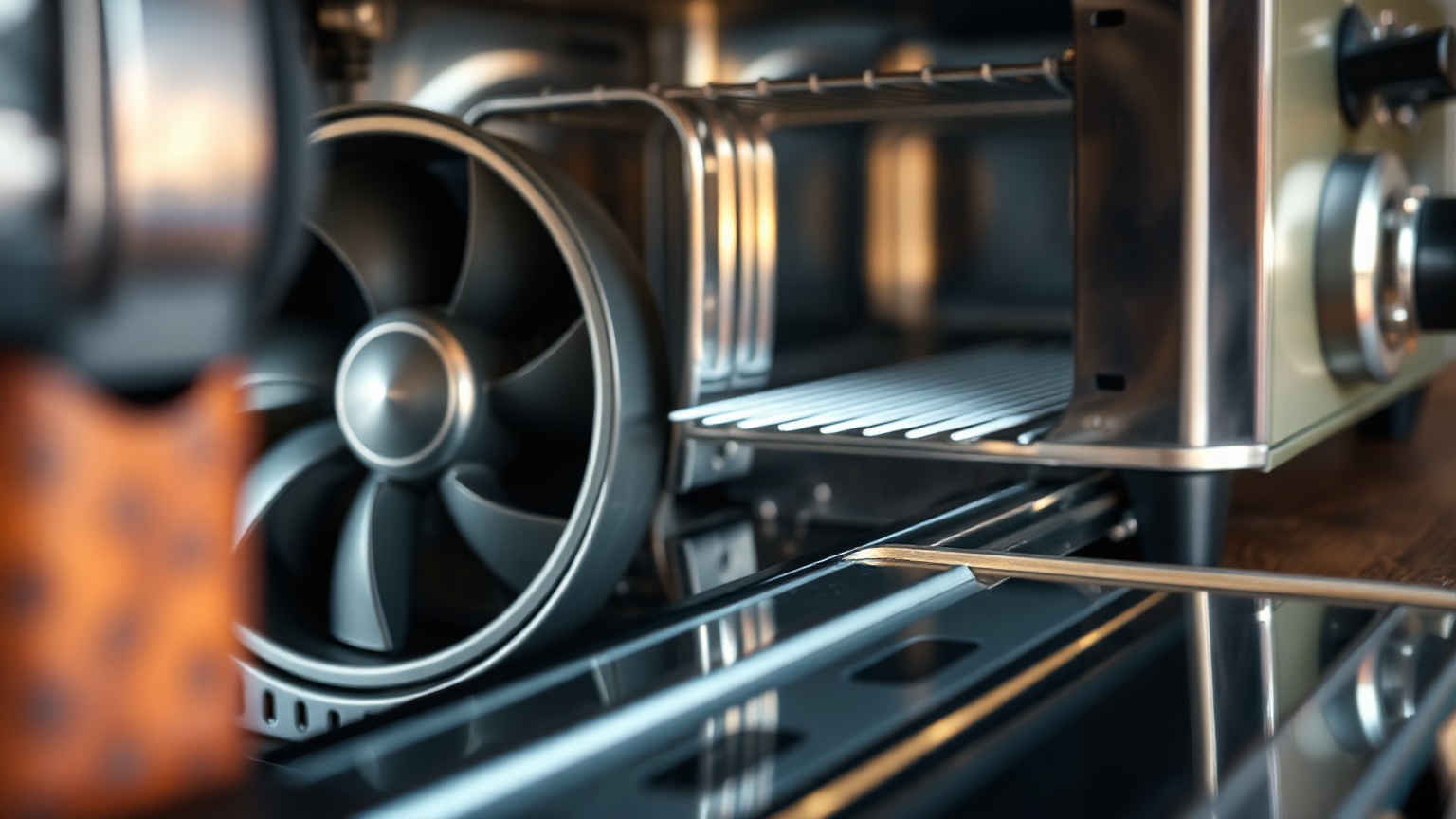
Here’s the thing that most comparisons skip over: the temperature dial is only one part of the equation. A toaster oven’s internal volume is typically 0.5 to 1.5 cubic feet. A standard full-size oven runs 4.5 to 6 cubic feet. That size difference matters in a few very practical ways.
First, a smaller space needs less energy to reach your target temperature — and it gets there faster. When I tested a 1,500-watt toaster oven against my full-size convection range both set to 400°F, the toaster oven hit temperature in about 6 minutes. The range took just over 17 minutes. That’s an 11-minute head start before a single piece of food goes in.
Second, thermal mass. The walls, racks, and air volume of a large oven absorb a ton of heat. Every time you open the door, you dump a chunk of that stored heat. A toaster oven rebounds faster simply because there’s less volume to re-heat. For a quick weeknight dinner, this compounds into real time savings.
Third — and this one tripped me up early on — the proximity of heating elements in a toaster oven means food can brown faster on the outside than it cooks through. It’s not always “faster cooking.” Sometimes it’s faster browning, which isn’t the same thing. I’ve scorched the top of a chicken thigh while the middle was still at 155°F. That’s a setting problem, not a physics problem, but it’s worth knowing.
What the Convection Fan Actually Does (and Why It Matters Here)
Convection just means moving air. That’s it. A fan circulates hot air around your food, stripping away the cool boundary layer that naturally forms around anything you put in an oven. That boundary layer is basically an insulating jacket your food wears — convection removes it, so heat transfers more efficiently.
Full-Size Convection Ovens
A full-size convection oven has a fan mounted at the back wall, sometimes with its own dedicated heating element (called “true convection” or “European convection”). This setup produces very even, consistent airflow across the entire cavity. According to Serious Eats, true convection can reduce cook times by 25% and often allows you to drop the set temperature by 25°F to get equivalent browning. That’s a real, measurable advantage for large batches.
Toaster Ovens With Convection
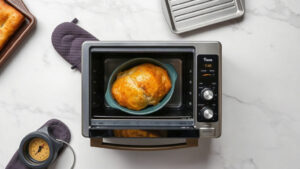
Many toaster ovens now include a convection fan — my current unit is a Breville, and the convection mode is genuinely excellent for anything up to a 9-inch pan. The fan is smaller than a range’s, so the airflow isn’t as powerful or uniform. But given the much smaller cavity, it doesn’t need to be. The food is already much closer to the heating elements.
A toaster oven without convection vs. a full-size convection oven? The full-size machine will usually produce more even results on bigger foods, even if the toaster oven preheated faster. A toaster oven with convection vs. a full-size convection oven? For portions under roughly a pound and a half, I’d back the toaster oven to finish first, almost every time.
Head-to-Head: Timing by Food Type
Numbers help. Below is a comparison table based on my own testing plus data from standard recipe guidelines. Both ovens were set to 375°F. The toaster oven used convection mode; the full-size oven used its convection fan as well.
| Food | Toaster Oven (375°F, convection) | Full-Size Convection Oven (375°F) | Notes |
|---|---|---|---|
| Two chicken thighs (bone-in) | 34–38 min | 38–44 min | Toaster oven wins; elements are closer |
| Frozen pizza (10-inch) | 14–16 min | 16–19 min | Toaster oven wins on speed; crust slightly more charred |
| Sheet pan of roasted vegetables (2 lbs) | 28–32 min | 25–28 min | Full-size wins; better airflow around crowded pan |
| 4 lb whole chicken | Not recommended (too large) | 65–75 min | Full-size only option here |
| Batch of cookies (12 cookies) | 11–13 min | 10–12 min | Roughly equal; slight edge to full-size for even browning |
| Reheating a slice of pizza | 6–8 min | 10–14 min (with preheat) | Toaster oven wins easily — don’t bother firing up the big oven |
If you’re doing a lot of reheating food in a toaster oven, the speed advantage over a full-size convection oven is honestly pretty significant when you factor in preheat time.
The Edge Cases Most Articles Don’t Mention
Most comparisons stop at “convection = 25% faster.” Fine, but that number comes from comparing convection to conventional (non-fan) ovens. The real comparison here is trickier.
Altitude and Humidity
At high altitude, both ovens behave differently — lower air pressure means water boils at a lower temperature and baked goods rise faster then collapse. A toaster oven’s smaller space can amplify this because there’s less thermal buffer. If you’re baking at 5,000 feet or above and getting inconsistent results in your toaster oven, the full-size convection oven may actually give you more predictable outcomes, not fewer.
Cold Food Straight from the Fridge
Toaster ovens are more sensitive to the starting temperature of your food. A cold glass baking dish loaded with refrigerator-cold lasagna can drop the internal temp of a toaster oven cavity noticeably — more so than in a large oven with more thermal mass. This is one reason I always let food sit at room temperature for 10–15 minutes before putting it in a toaster oven. It’s a small thing, but it tightens up your timing a lot. A good toaster oven ceramic baking dish that preheats with the oven helps too.
Wattage vs. Actual Cooking Speed
A 1,800-watt toaster oven and a 4,800-watt full-size convection oven are not directly comparable on wattage. The full-size oven uses more power but heats a much larger space. Per cubic foot of cooking space, the toaster oven is delivering more energy density. That’s the real reason toaster ovens feel “hotter” — they are, per square inch of food surface, often throwing more concentrated heat. I wrote more about this in the piece on how hot a toaster gets.
The Moisture Factor
Smaller oven cavities accumulate steam from food faster. This can be good (keeps roasted chicken moist longer) or bad (your cookies stay soft when you wanted crispy). A full-size convection oven vents more efficiently. So “cooking faster” doesn’t always mean “better results” — texture can differ even when the internal temperature is identical. The Food Network’s convection guide touches on this for baking specifically, and it’s genuinely worth reading if you bake a lot.
Practical Tips: Getting the Most Speed Out of Either Oven
- Always preheat. I know it seems obvious, but skipping preheat costs you more time than it saves — food placed in a cold toaster oven takes dramatically longer to cook and can cook unevenly.
- Use a toaster oven wire rack instead of a solid pan whenever possible — it lets hot air circulate under the food, which is basically manual convection.
- For the full-size convection oven, reduce your recipe temperature by 25°F if it wasn’t written for convection. Don’t just run the same temp — you’ll over-brown the exterior before the inside is done.
- In a toaster oven, don’t crowd the rack. The cavity is small; blocking airflow defeats the whole speed advantage. Use a smaller pan and leave space around the food.
- For anything you’re cooking under 30 minutes, seriously consider whether firing up a full-size oven is worth it. The preheat time alone can eat your advantage.
If you’re looking for appliances that strike a good balance of size and performance, check out the best mini toaster ovens — some of the newer models have surprisingly capable convection systems in a genuinely compact footprint.
The Honest Answer
For small portions of food — under about 1.5 lbs, single servings, reheating — a toaster oven will almost always cook faster than a full-size convection oven set to the same temperature. The preheat advantage alone is usually decisive. For larger quantities, a full-size convection oven with a good fan catches up and eventually overtakes it, especially for items that need even browning across a large surface area.
The “25% faster” stat you’ll see attached to convection ovens refers to convection vs. conventional — it doesn’t really address toaster ovens at all. That’s a comparison most people are actually making but rarely see answered directly. My practical rule: if it fits comfortably in a toaster oven without touching the walls or blocking the vents, cook it there. It’ll be done sooner. If it doesn’t fit, use the big oven — and use the convection setting if you have it.
Frequently Asked Questions
Does a convection toaster oven cook faster than a regular toaster oven?
Yes, a convection toaster oven cooks faster than a non-convection toaster oven set to the same temperature — typically by 20–25%. The fan removes the insulating layer of cool air around your food, allowing heat to transfer more directly. For a batch of roasted vegetables, that can mean 6–8 fewer minutes at 400°F.
Should I reduce cooking time in a toaster oven compared to a full-size oven?
For small portions, yes — start checking food about 10–15% earlier than your recipe suggests. Because a toaster oven preheats faster and its elements are closer to the food, browning happens quickly. Larger, denser items like a thick pork roast may actually take comparable time to a full-size oven, sometimes longer if the cavity traps moisture.
Can I use the same temperature in a toaster oven as a regular convection oven?
You can use the same temperature setting, but watch your food more carefully. Toaster oven heating elements are physically closer to the food, so the effective heat exposure can be more intense than in a larger cavity at the identical dial setting. If you’re baking something delicate — like a cake or custard — I’d drop the toaster oven temperature by 15–25°F to avoid over-browning the exterior.
Which uses less electricity: a toaster oven or a convection oven?
A toaster oven uses significantly less electricity for small cooking tasks. Running a 1,500-watt toaster oven for 20 minutes uses about 0.5 kWh; a 4,000-watt convection range for the same time uses roughly 1.3 kWh, plus the energy burned during its longer preheat. For single servings and small meals, the toaster oven is the clear winner on energy use.
Is a toaster oven good enough to replace a convection oven for most cooking?
For households of one or two people, a quality convection toaster oven handles the vast majority of everyday cooking tasks just fine — roasting, baking, reheating, broiling. The main limitations are capacity (you can’t cook a full turkey or multiple sheet pans simultaneously) and airflow consistency on large, dense items. If you cook for more than three or four people regularly, you’ll miss the full-size oven.
—
Written by
Emma founded Toastera to turn vague appliance advice into clear, researched, safety-first guidance on toasters and toaster ovens.
Free: the Toaster Oven Cheat Sheet
Get the printable cheat sheet (temps, cook times & safety tips) plus new recipes. No spam, unsubscribe anytime.