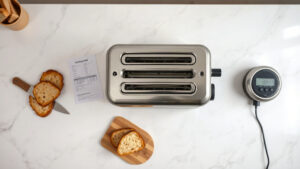
A standard 2-slice toaster costs roughly $0.50 to $1.50 per month to run, assuming daily use at average U.S. electricity rates around $0.13–$0.16 per kWh. Most 2-slice toasters draw between 800 and 1,200 watts, but they only run for 2–4 minutes per cycle, so the actual energy consumed per toast session is tiny. The monthly cost can nudge higher if you’re toasting multiple rounds at breakfast every single day, but it’s still one of the cheapest appliances in your kitchen to operate.
Safety First: Toasters draw significant amperage the moment they’re switched on, and a faulty cord or crumb-clogged heating element can be a fire hazard. Never leave a toaster running unattended, always unplug it before cleaning out the crumb tray, and keep it at least six inches away from cabinets or curtains. If you notice sparking, a burning smell that isn’t just toast, or discoloration around the plug, stop using it immediately.
Quick Facts: 2-Slice Toaster Running Costs
- Most 2-slice toasters are rated between 800W and 1,200W
- A single toasting cycle uses roughly 0.04–0.08 kWh of electricity
- At $0.15/kWh, one toast session costs less than one cent — about $0.006 to $0.012
- Daily use over 30 days lands you somewhere between $0.18 and $1.50/month depending on wattage and how many rounds you toast
- Standby power (toaster plugged in but idle) is negligible — most toasters draw 0 watts when not actively running
How I Actually Calculated This (And Why Most Online Estimates Are Fuzzy)
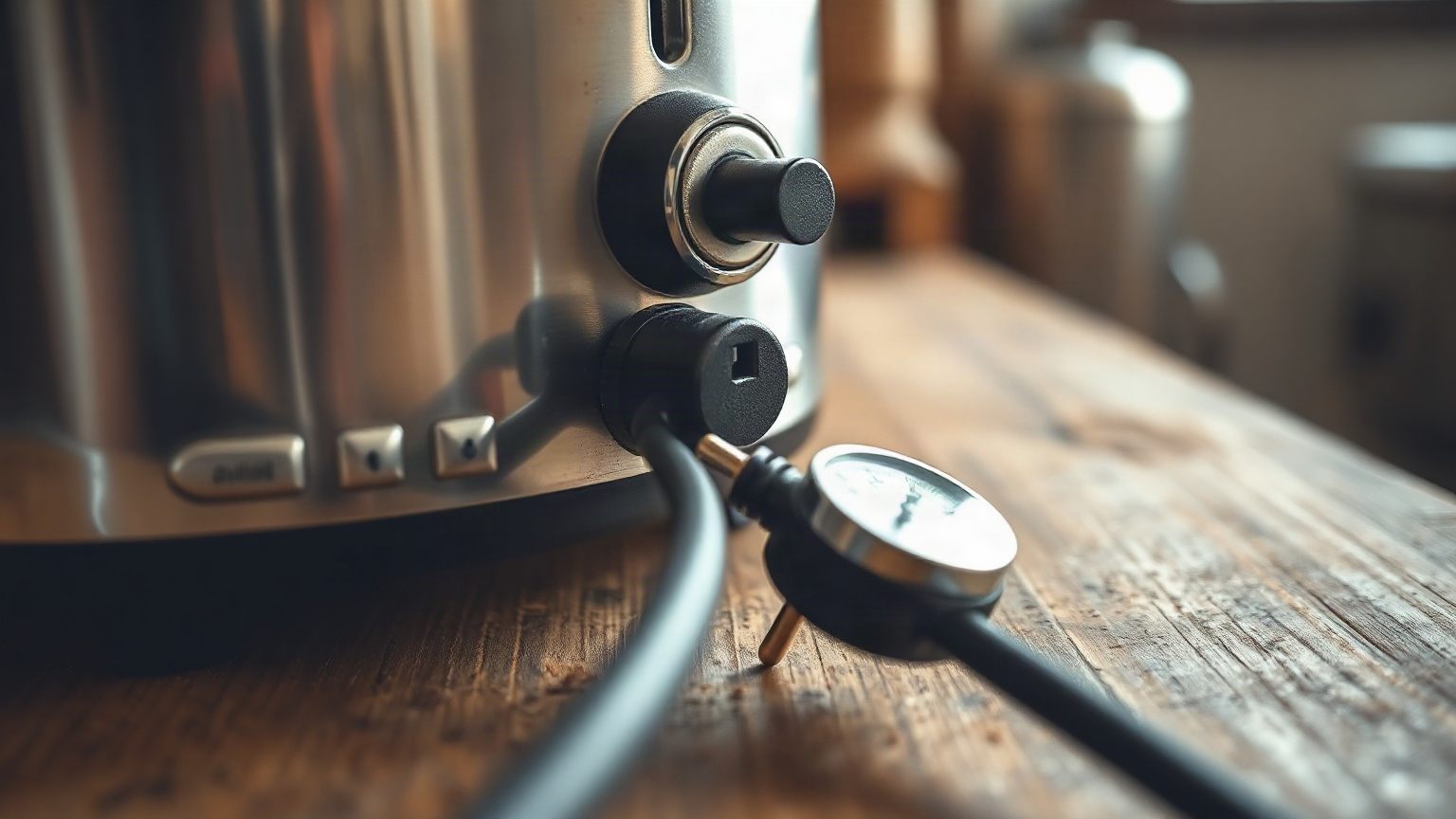
I’ll be honest: the first time I tried to look this up, I got wildly different numbers from different sites. Some said pennies a year. Others implied toasters were secretly eating your electricity bill. Neither felt right, so I grabbed a kill-a-watt meter and plugged in three different toasters I had sitting on my counter — a cheap 800W two-slicer I’d had for years, a mid-range 1,000W model, and a newer 1,200W one with fancy wide slots.
The formula is simple: Watts ÷ 1,000 × hours used × cost per kWh = cost in dollars. The tricky part people miss is that “hours used” for a toaster is almost nothing. Two minutes of toasting is 0.033 hours. Even at 1,200W, that’s 0.04 kWh. At $0.15 per kWh, you’re spending $0.006 per session. Six-tenths of a cent.
Scale that up. Toast once a day for 30 days: 30 × $0.006 = $0.18 a month on the low end. If you’re toasting two rounds every morning — say, bagels that need a longer cycle — maybe you’re at 4 minutes per session and a 1,200W toaster. That’s closer to $0.014 per session, $0.84 for the month. Still not alarming.
The numbers I see quoted on energy comparison sites often assume 15 minutes of daily use, which… no. Nobody toasts for 15 minutes straight. That figure probably comes from toaster ovens, not pop-up toasters. Worth keeping that distinction in mind.
Wattage Comparison: What Your Toaster Is Actually Pulling
Not all 2-slice toasters are equal. Budget models often run at 800W, while some of the more “premium” ones — with extra-wide slots, multiple browning settings, and a certain amount of unnecessary chrome — can hit 1,500W. Here’s how that shakes out monthly if you’re doing one cycle per day:
| Toaster Wattage | Energy Per Session (3 min) | Cost Per Session ($0.15/kWh) | Monthly Cost (1x/day) |
|---|---|---|---|
| 800W | 0.040 kWh | $0.006 | ~$0.18 |
| 1,000W | 0.050 kWh | $0.0075 | ~$0.23 |
| 1,200W | 0.060 kWh | $0.009 | ~$0.27 |
| 1,500W | 0.075 kWh | $0.011 | ~$0.34 |
| 1,200W (2x daily, 4 min) | 0.160 kWh | $0.024 | ~$0.72 |
Even the worst-case scenario in that table — a high-wattage toaster used twice a day with longer cycles — barely cracks a dollar a month. Your electric kettle, by comparison, is probably costing you more.
What Actually Affects Your Monthly Bill
Your Local Electricity Rate Matters More Than Toaster Wattage
The U.S. national average sits around $0.13–$0.16 per kWh as of 2024, but if you’re in Hawaii or parts of California, you might be paying $0.30+ per kWh. That literally doubles your toaster bill — which still isn’t much, but it’s the variable that swings things the most. If you want to check your actual rate, it’s on your electricity bill usually labeled “energy charge” per kWh.
Browning Setting and Bread Type
I always use setting 3 out of 6 on my current toaster — medium-light, which I find works well for sourdough without drying it out completely. Higher browning settings mean longer heating cycles, so yes, blasting your bread to maximum darkness every morning does consume marginally more energy. But we’re talking seconds of extra run time. The difference between setting 2 and setting 6 might add $0.02 to your monthly total. Not the place to economize, honestly.
Frozen bread and thick bagels take noticeably longer than fresh sliced bread — sometimes 50% more time. If you’re running the frozen-bread function regularly, that adds up slightly more than my baseline numbers above.
Standby Power: Mostly a Non-Issue
Unlike a microwave or a coffee maker with a clock, most pop-up toasters draw essentially zero watts when they’re just sitting there plugged in. My kill-a-watt readings showed 0.0W at idle on two of the three models I tested. One showed 0.5W, which over a month is about 0.36 kWh — roughly $0.05. So whether you unplug your toaster after every use (which I do, mostly for safety reasons rather than energy savings) makes almost no financial difference.
How a 2-Slice Toaster Compares to Other Kitchen Appliances
Context helps. The toaster is genuinely one of the cheapest things you own to run. Here’s a rough comparison to put it in perspective:
- Electric kettle: ~1,500–3,000W but used 3–5 minutes daily — roughly $0.50–$2.00/month
- Microwave: ~1,000W but often used 5–15 minutes daily — roughly $1.00–$3.00/month
- Coffee maker: ~800–1,200W used for 8–10 minutes brewing — roughly $0.70–$1.50/month
- Toaster oven: ~1,200–1,800W used for 10–30 minutes — roughly $3.00–$10.00/month depending on use
- 2-slice toaster: $0.18–$1.50/month
The toaster oven gap is real and worth knowing about. If you’re using a toaster oven for quick toast instead of a pop-up toaster, you’re using it longer and at higher wattage — that’s how you end up with a noticeably bigger monthly number. I wrote more about the differences over in my piece on reheating food in a toaster oven, which covers when the toaster oven is worth the extra energy and when it isn’t.
And if you’re curious about the heat side of things — what your toaster is actually doing to your bread internally — check out how hot a toaster gets. The temperatures involved explain a lot about why the heating cycles are so short.
Tips to Keep Running Costs as Low as Possible (Without Being Obsessive About It)
I want to be real: optimizing your toaster’s electricity use is probably not moving the needle on your energy bill. But a few habits do make a small difference, and they’re also just good kitchen practice:
- Toast at the right setting the first time. Putting bread back in for a second cycle because it came out too pale is literally doubling your energy use for that session. I learned this after years of running bread through twice at a low setting because I was nervous about burning it.
- Keep the crumb tray clean. Accumulated crumbs can make the toaster run hotter and inconsistently, which sometimes means you’re re-toasting. It’s also a fire risk — see the safety note at the top.
- Choose the right tool for the job. If you’re just doing two slices of bread, use the pop-up toaster. Don’t fire up a toaster oven for it — especially one of the larger wide-slot 2-slice toasters that have a “bagel” mode — it’s faster and cheaper.
- If you’re toasting multiple items, batch them. Toast two items at once instead of running two separate cycles.
One thing I’d push back on: I don’t think buying a lower-wattage toaster specifically to save electricity makes any financial sense. The difference between an 800W and a 1,200W toaster over a year is maybe $1.00. Buy the toaster that works well for your bread preferences and has slots wide enough for what you actually eat. Speaking of which — if you want a compact option that handles thick bread without drama, it’s worth browsing the best mini toaster ovens for a sense of what else is out there in the compact appliance space.
For U.S. electricity rate data you can trust, the U.S. Energy Information Administration’s monthly reports are where the real numbers come from — they publish average residential rates by state if you want to get precise about your own situation.
So Is It Worth Worrying About?
No. Not really. A 2-slice toaster is about as cheap to run as any appliance gets. Even if you’re toasting aggressively — two rounds every single morning, frozen bread, highest browning setting — you’re not going to crack $2.00 a month. That’s less than a single cup of drip coffee at a café.
The more interesting cost question, honestly, isn’t electricity — it’s the toaster itself. A cheap $20 toaster that browns unevenly, burns one side, or dies after 18 months costs you more in the long run than a $60–$80 model from a brand that actually stands behind their products. That’s where I’d put my attention if I were trying to get the best value from this particular corner of the kitchen.
If you want to do your own numbers, grab a Kill-A-Watt electricity monitor — they’re inexpensive, easy to use, and genuinely useful for understanding which of your appliances is actually worth monitoring. The toaster will not be the culprit. (My old window AC unit was. That was an unpleasant discovery.)
Frequently Asked Questions
How much electricity does a 2-slice toaster use per month?
A 2-slice toaster uses roughly 1.5 to 4.5 kWh per month with daily use, depending on its wattage and how long each cycle runs. At the U.S. average electricity rate of around $0.15/kWh, that works out to approximately $0.23 to $0.68 per month. Most households running a toaster once a day will land at the lower end of that range.
How much does it cost to run a toaster every day?
One daily toasting session on a typical 1,000W toaster for about 3 minutes costs roughly $0.0075 — less than a penny. Even running it twice a day with longer cycles, you’re looking at $0.02 to $0.03 per day. It’s one of the least expensive appliances to operate on a daily basis.
Does leaving a toaster plugged in use electricity?
Most pop-up toasters draw zero or near-zero watts when plugged in but idle — unlike microwaves or coffee makers with displays. Measured standby draw is typically 0–0.5W, costing maybe $0.05 per month at most. Unplugging is still recommended as a fire safety precaution, not really as an energy-saving measure.
Is a toaster cheaper to run than a toaster oven?
Yes, significantly. A pop-up toaster runs for 2–4 minutes per cycle, while a toaster oven typically needs 8–15 minutes to toast bread and uses higher wattage throughout. For plain toast, a 2-slice toaster is the cheaper and faster option. A toaster oven makes more sense for items that need more space or even heat distribution — like reheating pizza or toasting bagels with toppings.
How can I calculate my toaster’s exact running cost?
Find your toaster’s wattage on the label on the bottom, then use this formula: (Watts ÷ 1,000) × minutes used ÷ 60 × your electricity rate (from your bill) = cost per session. Multiply that by the number of sessions per month for your monthly total. A plug-in electricity monitor like a Kill-A-Watt gives you an even more precise real-world reading if you want to skip the math.

Written by
Emma founded Toastera to turn vague appliance advice into clear, researched, safety-first guidance on toasters and toaster ovens.
Free: the Toaster Oven Cheat Sheet
Get the printable cheat sheet (temps, cook times & safety tips) plus new recipes. No spam, unsubscribe anytime.