To convert a regular oven meatball recipe to a toaster oven, reduce the temperature by 25°F and start checking for doneness about 5 minutes earlier than the original recipe calls for. Toaster ovens run hotter and more unevenly than full-size ovens, so the same 400°F setting on a toaster oven will cook faster and brown more aggressively on the side closest to the heating element. A standard meatball recipe baked at 400°F in a regular oven translates to 375°F in a toaster oven, usually done in 15–18 minutes instead of 20–25.
Safety First: Toaster ovens reach very high temperatures and the exterior walls can become dangerously hot during and after baking. Always use oven mitts when handling pans, keep the toaster oven at least 4 inches from walls or cabinets, never leave it unattended with fatty meat like meatballs cooking inside (grease drips can cause flare-ups), and place it on a heat-safe surface only. Let the oven cool completely before wiping out any grease.
Quick Facts: Toaster Oven Meatball Conversion
- Reduce your regular oven temperature by 25°F when using a toaster oven.
- Start checking meatballs 5 minutes before the original recipe’s minimum time.
- Internal temperature of fully cooked meatballs (beef/pork) should reach 165°F — check with a meat thermometer, not just color.
- Use a light-colored metal pan or a wire rack set over a foil-lined tray for the best, most even browning.
- Batch size matters. Toaster ovens have small cavities — crowding the pan is the number one thing that kills your results.
I’ve made meatballs in a toaster oven probably dozens of times at this point. The first time I tried it, I used the exact same temperature and time from my regular recipe, walked away, and came back to find the tops nicely charred and the bottoms basically raw. Not ideal. Since then I’ve figured out a pretty reliable system, and I’m going to walk you through it.
Why Toaster Ovens Cook Differently
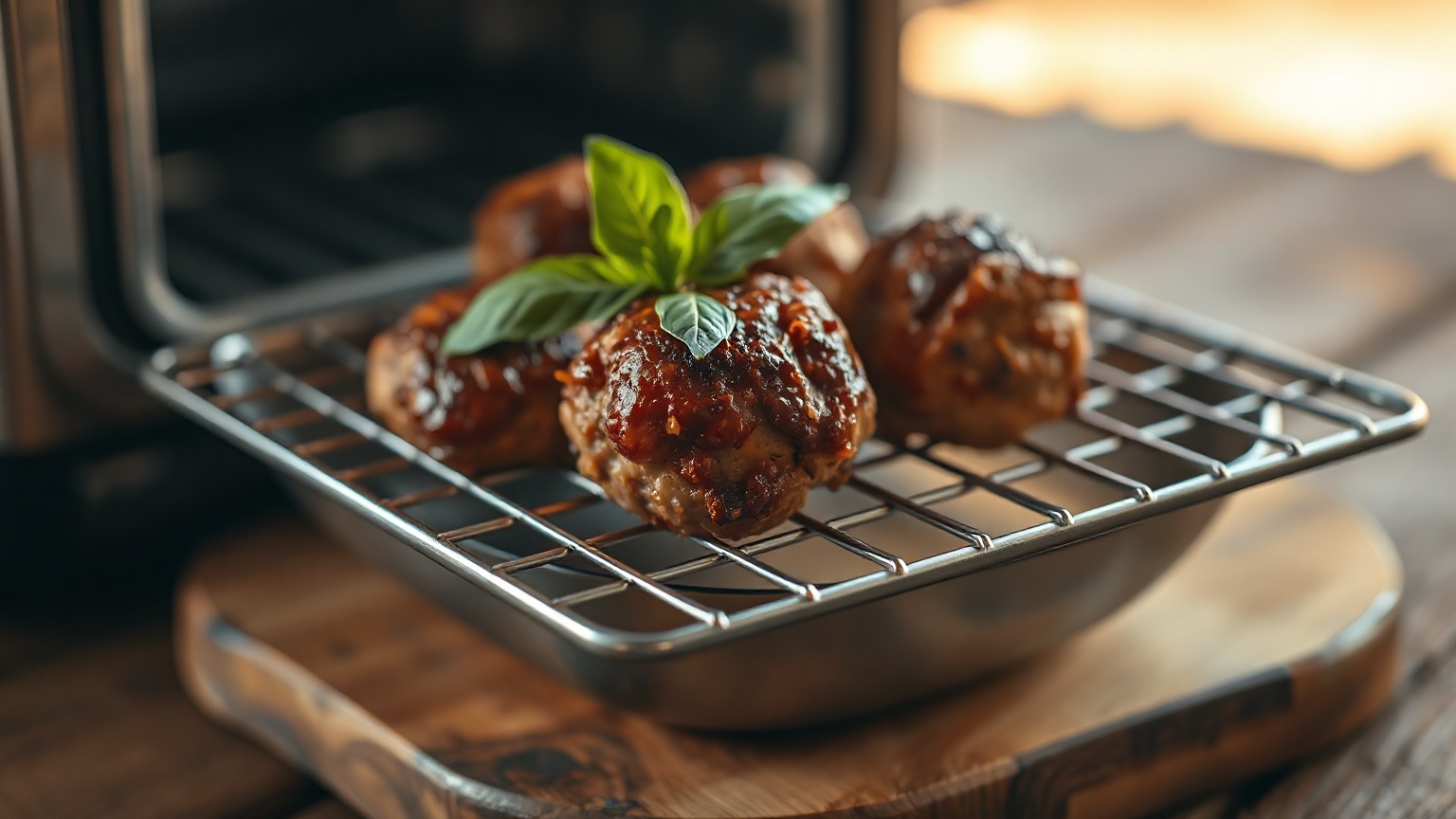
The physics are simple but the practical effects catch a lot of people off guard. In a regular oven, you’ve got a large cavity, heating elements that cycle on and off, and a fair amount of distance between your food and those elements. In a toaster oven, the cavity is tiny — sometimes just a few inches of clearance between the top of your meatballs and the upper heating element. That radiant heat hits your food hard and fast.
There’s also the convection factor to think about. Many toaster ovens have a convection fan setting, and if yours does, that changes the math further. Convection circulates hot air, which speeds up cooking even more and can brown things beautifully — or dry them out if you’re not paying attention. For meatballs, I’d actually recommend using convection if you have it, but dropping the temperature by 25°F and cutting your time by another 10–15% on top of that.
Hot spots are the other thing. My toaster oven runs hotter in the back left corner. I know this because I’ve tested it. If you haven’t yet, put a sheet of white bread in and toast it — wherever you get the darkest browning, that’s your hot zone. Rotate your meatball pan halfway through cooking to compensate.
The Temperature and Time Conversion Formula
Here’s what I actually use:
| Regular Oven Temp | Toaster Oven Temp | Approx. Time (1–1.5 inch meatballs) | With Convection |
|---|---|---|---|
| 350°F | 325°F | 20–22 minutes | 18–20 minutes |
| 375°F | 350°F | 18–20 minutes | 15–18 minutes |
| 400°F | 375°F | 15–18 minutes | 13–16 minutes |
| 425°F | 400°F | 13–16 minutes | 12–14 minutes |
These times are for meatballs that are roughly 1 to 1.5 inches in diameter — the standard cocktail-to-dinner size range. If you’re making massive 2-inch meatballs, add 3–5 minutes and definitely use a thermometer rather than guessing. According to the USDA’s guidelines on safe cooking temperatures, ground beef and pork mixtures need to reach 165°F internally. Don’t skip that check.
My personal preference for most meatball recipes is 375°F in the toaster oven (which replaces a standard 400°F recipe). It gives you a nice brown exterior without the top getting too dark before the inside is cooked through.
What About Recipes That Already Specify “Toaster Oven”?
If a recipe was written specifically for a toaster oven, follow it as-is. This whole conversion only applies when you’re adapting a recipe written for a standard 30-inch oven. There’s no need to adjust twice.
Pan Choice and Rack Position — Both Matter More Than You’d Think
This is probably where most people go wrong. Not the temperature, not the time — the pan and the rack position.
Choosing the Right Pan
Dark pans absorb more heat and will brown your meatballs faster on the bottom, sometimes too fast. I use a light-colored aluminum pan — specifically the kind that comes with most toaster ovens — or a small toaster oven baking pan meant for the smaller cavity size. If you use a regular full-size sheet pan shoved into a toaster oven, it often blocks airflow and creates weird uneven cooking. Get a pan that actually fits with a little room around the edges.
Better still: a toaster oven wire rack with a drip tray underneath. Elevating the meatballs means hot air circulates underneath them too, which means more even cooking and the fat drips away rather than pooling. The resulting texture is genuinely better.
Where to Position the Rack
Middle rack, almost always. The top position puts your meatballs too close to the upper heating element and you’ll get charring on top before the center is cooked. The bottom position means the tops won’t brown at all. Middle is the sweet spot. If your toaster oven only has two rack positions — top and bottom, no middle — go with bottom and check early. You’ll probably need to finish under the broiler for 2–3 minutes to get color on top.
Practical Tips for Actually Getting This Right
A few things I’ve learned the hard way, or just from doing it enough times:
Don’t overcrowd. I know it’s tempting to fit as many meatballs as possible in one batch. Resist. Crowded meatballs steam rather than roast, and you lose that browned crust. Leave at least half an inch between each one. If you’ve got a lot of meatballs to cook, do two batches. The second batch will cook slightly faster because the oven is already hot.
Preheat the toaster oven. Not optional. A cold start means your meatballs sit in warming air rather than hitting a hot environment immediately. Give it 10 full minutes to preheat. Some toaster ovens claim they preheat in 5 minutes; mine doesn’t. Test yours if you’re not sure.
Rotate halfway through. At the midpoint of cooking, open the oven and turn the pan 180 degrees. This helps compensate for hot spots. Takes about 5 seconds. Worth doing.
Use a meat thermometer. Color alone is not reliable with meatballs, especially when they’re dense or contain pork. A cheap instant-read thermometer solves this completely. Pull them at 165°F internal temperature — they’ll carry-over cook a degree or two after you remove them.
Watch for grease drips. Fatty meatballs (any recipe with a decent amount of pork or beef) will release a fair amount of fat. If it drips onto the heating element, you’ll get smoke. A foil-lined tray under a wire rack catches drips. This is why I always go with the rack setup if I have the option.
For more tips on getting the most out of your toaster oven for all types of food, have a look at our guide to reheating food in a toaster oven — a lot of the same principles about rack position and pan choice apply.
And if you’re working with a smaller, more compact unit and finding it harder to get consistent results, you might want to check out our roundup of the best mini toaster ovens — some models are significantly better than others at holding a steady temperature, which matters a lot for something like meatballs.
What Serious Cooks Actually Do With Meatballs in a Toaster Oven
There’s a reason baking meatballs (rather than pan-frying them) has become the go-to for a lot of home cooks. No standing over a skillet, no grease splatter across the stovetop. The oven does the work. And a toaster oven does it just as well as a full-size oven once you get the settings dialed in — it actually uses quite a bit less energy, which I appreciate.
Serious Eats has a great breakdown of what actually makes a meatball good — the fat ratio, the binders, the seasoning. Worth reading if you want to geek out on the recipe side of things. But assuming your recipe is solid, the conversion above will get you there in a toaster oven with minimal fuss.
One thing I want to flag: if you’re converting a recipe that calls for the broiler at the end to add color, that absolutely works in a toaster oven too. Most toaster ovens have a broil setting. Give your meatballs 2–3 minutes under the broiler at the very end — but watch them constantly. Broiling in a toaster oven goes from “perfect” to “black” shockingly fast. And I say that from experience.
Understanding how hot your particular model actually runs can also help you calibrate better. We’ve got a detailed piece on how hot a toaster gets that might fill in some gaps if you’re finding your oven’s dial doesn’t quite match what’s actually happening inside.
The Takeaway
Converting a regular oven meatball recipe to a toaster oven isn’t complicated. Drop the temperature by 25°F, start checking 5 minutes earlier than the recipe says, use a properly sized pan on the middle rack, and check the internal temperature with a thermometer. That’s genuinely most of it.
The toaster oven is, honestly, underrated for this. You get a great crust, shorter preheat time, and you’re not heating up a huge oven just to cook a batch of meatballs on a Tuesday night. Once you’ve made the conversion a couple of times with your specific oven, you’ll have a feel for it and won’t need to think about it anymore.
Frequently Asked Questions
What temperature do I bake meatballs at in a toaster oven?
375°F is a reliable all-purpose temperature for baking meatballs in a toaster oven — it gives you good browning without the risk of charring the top before the inside is cooked. If your original recipe calls for 400°F in a regular oven, 375°F in the toaster oven is the right conversion. Use a meat thermometer and pull them at 165°F internal temperature.
How long do meatballs take in a toaster oven?
At 375°F, standard 1 to 1.5-inch meatballs take about 15–18 minutes in a toaster oven. Larger meatballs (closer to 2 inches) will need 20–24 minutes. Always verify with a meat thermometer rather than relying on time alone, since toaster ovens vary quite a bit in how accurately they hold temperature.
Do I need to flip meatballs in a toaster oven?
If you’re using a flat pan, flipping once at the halfway point helps brown all sides more evenly. If you’re using a wire rack (which I’d recommend), flipping is less critical since hot air circulates underneath the meatballs anyway. Either way, rotating the pan 180 degrees at the halfway point is worth doing to account for hot spots.
Can I use convection mode in my toaster oven for meatballs?
Yes, and it actually works well for meatballs. Convection circulates air and speeds up browning, so you’ll want to drop the temperature by an additional 25°F and reduce your cooking time by about 10–15%. On a convection toaster oven, 350°F for 13–16 minutes is a good starting point for standard-size meatballs — but check the internal temperature to be sure.
Why are my toaster oven meatballs burning on top but raw inside?
This usually means your toaster oven temperature is too high, your meatballs are too close to the upper heating element, or both. Move your rack to the middle position, reduce the temperature by 25°F from whatever you’ve been using, and consider covering the meatballs loosely with foil for the first half of the cooking time then removing it to let them brown. Using a thermometer to verify doneness will prevent guessing.

Written by
Emma founded Toastera to turn vague appliance advice into clear, researched, safety-first guidance on toasters and toaster ovens.
Free: the Toaster Oven Cheat Sheet
Get the printable cheat sheet (temps, cook times & safety tips) plus new recipes. No spam, unsubscribe anytime.