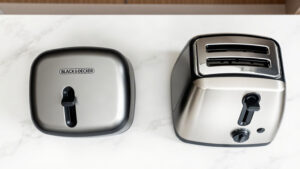
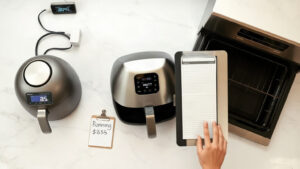
To genuinely replace a full-size oven, a toaster oven needs at least 1,500 watts — and honestly, 1,800 watts is the sweet spot for most real cooking tasks. Anything under 1,200 watts will toast bread just fine, but you’ll struggle to hit the sustained high heat needed for roasting or baking from scratch. The practical upshot: if you’re buying a toaster oven to fully sub in for your range, don’t settle for a compact 700-watt model no matter how good the deal looks.
Safety First: Toaster ovens draw significant amperage — a 1,800-watt unit pulls about 15 amps. Always plug yours directly into a dedicated wall outlet rated for the load, never into an extension cord or power strip. Keep at least 4 inches of clearance on all sides to prevent heat buildup and potential fire risk, and never leave it running unattended on a high broil setting.
Quick Facts: Toaster Oven Wattage at a Glance
- Most compact toaster ovens run between 700–1,200 watts — good for reheating and light toasting, not much else
- Full oven-replacement models typically land at 1,500–1,800 watts, with some convection units hitting 1,800W
- A standard full-size electric oven uses roughly 2,000–5,000 watts (most of that in the preheat burst)
- Convection fans in higher-wattage toaster ovens can compensate somewhat for the wattage gap by circulating heat more efficiently
- Running a 1,800W toaster oven for one hour costs roughly 18–25 cents — less than a full oven in most U.S. markets
What Wattage Actually Does Inside a Toaster Oven
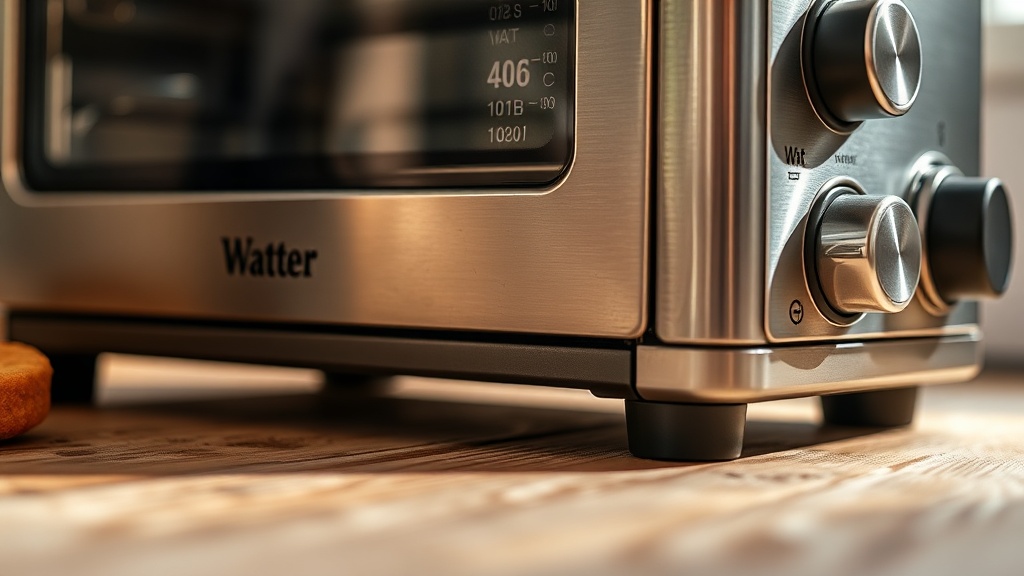
Wattage is basically how fast an appliance can convert electricity into heat. Higher wattage means the heating elements get hotter, faster, and — more importantly — they recover faster after you open the door and let the heat escape. That’s the part people don’t think about enough.
A 700-watt toaster oven takes forever to preheat. We’re talking 8 to 12 minutes to hit 350°F, and the moment you slide a cold pan of chicken thighs inside, the temperature tanks and takes ages to climb back. A 1,800-watt unit? Preheats to 400°F in under 6 minutes and bounces back almost immediately after you load it.
That recovery speed matters enormously for baking. Cookies spread differently at 375°F than they do at 340°F — even a brief temperature dip during bake time shows up in the final texture. My personal threshold is 1,500 watts as the floor for anything I’d consider “real” cooking, not just reheating leftovers.
The Wattage Breakdown: Which Range Does What
Not all wattage ranges are created equal, and manufacturers aren’t always upfront about what their products can realistically handle. Here’s what the numbers actually mean in kitchen terms.
700–1,000 Watts: Basic Toast and Reheat
These are the small guys — usually 4-slice capacity, no convection, and a dial timer. They’ll toast bread, warm up a slice of pizza, maybe bake a couple of frozen biscuits. But they can’t reliably hit or hold 450°F, so anything that needs serious high heat is off the table. Don’t try roasting vegetables in one of these expecting even browning. You won’t get it.
1,200–1,400 Watts: Capable but Limited
This is where things get more interesting. A 1,200-watt toaster oven can bake a small batch of muffins or reheat a casserole pretty well. It’ll struggle with larger items and tends to have hot spots — usually near the back heating element. Still not a full oven replacement, but fine for a solo cook or couple who doesn’t bake much.
1,500–1,800 Watts: The Real Oven-Replacement Zone
This is the range you want. Units in this category — think Breville Smart Ovens, the Cuisinart TOA-60, larger Ninja Foodis — can roast a whole chicken, bake a 9-inch pie, and hold consistent temperatures for 45+ minutes without drama. Convection at this wattage is genuinely effective. I’ve used a 1,800-watt convection toaster oven to bake croissants and the layering was fine. Not identical to my full oven, but close enough to not care most of the time.
For reheating food in a toaster oven, even a 1,500W model is overkill in the best way — leftovers come out crispier and better than anything a microwave does.
| Wattage Range | Typical Capacity | Best For | Can Replace Full Oven? |
|---|---|---|---|
| 700–1,000W | 2–4 slices / small | Toast, reheating, small frozen snacks | No |
| 1,200–1,400W | 4–6 slices / medium | Muffins, small casseroles, reheating | Not really |
| 1,500W | 6 slices / medium-large | Baking, roasting small cuts of meat | Close — with convection |
| 1,800W | 6–9 slices / large | Whole chicken, pies, sheet pan meals | Yes, for most tasks |
| 1,800W+ (air fry) | Large / air fryer combo | Air frying, dehydrating, full oven tasks | Yes, broadly |
How Toaster Oven Wattage Compares to a Full-Size Oven
A standard electric range oven uses somewhere between 2,000 and 5,000 watts — but that big top number is the preheat burst, when all the elements fire simultaneously to get the cavity up to temperature fast. Once it’s stabilized, a full oven cycling at 350°F uses something closer to 1,500–2,000 watts intermittently. So a 1,800-watt toaster oven is actually in the same ballpark during steady-state cooking.
The real advantage of the full oven is thermal mass and cavity size. More cubic feet of hot air means the temperature recovers faster when you open the door. A toaster oven’s small cavity actually works in its favor in some ways — less air to heat means faster preheat — but it also means temperature swings can be sharper.
According to Serious Eats’ toaster oven testing, the best performing units held temperatures within ±15°F of the set point, which is actually on par with many mid-range full-size ovens. Not bad at all.
Curious how the heat compares to a basic pop-up toaster? Check out our article on how hot a toaster gets — the difference is bigger than most people assume.
The Convection Factor: Why It Matters More Than Raw Watts
Here’s something manufacturers bury in the fine print: a convection fan can effectively make a lower-wattage unit perform like a higher-wattage one. Moving air transfers heat to food much more efficiently than still air. So a 1,500-watt convection toaster oven can often outperform a 1,800-watt non-convection model for baking and roasting.
That said, convection isn’t magic. It dries things out faster, which is great for roasting but not ideal for, say, a delicate custard or a bread loaf that needs steam. Most higher-end models let you toggle the fan on and off, which is the smarter buy.
If you’re shopping for a unit that can genuinely replace your oven, I’d prioritize: 1,500+ watts, convection with an on/off switch, and a large enough interior to fit a standard quarter sheet pan. That last one is a bigger deal than most reviews mention. If the pan doesn’t fit, half the recipes you’d want to cook won’t work.
Also worth picking up a decent toaster oven wire rack — many stock racks are poorly positioned for airflow, and swapping to one that sits at the right height makes a noticeable difference in how evenly food browns.
Real-World Use Cases: Can a Toaster Oven Actually Do It?
Let’s get specific. Here’s what a 1,800-watt toaster oven can handle versus where it starts to fall short.
What It Handles Well
- Roasting a 3.5 to 4 lb chicken at 400°F — totally doable, usually better browning than a full oven because of the smaller cavity
- Baking a single layer 9-inch cake or a batch of 12 cookies — works great, just watch your timing, toaster ovens can run hot
- Sheet pan vegetables, fish fillets, pork tenderloin — all solid
- Frozen pizza up to about 12 inches in diameter
- Broiling salmon or a steak with the rack in the upper position
Where It Struggles
- A turkey or anything over about 5 lbs — physically won’t fit in most models
- Multiple racks at once — most toaster ovens don’t have enough vertical space for two full racks of food
- Large batch baking, like 4 dozen cookies for a party — you’re doing that in rounds
- Casseroles in a standard 9×13 dish — most won’t fit, you’d need a half-size pan
For smaller households, a good mini or mid-size toaster oven at 1,500+ watts covers probably 80% of everyday cooking needs. Maybe 90%. The 10% that’s left is mostly large-format entertaining — roasting a big bird, cooking for a crowd.
The USDA’s safe internal temperature guidelines apply just the same in a toaster oven as a full oven — chicken still needs to hit 165°F regardless of what’s cooking it. Don’t skip the meat thermometer just because the appliance is smaller.
The Bottom Line on Toaster Oven Wattage
The short answer is 1,800 watts if you want genuine oven replacement capability. If your cooking is mostly lighter — reheating, baking the occasional batch of something small, roasting a couple chicken breasts — 1,500 watts is plenty. Go below 1,200 watts and you’re in toaster territory, not oven territory.
The wattage number alone doesn’t tell the whole story, though. Convection, interior size, and temperature accuracy matter just as much. But wattage is the starting point, the baseline. A unit that can’t generate enough heat fast enough will frustrate you no matter what other features it has.
My honest take: most people buying a toaster oven to replace or supplement a full oven should look at the 1,800-watt convection category and not spend a lot of time agonizing below that. You’ll use it more, cook better food, and stop fighting the appliance. That’s the point.
Frequently Asked Questions
How many watts does a toaster oven use per hour?
A 1,800-watt toaster oven running for one full hour uses 1.8 kWh of electricity, which typically costs between 18 and 27 cents depending on your local electric rate. In practice, most cooking cycles don’t run a full continuous hour — the element cycles on and off to maintain temperature — so actual consumption is usually a bit lower than the nameplate wattage suggests.
Can a 1,500-watt toaster oven replace a full-size oven?
Yes, for most everyday cooking tasks a 1,500-watt toaster oven with convection can replace a full-size oven. It’ll roast, bake, and broil effectively for 1–4 people. The main limitations are physical size — you can’t fit a 15-pound turkey in one — and batch cooking, where a full oven’s larger cavity lets you cook more food simultaneously.
Is a higher wattage toaster oven more energy efficient?
Higher wattage toaster ovens generally reach cooking temperature faster and recover heat more quickly, which actually makes them more efficient per meal compared to low-wattage units that take longer to do the same job. Both are significantly more energy efficient than running a full-size electric oven for the same task, since a toaster oven’s smaller cavity requires less energy to heat and maintain.
What wattage toaster oven is best for baking?
For baking — cookies, cakes, muffins, bread — look for at least 1,500 watts, and ideally 1,800 watts with a convection option you can switch off when needed. Convection is great for even browning but can over-dry delicate baked goods, so the ability to bake in still-air mode at full power is important for getting good results across different recipes.
Do toaster ovens use a lot of electricity compared to a regular oven?
Toaster ovens use considerably less electricity than full-size ovens for comparable cooking tasks — typically 1,500–1,800 watts versus a full oven’s 2,000–5,000 watt preheat demand. For a meal that takes 30 minutes to cook, a toaster oven can cut energy use by 50% or more compared to a conventional electric oven, mostly because the smaller cavity heats up and stabilizes much faster.

Written by
Emma founded Toastera to turn vague appliance advice into clear, researched, safety-first guidance on toasters and toaster ovens.
Free: the Toaster Oven Cheat Sheet
Get the printable cheat sheet (temps, cook times & safety tips) plus new recipes. No spam, unsubscribe anytime.