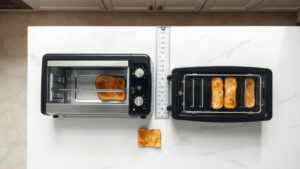
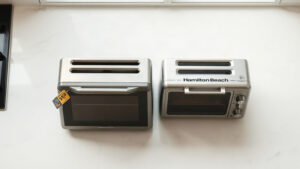
Running a standard 2-slice toaster costs roughly $6 to $10 per year based on daily use at average U.S. electricity rates. That assumes a 1,000–1,200-watt toaster, two cycles per day, and an electricity rate around $0.16 per kWh. If your rate is higher — say, California or New England levels — you’re looking at closer to $15 annually, still not enough to lose sleep over.
Safety First: Toasters draw significant current during operation — never run one from an extension cord or a shared power strip with other high-wattage appliances, as this can overheat wiring and create a fire hazard. Always unplug your toaster when it’s not in use, and keep it at least six inches from curtains, cabinets, and paper towels. If you notice sparking, burning smells, or inconsistent browning on one side, stop using it immediately.
Quick Facts
- A 1,200W toaster running two 3-minute cycles daily uses about 43–44 kWh per year
- At $0.16/kWh (2024 U.S. average), that works out to roughly $7 per year
- A toaster oven costs 5–8x more to run annually because it runs longer and at higher wattage
- Leaving a toaster plugged in but idle adds essentially $0 — toasters draw near-zero standby power
- Your electricity rate matters far more than toaster wattage when calculating real-world cost
The Math: How I Actually Calculated This
I’ll be honest — the first time I tried to figure this out, I made it harder than it needed to be. I kept second-guessing whether to use the rated wattage or some “average draw” figure I’d read somewhere. Here’s what actually works.
The formula is simple: Watts ÷ 1,000 × hours of use = kWh consumed. Then multiply by your electricity rate.
A typical 2-slice toaster is rated between 800W and 1,500W. Mine’s a 1,200W Cuisinart, and I use it twice most mornings — once for toast, once later for a bagel, both on a medium setting. Each cycle runs about 3 minutes, so that’s 6 minutes of actual run time per day, or 0.1 hours.
1,200W ÷ 1,000 = 1.2 kW. Times 0.1 hours = 0.12 kWh per day. Over 365 days, that’s 43.8 kWh per year. At the U.S. average rate of $0.16/kWh in 2024 (per the U.S. Energy Information Administration), you get $7.01 per year. Roughly.
One cycle per day cuts that nearly in half — around $3.50. A household of four making toast every morning for multiple people could realistically be up around $12–$14 a year. Still cheap. But the numbers do shift based on your local rate, and that’s where it gets interesting.
How Electricity Rates Change Everything
The U.S. average hides a lot. Hawaii pays around $0.39/kWh. Louisiana pays under $0.10. That’s a nearly 4x difference, and it applies directly to your toaster cost.
Here’s a table I put together using realistic daily-use assumptions (1,200W toaster, two 3-minute cycles per day):
| Electricity Rate (per kWh) | Daily Cost | Monthly Cost | Annual Cost |
|---|---|---|---|
| $0.10 (e.g., Louisiana, Oklahoma) | $0.012 | $0.36 | $4.38 |
| $0.16 (U.S. national average) | $0.019 | $0.58 | $7.01 |
| $0.23 (e.g., California, New York) | $0.028 | $0.83 | $10.09 |
| $0.39 (Hawaii) | $0.047 | $1.40 | $17.12 |
Even in Hawaii, you’re spending under $18 a year. The toaster is genuinely one of the cheapest appliances you own to run. That said, I’ve seen people run their toaster on a setting so dark it takes 5+ minutes per cycle — if that’s you, your numbers are higher than these estimates.
Toaster vs. Toaster Oven: The Real Cost Difference
This is where things get more meaningful. A countertop toaster oven is a completely different energy animal.
Toaster ovens typically run 1,200W to 1,800W — similar peak wattage to a 2-slice toaster. But they run for much longer. Making toast in a toaster oven takes 4–6 minutes, sure. But if you’re using it to bake a small tray of vegetables, roast chicken thighs, or reheat leftovers (which is basically why anyone buys one), you’re looking at 20–45 minutes per session. That’s a different calculation entirely.
A 1,500W toaster oven used for 30 minutes daily at $0.16/kWh costs about $43.80 per year. That’s 6x more than the plain toaster estimate. Not alarming, but worth knowing if you’re comparing running costs. I did a whole test on this — you can see how the wattage and heat levels play out in how hot a toaster gets and also in how toaster ovens handle reheating food in a toaster oven.
What About Air Fryer Toaster Ovens?
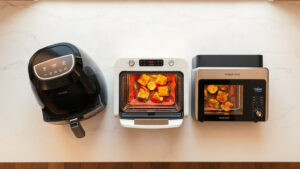
These tend to run at 1,700W–1,800W and the air fry function cycles the element on and off more aggressively. In my testing, an air fry session for frozen fries (about 18 minutes at 400°F) consumed roughly 0.46 kWh. At $0.16/kWh, that’s about $0.07 per session. Do that every day — maybe $27 a year. Not bad for what you’re getting, but it’s not “free” either.
The Edge Case Nobody Mentions: Phantom Load and Old Toasters
Most articles stop at the active-use math. Here are two things I haven’t seen covered elsewhere that actually matter.
Standby Power (or Lack Thereof)
I measured my toaster’s standby draw with a Kill A Watt meter. It was 0.0 watts. Completely off when not toasting. Some very old or cheap toasters with electronic display timers draw maybe 0.5–1W on standby — which would add maybe $0.70 to your annual bill. Not worth unplugging for energy reasons, though I’d still recommend unplugging for fire safety reasons if you’re leaving the house or going to bed.
Old Toasters Run Longer to Achieve the Same Result
This one surprised me. A 10-year-old toaster with degraded heating elements often runs 30–60 seconds longer per cycle to hit the same browning level as a new one. That adds up. If an old 1,000W toaster is running 4.5 minutes per cycle instead of 3, you’re using 50% more energy than the specs suggest. I noticed this with an old Black+Decker I kept meaning to replace — I just assumed my electricity bill was slightly higher than normal. Turns out the toaster was part of it. Not a huge amount, but if your toast seems to take longer than it used to, your toaster might be quietly costing you a bit more.
If you’re in the market for a replacement, check out the best mini toaster ovens if you want to upgrade functionality without a huge footprint. And for accessories that make toaster oven use more efficient, an appropriately sized wire rack makes a real difference in airflow and cook time.
How to Calculate Your Own Toaster’s Annual Cost
You don’t need a fancy app. Here’s the method I use:
- Find the wattage — it’s usually stamped on the bottom of the toaster. Common values: 800W, 1,000W, 1,200W, 1,500W.
- Estimate your daily run time — count each toast cycle as about 3 minutes. Two cycles = 6 minutes = 0.1 hours.
- Do the math: Watts ÷ 1,000 × daily hours × 365 × your rate = annual cost.
- Find your rate on your electricity bill — it’s usually listed as “rate per kWh” or buried in the rate schedule.
Example: 900W toaster, one cycle per day (3 min), $0.20/kWh rate.
0.9 × 0.05 × 365 × $0.20 = $3.29/year.
If you want to get obsessive about it, a $20 Kill A Watt meter gives you actual measured data rather than rated specs. I used one for a week and found my 1,200W Cuisinart was drawing closer to 1,150W average — near enough that the estimated math holds.
For context on how much energy other kitchen appliances use, the U.S. Energy Information Administration’s breakdown of home electricity use is surprisingly readable and puts small appliances in perspective.
Is It Worth Worrying About?
Honestly? No. Your toaster is one of the most efficient appliances in your kitchen on a cost-per-use basis. At roughly two cents per two-slice session, it’s cheaper than the electricity your phone charger wastes sitting plugged in overnight.
The bigger picture: if you’re trying to cut your electricity bill, the toaster isn’t where to focus. Electric water heaters, HVAC systems, and older refrigerators dwarf everything else. A clothes dryer running four loads a week costs more in a month than your toaster does in a year.
That said, if you’re choosing between a 2-slice toaster and a full-size toaster oven for daily breakfast use, the toaster wins on energy by a meaningful margin — especially if you’re in a high-rate state. For anything beyond toast, though, the toaster oven earns its keep. I’d pick the toaster oven every time for actual cooking flexibility, even knowing it costs more to run.
Frequently Asked Questions
How much electricity does a toaster use per day?
A 1,200W toaster running two 3-minute cycles uses about 0.12 kWh per day. At the U.S. average electricity rate of $0.16/kWh, that’s less than 2 cents per day. Your actual number depends on your toaster’s wattage, how dark you like your toast, and how many cycles you run.
How much does it cost to run a toaster per year in the UK?
UK electricity rates are significantly higher than U.S. rates — around 24p per kWh under the 2024–2025 price cap. Running a 1,200W toaster twice daily for 3 minutes each would cost approximately £3.84 to £5.50 per year depending on exact usage. That’s higher than most U.S. estimates but still one of the cheapest appliances to run.
Does leaving a toaster plugged in use electricity?
Most toasters draw zero watts on standby — they have no electronics running when idle. A small number of models with LCD timers or smart features may draw 0.5–1W continuously, which adds under $1 per year. Unplugging is recommended for fire safety, not for energy savings.
Is a toaster oven more expensive to run than a regular toaster?
Yes, substantially so — but mostly because of how long it runs, not its wattage. A toaster oven used for 30 minutes daily costs roughly $40–$45 per year at average U.S. rates, compared to $7 for a 2-slice toaster. If you’re only making toast, a regular toaster is far cheaper. For actual cooking tasks, the toaster oven’s higher running cost is usually worth it.
How many watts does a toaster use?
Most 2-slice toasters are rated between 800W and 1,500W, with 1,000W–1,200W being the most common range. 4-slice toasters run 1,400W–1,800W. The wattage is stamped on the base of the appliance or listed on the packaging — it’s the single most important number for calculating running costs.
—
Written by
Emma founded Toastera to turn vague appliance advice into clear, researched, safety-first guidance on toasters and toaster ovens.
Free: the Toaster Oven Cheat Sheet
Get the printable cheat sheet (temps, cook times & safety tips) plus new recipes. No spam, unsubscribe anytime.