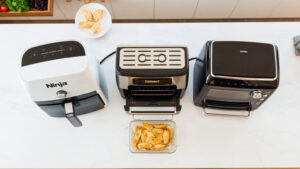
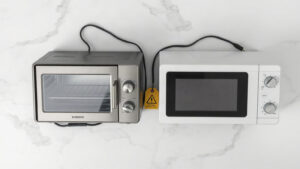
A 4-slice toaster oven needs at least 1,200 watts to cook food properly, though 1,500–1,800 watts is the sweet spot for consistent results. Below 1,000 watts, you’ll get uneven browning, longer cook times, and temperature recovery so slow it’ll frustrate you mid-recipe. For most real cooking tasks — roasting vegetables, baking a small chicken breast, reheating leftovers that actually get crispy — 1,500 watts is the practical minimum worth buying.
Safety First: Toaster ovens draw significant current — a 1,800W model on a 15-amp circuit pulls 15 amps by itself, leaving almost nothing for other appliances. Always plug your toaster oven directly into a wall outlet (never a power strip or extension cord), keep at least 4 inches of clearance on all sides for heat venting, and never leave it running unattended when cooking fatty foods like bacon — grease buildup on the heating elements is a genuine fire risk.
Quick Facts: 4-Slice Toaster Oven Wattage
- Most 4-slice toaster ovens range from 1,000W to 1,800W — that’s a bigger spread than most people realize.
- 1,500W is widely considered the minimum for reliable baking (consistent 350°F hold without temperature drops).
- A 1,800W model preheats to 400°F roughly 2–3 minutes faster than a 1,000W model — which matters a lot when you’re hungry.
- Running a 1,500W toaster oven for one hour costs approximately 18–22 cents at average U.S. electricity rates (about 12–15¢/kWh).
- Wattage affects temperature recovery — after you open the door, a high-watt unit bounces back to set temp much faster.
Why Wattage Actually Matters More Than You’d Think
I’ll be honest — before I started testing toaster ovens seriously, I assumed wattage was mostly a marketing number. Like, how different could 1,000 watts really be from 1,500? Pretty different, as it turns out.
The wattage of a toaster oven determines three things that directly affect cooking quality: how fast it preheats, how well it holds a set temperature under load (a cold pan going in drops the internal temp significantly), and how quickly it recovers after you open the door. A low-watt unit might reach 350°F eventually, but it struggles to stay there once you put food in. That’s how you end up with chicken that’s gray and steamed-looking rather than properly roasted.
The first time I tested a budget 1,000W 4-slice oven, I set it to 400°F, waited for the preheat signal, then slid in a small pan of vegetables. Six minutes later they were sweating, not roasting. The oven had dropped to around 330°F from the cold pan alone and just couldn’t climb back. That’s not a quirk — that’s an underpowered appliance.
The Wattage Ranges Explained: What Each Tier Actually Buys You
Under 1,000W: Toast Only, Basically
Sub-1,000W toaster ovens exist, and they’re fine for bread. That’s about it. They’ll toast, they’ll warm a slice of pizza, but anything that requires sustained heat — cookies, chicken, a frittata — is going to disappoint you. Don’t buy one expecting to actually cook in it.
1,000–1,200W: Functional, With Limits
This is where a lot of the budget 4-slice ovens land, including the popular Black+Decker TO1313SBD. They’ll bake. They’ll roast. But you need to manage your expectations — add 20–25% to recipe cook times, and don’t try to cook from frozen without adjusting. Temperature swings of 25–40°F are normal in this range. For a college apartment or light use? Fine. For someone who wants to actually rely on it as a secondary oven? You’ll hit the ceiling pretty fast.
1,500W: The Real Sweet Spot
Once you get to 1,500 watts, cooking behavior changes noticeably. Preheat times drop to around 4–6 minutes for 350°F. Temperature recovery after loading is fast enough that standard recipe times actually work. I baked chocolate chip cookies at 375°F in a 1,500W convection toaster oven and they came out within 30 seconds of the same recipe in my full-size oven. That’s the bar.
Most mid-range 4-slice ovens hit this mark: the Hamilton Beach 31123D, the Oster TSSTTVMNDG, and various Cuisinart models hover around 1,500W. Good value here.
1,800W and Above: For Serious Cooking
The Breville Smart Oven and its siblings run at 1,800W. So does the Cuisinart TOA-70. At this wattage, you get fast preheat (under 5 minutes to 400°F in my testing), rock-solid temperature stability, and enough headroom for convection + broiling simultaneously. Worth every penny if you’re using the toaster oven as your primary cooking appliance, or cooking for more than two people regularly. For occasional toast and reheating? Overkill, and your electricity bill will show it.
Wattage vs. Cooking Function: A Practical Breakdown
Not all cooking modes are equal in their power demands. Here’s how wattage maps to specific tasks you might actually want a 4-slice toaster oven to do.
| Cooking Task | Minimum Watts for Good Results | Ideal Watts | Notes |
|---|---|---|---|
| Toasting bread | 800W | 1,000–1,200W | Even low-watt units do fine here |
| Reheating leftovers | 1,000W | 1,200–1,500W | See our guide on reheating food in a toaster oven |
| Baking cookies/muffins | 1,200W | 1,500W+ | Temp stability matters most |
| Roasting vegetables | 1,200W | 1,500–1,800W | Low watts = steaming, not roasting |
| Baking chicken breast | 1,500W | 1,800W | Needs temp recovery after cold meat goes in |
| Convection cooking | 1,500W | 1,800W | Fan + heat = higher draw |
| Broiling | 1,500W | 1,800W | Top element runs at max; needs headroom |
The takeaway: if baking and roasting are on your list at all, don’t go below 1,500W. It’s really that simple.
The Edge Case Nobody Talks About: Altitude and Ambient Temperature
Here’s something the comparison sites almost never mention. If you live at high altitude (Denver, Salt Lake City, Albuquerque — anywhere above 3,500 feet), your toaster oven needs more wattage buffer than it would at sea level. Water boils at lower temperatures up there, which sounds irrelevant until you realize it affects baking chemistry and how your oven’s thermostat calibration behaves. A 1,200W oven that’s already borderline at sea level will frustrate you even more at altitude.
Similarly, if your kitchen runs cold in winter — uninsulated apartment, older house — a lower-watt toaster oven will lose more heat to the environment and cycle more aggressively. I noticed this in my own kitchen in January: the same 1,200W unit I tested in September took about 90 seconds longer to preheat when the kitchen was 62°F instead of 70°F. Not huge, but worth knowing.
In both cases, erring toward 1,500W or above gives you a useful buffer. And if you’re shopping for a compact unit, check out our picks for the best mini toaster ovens — some of them punch above their weight on wattage per cubic inch.
Popular 4-Slice Toaster Oven Models Compared
Let me put some actual product names to these wattage ranges, with honest opinions on each.
| Model | Wattage | Price Tier | Best For | Honest Take |
|---|---|---|---|---|
| Black+Decker TO1313SBD | 1,150W | Budget | Light use, toasting, reheating | Fine for a first apartment, not a serious cooking tool |
| Hamilton Beach 31123D | 1,400W | Budget-Mid | Everyday baking, small roasts | Underrated; surprisingly stable temps for the price |
| Oster TSSTTVMNDG | 1,500W | Mid-range | Daily cooking, convection baking | Solid all-rounder, convection actually works well |
| Cuisinart TOA-70 | 1,800W | Mid-Premium | Air frying, roasting, serious baking | My personal pick for most home cooks |
| Breville Smart Oven BOV800XL | 1,800W | Premium | Replacing a second oven, precision cooking | Best-in-class but you’re paying for it |
My clear recommendation: the Cuisinart TOA-70 for most people. It’s 1,800W, it has an air fryer function that actually works, and it bakes evenly enough that I’ve stopped second-guessing it. The Breville is better — but unless you’re cooking for four people multiple times a day, the price difference is hard to justify.
If budget is a real constraint and you mostly want to bake occasionally or reheat things, the Hamilton Beach 31123D at 1,400W is a genuinely decent buy. Just know its limits. For more on how temperature performance varies across these units, see our look at how hot a toaster gets and what that means practically.
Does Convection Change the Wattage You Need?
Yes, a bit. Convection mode uses a fan to circulate hot air, which means your food cooks at lower temperatures (typically 25°F lower than conventional settings, per Serious Eats’ convection cooking guide) and faster. The fan itself draws a small amount of additional power — usually 20–50W — but the bigger deal is that convection increases your effective cooking performance without demanding much more electricity. A 1,500W convection toaster oven often outperforms a 1,800W non-convection unit for roasting.
So if you’re comparing two models and one has convection, factor that in. A 1,500W convection oven is genuinely more capable than a 1,500W standard oven for most tasks. Get a good toaster oven baking pan and you’ll see the difference immediately in how evenly food browns.
The Bottom Line on 4-Slice Toaster Oven Wattage
If you want a 4-slice toaster oven that cooks real food — not just warms it — 1,500 watts is your floor, not your ceiling. It’s the point where recipe times stop being fictional, where a chicken breast actually roasts instead of steams, and where baking starts to feel reliable rather than experimental.
1,000W units aren’t useless. They toast. They reheat. But if you’re spending money on an appliance you expect to cook with, spend the extra $20–40 to get into the 1,500W range. And if you cook frequently or want convection air-frying too, go to 1,800W — the Cuisinart TOA-70 is my pick there. You’ll use it more than you expect, and it’ll earn its counter space.
Frequently Asked Questions
How many watts does a 4-slice toaster oven use?
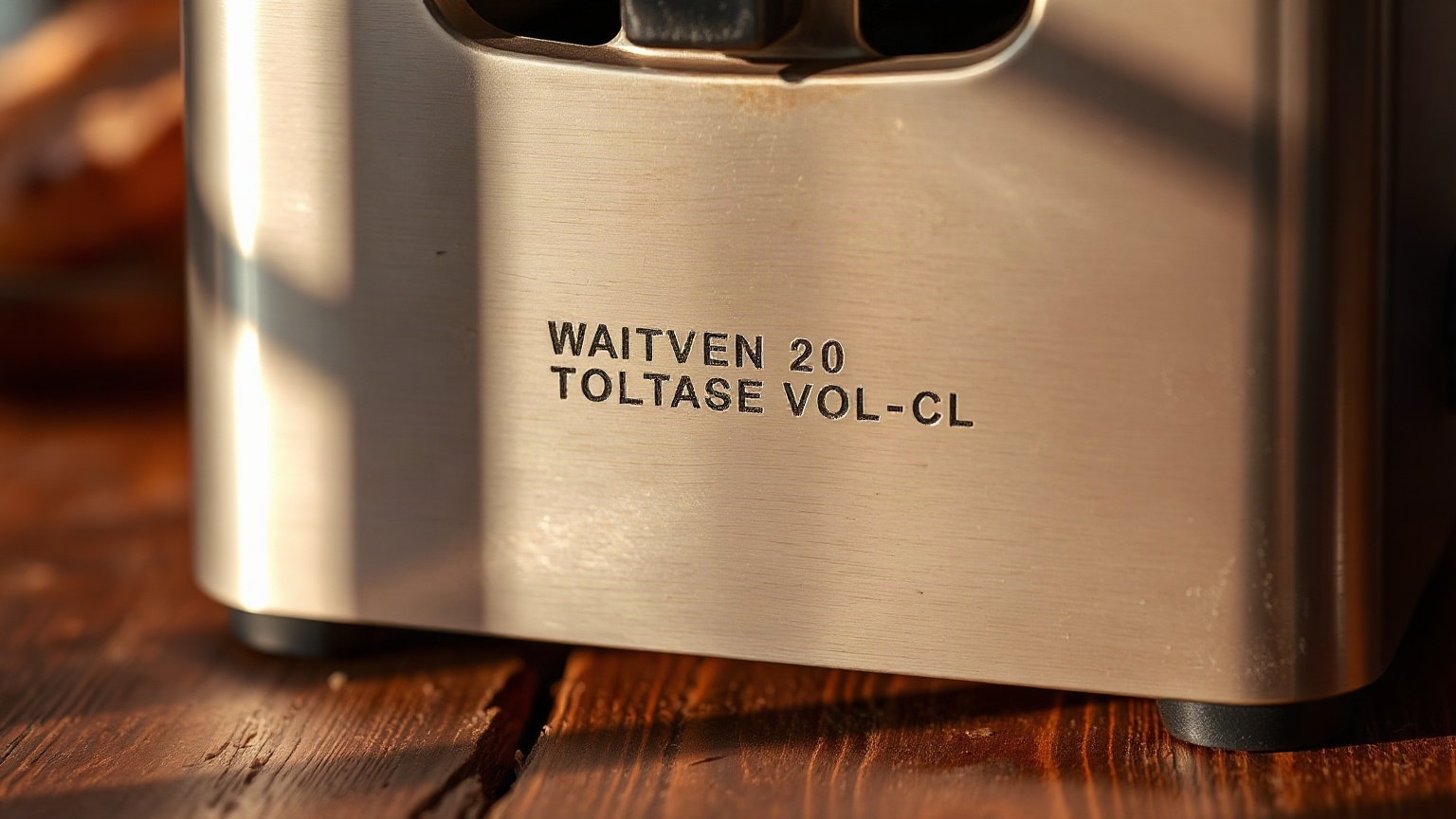
Most 4-slice toaster ovens use between 1,000 and 1,800 watts, with 1,200–1,500W being the most common range in mid-price models. Budget units often land around 1,000–1,150W, while premium models like the Breville Smart Oven run at 1,800W. The wattage is usually printed on the bottom of the unit or listed in the product specs.
Is 1,000 watts enough for a toaster oven to bake?
1,000 watts is technically enough to bake, but results will be inconsistent — especially for anything that requires stable high heat, like cookies or roasted meat. Temperature recovery after loading a cold pan is slow at this wattage, which often means longer cook times and uneven browning. For reliable baking, 1,500W is a better target.
How much does it cost to run a toaster oven per hour?
At average U.S. electricity rates of around 12–15 cents per kilowatt-hour, a 1,500W toaster oven costs roughly 18–23 cents per hour to run at full power. A 1,800W model costs about 22–27 cents per hour. Neither is going to spike your bill meaningfully unless you’re running it for several hours daily — they’re significantly cheaper to operate than a full-size oven for small meals.
Does higher wattage mean a toaster oven cooks food faster?
Higher wattage primarily means faster preheat and better temperature recovery, not always dramatically faster cooking once the oven is up to temperature. A 1,800W oven reaches 400°F about 2–3 minutes faster than a 1,000W model in my testing. The bigger practical benefit is consistency — higher-watt ovens hold their set temperature more steadily throughout the cook.
Can I run a toaster oven on a standard 15-amp household circuit?
Yes — a 1,800W toaster oven draws about 15 amps on a standard 120V circuit, which is exactly at the limit of a 15-amp breaker. That means you shouldn’t run anything else significant on that same circuit simultaneously. Plug the toaster oven directly into a wall outlet, not a power strip, and avoid running a microwave or coffee maker on the same circuit at the same time to prevent tripping the breaker.

Written by
Emma founded Toastera to turn vague appliance advice into clear, researched, safety-first guidance on toasters and toaster ovens.
Free: the Toaster Oven Cheat Sheet
Get the printable cheat sheet (temps, cook times & safety tips) plus new recipes. No spam, unsubscribe anytime.