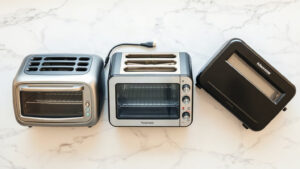
A standard 2-slice toaster draws between 5 and 10 amps at 120 volts, depending on its wattage rating — most fall right around 8 amps during normal operation. The math is simple: amps equal watts divided by volts, so a 900-watt toaster on a 120V outlet pulls 7.5 amps. That’s well within what a standard 15-amp kitchen circuit can handle, but it becomes relevant fast if you’ve got other appliances sharing the same circuit.
Safety First: Never plug a toaster into an extension cord or power strip — toasters draw significant amperage in short bursts and can overheat undersized wiring, creating a real fire risk. Always plug directly into a grounded wall outlet, and if your circuit breaker trips repeatedly when toasting, stop using that outlet and have an electrician check the circuit load before continuing.
Quick Facts: 2-Slice Toaster Amp Draw
- Most 2-slice toasters are rated between 650 and 1,200 watts — translating to roughly 5.4 to 10 amps at 120V
- The most common wattage for a mid-range 2-slice toaster is around 900W, which draws approximately 7.5 amps
- A 15-amp kitchen circuit can technically support a toaster alongside other small draws, but sharing with a microwave or coffee maker on the same circuit is asking for trouble
- Toasters don’t draw power continuously — they cycle heating elements on and off, so the average draw over a 2-minute toast cycle is lower than the rated peak
- 4-slice toasters and toaster ovens draw significantly more — up to 15 amps — and often need a dedicated circuit
The Basic Math: How to Calculate Amps from Watts
It’s genuinely easy once you know the formula. Amps = Watts ÷ Volts. In the U.S., standard household outlets run at 120 volts. So if your toaster’s label says 1,000 watts, you divide 1,000 by 120 and get 8.33 amps. Done.
The wattage is always printed somewhere on the toaster — usually on a sticker on the bottom. I’ve found that people skip this step entirely and then wonder why their circuit trips. Flip your toaster over right now. The number’s there.
Here’s where it gets slightly more nuanced. Toasters don’t run at their rated wattage the entire time they’re on. The heating elements cycle — they hit peak draw when you first push the lever down, then modulate. So a toaster rated at 1,200 watts might only average around 900–1,000 watts over a full toast cycle. The nameplate rating is the worst-case peak, not the average.
Amp Draw by Toaster Type: A Real Comparison
Not all toasters are equal. A cheap 2-slice unit from a discount store and a premium wide-slot model both get called “2-slice toasters,” but they can differ by 500 watts or more. Here’s a breakdown of what you’re actually looking at across different categories.
| Toaster Type | Typical Wattage | Amps Drawn (120V) | Circuit Requirement |
|---|---|---|---|
| Compact 2-slice (budget) | 650–800W | 5.4–6.7A | Standard 15A circuit |
| Mid-range 2-slice | 850–1,000W | 7.1–8.3A | Standard 15A circuit |
| Wide-slot / bagel 2-slice | 1,000–1,200W | 8.3–10A | Standard 15A circuit (avoid sharing) |
| 4-slice toaster | 1,400–1,800W | 11.7–15A | 15A dedicated or 20A circuit |
| Countertop toaster oven | 1,200–1,800W | 10–15A | Dedicated circuit recommended |
| Commercial toaster | 1,800–2,400W | 15–20A | Dedicated 20A circuit required |
I tested my own Cuisinart CPT-180 2-slice toaster (rated at 900W) with a plug-in power meter — the kind that sits between the outlet and the appliance and shows real-time wattage. At the moment I pushed the lever down on setting 4, it spiked to around 870 watts, which works out to roughly 7.25 amps. Over the full 2-minute cycle, it averaged closer to 820 watts. That’s pretty typical for a mid-range unit. The numbers on the label are honest, at least.
Why Your Kitchen Circuit Actually Matters
Most kitchens in U.S. homes have 15-amp or 20-amp circuits, with the National Electrical Code actually requiring at least two 20-amp small-appliance circuits in kitchen areas built to modern code. But older homes? That’s a different story. I’ve been in apartments where the entire counter space ran off a single 15-amp circuit shared with the refrigerator. That’s a setup waiting to trip.
The 80% Rule You Shouldn’t Ignore
Electricians follow what’s called the 80% rule for continuous loads: don’t run a circuit above 80% of its rated capacity for extended periods. A 15-amp circuit should ideally carry no more than 12 amps continuously. A 20-amp circuit, no more than 16 amps. Toasting is short enough that you’re rarely in “continuous load” territory — a toast cycle is 90 seconds to 3 minutes — but it still matters if you’re stacking appliances.
The Appliance Stacking Problem
Here’s what actually trips breakers in most kitchens: it’s not the toaster alone. It’s the toaster running at the same time as the coffee maker (8–13 amps), or the microwave (around 10–15 amps on startup). Add those together on a 15-amp circuit and you’ve got a problem. My own rule is simple — if the microwave is running, the toaster waits. Takes an extra two minutes. Tripping breakers is annoying, and repeatedly tripping them is bad for the breaker itself over time.
If you’re curious about the heat side of the equation — what the elements are actually doing inside — I wrote about how hot a toaster gets internally, which is a separate but related rabbit hole.
Edge Cases Most Articles Skip Entirely
The competitive articles on this topic tend to cover the basics and stop there. But a few situations change the numbers in ways worth knowing about.
Voltage Sag on Older Wiring
In homes with older wiring or long runs from the panel, the actual voltage at your outlet might be 112V or 115V instead of 120V. Lower voltage means the toaster’s heating elements draw slightly more current to maintain the same power output — not a huge difference, but if you’re already close to the circuit limit, it nudges you closer. A toaster rated at 1,200 watts at 120V running on 112V could draw around 10.7 amps instead of 10. Small, but not zero.
The Startup Surge
Toasters don’t have the dramatic inrush current that motors do (refrigerators and microwaves are much worse for this), but there is a brief spike when the elements first energize — typically lasting under a second. In practice this rarely causes issues, but if you’re on a very marginal circuit and using an older breaker, it can be the thing that pushes it over. Not common. Worth knowing.
Frozen Bread Cycles
Most modern 2-slice toasters have a frozen bread setting. This extends the toast cycle — sometimes by 50% or more — which means the toaster is drawing current for longer, even if the per-second draw is the same. Total energy used goes up. Not a circuit problem, but relevant if you’re tracking electricity costs or you’re on a very tight circuit with something else running simultaneously.
GFCI Outlets and Toasters
Kitchen outlets near sinks are usually GFCI-protected (ground fault circuit interrupter). These are more sensitive than standard breakers and can trip on appliances with certain electrical characteristics — especially older toasters with worn heating elements that develop minor leakage current. If your toaster keeps tripping a GFCI outlet and you’ve ruled out the circuit overload explanation, the toaster itself might be failing. Time to replace it, not reset the outlet repeatedly. This is an underrated safety point.
Practical Tips for Managing Toaster Power Draw
None of this needs to be complicated. A few habits make the whole thing a non-issue.
- Don’t use an extension cord. I know I said it in the safety note, but it bears repeating. Toasters and extension cords are a genuinely bad combination. Even a heavy-duty cord can overheat with sustained amperage draw.
- Know what’s on your circuit. If your kitchen is in an older home, plug a lamp into the same outlet, then go flip breakers until the lamp goes off. Now you know what else is on that circuit. Takes five minutes.
- Stagger appliance use. Toast first, then start the coffee maker. Or vice versa. The two minutes it takes to toast bread is short enough that sequencing isn’t a hardship.
- If you want a toaster oven instead, be aware the amp draw jumps significantly — check out the best mini toaster ovens for models that balance power and efficiency. Some compact models stay under 1,200W.
- Track your electricity use with a simple kill-a-watt meter if you’re curious. They’re inexpensive and actually kind of addictive once you start plugging everything in.
If you use your toaster oven for more than just toast — reheating leftovers, for example — the longer run times matter more for both circuit planning and electricity cost. I’ve got a full breakdown on reheating food in a toaster oven that covers the practical side of that.
For anyone who wants to monitor their actual usage, a Kill A Watt electricity monitor is the tool I’d actually recommend — plug the toaster into it, plug it into the wall, and you get real-time wattage, voltage, amperage, and cumulative kWh. Genuinely useful for understanding what everything in your kitchen is actually doing. And if you’re in the market for a solid 2-slice upgrade with reasonable power draw, searching for a wide-slot 2-slice stainless toaster will get you into the right territory without going overboard on wattage.
The Bottom Line
A 2-slice toaster drawing 7–9 amps on a standard 15-amp kitchen circuit is completely normal and not something to lose sleep over. The situations where it actually becomes a problem are pretty specific: old wiring, overloaded circuits, extension cords, or a failing appliance tripping a GFCI. None of those are the toaster’s fault exactly — they’re circuit management issues.
Know your toaster’s wattage. Know what’s on your circuit. Don’t stack high-draw appliances at the same time. That’s honestly 90% of the practical advice here. The amp draw math is just the reason those habits make sense. According to the U.S. Energy Information Administration, small kitchen appliances like toasters account for a surprisingly meaningful share of household electricity use — not individually, but collectively — so it doesn’t hurt to understand what they’re actually pulling.
Frequently Asked Questions
How many amps does a 2-slice toaster use?
A 2-slice toaster typically draws between 5.4 and 10 amps at 120 volts, depending on its wattage rating. Most mid-range models land around 7 to 8.5 amps during a normal toast cycle. You can calculate it yourself: divide the toaster’s wattage (printed on the bottom label) by 120.
Can a 2-slice toaster trip a 15-amp breaker?
A toaster alone almost never trips a 15-amp breaker — it draws at most 10 amps, which leaves headroom on a 15-amp circuit. The problem happens when the toaster runs simultaneously with other high-draw appliances like a microwave or coffee maker on the same circuit, pushing the total over 15 amps. If your breaker trips with just the toaster running, that’s a sign of a wiring issue or a failing breaker worth having checked.
Do I need a dedicated circuit for a 2-slice toaster?
No — a standard 2-slice toaster doesn’t need a dedicated circuit and runs fine on a shared 15-amp or 20-amp kitchen circuit. Dedicated circuits become relevant for 4-slice toasters, toaster ovens, and other high-wattage appliances that regularly approach or exceed 1,500 watts. Modern kitchen building codes require at least two dedicated small-appliance circuits, but a basic 2-slice toaster isn’t the reason for that requirement.
How many watts does a 2-slice toaster use per cycle?
Most 2-slice toasters are rated between 650 and 1,200 watts, and a typical toast cycle runs 90 seconds to 3 minutes. A 900-watt toaster running for 2 minutes uses 0.03 kWh per cycle — about a fraction of a cent at average U.S. electricity rates. Running it every morning for a year adds up to roughly 10–11 kWh total, which costs around $1.50 annually.
Is it safe to leave a toaster plugged in when not in use?
Leaving a toaster plugged in is generally safe as long as it’s not actively malfunctioning, but unplugging it when not in use is the more cautious approach — and what most fire safety organizations recommend. Toasters accumulate crumbs near active heating elements over time, and a stuck or faulty lever that activates without you noticing is a real (if uncommon) failure mode. Unplugging takes two seconds and eliminates the risk entirely.

Written by
Emma founded Toastera to turn vague appliance advice into clear, researched, safety-first guidance on toasters and toaster ovens.
Free: the Toaster Oven Cheat Sheet
Get the printable cheat sheet (temps, cook times & safety tips) plus new recipes. No spam, unsubscribe anytime.