To convert oven bake time to air fryer for a frozen casserole, reduce the temperature by 25°F and cut the cook time by roughly 20–25%. So if your package says 375°F for 45 minutes in a conventional oven, set your air fryer to 350°F and start checking around the 33–35 minute mark. That said, the exact result depends on your casserole’s thickness, dish material, and whether your air fryer runs hot — which many do.
Safety First: Air fryers and toaster ovens reach very high internal temperatures quickly. Always use oven mitts rated for high heat when removing casserole dishes — ceramic and glass baking dishes get dangerously hot and hold heat longer than metal pans. Never place a frozen glass dish directly into a preheated air fryer without checking it’s labeled oven-safe; thermal shock can cause it to crack or shatter.
Quick Facts: Frozen Casserole Air Fryer Conversion
- Standard conversion: subtract 25°F from the oven temp and reduce cook time by 20–25%
- Always preheat your air fryer for at least 3–5 minutes before the casserole goes in
- Internal temperature for most casseroles should hit 165°F at the center — use a thermometer, not just a timer
- Cover with foil for the first half of cooking to prevent the top from burning before the middle is done
- Dish size matters more than you’d think — a standard 9×13 casserole won’t fit most countertop air fryer baskets; you’ll need a toaster oven-style air fryer or a smaller dish
I’ve scorched the top of more than one frozen lasagna waiting to learn that last lesson. Here’s everything I actually use when I’m converting a frozen casserole to the air fryer — no guessing, just a formula that works.
The Actual Conversion Formula (and Why It Works)
Air fryers circulate hot air aggressively. That forced convection cooks food faster and browns the outside more quickly than a standard bake setting — which is exactly why you can’t just dump the same time and temp in and walk away.
The formula I rely on:
- Temperature: Oven temp minus 25°F
- Time: Oven time multiplied by 0.75 (so 40 minutes becomes 30 minutes)
- Check early: Start checking at the 75% mark and go from there
Here’s a reference table for the most common casserole oven temps:
| Oven Temp | Air Fryer Temp | Oven Time | Start Checking At |
|---|---|---|---|
| 325°F | 300°F | 60 min | 42–45 min |
| 350°F | 325°F | 45 min | 33 min |
| 375°F | 350°F | 45 min | 33 min |
| 400°F | 375°F | 35 min | 25–26 min |
| 425°F | 400°F | 30 min | 22 min |
One thing that tripped me up the first time: I assumed the conversion would be precise enough to just set a timer and forget it. It’s not. There’s too much variation between air fryer models, dish materials, and how frozen your casserole actually is. The table above gets you close. A meat thermometer gets you done.
What Kind of Dish Can You Actually Use?
This is where most people hit a wall. Your average frozen casserole comes in a disposable aluminum tray or a 9×13 ceramic dish — and neither of those fits neatly in a basket-style air fryer.
Basket Air Fryers
If you have a basket-style air fryer (the kind with the pull-out drawer), you’re limited to whatever fits inside the basket. That usually means an 8×8 baking dish or smaller — or a smaller loaf pan. Disposable aluminum trays can work if they fit; they’re actually great for this because the thin metal heats up fast. A small aluminum casserole pan sized for a 6-quart basket is worth keeping on hand.
Don’t try to force a 9×13 dish in there. I’ve seen people break dishes and scratch baskets. Just don’t.
Toaster Oven Air Fryers
This is honestly my preference for frozen casseroles. A toaster oven with an air fry setting — models like the Breville Smart Oven Air Fryer or the Cuisinart TOA-70 — give you a full-size rack and much more usable interior space. You can fit a standard 9×13 in several of them. The air fry function works the same way (forced convection), so the conversion formula still applies. Check out my notes on the best mini toaster ovens if you’re trying to decide which one to get.
For a toaster oven air fryer, you’ll also want a proper wire rack so air circulates underneath the dish. A toaster oven wire rack that fits your specific model is worth checking before you buy — they’re not all universal.
How to Actually Cook a Frozen Casserole in the Air Fryer
Let me walk through my actual process. Not a generic set of steps — what I specifically do.
Step 1: Preheat. Don’t skip it.
I set the air fryer to the converted temperature and let it run for at least 4 minutes before anything goes in. Cold start cooking is inconsistent, especially with something frozen. The outside of a frozen casserole starts to thaw and steam if the air fryer’s still heating up — you end up with a soggy middle and a surprise burnt edge.
Step 2: Cover with foil for the first half
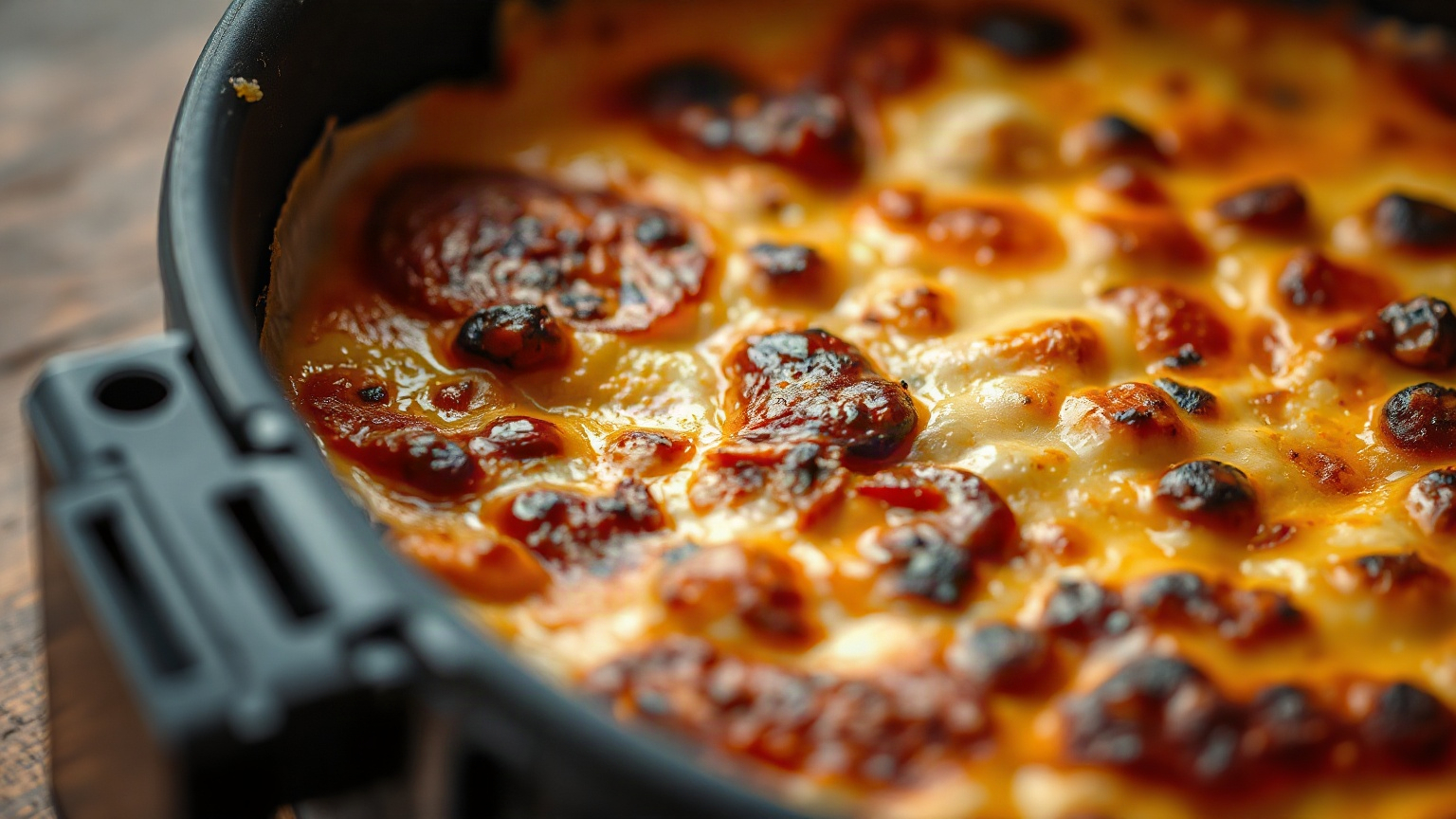
The forced air in an air fryer will brown the top of your casserole fast. Too fast, if it’s still frozen solid underneath. I cover the dish loosely with aluminum foil for roughly the first half of cook time, then remove it to let the top crisp up. This one step prevents a lot of frustration. Cheese casseroles especially — they’ll go from perfectly browned to charred in about four minutes if you’re not watching.
Step 3: Check the center temperature
Per USDA food safety guidelines, casseroles with meat, eggs, or dairy should reach 165°F internally. I always use an instant-read thermometer — not because I’m paranoid, but because “looks done” has burned me before. Literally. Ate a lukewarm frozen pasta bake once that was still 140°F in the middle. It wasn’t fun.
If the top’s browning fast but the center’s still cold, cover it back up with foil, drop the temp by 10–15°F, and give it more time. Low and slow is better than hot and raw.
Step 4: Rest before serving
Let the casserole sit for 5 minutes after it comes out. The center will continue to cook slightly, and the whole thing will hold together better when you cut into it. Skipping this step is fine if you like scalding your mouth and watching it fall apart on the plate. Your call.
Variables That Change the Timing
The formula is a starting point, not a guarantee. A few things that actually affect how long it takes:
Dish thickness and depth
A 2-inch-deep casserole takes longer than a shallow one. Obviously. But it’s easy to forget that when you’re following a package time written for a conventional oven. If your casserole is unusually deep — think a thick shepherd’s pie or a dense enchilada bake — add 15–20% more time beyond the formula and check early.
Your specific air fryer model
Some air fryers run hot. I’ve had models that were clearly 25°F above their stated temperature — you could tell by how fast things browned. If you’re getting scorching tops consistently, try dropping the temp an additional 15–25°F rather than fussing with foil the whole time. An oven thermometer inside the air fryer during preheat will tell you exactly what you’re dealing with. This is covered a bit more in the context of reheating food in a toaster oven, where the same temperature inconsistency comes up.
Whether it’s thawed or fully frozen
If you’ve let the casserole thaw in the fridge overnight, cut the cook time closer to 30–35% less than the oven time — not just 20–25%. A fully frozen casserole needs closer to the standard 20–25% reduction. Partially thawed is the trickiest because the outer edges may be nearly room temp while the center is still a solid block of ice. If that’s the situation, I’d lean toward covering with foil the entire first two-thirds of cooking.
A Few Specific Casserole Types and How They Behave
Not all casseroles are the same. Here’s what I’ve noticed with common ones.
Lasagna: Dense, needs time. Stick to the full 20% time reduction and don’t rush it. The foil technique is non-negotiable here or the top layer of cheese will burn. Serious Eats has a good breakdown of lasagna layering if you’re making one from scratch — same thermal logic applies when you freeze and reheat it.
Chicken and rice casseroles: These cook faster because the rice has already absorbed liquid. Watch them closely after the 25-minute mark.
Green bean casserole: The crispy topping will absolutely burn. Cover it until the last 5–7 minutes, then uncover and watch it like a hawk.
Mac and cheese: Usually fine with the standard formula, but if there’s a breadcrumb topping, treat it like the green bean situation above.
For the dish itself, I’d suggest having a dedicated toaster oven baking pan set in a smaller size — it makes this whole process much easier than trying to cram a full-size casserole dish into a compact air fryer.
Wrapping Up
The conversion isn’t magic — it’s just accounting for the fact that air fryers cook faster and brown more aggressively than a standard oven. Subtract 25°F, multiply time by 0.75, cover with foil for the first half, and check the center with a thermometer before you call it done. That’s genuinely it. Once you’ve done it a few times, you’ll stop needing the formula and just start adjusting by instinct. But until then, the table above is your friend.
The biggest thing I’d tell someone brand new to this: don’t trust the timer alone. Oven packaging times are written for a specific conventional oven at sea level. Your air fryer, your dish, your altitude — it’s all slightly different. Use the thermometer. It takes five seconds and it will save you from a lot of disappointment.
Frequently Asked Questions
How do I convert oven bake time to air fryer time for a frozen casserole?
Reduce the oven temperature by 25°F and multiply the oven cook time by 0.75 to get your air fryer starting point. So a casserole that bakes at 375°F for 40 minutes would go into the air fryer at 350°F for about 30 minutes — then you check the center with a thermometer and add time if needed. Always cover with foil for the first half to prevent the top from overbrowning before the interior is heated through.
Can you cook a frozen casserole in an air fryer without thawing it first?
Yes, you can cook a frozen casserole directly from frozen in the air fryer — no thawing required. Use the standard conversion formula (minus 25°F, times 0.75 on time) and expect it to take slightly longer than a thawed version. Cover with foil for at least the first half of cooking, and verify the center hits 165°F before serving.
What temperature do you cook a frozen casserole in an air fryer?
Most frozen casseroles cook well between 325°F and 375°F in an air fryer, depending on what the original oven recipe calls for. Take the oven temperature from the package directions, subtract 25°F, and that’s where to set your air fryer. For thick, dense casseroles like lasagna, staying on the lower end of that range and covering with foil helps the center cook through without burning the top.
How long does a frozen casserole take in an air fryer?
A frozen casserole typically takes 25–45 minutes in an air fryer, depending on thickness and starting temperature. Use the 75% rule: multiply the original oven time by 0.75 and start checking there. A shallow chicken casserole might be done in 28 minutes while a deep frozen lasagna could take 40–45 minutes — so a thermometer reading of 165°F at the center is the only reliable indicator.
Does the air fryer conversion formula work for store-bought frozen casseroles?
Yes, the same minus-25°F and 75%-of-time formula applies to store-bought frozen casseroles, not just homemade ones. The packaging instructions are written for conventional ovens, so the adjustment is the same regardless of who made it. Just be aware that some store-bought casseroles are in packaging not suitable for air fryers — if the dish is plastic or has a cardboard bottom, transfer the contents to an oven-safe pan first.
—
Written by
Emma founded Toastera to turn vague appliance advice into clear, researched, safety-first guidance on toasters and toaster ovens.
Free: the Toaster Oven Cheat Sheet
Get the printable cheat sheet (temps, cook times & safety tips) plus new recipes. No spam, unsubscribe anytime.