To convert an air fryer recipe to a toaster oven, raise the temperature by 25°F and increase the cook time by roughly 20–25%. Air fryers circulate heat so aggressively that food cooks faster than in a conventional toaster oven, even one with a convection fan. Once you understand that gap, the conversion becomes pretty mechanical.
Safety First: Toaster ovens run hot — some models hit 450°F or higher — and the exterior walls, rack, and pan can cause serious burns. Always use oven mitts rated for high heat when removing pans or adjusting racks mid-cook, and never leave food unattended when cooking at high temperatures, especially anything with a lot of fat or oil that could splatter onto the heating elements and ignite.
Quick Facts Before You Start
- Air fryers cook roughly 20–30% faster than toaster ovens because of their intense, compact airflow.
- Standard conversion: add 25°F to the air fryer temp, then add 20–25% more time.
- Convection toaster ovens close the gap — if yours has a convection setting, use it and only add about 10–15% more time instead.
- Thin, fast-cooking items (fries, fish fillets) need less time adjustment than dense foods (chicken thighs, meatballs).
- Always check for doneness a few minutes early on your first attempt. You can add time; you can’t un-burn food.
I’ve spent a lot of time testing toaster ovens — you can get a sense of how they handle heat from my piece on how hot a toaster gets — and the number one question I get from readers is some version of “my air fryer recipe came out raw” or “my food was burnt.” Almost every time, it’s a conversion issue. So let’s just fix that properly.
Why Air Fryers and Toaster Ovens Cook So Differently
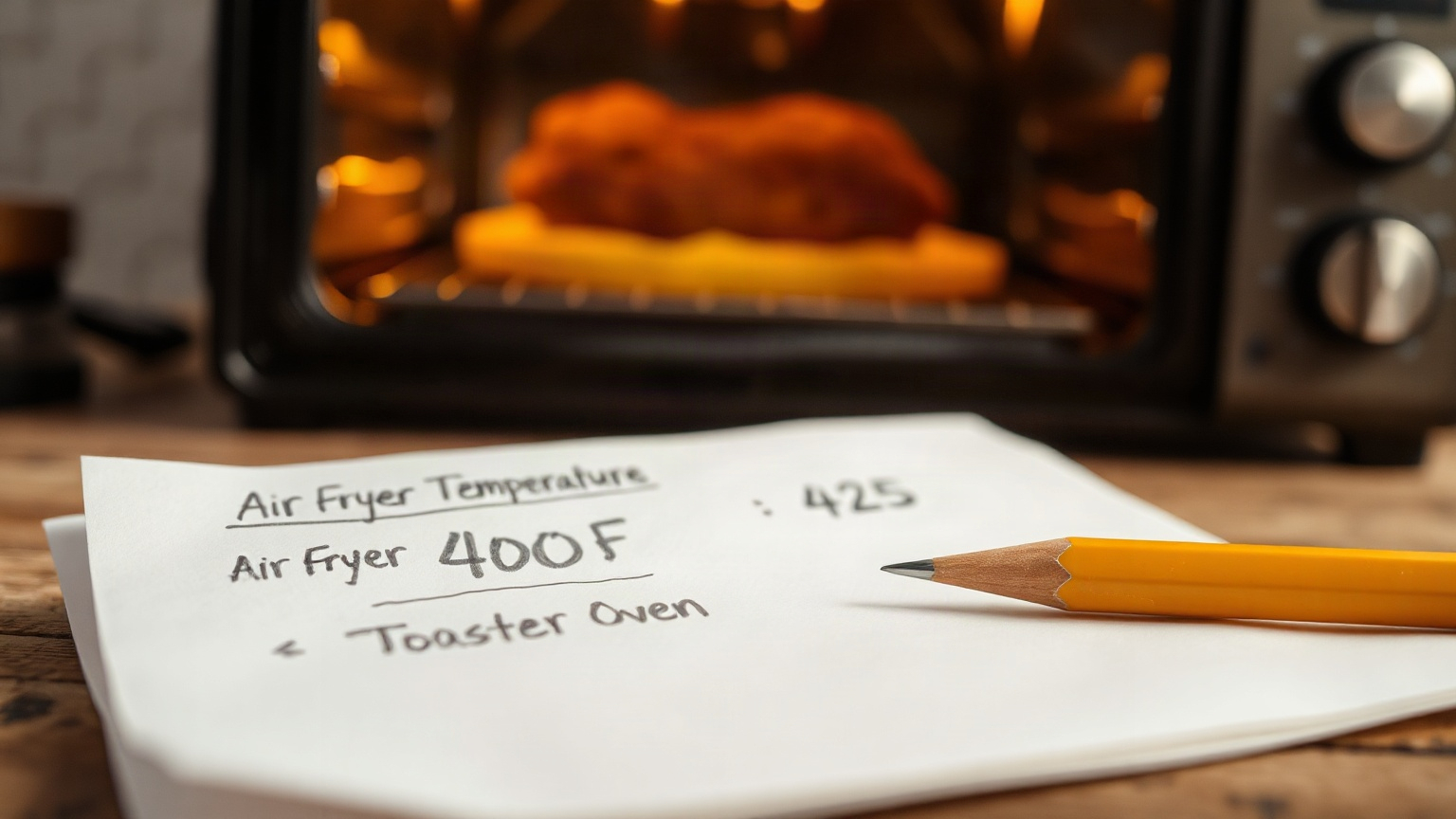
It’s not just marketing. Air fryers really do cook differently, and the reason is physical. A typical air fryer has a tiny cooking chamber — often less than 5 quarts — with a fan blasting superheated air directly at your food from centimeters away. That constant, close-range airflow strips moisture fast and browns things quickly. Chicken wings that take 22 minutes in a countertop air fryer? Plan on 30–35 in a toaster oven, even with convection running.
Toaster ovens have a larger interior. More space means the hot air has farther to travel and more room to cool before it hits your food. That’s not a flaw — it actually gives you more control and more even browning on larger batches — but it does mean the raw timing from an air fryer recipe will leave you with undercooked food if you follow it blindly.
The first time I tried making frozen spring rolls using the air fryer directions on the box in my toaster oven, I followed them exactly. They were warm in the middle and pale on the outside. That was the moment I started actually paying attention to this stuff.
The Exact Conversion Formula
Temperature Adjustment
Add 25°F (about 15°C) to whatever the air fryer recipe calls for. If the recipe says 375°F, set your toaster oven to 400°F. That’s it for the temperature side. Don’t overthink it.
If you’re using the convection setting on your toaster oven, you can sometimes skip this step or just add 10–15°F instead, since convection already helps compensate for the lack of intense airflow. Personally I still bump it up a bit regardless, because most home toaster ovens don’t circulate air as efficiently as they claim on the box.
Time Adjustment
Multiply the air fryer cook time by 1.25. So a 20-minute air fryer recipe becomes 25 minutes in the toaster oven. For convection mode, multiply by 1.15 instead — closer to 23 minutes in that example.
But here’s where it gets a little nuanced. Dense foods — bone-in chicken, thick pork chops, anything over an inch thick — lean toward the higher end of that range or even beyond. Thin stuff like sliced zucchini, frozen fries, or shrimp? They’re usually fine with just a 15–20% time bump. The formula is a starting point, not a guarantee.
Check early. That’s the only real advice that matters at the end of the day.
Conversion Table: Common Air Fryer Temps and Times vs. Toaster Oven
| Food | Air Fryer Temp / Time | Toaster Oven (Standard) | Toaster Oven (Convection) |
|---|---|---|---|
| Frozen french fries | 400°F / 15 min | 425°F / 20 min | 415°F / 17 min |
| Chicken wings | 375°F / 22 min | 400°F / 28–30 min | 400°F / 25 min |
| Salmon fillet | 390°F / 10 min | 415°F / 13–14 min | 415°F / 12 min |
| Frozen spring rolls | 380°F / 12 min | 400°F / 16 min | 400°F / 14 min |
| Chicken thighs (bone-in) | 380°F / 25 min | 400°F / 32–35 min | 400°F / 28–30 min |
| Mozzarella sticks | 360°F / 8 min | 385°F / 11 min | 385°F / 9–10 min |
| Roasted broccoli | 375°F / 10 min | 400°F / 13–14 min | 400°F / 12 min |
These are my tested starting points. Your specific toaster oven model will have quirks — some run hot, some run cool. Once you’ve cooked something once, jot down what worked. I keep a sticky note inside one of my cabinet doors. Low-tech, but it’s saved me more than a few burnt dinners.
Equipment Adjustments That Actually Matter
Use a Wire Rack When You Can
One reason air fryers brown so well is airflow underneath the food. Most air fryer baskets are perforated — hot air hits the bottom of your food, not just the top. If you put food flat on a solid pan in your toaster oven, you lose that. The bottom ends up steaming while the top browns. Use an elevated toaster oven wire rack set over a baking sheet when possible. It makes a real difference, especially for anything breaded.
Pan Choice Changes Things
Dark pans absorb more heat and speed up browning on the bottom. Light aluminum pans reflect more heat and cook more gently. For most air fryer conversions — things that were originally meant to get crispy fast — I lean toward a dark, nonstick toaster oven baking pan. It compensates a little for the slower heat transfer compared to an air fryer basket.
Don’t Overcrowd
Air fryer recipes are sized for small baskets. A recipe that serves two in an air fryer might look underwhelming spread across a toaster oven tray, but resist the urge to pile things up. Crowding traps steam and you’ll end up with the exact opposite of crispy. Single layer. Always. If you’re making more food, cook in batches.
Foods That Don’t Convert Perfectly (And What to Do)
Some foods are just really optimized for an air fryer’s cooking environment, and no conversion fully replicates the result. Frozen onion rings are a good example. They come out genuinely crispy in an air fryer and only okay in a toaster oven — acceptable, not remarkable. Same goes for anything that relies on a very dry, crunchy exterior: the intense close-range airflow of an air fryer is hard to replicate.
My workaround for things like this is to give them a light spritz of cooking spray before they go in the toaster oven. It encourages surface browning without adding much at all in terms of actual grease or flavor change. Also, flipping halfway is non-negotiable for these types of items. Air fryers expose the food to airflow on all sides simultaneously; a toaster oven doesn’t, so you have to compensate manually.
For reheating food in a toaster oven, the same basic principle applies — you want a little elevation, not too much moisture trapped, and slightly higher heat than you’d think.
Serious Eats has a solid breakdown of how convection heat works if you want to go deeper on the physics: their toaster oven guide explains why airflow matters so much in a way that’s genuinely worth reading.
A Practical First-Try Checklist
If you’re converting a recipe for the first time, run through this before you start:
- Add 25°F to the air fryer temperature (or 10–15°F if using convection mode).
- Multiply the cook time by 1.25 (or 1.15 for convection).
- Set a timer to check 3–5 minutes before your estimated done time.
- Use a wire rack over a pan if the food should be crispy.
- Flip or rotate halfway through for anything that needs even browning.
- Use a meat thermometer for proteins — visual doneness is unreliable, especially in a toaster oven where the top can look done while the center isn’t. The USDA recommends chicken reach 165°F internal temperature.
And if you’re still shopping for a toaster oven that handles this kind of cooking well, my roundup of the best mini toaster ovens covers models with solid convection performance at different price points.
The Bottom Line
The formula is simple: 25°F higher, 25% more time. That covers about 80% of conversions without any drama. Convection closes that gap a bit — if your toaster oven has it, use it. And for anything dense or protein-heavy, use a thermometer instead of relying on time alone.
Once you’ve done a handful of conversions, you stop needing to calculate anything. You just know. The first few require a little attention, but it becomes second nature fast. And honestly, a toaster oven gives you more control over the final result than most air fryers do, once you learn to work with it.
Frequently Asked Questions
How do I convert air fryer temperature to toaster oven temperature?
Add 25°F to the temperature listed in the air fryer recipe. If the recipe calls for 375°F, set your toaster oven to 400°F. If you’re using a convection toaster oven, you can get away with adding just 10–15°F since the fan helps compensate for the slower airflow.
How much longer does a toaster oven take compared to an air fryer?
Expect roughly 20–25% more time in a standard toaster oven, or 10–15% more if you’re using convection mode. A 20-minute air fryer recipe becomes about 25 minutes in a toaster oven without convection. Dense foods like bone-in chicken sometimes need even more — check with a thermometer to be sure.
Can a toaster oven replace an air fryer?
For most everyday cooking, yes — especially if your toaster oven has a convection setting. Results for some items (onion rings, certain breaded foods) won’t be quite as crispy, but the gap is smaller than most people expect. Using a wire rack over a baking pan helps close it further by allowing airflow under the food.
Why does food come out soggy in a toaster oven when the air fryer recipe worked fine?
Usually it’s one of two things: the food is sitting flat on a solid pan with no airflow underneath, or the oven is overcrowded and steam is getting trapped. Use a rack, cook in a single layer, and give food enough space between pieces. A light spray of cooking oil on the surface also helps with browning and crispiness.
Do I need to preheat my toaster oven when converting an air fryer recipe?
Yes, and it matters more than people realize. Air fryers preheat in under two minutes; toaster ovens typically take 8–12 minutes to fully stabilize at temperature. Putting food into a cold or partially heated toaster oven throws off the timing and leads to uneven cooking. Always preheat fully before the food goes in.

Written by
Emma founded Toastera to turn vague appliance advice into clear, researched, safety-first guidance on toasters and toaster ovens.
Free: the Toaster Oven Cheat Sheet
Get the printable cheat sheet (temps, cook times & safety tips) plus new recipes. No spam, unsubscribe anytime.