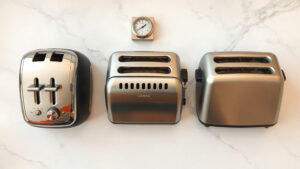
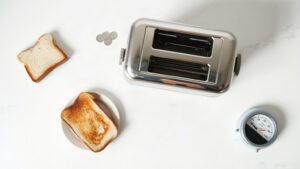
A standard 2-slice toaster uses between 700 and 1,000 watts, while a 4-slice toaster typically runs between 1,200 and 1,800 watts. The bigger model draws more power per cycle, but because both toast bread in roughly the same amount of time, the 4-slice version costs about twice as much per use. If you’re only toasting two slices a day, you’ll spend noticeably less running the smaller unit over a full year.
Safety First: Toasters draw significant current through their heating elements — never operate one near water, never insert metal objects to retrieve stuck bread, and always unplug the unit before cleaning the crumb tray. If your toaster trips a circuit breaker or smells like burning plastic (not just toast), stop using it immediately and don’t plug it back in until you’ve inspected the cord and plug for damage.
Quick Facts: 2-Slice vs 4-Slice Toaster Wattage
- Most 2-slice toasters run at 750–1,000 watts; most 4-slice models run at 1,200–1,800 watts.
- A single toast cycle takes roughly 2–4 minutes on either size, so the difference in daily cost is almost entirely about wattage, not time.
- Running a 1,500-watt 4-slice toaster twice a day adds up to roughly $10–$15 more per year than a 900-watt 2-slice model (at average U.S. electricity rates around $0.16/kWh).
- If you regularly fill all four slots, the cost-per-slice actually favors the 4-slice toaster — you’re toasting more bread for only a little more electricity.
- Standby power (when plugged in but not running) is negligible on basic toasters — typically less than 1 watt.
What These Numbers Actually Mean in Real Life
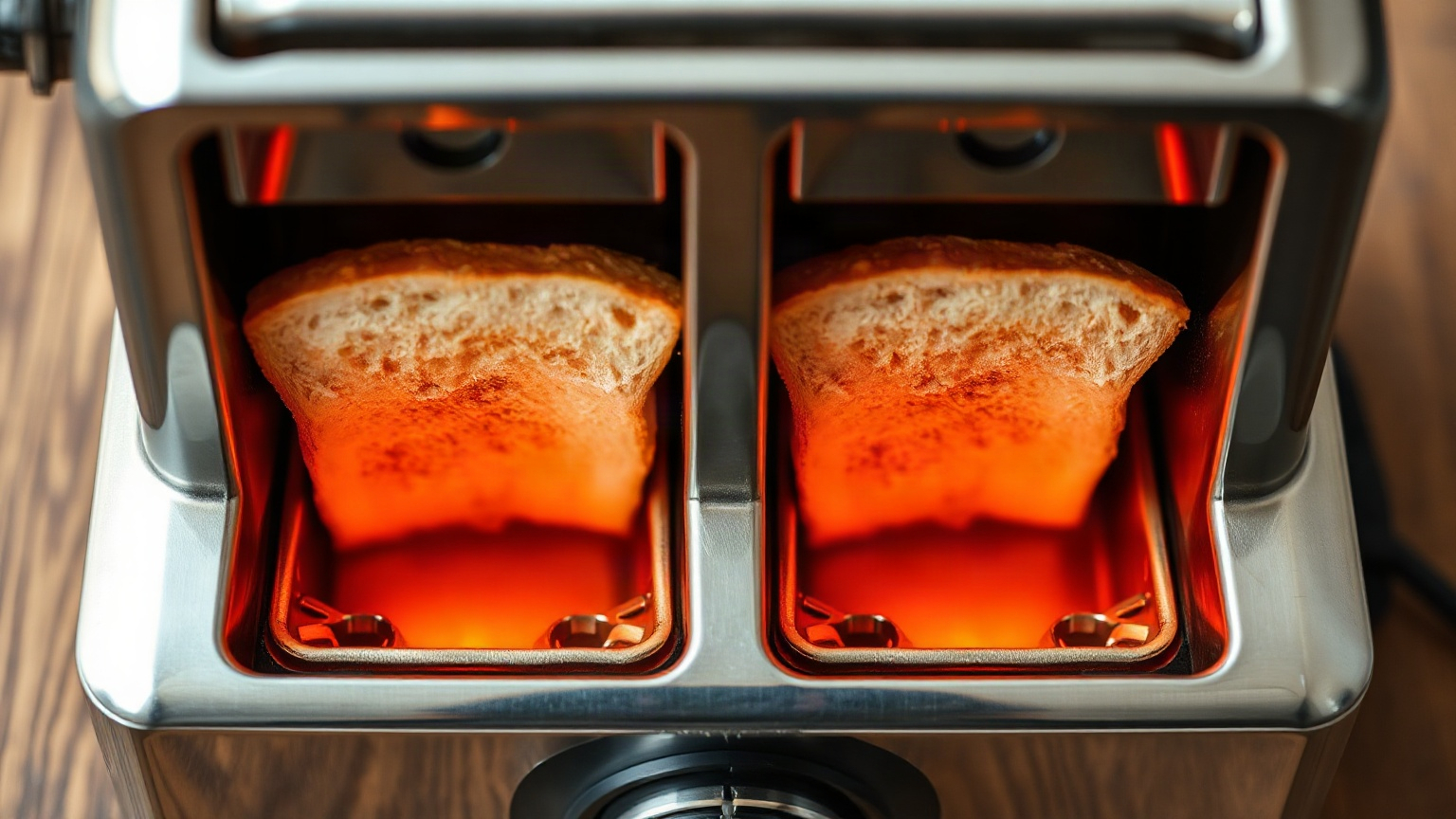
I’ll be honest — when I first started tracking my kitchen appliance usage, I expected toasters to be one of the bigger offenders. They’re loud, they glow orange inside, and that 1,500-watt figure on a 4-slice model sounds alarming. But toasters run for such a short burst that the real-world cost is almost laughably small. We’re talking fractions of a cent per cycle.
Here’s the math I actually ran. My 4-slice Hamilton Beach runs at about 1,400 watts. A typical toast cycle for me — level 4 on the dial, which gives a medium-brown result without the bread getting dry — takes about 3 minutes. That’s 0.07 kWh per cycle. At $0.16/kWh, that’s roughly $0.011 per use. Eleven-hundredths of a cent. My old 2-slice Cuisinart drew 850 watts and took the same 3 minutes, so about $0.0068 per cycle. The daily difference, if I toast twice a day, is under half a cent.
Over a full year, that gap is maybe $1.50 to $3.00. Not nothing, but also not the thing to lose sleep over.
Wattage Comparison: Popular 2-Slice and 4-Slice Toasters
To give this some grounding, here are real models and their rated wattages. I’ve personally used or tested most of these in my kitchen over the past couple of years.
| Model | Slots | Rated Wattage | Price Tier | Notes |
|---|---|---|---|---|
| Cuisinart CPT-122 | 2-slice | 850W | Budget | Reliable, no frills, compact footprint |
| Breville BTA720XL | 2-slice | 1,800W | Premium | High wattage toasts faster; worth it if you’re impatient |
| Hamilton Beach 22502 | 4-slice | 1,400W | Budget | My current everyday toaster; solid value |
| Cuisinart CPT-180 | 4-slice | 1,800W | Mid-range | Even toasting, good slot width for thick bread |
| KitchenAid KMT4116 | 4-slice | 1,800W | Premium | Heavy, looks great, toasts evenly top to bottom |
| BLACK+DECKER TR3500SD | 4-slice | 1,500W | Budget | Fine for basic use, runs a bit hot on higher settings |
One thing that surprised me: some 2-slice models pull more wattage than budget 4-slice ones. The Breville 2-slice at 1,800W is a good example. Premium toasters often use higher wattage to toast faster, not because they’re less efficient. So “2-slice = lower wattage” isn’t always the rule.
When the 4-Slice Toaster Is Actually the More Efficient Choice
This is the part most wattage comparisons skip. Efficiency isn’t just about raw power draw — it’s about cost per output.
If You’re Feeding a Household of Four
Say you need to toast four slices for breakfast. With a 2-slice toaster, you run two separate cycles. That’s 2 × 3 minutes at 900W = 0.09 kWh. A 4-slice model at 1,400W does all four slices in one 3-minute cycle: 0.07 kWh. The 4-slice actually uses less electricity to toast the same amount of bread. And nobody’s standing around waiting for the second batch. That part matters more to me than the electricity cost, honestly.
If You Only Toast One or Two Slices Per Day
A 2-slice toaster wins here. You’d be running a 4-slice unit at full wattage to toast half its capacity. It’s not a dramatic difference, but over time, running the smaller appliance for your actual needs is the smarter call. I lived alone for three years with a 2-slice and never once wished for more slots.
If you’re curious how toaster heating elements actually behave — how hot they get and why the wattage doesn’t tell the whole story — I wrote about how hot a toaster gets and it goes deeper on the physics of it.
The Real-World Annual Cost: Running the Numbers
I ran these calculations using the U.S. Energy Information Administration’s average residential electricity rate, which hovers around $0.16 per kWh as of recent years. Your rate may differ — check your utility bill, because rates in California or New England can push $0.25–$0.30/kWh, which changes the math somewhat.
Assumptions: two toast cycles per day, 3 minutes per cycle, 365 days.
- 900W 2-slice toaster: ~$1.58 per year
- 1,400W 4-slice toaster: ~$2.46 per year
- 1,800W 4-slice toaster: ~$3.15 per year
Yes. Those numbers are that small. The whole “which toaster costs less to run” question matters a lot less than I expected when I first started testing these things. The bigger financial factor is whether a cheap toaster dies in 18 months and you replace it, versus a well-built model lasting a decade.
If you want to cut kitchen electricity costs in a meaningful way, look at your toaster oven usage instead. Those run at 1,200–1,800 watts for 20–30 minute sessions, not 3-minute bursts. Reheating food in a toaster oven is efficient compared to a full oven, but it’s still a bigger draw than your pop-up toaster by a wide margin.
Specific Model Recommendations: Which One Should You Buy?
Since we’re already comparing, let me give you an actual answer instead of a shrug.
Best Budget 2-Slice: Cuisinart CPT-122
It’s 850 watts, it works, it fits in tight spaces, and it doesn’t cost much. I used one for two years. The browning can be slightly uneven on the edges of wider slices, but for everyday sandwich bread it’s fine. Check current pricing for the Cuisinart CPT-122.
Best Mid-Range 4-Slice: Hamilton Beach 22502
This is what’s sitting on my counter right now. At 1,400 watts, it’s not pulling max power like the premium units, and the toast comes out consistent across all four slots. The slot width is decent for most artisan bread. My one gripe: the shade control markings are vague, and I’ve slightly overcooked toast on setting 5 more than once. Settle on 3 or 4 and you’ll be fine. See the Hamilton Beach 4-slice toaster on Amazon.
Best Premium 2-Slice: Breville BTA720XL
Yes, it’s 1,800 watts — same as many 4-slice models. But it toasts fast and evenly, and the “A Bit More” button is one of those small features I didn’t know I wanted until I had it. Worth the premium if toast quality matters to you daily. Browse the Breville BTA720XL on Amazon.
My Clear Pick
For a single person or a couple: 2-slice, full stop. You’ll barely notice the electricity savings, but the counter space savings are real and the price difference usually buys you a better-built unit in the same budget. For a family of three or more: get the 4-slice. Running two cycles every morning is annoying, the second batch always gets cold, and the electricity difference is genuinely negligible. The Hamilton Beach at mid-range or the KitchenAid if you want something that’ll last 10 years.
And if you’re in a small apartment or tight on counter space, check out the best mini toaster ovens — some of those can toast bread and handle everything else, which makes the whole 2-vs-4-slice question moot.
The Bottom Line
The wattage gap between a 2-slice and 4-slice toaster is real — roughly 500–900 watts difference — but the actual daily cost difference is under a cent for most people. Don’t let that number drive your buying decision. What should drive it is how many slices you actually need per morning, how much counter space you have, and whether you want a toaster that’ll still work properly in five years.
If you’re filling all four slots, the 4-slice wins on efficiency per slice. If you’re making two pieces of toast and calling it a day, the 2-slice is the sensible pick. Either way, the annual electricity cost is going to be somewhere between the price of a large coffee and a cheap paperback. That’s not the hill to optimize on.
Buy the one that fits your household. Keep it clean. And if you’re on the fence about toast quality versus energy use, know that the heating element design matters a lot more to your results than the wattage number on the box.
Frequently Asked Questions
How many watts does a 2-slice toaster use?
Most 2-slice toasters draw between 700 and 1,000 watts, though premium models like the Breville BTA720XL can reach 1,800 watts for faster toasting. The average for a basic, reliable 2-slice model sits around 850–950 watts. Higher wattage on a 2-slice usually means faster toast time, not worse efficiency.
How many watts does a 4-slice toaster use?
A 4-slice toaster typically uses 1,200 to 1,800 watts. Budget models like the Hamilton Beach 22502 tend to be at the lower end around 1,400W, while mid-range and premium models often max out at 1,800W. The higher wattage in 4-slice models isn’t waste — it’s heating more slots simultaneously.
Does a 4-slice toaster cost more to run than a 2-slice toaster?
Yes, but the difference is tiny — typically less than $2 per year at average U.S. electricity rates if you’re toasting twice daily. If you regularly toast four slices at once versus running two separate cycles on a 2-slice toaster, the 4-slice can actually be cheaper per slice because it handles more bread in one cycle.
Is it more energy-efficient to use a toaster or a toaster oven to toast bread?
A pop-up toaster is more efficient for toasting bread. It runs at high wattage for just 2–4 minutes, whereas a toaster oven takes longer to preheat and runs for more minutes overall, using more electricity per slice. For plain toast, stick to the pop-up toaster — save the toaster oven for jobs it actually handles better, like bagels, open-faced sandwiches, or anything that needs top-down browning.
Should I unplug my toaster when I’m not using it?
Unplugging saves a negligible amount of electricity — basic toasters draw less than 1 watt on standby. The better reason to unplug is safety: toasters can be a fire risk if crumbs accumulate near the heating element and the unit gets bumped or left near a heat source. Unplugging and cleaning the crumb tray regularly is a better habit than worrying about phantom power draw.

Written by
Emma founded Toastera to turn vague appliance advice into clear, researched, safety-first guidance on toasters and toaster ovens.
Free: the Toaster Oven Cheat Sheet
Get the printable cheat sheet (temps, cook times & safety tips) plus new recipes. No spam, unsubscribe anytime.