No, you should not leave a toaster oven on when you leave the house. Toaster ovens reach internal temperatures between 300°F and 500°F, and their heating elements can ignite nearby crumbs, grease buildup, or even a carelessly placed dish towel. An unattended toaster oven is one of the leading causes of kitchen fires in American homes — the U.S. Fire Administration estimates cooking equipment starts roughly 49% of all home fires, and countertop appliances are a significant slice of that.
Safety First: Never leave a toaster oven running in an empty house or unattended room. Heating elements can reach 500°F and will ignite crumbs, grease, paper, or nearby flammable materials without warning. If your toaster oven lacks an automatic shutoff timer, treat it the same as an open flame on a stovetop — someone needs to be home and aware. Unplug it when it’s not actively in use.
Quick Facts Before We Get Into It
- Toaster ovens operate between 200°F and 500°F depending on the setting — hot enough to start a fire from accumulated crumbs alone.
- Most toaster ovens do NOT have automatic shutoff unless you specifically use the built-in timer and the model is designed to cut power when it ends (many don’t — they just stop the timer and keep heating).
- Roughly 50% of people never unplug their toaster oven between uses, according to informal polling on home appliance forums — and most of them have never thought twice about it.
- Even a plugged-in but “off” toaster oven presents a lower but non-zero risk due to electrical faults and standby power draw.
- The safest habit: turn it off, let it cool, then unplug it every single time you’re done cooking.
What Actually Happens Inside a Toaster Oven When It’s Running
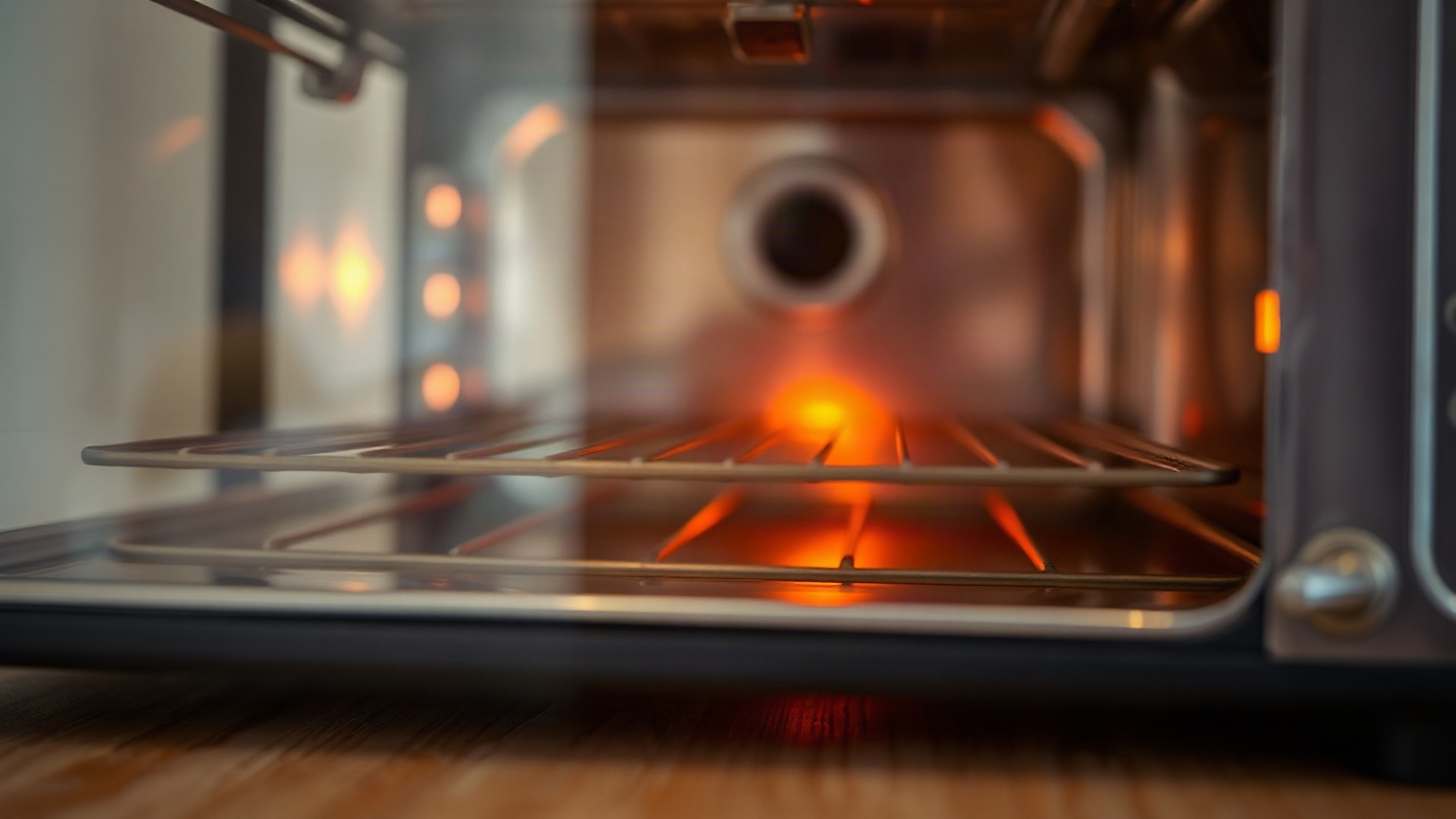
I’ll be honest — I didn’t fully appreciate how hot these things get until I started paying attention. The first time I used my Breville Smart Oven on the convection roast setting, I absentmindedly left a paper napkin on top of the unit. It didn’t catch fire, but it was noticeably scorched within about eight minutes. That was a wake-up call.
A toaster oven’s heating elements — usually nichrome wire or quartz rods — glow red when active. They’re cycling on and off to maintain your set temperature, but at peak, they’re operating well above that target. If you set the oven to 350°F, the element itself is significantly hotter than that. The outer casing gets hot too. Not “burn you instantly” hot, but hot enough that you should never store anything on top or immediately beside it.
You can read more about the actual temperatures these appliances reach in our piece on how hot a toaster gets — the numbers might surprise you.
The Crumb Tray Problem Nobody Talks About Enough
Here’s the thing most fire safety articles gloss over: it’s rarely the heating element alone that causes a fire. It’s crumbs. And grease. Both of which accumulate in the bottom of your toaster oven faster than you’d expect, especially if you’re cooking anything with cheese, oil, or breading. A crumb tray that hasn’t been cleaned in a few weeks can hold enough combustible material to actually ignite — slowly, and then suddenly.
I make it a habit to pull and wipe my crumb tray every three or four uses. It takes about 45 seconds. The difference in what comes out is honestly alarming if you’ve been skipping it.
Does “Off” Actually Mean Off? The Timer Confusion
This is where a lot of people get tripped up, myself included early on. Many toaster ovens have a mechanical or digital timer that you set for your cook time. When the timer runs out, you hear the ding. Job done, right?
Not always. Some models — particularly older analog ones — use the timer to trigger the heating cycle but then hold the temperature setting. The dial is still pointed at “350°F.” The element can cycle back on. I’ve tested this with an infrared thermometer on an older Hamilton Beach model, and yes, the interior crept back up to around 180°F about four minutes after the timer went off because the temperature knob was still in the “bake” position.
Newer, more sophisticated models like the Breville Smart Oven Air Fryer or the Cuisinart TOA-70 do cut power completely when the cooking cycle ends — but you should verify that for your specific unit. Check the manual, or just use an infrared thermometer to see if the interior temperature drops steadily after the timer ends. If it plateaus or creeps back up, your oven is still active.
Toaster Oven Temperature and Risk Comparison
Different cooking modes carry different risk profiles. Here’s a rough breakdown of what you’re dealing with:
| Cooking Mode | Typical Temp Range | Risk Level If Unattended | Notes |
|---|---|---|---|
| Toast | 300°F – 450°F | High | Short cycle but rapid heat spike; crumbs ignite easily |
| Bake | 325°F – 450°F | High | Sustained heat, grease splatter risk with fatty foods |
| Broil | 450°F – 500°F | Very High | Element stays on continuously; highest fire risk |
| Convection Roast | 350°F – 450°F | High | Fan circulates heat; can dry out and ignite food residue |
| Warm/Keep Warm | 150°F – 200°F | Moderate | Lower risk, but still not safe to leave unattended for hours |
| Air Fry | 350°F – 425°F | High | Oil mist from food can coat interior and build up over time |
Broil mode is the one that worries me most. The element never cycles off — it’s on at full power the entire time. Leaving the house with a broil cycle running would be genuinely reckless.
The Edge Case Everyone Ignores: What About Just Leaving It Plugged In?
Most fire safety content focuses on leaving a running toaster oven unattended. Fair enough. But there’s a separate question: is it safe to leave a toaster oven plugged in when you’re not home, even if it’s switched off?
Technically, a switched-off appliance draws very little standby power and poses minimal fire risk — assuming perfect conditions. But toaster ovens aren’t always in perfect condition. Worn power cords, frayed internal wiring, a faulty thermostat stuck in the “on” position — these are real failure modes, especially in older units or cheaper models. Electrical faults don’t announce themselves. They just happen.
My personal rule: I unplug it. Every time. It takes two seconds and it removes any possibility of an electrical fault causing a problem while I’m out. Some people find this fussy. I find it easy.
What About Smart Plugs?
A few readers have asked me whether using a smart plug (the kind you can shut off remotely from your phone) is a valid workaround. And yes, actually — it’s a decent safety net if you forgot to turn something off and you’re already down the street. But it’s not a replacement for good habits. A smart plug cuts power to the appliance, but if the heating element is already hot when you cut the power, the residual heat is still there. Use it as a backup, not a primary strategy.
Also: if you’re frequently relying on a smart plug to shut off your toaster oven remotely, that’s a sign your workflow needs adjusting. Forgetting once is human. Depending on it is a different thing.
Practical Habits That Actually Reduce Risk
I’m not here to scare you out of using your toaster oven. It’s one of the most useful appliances in my kitchen — I use it almost daily for everything from reheating leftovers to roasting small batches of vegetables. If you want ideas on what it can do, our guide on reheating food in a toaster oven is worth a look. But using it safely takes a few deliberate habits.
- Stay in the kitchen while it’s running. Or at least within earshot. You don’t need to stare at it, but you should be able to smell smoke or hear something go wrong.
- Clean the crumb tray regularly — every 3-4 uses if you’re cooking anything greasy or breaded. It’s the single most impactful maintenance habit.
- Use appropriate cookware. A good toaster oven baking pan fits properly and reduces the chance of drips hitting the heating element. Improvising with full-size cookie sheets that don’t fit is a bad idea I’ve made exactly once.
- Keep clearance around the unit. Six inches minimum on the sides, a foot above. Nothing on top. Not a cutting board, not a dish towel, not a bag of bread.
- Unplug when done. Non-negotiable for me.
- Know your model. Read whether your unit has a true auto-shutoff or just a timer. The manual is boring but it has this information.
If you’re looking for a unit that handles safety features well right out of the box, our roundup of the best mini toaster ovens covers several models with auto-shutoff as a built-in feature. It’s worth prioritizing if you’re shopping.
And if you want a good toaster oven wire rack for better airflow and more even cooking, a proper-fitting one makes a real difference — especially for anything you’re cooking on the broil setting where even heat distribution matters.
The U.S. Fire Administration’s cooking fire safety page has solid data on countertop appliance risk if you want the official read on this — it’s not alarmist, just factual.
The Honest Bottom Line
Don’t leave your toaster oven running when you leave the house. That’s the answer and it’s not a close call. Even well-designed models with auto-shutoff timers carry some residual risk — and plenty of people have toaster ovens that don’t have reliable shutoffs at all.
The good news is that toaster oven safety isn’t complicated. It doesn’t require special equipment or a lot of effort. It just requires treating it like the high-heat appliance it actually is, rather than assuming it’s as passive as a microwave. Keep it clean, keep it supervised while it’s on, unplug it when you’re done, and you’re going to be absolutely fine.
The people who end up with problems are almost always the people who got comfortable and stopped paying attention. Don’t be that person. It’s an easy habit to keep.
Frequently Asked Questions
Is it safe to leave a toaster oven on when you leave the house?
No, it’s not safe to leave a toaster oven running in an empty house. Toaster ovens operate at temperatures between 300°F and 500°F, and an unattended unit can ignite accumulated crumbs, grease, or nearby flammable materials without any warning. Even models with timers may continue heating if the temperature dial is still set — always confirm your specific model cuts power completely when the cycle ends.
Is it safe to leave a toaster oven plugged in when not in use?
Leaving a toaster oven plugged in but switched off is lower risk than leaving it running, but it’s still not the safest habit. Aging wiring, faulty thermostats, or internal electrical failures can all occur even in a unit that appears to be off. Unplugging it when you’re done cooking takes seconds and eliminates any possibility of an electrical fault while you’re away.
How hot does a toaster oven get?
Toaster ovens typically reach between 200°F on a warm setting and 500°F at full broil. The heating elements themselves operate at temperatures above the set dial temperature during their active cycle. The exterior of the unit gets hot enough to scorch materials placed against or on top of it, which is why clearance space around the appliance matters.
Do toaster ovens turn off automatically?
Some toaster ovens do shut off automatically when a timer cycle ends, but not all of them — and this varies significantly by model. Many analog toaster ovens with a mechanical timer will ding when time is up but remain in a heating mode if the temperature knob is still set. Check your model’s manual to confirm whether the cooking cycle actually cuts power, or test it with an infrared thermometer to see whether the interior cools down steadily after the timer ends.
What is the most common cause of toaster oven fires?
Accumulated crumbs and grease in the bottom of the unit are the most common cause of toaster oven fires — not the heating element on its own. Food debris builds up over time and can ignite when it reaches combustion temperature during normal cooking. Regular cleaning of the crumb tray every few uses is the single most effective thing you can do to reduce fire risk from a toaster oven.

Written by
Emma founded Toastera to turn vague appliance advice into clear, researched, safety-first guidance on toasters and toaster ovens.
Free: the Toaster Oven Cheat Sheet
Get the printable cheat sheet (temps, cook times & safety tips) plus new recipes. No spam, unsubscribe anytime.