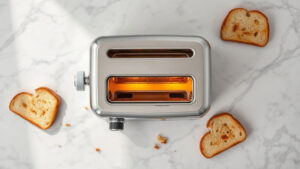
A long-slot toaster won’t fit thick bread slices usually because the slot width — not the slot length — is too narrow. Most standard toasters have slots that are only 1.25 to 1.5 inches wide, while a thick-cut sourdough or brioche loaf can easily run 1.75 to 2 inches. The fix is either a toaster with extra-wide slots (at least 1.5 inches, ideally 1.75 inches) or switching to a toaster oven for anything truly chunky.
Safety First: Never force oversized bread into a toaster slot. If the bread gets stuck against the heating elements, it’s a direct fire hazard. Unplug the toaster before trying to remove any stuck bread, and never use a metal utensil to fish it out while the unit is plugged in — that’s a shock risk, full stop.
Quick Facts
- Standard toaster slots are 1.25–1.5 inches wide. That’s simply not enough for most artisan or Texas toast-style bread.
- Long-slot toasters solve the length problem (fitting baguettes, oblong rolls), but most still share the same narrow width as 2-slice models.
- Extra-wide-slot toasters exist — look for anything advertising 1.5 inches or wider. Some go to 1.75 inches, which handles almost everything short of a full demi-baguette standing upright.
- Forcing bread against a heating element can cause localized scorching or, worse, a small fire. It’s not a theoretical risk — I’ve seen it happen.
- A toaster oven is the real answer for anything over 1.75 inches thick — more flexibility, and you’re not fighting the slot at all.
Why “Long Slot” Doesn’t Actually Mean “Wide Slot”
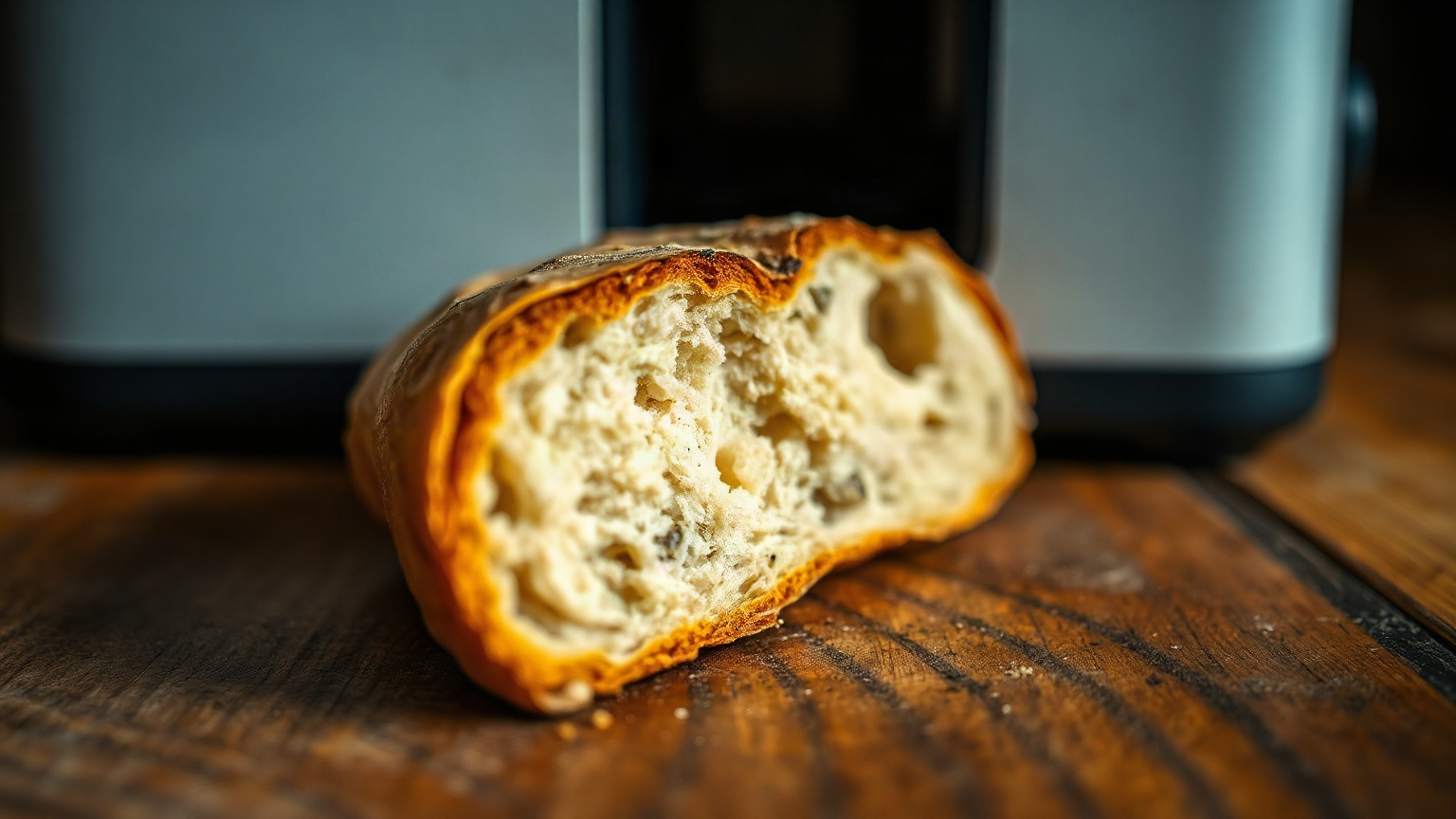
This trips people up constantly. Long-slot toasters are designed to handle longer bread — think a full hoagie roll, a slice of sourdough boule that’s more oval than square, or half a baguette laid sideways. The slot might run 12 inches or more from end to end. But the width of that slot? Often identical to a standard 2-slice toaster that costs $20 at a grocery store.
I made this exact mistake myself. I bought a long-slot 4-slice model specifically for sourdough, proud of myself for thinking it through — and the first loaf I tried to toast was a thick-cut miche from a local bakery that wouldn’t drop more than halfway into the slot. Annoying doesn’t begin to cover it.
Slot width and slot length are completely independent specs. Manufacturers don’t always advertise width clearly, which makes this confusing. So when you’re shopping, you have to check both dimensions explicitly.
What “Thick-Cut” Actually Means in Millimeters
Standard pre-sliced sandwich bread is about 12–13mm thick. “Thick-cut” packaged bread (like Texas Toast) is around 19–22mm. Artisan sourdough sliced at home? Easily 25–35mm if you’re cutting it by hand and being generous. That’s the range where standard toasters fail completely — we’re talking nearly 1.4 inches before you’ve even gotten to a proper brioche slice or a doorstop piece of country white.
The Real Culprits: Why Toaster Slots Are Still So Narrow
Nobody’s standardized toaster slot dimensions. There’s no regulatory body saying a toaster slot must accommodate X thickness of bread. Manufacturers design around the most common use case — bagged sandwich bread — and that’s roughly 12–16mm. That’s your baseline. Everything wider than that is a bonus feature, not a given.
There’s also a physical constraint: the wider the slot, the further apart the heating elements have to be, which means the toaster either gets physically larger or loses toasting efficiency at the center of a thinner slice. It’s a genuine engineering trade-off, not laziness. But it does mean the bread market and the toaster market have diverged quietly over the last 20 years as artisan bread got popular and toaster design mostly didn’t change.
Worth knowing: some budget long-slot toasters advertise “extra wide” in the marketing copy but mean the length is extra wide, not the depth. Read the fine print. If the spec sheet doesn’t list slot width in inches or millimeters, email the manufacturer or just assume it’s standard width until proven otherwise.
How to Actually Measure Your Bread — and Your Toaster Slot
Grab a ruler. Measure the bread at its thickest point, not the middle where it might be a little compressed. Then measure your toaster slot: put the ruler flat across the top of the toaster and measure the slot opening from one inner wall to the other. Simple, but most people never do it before buying a new loaf of sourdough.
My rule of thumb: you want at least 5–6mm of clearance on each side of the bread. So if your bread is 28mm thick, you want a slot that’s at least 38–40mm (roughly 1.5 inches) wide. That clearance matters because bread swells slightly when it heats up, and a tight fit at room temperature becomes a stuck-bread situation at 300°F.
Here’s the part most buying guides miss: the slot width at the bottom of the slot can be narrower than at the top. Some toasters have a slight taper — wider at the opening, pinched at the base near the crumb tray. If you’re getting the bread in but it’s hanging up halfway down, that’s your problem. There’s not much to do about it except get a different toaster or switch to a toaster oven for that particular bread.
Toaster Slot Width Comparison: What to Expect at Each Price Tier
To save you the legwork, here’s how slot width tends to break down across common toaster categories. I’ve tested or handled most of these personally; where I haven’t, I’ve cross-referenced the manufacturer specs.
| Toaster Type | Typical Slot Width | Handles Texas Toast? | Handles 1-inch Artisan? | Price Tier |
|---|---|---|---|---|
| Standard 2-slice (budget) | 1.0–1.25 in (25–32mm) | Barely / No | No | Budget ($15–30) |
| Standard 2-slice (mid-range) | 1.25–1.4 in (32–36mm) | Sometimes | No | Mid ($30–60) |
| Standard long-slot (4-slice) | 1.25–1.5 in (32–38mm) | Usually | Marginal | Mid ($40–80) |
| Extra-wide slot (any config) | 1.5–1.75 in (38–44mm) | Yes | Usually yes | Mid-Premium ($60–120) |
| Toaster oven (countertop) | N/A — open rack | Yes | Yes | Varies ($40–300+) |
The takeaway: if you’re regularly toasting anything thicker than standard Texas Toast, an extra-wide slot toaster or a quality toaster oven is your answer. The standard long-slot toaster only solves one dimension of the problem.
Specific Toaster Models Worth Considering If You Toast Thick Bread
Breville BTA840XL Die-Cast 4-Slice
The Breville BTA840XL has slots that run about 1.5 inches wide — not the widest on the market, but it also has a “Lift and Look” feature that lets you check doneness mid-cycle without canceling the toast. Honestly, that feature alone has saved me from burning more slices than I’d like to admit. It’s a premium-tier toaster, but it handles thick-cut bread reliably. The long-slot version especially suits sourdough boule slices. Check current pricing on Breville long-slot toasters on Amazon.
Cuisinart CPT-180 Metal Classic
Cuisinart’s extra-wide 4-slice models tend to sit around 1.5 inches wide and are consistently honest about it in the specs. Mid-range price, solid build quality for the money. Not exciting, but it works. For most people who just want reliable thick-bread toasting without spending Breville money, this is the practical choice.
When to Skip the Toaster Entirely
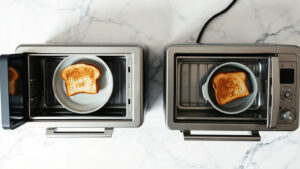
If your bread regularly tops 1.5 inches — think a bakery-cut ciabatta, a thick pain de campagne, or homemade sandwich bread cut on the generous side — just use a toaster oven. Slide the bread on the wire rack, set it to toast at around 375–400°F, and check it at the 4-minute mark. You get even browning on both sides (flip it once halfway), no slot fighting, no stuck bread. The flexibility of a toaster oven for thick items is just hard to argue with.
I keep both on my counter. The toaster for everyday sandwich bread in the morning, the toaster oven for anything artisan or anything I’m reheating with toppings. It’s not wasteful — they’re genuinely different tools. You can find a decent compact toaster oven with a toast function without giving up much counter space.
The Edge Case Nobody Talks About: Bread That Fits Width-Wise but Burns on One Side
Here’s something the “your slot is too narrow” conversation usually skips: sometimes the bread physically fits but toasts unevenly — one side dark, the other pale. This happens when thick bread sits too close to one heating element and too far from the other. It’s a problem specific to thick slices because thinner bread hangs closer to center and gets more balanced heat.
The fix is counterintuitive: go one shade lighter on your browning setting than you think you need, then run it twice. Or use the “bagel” mode if your toaster has one — bagel mode usually runs one side at full power and the other at reduced power, which for thick bread can actually give more even results than standard toast mode. Weird, but it works on some models.
Understanding how hot a toaster gets internally can help explain this: the elements near the center of the slot run hotter than the ambient air, so thick bread that’s touching or near an element on one side will always brown faster on that face. It’s physics, not a defective toaster.
The Bottom Line
Long-slot toasters are great for fitting unusual bread shapes — oblong rolls, baguette halves, those big sourdough slices that overhang a standard slot lengthwise. But they don’t automatically fix the width problem. If your thick bread won’t drop into the slot, you need a toaster that specifically advertises extra-wide slots of at least 1.5 inches (1.75 is better), or you need to move that bread to a toaster oven and stop fighting the slot entirely.
Measure your bread. Measure your slot. Give yourself at least 5mm clearance on each side. And if you’re regularly slicing artisan bread at home — just get a toaster oven for those loaves. It’s the path of least resistance, and the toast actually comes out better anyway. I say this as someone who spent two years stubbornly insisting a pop-up toaster was all I needed. It wasn’t.
For a broader look at which toasters handle thick bread well across different budgets, Serious Eats has done solid hands-on testing worth reading alongside this. And if you’re curious how slot dimensions factor into toasting science more broadly, the Food Network’s kitchen equipment coverage occasionally touches on it from a culinary angle.
Frequently Asked Questions
Why won’t my thick bread fit in my long-slot toaster?
Long-slot toasters are built to handle bread that’s long, not bread that’s thick — the slot width is usually the same as a standard toaster, around 1.25 to 1.5 inches. If your artisan or Texas Toast bread is thicker than the slot opening, it physically can’t drop in. You need a toaster with extra-wide slots or a toaster oven for anything over about 1.5 inches thick.
What is the standard slot width on most toasters?
Most standard toasters have slot widths between 1.0 and 1.5 inches (roughly 25–38mm). Budget models tend to sit at the lower end, around 1.0–1.25 inches, which won’t handle even thick-cut packaged bread comfortably. Extra-wide models go up to 1.75 inches, which covers nearly all commercially available bread.
Is it safe to force thick bread into a toaster slot?
No — forcing bread against the heating elements is a genuine fire risk. The bread can press directly onto the element and ignite, especially if there’s any butter or oil on the surface. If bread is stuck in a toaster, unplug the unit completely before doing anything, and never use a metal object to remove it while it’s plugged in.
Can I use a toaster oven instead of a toaster for thick bread?
Yes, and for very thick slices it’s actually a better result. Set the toaster oven to around 375–400°F on a toast or bake setting, place the bread directly on the wire rack, and flip once after about 3–4 minutes. You get even browning on both sides without any slot clearance issues.
How do I know if a toaster’s slot is wide enough for my bread before buying?
Check the manufacturer spec sheet for “slot width” listed in inches or millimeters — not just slot length. If no width is listed, assume it’s standard (1.25 inches) and contact the manufacturer to confirm. Measure your bread at its thickest point and add at least 10mm (about 0.4 inches) of clearance to get the minimum slot width you need.

Written by
Emma founded Toastera to turn vague appliance advice into clear, researched, safety-first guidance on toasters and toaster ovens.
Free: the Toaster Oven Cheat Sheet
Get the printable cheat sheet (temps, cook times & safety tips) plus new recipes. No spam, unsubscribe anytime.