A toaster trips your breaker because it’s drawing more current than the circuit can safely handle — usually due to a faulty heating element, a ground fault inside the appliance, or a circuit that’s already overloaded before you even put the bread in. Most standard toasters pull between 800 and 1,500 watts, and if the wiring inside degrades or shorts, that draw spikes far beyond what the breaker is rated for. The fix depends entirely on which of those causes you’re dealing with.
Safety First: A toaster that repeatedly trips your breaker may have a live ground fault or damaged internal wiring. Do NOT attempt to open, repair, or continue using it until you’ve identified the cause. Unplug it immediately after a trip — not just the breaker — and keep it unplugged during any inspection. If you notice burning smells, scorch marks near the plug, or the breaker trips the instant you plug it in (before it even heats up), stop using the appliance entirely and replace it.
Key Takeaways
- Most toasters draw 800–1,500 watts. A faulty one can spike well above that, tripping a 15-amp breaker almost instantly.
- Ground faults are the most common culprit when a toaster trips a breaker specifically — not just shuts itself off.
- An overloaded circuit (too many appliances sharing the same breaker) is a surprisingly common and easily missed cause.
- GFCI outlets in kitchens will trip before the main breaker does — if yours is tripping at the outlet level, that’s actually the system working correctly.
- A toaster that trips the breaker every single time is not safe to keep using. Replace it.
What’s Actually Happening Inside the Toaster When It Trips
Your breaker’s whole job is to interrupt the circuit when current gets dangerously high. It doesn’t know or care why the current is high — it just reacts. So when a toaster keeps tripping it, something inside the toaster is pulling too much current, or is letting current flow somewhere it absolutely shouldn’t go.
There are three main failure modes that cause this.
Degraded or Shorted Heating Element
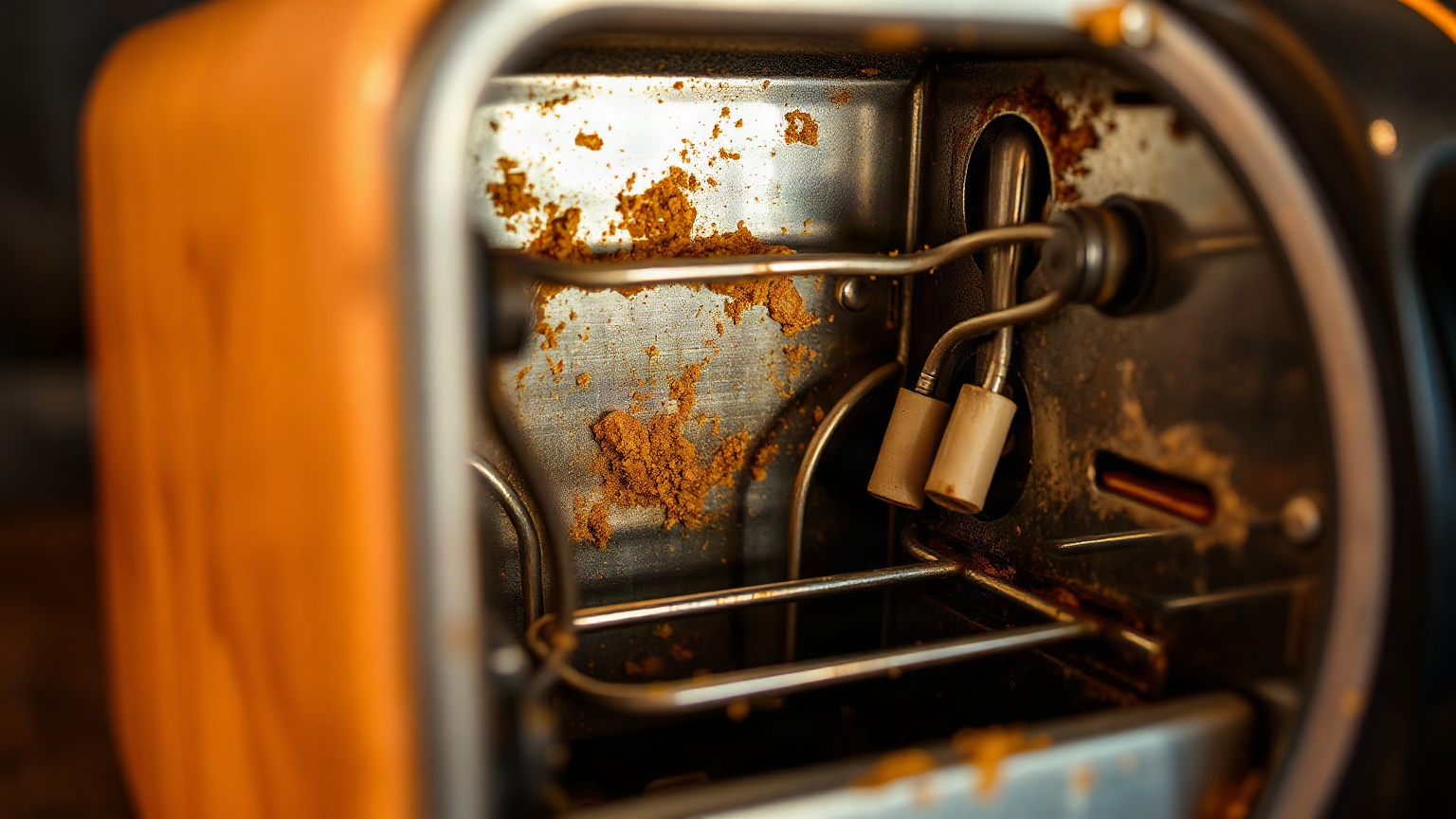
The heating element in a toaster is essentially a long, coiled resistance wire. It’s supposed to resist current, turning it into heat. Over time — especially if the toaster gets crumbs packed around the element, or if it’s been dropped — that wire can develop a break or partial short. When that happens, resistance drops, current surges, and the breaker does exactly what it’s designed to do.
I had this happen with a cheap two-slot toaster I’d owned for about four years. It started tripping the breaker maybe one out of every five uses, then progressed to every single time within about two weeks. That escalation pattern — intermittent at first, then constant — is a classic sign of an element that’s failing progressively.
Ground Fault Inside the Appliance
This one’s more serious. A ground fault means current is leaking out of its intended path and finding a route to ground through something it shouldn’t — the metal casing, for instance. This is exactly what GFCI (Ground Fault Circuit Interrupter) outlets are designed to catch, and they’ll trip at as little as 4–6 milliamps of leakage. That’s sensitive enough to protect you from a shock that might not even feel severe but could still be dangerous.
If your toaster is tripping a GFCI outlet rather than the main breaker panel, that’s actually the distinction mattering here. GFCI trips are about ground faults. Main breaker trips are about overcurrent. Both are bad news for the toaster, but they point to slightly different root causes.
Water or Moisture Damage
This one gets missed constantly in troubleshooting guides. If a toaster sat near a sink, got splashed, or was stored in a damp cabinet, moisture inside the chassis can create a conductive path where there shouldn’t be one. Moisture-related faults can be intermittent and maddening — the toaster works fine in dry conditions and trips the breaker when humidity is higher. It’s an edge case, but I’ve seen it happen. If you’ve recently had any kind of kitchen water incident near the appliance, that’s worth factoring in.
Circuit Overload: The Cause That Has Nothing to Do With Your Toaster
Not every breaker trip is the toaster’s fault. If your kitchen is running a microwave, a coffee maker, a refrigerator, and a toaster all on the same 15-amp circuit, you may simply be exceeding what the circuit can handle — even if every individual appliance is working perfectly.
Here’s a quick way to check: unplug everything else on that circuit, then try the toaster alone. If it runs without tripping, you’ve got an overload problem, not an appliance problem. The fix there is to either spread appliances across different circuits or have an electrician add a dedicated 20-amp kitchen circuit — which, honestly, most modern kitchens should have anyway.
Standard kitchen circuits in older homes are often 15 amps. Modern code typically requires at least two 20-amp small-appliance circuits in kitchens. If your home is older, underpowered circuits may be a recurring issue, not just with your toaster.
Toaster Wattage vs. Circuit Capacity: A Quick Reference
It helps to see the numbers side by side. Here’s how common toaster types compare to typical circuit limits:
| Appliance Type | Typical Wattage | Amps Drawn (120V) | Notes |
|---|---|---|---|
| 2-slice pop-up toaster | 800–1,200W | 6.7–10A | Fine on a 15A circuit alone |
| 4-slice pop-up toaster | 1,200–1,800W | 10–15A | Borderline on 15A, fine on 20A |
| Toaster oven (compact) | 1,200–1,500W | 10–12.5A | Should be on a dedicated circuit |
| Toaster oven (full-size) | 1,500–1,800W | 12.5–15A | Needs a dedicated 20A circuit |
| Standard kitchen circuit | — | 15–20A max | 80% load rule = 12–16A continuous |
That “80% load rule” is worth knowing. The National Electrical Code recommends you don’t run a circuit above 80% of its rated capacity continuously. So a 15-amp circuit really shouldn’t have more than 12 amps running through it for any extended period. A 4-slice toaster by itself can bump right up against that.
If you’re curious how how hot a toaster gets relates to wattage and element load, that piece breaks down the temperature side of things.
How to Diagnose Which Problem You Actually Have
Don’t just replace the toaster without figuring out what went wrong — especially if you’re on an older circuit. Here’s how I’d work through it.
Step 1: Note Exactly When It Trips
Does the breaker trip the moment you plug the toaster in? That’s a hard ground fault — the appliance is shorted before it even heats up. Does it trip once the heating cycle starts? More likely an overcurrent issue from the element. Does it trip after a minute or two? Could be a thermal issue or a circuit that’s warming up and hitting its limit under sustained load.
Step 2: Isolate the Appliance
Unplug everything else on that circuit. Reset the breaker. Plug in only the toaster. Run it. If it still trips, the problem is the toaster. If it doesn’t trip, your circuit was overloaded.
Step 3: Try a Different Circuit
Plug the toaster into an outlet on a completely different circuit — a bedroom outlet, for instance, ideally one you know is lightly loaded. If it trips that breaker too, you have a confirmed appliance fault. If it runs fine, your kitchen circuit has a problem.
Step 4: Check the Cord and Plug
Look at the cord where it meets the toaster body, and at the plug itself. Discoloration, fraying, any melted plastic smell — those are signs of an arcing fault. This is not something you repair. It’s something you replace.
What you should not do is pop open the toaster and start poking around inside with the idea of “just having a look.” There’s capacitor charge in some models that persists after unplugging. And honestly, toasters aren’t really serviceable by home repair standards — the parts are cheap enough that the repair math never works out.
When to Replace vs. When to Fix the Circuit
If diagnostics confirm the toaster itself is the problem — replace it. Full stop. A toaster that’s shorted or has a ground fault is not something you repair at home, and there’s no toaster on the market worth the risk of injury. Even a decent 4-slice stainless toaster runs under $50. That’s a low bar.
If your old toaster was doing a lot of work — daily use, lots of crumbs, been dropped at some point — and it’s more than 5–7 years old, I’d replace it without much deliberation. I’ve run toasters well past that point and regretted not swapping sooner once things went sideways.
If diagnostics point to the circuit, that’s a different conversation. A licensed electrician can tell you fairly quickly whether you need a dedicated circuit added or whether your panel needs an upgrade. It’s not a cheap fix, but repeatedly tripping breakers is hard on the breaker itself — breakers do wear out from repeated trips, and a weakened breaker is a safety problem in its own right.
If you’re shopping for a replacement and want something reliable that won’t overtax a typical kitchen circuit, the compact toaster ovens in the 1,200-watt range are worth a look — they give you a lot of functionality without the aggressive draw of larger models. We’ve also rounded up our picks for the best mini toaster ovens if you want a starting point.
One Edge Case Worth Knowing About: Old Crumb Buildup as a Fire Hazard
This doesn’t directly cause breaker trips, but it’s related enough to mention. Heavy crumb buildup inside a toaster can get hot enough to ignite during normal use — and before that happens, it can cause uneven element loading that contributes to electrical stress. The National Fire Protection Association lists toasters among the leading causes of kitchen fires, almost always due to buildup near heating elements.
Empty the crumb tray every couple of weeks if you use the thing daily. It takes thirty seconds.
The Bottom Line
A toaster that keeps tripping the breaker is telling you something specific — either it’s failing internally, your circuit is overloaded, or both. The diagnostic steps above will tell you which one within about ten minutes. If the toaster is the problem, replace it. They’re not worth repairing and they’re genuinely not safe to keep running when they’re behaving this way. If the circuit is the problem, that’s worth a conversation with an electrician before you plug anything back in.
It’s a pain, I know. But a tripping breaker is the system doing its job — the alternative is a lot worse.
Frequently Asked Questions
Why does my toaster trip the breaker but nothing else does?
Your toaster likely has an internal fault — either a partially shorted heating element or a ground fault in the wiring — that’s causing it to draw far more current than it should. Other appliances don’t have that fault, so they run within normal limits. Try the toaster on a different, lightly loaded circuit to confirm the issue is the appliance and not an overloaded kitchen circuit.
Can I reset the breaker and keep using the toaster?
Not safely, no. If the toaster trips the breaker every time you use it, there’s an ongoing fault that isn’t going to fix itself. Continuing to use it risks damaging the breaker itself with repeated trips, and there’s a real risk of electrical fire or shock if the fault involves a ground leak. Replace the toaster.
Is it the toaster or the breaker that’s the problem?
Isolate the toaster on its own circuit with nothing else plugged in. If it still trips, the toaster is faulty. If it runs fine alone but trips when other appliances are running simultaneously, your circuit is overloaded — the toaster itself may be fine. A breaker that trips only under load from one specific appliance is almost always reacting to that appliance.
Why does my toaster trip the GFCI outlet but not the main breaker?
GFCI outlets trip at extremely low levels of ground-fault current — as little as 4 to 6 milliamps — because they’re designed to protect against shock rather than fire. If your toaster trips a GFCI, it has a ground fault: current is leaking somewhere it shouldn’t be, possibly through the chassis. This is a sign of internal damage and means the appliance should be replaced, not reset and reused.
How many watts can a kitchen circuit handle?
A standard 15-amp, 120-volt kitchen circuit can theoretically handle 1,800 watts, but the safe continuous load is 80% of that — around 1,440 watts. A 20-amp circuit tops out at 2,400 watts with a safe continuous load of about 1,920 watts. Running a toaster alongside a coffee maker and microwave on a single 15-amp circuit will almost always exceed that threshold.

Written by
Emma founded Toastera to turn vague appliance advice into clear, researched, safety-first guidance on toasters and toaster ovens.
Free: the Toaster Oven Cheat Sheet
Get the printable cheat sheet (temps, cook times & safety tips) plus new recipes. No spam, unsubscribe anytime.