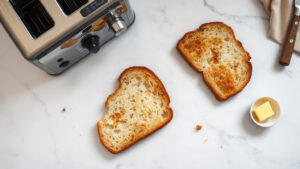
Yes, you can toast two different size slices in a 4-slice toaster at the same time — but only if the toaster has independent dual-slot controls, which most decent models do. The two pairs of slots operate separately, so you can run one side at a higher setting for a thick sourdough slice while the other side lightly toasts a thinner piece of sandwich bread. The catch is that some budget toasters share a single control knob across all four slots, and those will give you uneven results every single time.
Safety First: Never force oversized bread slices into toaster slots — if a slice is too thick and gets stuck near the heating elements, it’s a genuine fire risk. Always check that nothing is wedged against the internal elements, unplug before attempting to remove stuck bread, and never use a metal utensil inside a live toaster. Keep the crumb tray emptied; built-up crumbs under active heating elements can ignite.
Quick Facts
- Most 4-slice toasters are essentially two 2-slice toasters in one housing, with two independent sets of controls.
- Independent controls let you set different browning levels on each side simultaneously — standard on mid-range and premium models.
- Budget 4-slice toasters (roughly under $30) often share a single dial, meaning all four slots run at the same setting.
- Slot width matters more than browning setting when it comes to fitting different bread types — most standard slots accept slices up to about 1.5 inches wide; wide-slot models go up to 1.75 inches.
- Toasting different breads together is totally fine for safety; the only real issue is getting both pieces done to your liking at the same time.
How a 4-Slice Toaster Actually Works
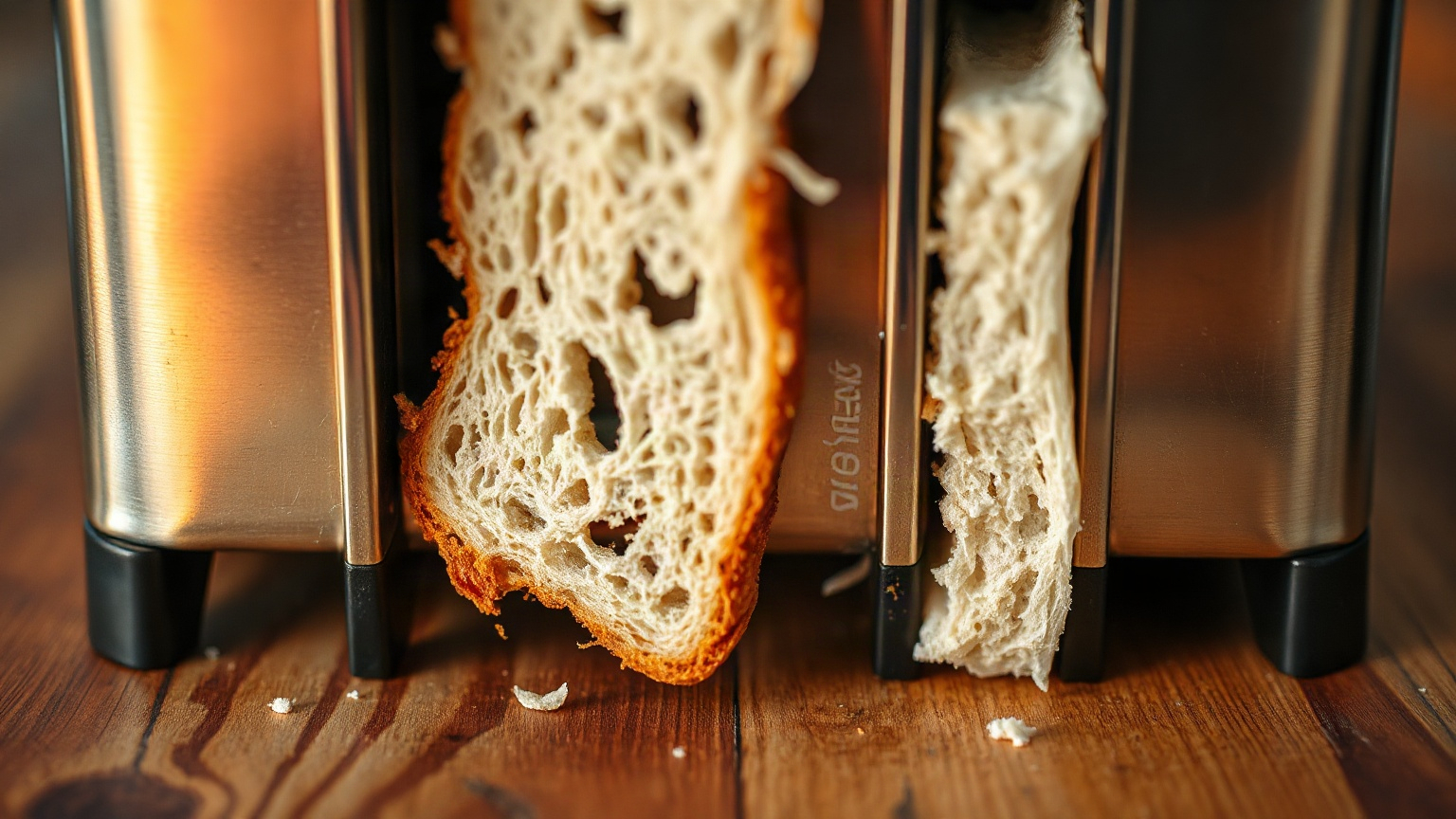
Here’s the thing that most people don’t realize until they’ve had a 4-slice toaster for years: the design is almost always two 2-slot units sharing a single outer shell. Same wiring philosophy, same lifting mechanism style, just doubled up. Each pair of slots has its own heating elements, its own thermostat or timer circuit, and — in the better models — its own control dial or lever on each end of the machine.
That physical separation is why toasting different sizes at once is even possible. Each side doesn’t “know” or care what the other side is doing. I ran a quick test on a Cuisinart CPT-435 on a Tuesday morning with a thick slice of Dave’s Killer Bread on the right (setting 4) and a thin piece of plain white sandwich bread on the left (setting 2). Both came out exactly how I wanted. Total time was about 2.5 minutes. The white bread finished first by maybe 20 seconds, which made sense given the lower mass.
If you’ve ever wondered how hot a toaster gets internally, the heating elements typically reach between 300°F and 500°F depending on the browning setting. Thicker bread needs more of that heat to penetrate the center without burning the outside, which is exactly why separate controls matter.
The Single-Dial Problem (And Why It Ruins Mixed Toasting)
Not all 4-slice toasters are created equal. Cheap ones — and I mean the $20-$25 ones you see at discount stores with a single browning dial in the middle — run all four slots off one shared control. That design is fine if you’re always toasting four identical slices. But try to put a bagel half on one side and a regular piece of bread on the other, and you’re stuck compromising on a single setting that probably underdoes one and overdoes the other.
I actually owned one of these for about eight months before I figured out why my toast was always slightly wrong. I thought I was adjusting wrong. Nope — the dial was just controlling everything at once. Classic beginner mistake, honestly.
The fix is simple: check whether the model you own or are considering buying has two separate control dials — one on each end of the unit. That’s your signal that it operates as two independent 2-slot toasters sharing a body.
What “Different Size” Actually Means — It’s Not Just About Thickness
When people ask about toasting two different size slices, they usually mean one of three things:
Different Bread Thicknesses
This is the most common scenario. Sourdough from an artisan bakery can run 3/4 inch to nearly an inch thick. Standard sandwich bread sits at about 1/2 inch. The thickness difference matters because thicker bread needs a longer cycle or higher setting to toast through without staying doughy in the middle. With independent controls, you dial each side appropriately and they both finish fine. Without independent controls, pick the setting that works better for the thicker slice and accept slightly over-toasted thin bread — or vice versa.
Different Bread Types (Bagels vs. Regular Slices)
Bagels need a bagel setting, ideally — most good 4-slice toasters have a dedicated bagel function that heats the inner-facing element more aggressively while running the outer one at lower intensity. This toasts the cut face while just warming the crust. If you’re toasting a bagel on one side while your kid wants a plain slice of whole wheat on the other, you need each side to have its own function selector. This is specifically where mid-range models like the Cuisinart 4-slice wide-slot toaster earn their keep. Each side has its own bagel button.
Different Physical Heights (Small vs. Large Format Bread)
Texas toast, brioche slices, or large country sourdough rounds can be physically taller than the slot opening. Most standard 4-slice toasters have slots that are about 1.5 inches wide and 5 to 5.5 inches tall. Wide-slot models extend that to roughly 1.75 inches wide and sometimes 6 inches tall. If one side needs to fit tall bread and the other fits standard bread, that’s not really a problem — both slots on each side are identical in size, so it’s not like one side accommodates larger physical pieces than the other. You just need a wide-slot model overall if oversized bread is in the mix.
How Different 4-Slice Toasters Handle Mixed Toasting: A Comparison
Here’s a look at how some popular models handle the specific scenario of toasting two different bread types simultaneously. I’ve grouped them by what actually matters for this use case.
| Model | Independent Controls | Bagel Setting Per Side | Slot Width | Price Tier |
|---|---|---|---|---|
| Hamilton Beach 24633 | No (shared dial) | No | Standard (~1.5″) | Budget |
| Cuisinart CPT-435 | Yes | Yes (each side) | Wide (~1.5″) | Mid-range |
| Breville BTA840XL | Yes | Yes (each side) | Extra-wide (~1.5″) | Mid-range/Premium |
| KitchenAid KMT4116 | Yes | Yes (each side) | Wide (~1.5″) | Mid-range |
| Dualit 4-Slot Toaster | Yes | Manual timer only | Extra-wide | Premium |
My honest take: the Cuisinart CPT-435 is the one I’d actually recommend for most people who want this flexibility without overspending. The Breville is lovely but it’s priced for people who care a lot about their toast, and I say that without judgment. The Hamilton Beach is fine if you’re always toasting four identical slices. For anything else, don’t bother with single-dial models.
If you’re considering whether a toaster oven might handle this better for you — it might, especially for large bread — check out the best mini toaster ovens for a comparison.
The Edge Case Most People Miss: One Side Idle, One Side Running
Here’s something the other articles out there don’t really address. What if you only want to toast two slices but you own a 4-slot toaster? Should you use one side or split across both sides?
Use one full side. Keep both slices together on the same 2-slot pair. The reason is simple: each pair of slots shares one set of heating elements and one crumb tray section. Running just one slot from each pair means you’re heating up two separate element sets for two slices, which wastes electricity and doesn’t actually toast any faster. Keep the pair together and leave the other side completely cold.
Related: some people ask whether running only one side affects the other side’s performance on the same cycle. It doesn’t. The sides are thermally pretty well separated. I’ve run one side continuously while the other sat idle for months without any heat bleed or uneven toasting. They’re genuinely independent.
And if you’re regularly feeding a household where one person wants toast and another wants reheated leftovers, it might be worth looking at reheating food in a toaster oven as a parallel tool — a toaster oven handles size variety much more flexibly.
Practical Tips for Getting Mixed Toasting Right
- Start the thicker or denser bread about 30-45 seconds before the thinner piece — just push down its lever first, then push the other side a moment later. This way they finish closer together.
- For frozen bread on one side and fresh bread on the other, use the frozen setting (if available) on the frozen side only. The difference in toasting time between frozen and fresh is significant — usually an extra 60-90 seconds for frozen.
- Don’t cram wide bread into a standard-width slot hoping it’ll fit better once it toasts down. It won’t. And it’ll get stuck. Ask me how I know.
- If your toaster doesn’t have independent controls, use the setting that suits the thicker piece and just watch the thinner slice — pull it manually if it starts looking done before the cycle ends.
- Clean the crumb tray every week or so if you’re mixing bread types. Different breads shed different amounts of crumbs, and denser crumbs from seedy loaves build up faster than you’d expect.
For 4-slice toasters with independent wide-slot controls, there are several solid options across price ranges — just filter specifically for dual-control models when you’re browsing.
The Bottom Line
A 4-slice toaster can absolutely handle two different bread sizes at the same time, as long as it has independent controls for each pair of slots. That’s the whole answer. If your toaster has two separate dials — one on each end — you’re good. Set each side independently, stagger your start times if one bread is significantly denser, and you’ll get consistently good results on both pieces.
If your toaster has one central dial, it’s not broken, it just wasn’t designed for this use case. It’ll work in a pinch, but you’ll be compromising on one of the two slices every time. For a household that regularly eats different bread types at the same meal, that’s annoying enough to justify an upgrade to something with dual controls. The price difference between a basic shared-dial model and a decent dual-control one is usually $20-$30. Worth it.
Frequently Asked Questions
Can you toast two different size slices in a 4-slice toaster at the same time?
Yes, you can — provided the toaster has independent controls for each pair of slots. With dual controls, you set each side to the appropriate browning level for the specific bread on that side, and they operate completely separately. Single-dial models will apply the same setting to all four slots, which makes dialing in two different breads more difficult.
Do all 4-slice toasters have independent controls for each side?
No. Budget models, typically under about $30, often use a single shared dial that controls all four slots simultaneously. Mid-range and premium 4-slice toasters — from brands like Cuisinart, Breville, and KitchenAid — almost always offer two independent control sets, one per 2-slot pair. Check the product listing for “independent controls” or look for two separate dials on the unit.
What’s the best way to toast thick and thin bread at the same time in a 4-slice toaster?
Put the thick bread on one side at a higher setting (around 4-5 on a 1-6 scale) and the thin bread on the other side at a lower setting (around 2-3). Start the thick bread’s side about 30 seconds before the thin bread’s side so they finish at roughly the same time. This works best on toasters with independent controls; on a shared-dial model, set it closer to the thick bread’s ideal setting and monitor the thin slice manually.
Can you use only 2 slots in a 4-slice toaster to save electricity?
Yes, and you should. Use only one complete 2-slot pair rather than splitting across both sides. Using one slot from each pair activates two separate heating element sets for just two slices, which is less efficient. Keeping both slices on the same side uses a single element set and is the more energy-conscious approach.
Can a 4-slice toaster toast a bagel on one side and regular bread on the other at the same time?
Yes, on toasters that have per-side function buttons, you can activate the bagel setting on one pair of slots while running the standard toast setting on the other. Models like the Cuisinart CPT-435 and Breville BTA840XL both support this configuration. On toasters with only a single bagel button that controls all four slots, you can’t do both functions simultaneously.

Written by
Emma founded Toastera to turn vague appliance advice into clear, researched, safety-first guidance on toasters and toaster ovens.
Free: the Toaster Oven Cheat Sheet
Get the printable cheat sheet (temps, cook times & safety tips) plus new recipes. No spam, unsubscribe anytime.