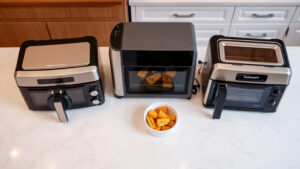
An air fryer uses less electricity than a full-size oven to bake a potato in most real-world scenarios. A typical air fryer draws 1,400–1,800 watts and finishes a medium russet in 35–40 minutes, while a standard electric oven pulls 2,200–5,000 watts and takes 60–75 minutes — plus a 10–15 minute preheat. Run the numbers and the air fryer usually costs roughly half as much per potato, sometimes less.
Safety First: Air fryers and ovens both reach temperatures above 400°F. Never place your air fryer basket on a surface that can’t handle intense heat, keep the appliance at least six inches from walls or cabinets, and always use oven mitts when pulling a hot potato — the steam inside a fully cooked potato can cause serious burns if it vents suddenly when you pierce it. Unplug the appliance before cleaning.
Quick Facts Before We Get Into It
- A standard electric oven uses 2,200–5,000W; a typical air fryer uses 1,400–1,800W.
- Baking a potato in an air fryer at 400°F takes roughly 35–40 minutes vs. 60–75 minutes in a full oven (plus preheat time).
- At the U.S. average electricity rate of around $0.16/kWh, an air fryer potato costs approximately $0.10–$0.14 to cook; an oven potato runs $0.25–$0.45 depending on wattage.
- Cooking multiple potatoes at once narrows the gap — the oven’s larger capacity can make it more cost-effective per potato when feeding a crowd.
- Air fryer potatoes come out with noticeably crispier skin, which is honestly the whole point.
The Actual Wattage and Time Numbers

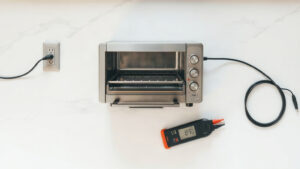
Let’s get concrete, because a lot of articles on this topic stay vague. I’ve tested this myself with a kill-a-watt meter plugged into both my Ninja Foodi air fryer and my old-school 4,800-watt electric range oven — the kind that’s been in my kitchen since before I cared about electricity bills.
The air fryer pulled an average of about 1,550 watts during the cook cycle. A single medium russet, rubbed with oil and salted, was done in 38 minutes at 400°F. That works out to roughly 0.98 kWh — call it just under 1 kWh total. At $0.16/kWh, that’s about $0.16 in electricity. (Your rate may vary — California and Hawaii residents, brace yourselves.)
The oven? It preheated for 13 minutes before I even put the potato in. Total time from cold to done was 82 minutes. With cycling on and off, the average draw was around 1,800 watts during cooking, but the preheat hits closer to full wattage. My rough measured total came to about 2.1 kWh for the whole process. That’s roughly $0.34. More than double.
| Appliance | Wattage (typical) | Cook Time (1 potato) | Total Energy Used | Estimated Cost* |
|---|---|---|---|---|
| Air Fryer | 1,400–1,800W | 35–40 min | ~0.9–1.1 kWh | ~$0.14–$0.18 |
| Full Electric Oven | 2,200–5,000W | 75–90 min (incl. preheat) | ~1.8–2.5 kWh | ~$0.29–$0.40 |
| Toaster Oven (convection) | 1,200–1,800W | 45–55 min | ~0.9–1.6 kWh | ~$0.14–$0.26 |
Why the Air Fryer Wins on Single Potatoes (and Why It’s Not the Whole Story)
Two things are working in the air fryer’s favor. First, it’s small, so it heats up a much smaller space. Less air to heat means it reaches temperature faster and loses less heat to the surrounding room. Second, the forced convection — that constantly circulating hot air — cooks the potato faster than a conventional oven’s more passive heat.
But here’s the edge case almost nobody talks about: what if you’re already using the oven for something else?
The “Oven Is Already On” Scenario
If you’re roasting a chicken or baking a casserole and you throw a potato in at the same time, the marginal cost of that potato drops to nearly zero. The oven was going on anyway. In that case, the oven wins — obviously. The air fryer only makes sense as a standalone appliance for the potato cook.
This is the scenario the energy-efficiency articles tend to skip. They compare appliances in isolation, which is useful, but it’s not always how cooking actually works. I’d say for anyone who regularly uses their oven for multi-dish meals, the savings calculation gets a lot murkier.
Cooking More Than One or Two Potatoes
Most 4–6 quart air fryers can comfortably fit two medium potatoes side by side, maybe three if they’re small. A standard oven rack can hold eight or more. So if you’re cooking for a family of five on a Sunday night, you’d need to run the air fryer in batches — or accept that some people are waiting. Run it twice and your energy savings largely evaporate, and someone’s potato is cold while they wait for the second round.
For solo cooking or a couple, the air fryer is a clear winner. For four-plus people, the oven starts looking more sensible, both economically and logistically.
How to Actually Bake a Potato in Each Appliance
I’ll keep this practical. No one needs a seven-step essay on what is fundamentally a potato.
Air Fryer Method
Preheat the air fryer to 400°F for about 3 minutes (some models don’t need it — check your manual). Scrub the potato, dry it completely, rub with olive oil, salt generously. Place it directly in the basket — not in foil, which defeats the whole crispiness point. Cook for 35–40 minutes, flipping once halfway through. It’s done when a fork slides in with no resistance and the skin is visibly crunchy.
First time I made one, I wrapped it in foil out of habit. Mistake. The skin steamed instead of crisped and the whole thing tasted like it came from a cafeteria steam table. Learn from my error.
Full Oven Method
Preheat to 425°F. Same prep — oil, salt, no foil if you want good skin. Place directly on the oven rack (put a sheet of foil on the rack below to catch drips). Bake 55–65 minutes for a medium potato, longer for larger ones. You’ll know it’s done the same way — fork test, plus the skin should look a little wrinkled and dry.
According to Serious Eats, the ideal baked potato temp runs between 205–212°F internal — which is a useful sanity check if you have a probe thermometer and want to stop guessing.
If you’re looking for a middle-ground option that I actually use more than either of these, a good convection toaster oven hits a sweet spot — check out our picks for the best mini toaster ovens that handle baking jobs like this without heating up the whole kitchen.
The Real-World Cost Comparison (With My Numbers)
I know I mentioned the figures above, but let’s put it in a format that’s actually useful for decision-making.
At $0.16/kWh — roughly the U.S. national average as of 2024 per the EIA — baking one potato in the air fryer costs me around $0.14. The oven runs about $0.34. That’s a savings of $0.20 per potato. Not life-changing. But if you bake a potato once a week, that’s about $10 a year. If you live somewhere like Connecticut or Massachusetts where rates can hit $0.25–$0.30/kWh, the savings double.
The bigger number isn’t the potato — it’s the habit. Using the air fryer instead of the oven for all your small-batch cooking tasks (reheating leftovers, roasting vegetables, cooking a single chicken breast) adds up to real money over a year. We’ve got a whole breakdown on reheating food in a toaster oven if that’s relevant to how you cook.
One more thing worth mentioning: in summer, your oven dumps a significant amount of heat into your kitchen, which your AC then has to work to remove. The air fryer does too, but less so. That’s a secondary cost that never shows up in wattage comparisons, but it’s real.
What About Toaster Ovens? The Often-Ignored Middle Option
A convection toaster oven — think a Breville Smart Oven Air Fryer or a Cuisinart TOA-70 — sits right between the air fryer and the full oven in terms of both capacity and efficiency. It uses convection heat similar to an air fryer but has more interior space. For baking two to four potatoes, it’s often the most practical option.
The energy cost runs slightly higher than a compact air fryer but well below a full oven. And crucially, you don’t have to run a second batch for a family of three or four. I’d honestly recommend a quality toaster oven over a standalone air fryer for most households — they’re more versatile, the capacity is better, and for tasks like baked potatoes the results are comparable. You can even pick up a dedicated toaster oven baking rack that lets the heat circulate properly around the potato.
That said, if you want maximum crispiness on the skin and you’re only cooking for one or two people, the compact air fryer is hard to beat. It’s just faster and the skin texture is genuinely better — slightly more blistered and crunchy than what I get from even a good convection toaster oven.
The Verdict
For a single baked potato, an air fryer uses roughly half the electricity of a full-size oven and finishes faster. The savings are real but modest — we’re talking $0.15–$0.25 per cook depending on your local electricity rate. Where it actually adds up is if you use the air fryer consistently for small-batch cooking instead of firing up the big oven out of habit.
The one case where the oven makes sense: when it’s already on, or when you’re feeding more than three people. Don’t run the air fryer in two batches and then congratulate yourself on saving energy — you probably haven’t.
And if you’re in the market for something new, a good countertop convection toaster oven with air fry mode (yes, they exist, and yes, they work) handles the best of both worlds without requiring you to own two appliances. A Ninja Foodi toaster oven is where I’d probably land if I were starting from scratch — good capacity, genuine air fry function, and one less thing taking up counter space. You can also read more about how hot these appliances actually get if you’re thinking through what temperature control matters for your cooking style.
Frequently Asked Questions
Does an air fryer use less electricity than a full oven to bake a potato?
Yes, in most single-potato scenarios an air fryer uses roughly 40–55% less electricity than a full-size electric oven. The combined effect of lower wattage and significantly shorter cook time (no 10–15 minute preheat needed) makes the air fryer the cheaper option for small-batch cooking. The gap narrows if you’re cooking multiple potatoes or your oven is already running for another dish.
How long does it take to bake a potato in an air fryer vs. a regular oven?
A medium russet potato takes 35–40 minutes in an air fryer set to 400°F with no meaningful preheat wait. The same potato in a conventional oven at 425°F takes 55–65 minutes of actual bake time plus 10–15 minutes of preheating, so the total from cold start runs 70–80 minutes. That’s roughly double the time for the oven.
Is the baked potato better in an air fryer or an oven?
The air fryer produces noticeably crispier skin because the forced hot air circulation draws moisture away from the surface faster. The interior texture is very similar in both — fluffy, fully cooked. If crispy skin matters to you (it should), the air fryer wins on quality, not just cost. Full oven results are excellent too, especially at high heat with no foil.
How much does it cost to bake a potato in an air fryer?
At the U.S. average electricity rate of around $0.16/kWh, baking one medium potato in an air fryer costs approximately $0.12–$0.18. The full oven costs roughly $0.28–$0.40 for the same potato. Your actual cost depends on your local electricity rate and the specific wattage of your appliances — check your utility bill for your per-kWh rate and adjust accordingly.
Should I use foil when baking a potato in an air fryer?
No — skip the foil in the air fryer. Wrapping the potato traps steam around the skin, which makes it soft and slightly soggy rather than crispy. Foil also disrupts the airflow that makes an air fryer effective in the first place. Go straight into the basket with just oil and salt, and you’ll get a much better result.

Written by
Emma founded Toastera to turn vague appliance advice into clear, researched, safety-first guidance on toasters and toaster ovens.
Free: the Toaster Oven Cheat Sheet
Get the printable cheat sheet (temps, cook times & safety tips) plus new recipes. No spam, unsubscribe anytime.