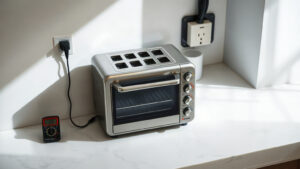
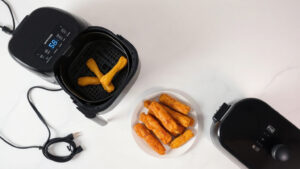
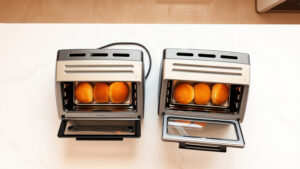
The air fryer wins for crispiness on frozen waffles — but only by a specific margin, and the toaster oven has a real case in certain situations. Hot, rapidly circulating air pulls moisture out of the waffle’s surface faster than radiant heat alone, which is why the air fryer consistently produces a crunchier exterior. That said, if you’re feeding more than two people or you care about the inside staying soft while the outside crisps, the toaster oven might actually serve you better.
Safety First: Both air fryers and toaster ovens reach temperatures above 400°F and their exterior surfaces get hot enough to cause burns on contact. Keep a clear 4–6 inch gap around your appliance for ventilation, never leave either running unattended with greasy residue buildup inside, and always use silicone-tipped tongs — not your fingers — to flip or remove waffles from a hot basket or rack.
Quick Facts: Air Fryer vs Toaster Oven for Frozen Waffles
- Air fryers cook frozen waffles in roughly 4–5 minutes at 360°F; toaster ovens typically need 6–8 minutes at 375°F
- Air fryer waffles come out measurably crispier on the outside due to convection airflow, not higher temperature
- Toaster ovens handle bigger batches — 4 to 6 waffles at once vs. 2 to 3 in most air fryer baskets
- Neither appliance requires preheating for frozen waffles, though a 2-minute preheat in the air fryer does improve texture
- For the best results in a toaster oven, use the convection setting if your model has one — it closes most of the crispiness gap
How I Actually Tested This (And What Went Wrong First)
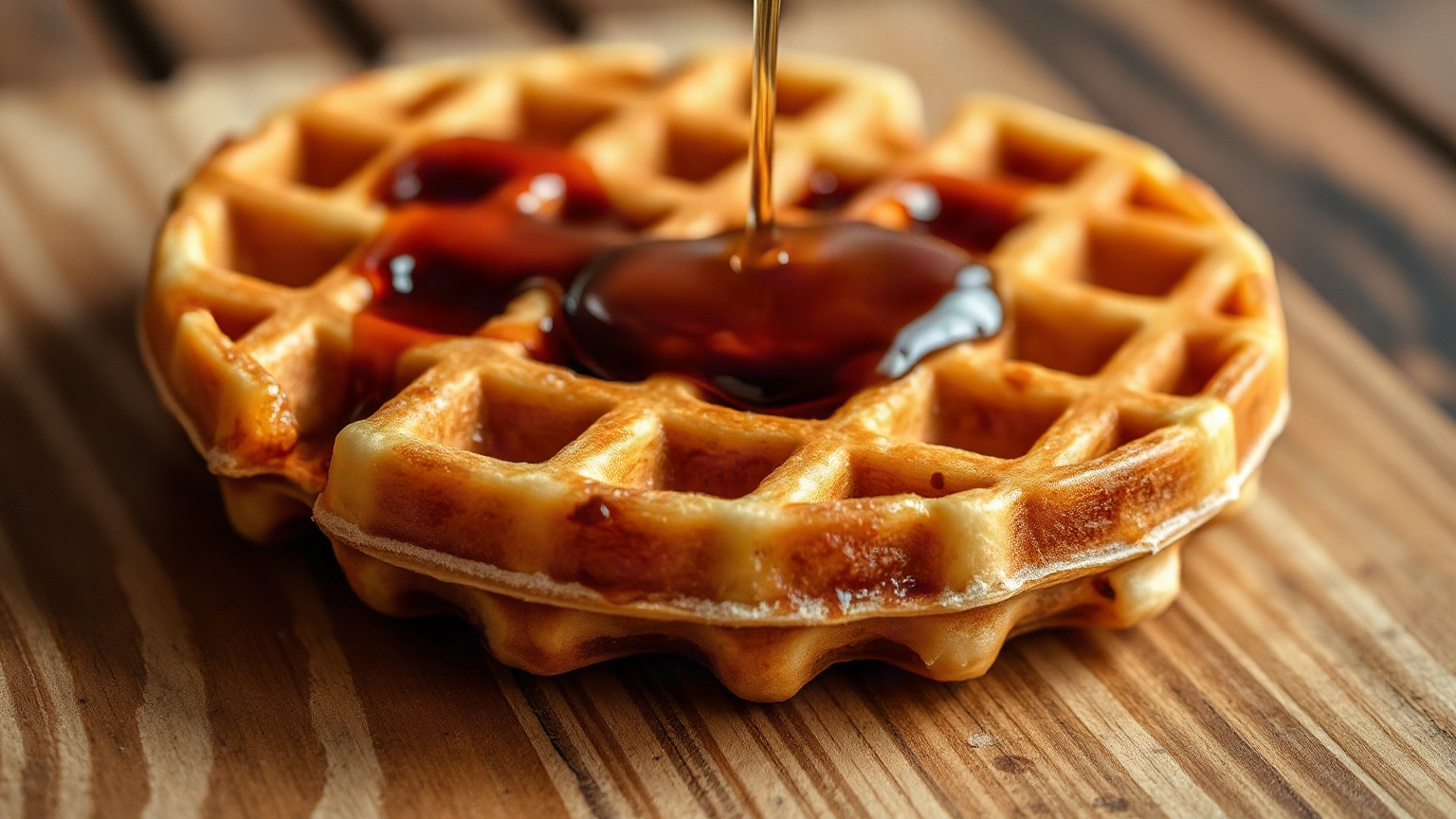
I ran this test on a Tuesday morning with a box of Eggo Homestyle waffles — nothing fancy, just the standard freezer staple most people actually buy. My setup was a Ninja Foodi 6-quart air fryer on one counter and a Cuisinart TOA-70 toaster oven on the other. Both got the same number of waffles, same starting temperature (straight from the freezer), and I timed everything with the same phone timer.
First attempt: I didn’t preheat either one. The toaster oven waffles were honestly fine — warm all the way through, slightly soft on top. The air fryer waffles were also fine, but I could already see the edges pulling away slightly and crisping up around the grid pattern. Second attempt: I gave the air fryer a 2-minute preheat at 360°F. That made a noticeable difference. The exterior crunch was significantly better. The toaster oven with its convection fan on at 375°F for 7 minutes was close — but not quite the same.
What tripped me up the first time: I set the air fryer to 400°F because I figured hotter equals crispier. It doesn’t, with waffles. The outside charred faintly on the edges while the center was still a little cold. 360°F is the sweet spot. I’ve seen this mistake recommended all over the internet and it genuinely produces worse results.
The Science Behind Why One Wins (It’s Not About Temperature)
People assume the air fryer crisps better because it runs hotter. But that’s not really what’s happening. The temperature difference between an air fryer and a toaster oven set to similar levels is minimal. What’s different is airflow velocity. An air fryer basket has a high-speed fan pushing hot air across all surfaces of the food simultaneously. A toaster oven — even with convection — moves air more gently and from fewer angles.
Frozen waffles have a lot of surface moisture. That moisture needs to evaporate before the Maillard reaction can really get going and produce that toasted, slightly caramelized crunch. The faster you strip the surface moisture, the crispier the result. Air fryers do this faster. It’s genuinely that simple.
Serious Eats has written about this in the context of air frying generally — the physics are the same as a commercial convection oven, just scaled down and intensified. Their take on air fryer mechanics is worth reading if you want the full breakdown.
Head-to-Head: Specific Times, Temps, and Results
Air Fryer Settings That Actually Work
360°F, 4–5 minutes, no flipping required for most basket-style air fryers. I do give them a flip at the 3-minute mark if I want truly even crisping on both sides. Don’t stack them. This is obvious but I’ve seen people try it. One layer, basket-flat, done.
If your air fryer runs hot (some do), drop to 350°F and add 30 seconds instead. You’ll know yours runs hot if the edges consistently darken before the center is warm.
Toaster Oven Settings That Actually Work
375°F on the convection setting, 6–8 minutes. Place the waffles directly on the wire rack — not a baking sheet — so air can get underneath. That single change improves crispiness dramatically in a toaster oven. If your toaster oven doesn’t have convection, use the toast setting or regular bake at 400°F and expect slightly softer results. You can check our guide on reheating food in a toaster oven for more context on how the heat modes differ.
One thing the toaster oven does better: it’s kinder to the inside texture. Because the heat is slightly less aggressive, the waffle interior stays more tender. If you’re someone who likes a crisp outside but a fluffy, almost doughy center, the toaster oven might actually be your preference. Personal taste thing. I marginally prefer that texture myself on lazy mornings.
| Factor | Air Fryer | Toaster Oven |
|---|---|---|
| Recommended Temp | 360°F | 375°F (convection) |
| Cook Time (from frozen) | 4–5 minutes | 6–8 minutes |
| Exterior Crispiness | High | Medium-High |
| Interior Texture | Slightly dry if overdone | Softer, more tender |
| Batch Size | 2–3 waffles | 4–6 waffles |
| Preheat Needed? | Optional but helpful (2 min) | Not necessary |
| Energy Use | Lower (shorter run time) | Slightly higher |
Specific Models Worth Knowing About
If you’re deciding between appliances (or justifying a new one), here’s where specific models matter.
Best Air Fryers for Frozen Waffles
The Ninja Foodi 6-quart is what I use and what I’d recommend for most people. The basket size handles three standard Eggo-sized waffles comfortably, the temperature is consistent, and it preheats in under 90 seconds. Mid-range price tier. No complaints after two years of regular use.
The Cosori Pro basket-style air fryer is a solid budget-to-mid-range option with reliable temperature accuracy. It runs slightly cooler than its display suggests, which is actually helpful for waffles — you’re less likely to accidentally scorch the edges at 360°F.
Best Toaster Ovens (Including Air Fryer Combo Models)
The Cuisinart TOA-70 sits in mid-range territory and is genuinely good at both functions. Its air fry mode produces results that are very close to a dedicated basket-style air fryer — closer than most people expect. If counter space is limited and you want one appliance to do both jobs, this is an honest pick. See our list of best mini toaster ovens for more options across price points.
The Breville Smart Oven Air Fryer Pro is premium-tier — it’s expensive and it’s large, but its convection performance is legitimately excellent. If you’re regularly cooking for three or four people and you want to do more than just waffles, it earns its counter space. For waffles alone? Overkill.
The Hamilton Beach models in the budget tier are fine for occasional use. The convection fan is weaker, the temperature calibration is less precise, and results with frozen waffles are noticeably less consistent. Worth it if you’re on a tight budget and don’t use it daily.
| Model | Type | Price Tier | Batch Size | Waffle Result |
|---|---|---|---|---|
| Ninja Foodi 6-qt | Basket Air Fryer | Mid-range | 2–3 waffles | Excellent crisp |
| Cosori Pro | Basket Air Fryer | Budget-Mid | 2–3 waffles | Very good crisp |
| Cuisinart TOA-70 | Toaster Oven + Air Fry | Mid-range | 4–5 waffles | Good (air fry mode) |
| Breville Smart Oven Air Fryer Pro | Toaster Oven + Air Fry | Premium | 5–6 waffles | Very good (convection) |
| Hamilton Beach (standard) | Toaster Oven | Budget | 4 waffles | Decent, softer result |
The Edge Case Almost Nobody Mentions: Waffles Straight from the Fridge
Every comparison I’ve seen treats this as a frozen-only problem. But a lot of people pull waffles out the night before or have leftover homemade ones sitting in the fridge. Refrigerated waffles are actually harder to get right than frozen ones. They’re not as cold, so they heat faster — but they’ve also had time to fully absorb moisture and go a bit limp and rubbery.
For refrigerated waffles, the air fryer’s advantage is even more pronounced. I’d go 350°F for 3 minutes, check, then add 1 more minute if needed. The toaster oven tends to warm a refrigerated waffle through before it has time to crisp the surface, which gives you a hot but slightly soggy result. Not terrible. But not great either.
Also worth mentioning for people with thick, Belgian-style frozen waffles: add a minute to either method. The thicker grid means more mass to heat through, and rushing it at a higher temperature gives you charred edges and a cold middle — which I found out the hard way with a box of Van’s Protein waffles that have a noticeably denser structure than standard Eggos.
So Which Should You Actually Use?
If crispy waffles are your single priority and you’re making 1–3 at a time: use the air fryer. 360°F, 4–5 minutes, 2-minute preheat if you have time. That’s the answer.
If you’re feeding a family, want one appliance to handle more than one job, or you prefer a slightly softer waffle interior: the toaster oven on convection mode is genuinely good and produces results that most people won’t notice are slightly less crispy than the air fryer version. The temperature dynamics inside each appliance explain a lot of this difference in practical terms.
The honest verdict: a basket air fryer wins the head-to-head on crispiness. But a combo toaster oven with an air fry mode (like the Cuisinart TOA-70) closes the gap meaningfully while giving you more flexibility. If I could only have one appliance, I’d take the combo toaster oven. If I already had a toaster oven and was buying a second appliance, I’d get the basket air fryer.
For what it’s worth, the USDA recommends reheating frozen foods to an internal temperature of 165°F for food safety — both methods clear this easily if you follow the times above. Their guidance on reheating frozen foods is worth bookmarking if you cook from frozen regularly.
Frequently Asked Questions
Can you cook frozen waffles in an air fryer without preheating?
Yes, and they’ll turn out fine — but preheating for 2 minutes at 360°F noticeably improves the crispiness of the exterior. Without preheating, the waffle spends the first minute or two in a warming-up environment rather than immediate high-heat airflow, which reduces the crunch factor. It’s not a huge deal on a rushed morning, but it’s worth the extra two minutes if you care about texture.
What temperature should I use for frozen waffles in a toaster oven?
375°F on the convection setting is the most reliable option, with the waffle placed directly on the wire rack (not a baking sheet) for 6–8 minutes. If your toaster oven doesn’t have convection, use the toast mode or bump to 400°F on bake — but keep an eye on the edges. Toaster ovens vary quite a bit in how they distribute heat, so your first batch is essentially a calibration run.
Are air fryer frozen waffles crispier than toaster oven waffles?
Yes, consistently. The high-velocity circulating air in a basket air fryer removes surface moisture faster than a toaster oven’s radiant or convection heat, which produces a crunchier exterior. The difference is real but not dramatic — most people eating without side-by-side comparison wouldn’t call the toaster oven version “soft.” If you use a toaster oven with a strong convection setting and place waffles on the wire rack, you’ll get close.
How long do frozen waffles take in the air fryer?
4–5 minutes at 360°F from fully frozen, with an optional flip at the 3-minute mark. Thicker Belgian-style waffles may need 5–6 minutes. Don’t go above 375°F — higher temperatures crisp the edges before the center is warm, which is a common mistake. If your air fryer runs hot, reduce the temperature by 10–15 degrees and add 30–60 seconds instead.
Can I use a toaster oven instead of a toaster for frozen waffles?
Absolutely, and in most cases the toaster oven produces a better result than a standard pop-up toaster because you can control temperature more precisely and the waffle heats more evenly. Pop-up toasters can scorch the outer grid while leaving the interior cool. The toaster oven also handles thicker waffles that don’t fit standard toaster slots — which is a frequent annoyance with Belgian-style frozen waffles.
—
Written by
Emma founded Toastera to turn vague appliance advice into clear, researched, safety-first guidance on toasters and toaster ovens.
Free: the Toaster Oven Cheat Sheet
Get the printable cheat sheet (temps, cook times & safety tips) plus new recipes. No spam, unsubscribe anytime.