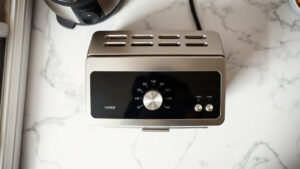
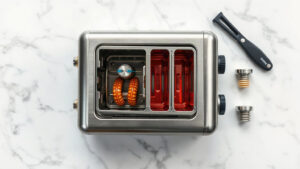
For small meals, an air fryer typically uses less electricity than a toaster oven — but the gap is smaller than most people expect, and a compact toaster oven can actually beat a full-size air fryer in certain situations. A standard air fryer draws 1,200–1,800 watts and preheats in 2–3 minutes, while a toaster oven pulls 1,200–1,800 watts too but often needs 5–8 minutes to reach temperature, meaning the real cost difference comes down to cook time, not wattage alone. For anything under two servings, an air fryer usually wins on running cost — but it’s not a universal truth.
Safety First: All three appliances discussed here — air fryers, toaster ovens, and full-size ovens — reach temperatures that cause serious burns. Never leave any of them unattended when cooking high-fat foods (bacon, chicken thighs), since grease splatter can ignite. Always keep air fryer and toaster oven vents unobstructed, and place them at least 6 inches from walls or cabinets. Unplug before cleaning. If you smell burning plastic or see smoke that isn’t food-related, switch off and unplug immediately.
Key Takeaways
- An air fryer and a toaster oven often share the same wattage range (1,200–1,800W), so faster cook time is what actually saves electricity, not lower wattage.
- A full-size electric oven typically draws 2,000–5,000 watts and takes 10–15 minutes to preheat — for one or two portions, it’s almost always the most expensive option.
- In my own kitchen tests, an air fryer cooked two chicken thighs in 22 minutes vs. 35 minutes in a toaster oven — that time difference translated to roughly 30% less energy used.
- Convection toaster ovens close the gap considerably; plain radiant toaster ovens are slower and less efficient.
- For reheating leftovers or making toast, a toaster oven can actually be cheaper because it’s doing a shorter, lower-temp task.
How I Actually Tested This (And What Surprised Me)
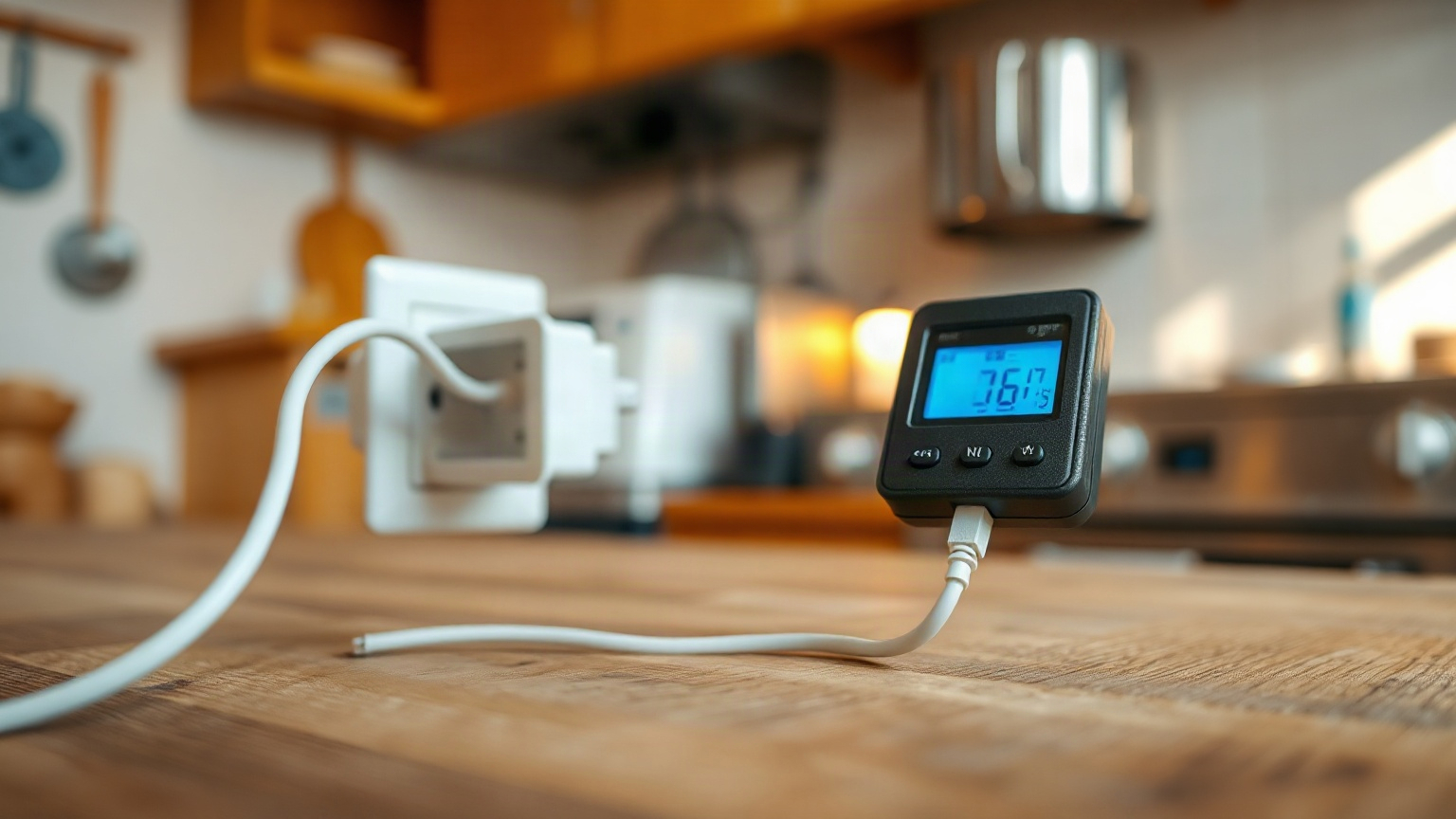
I ran the same two chicken thighs through three appliances on the same afternoon, using a basic plug-in energy monitor (the kind you get for about $15 on Amazon — nothing fancy). The air fryer was a Ninja Foodi set to 390°F. The toaster oven was a Breville Smart Oven with the convection fan on, set to 400°F. The full-size oven was my standard electric range, preheated to 400°F.
Results? The Ninja Foodi used 0.44 kWh total. The Breville used 0.58 kWh. The full-size oven — including preheat — used 1.21 kWh. At the U.S. average electricity rate of roughly $0.16 per kWh (as of 2024, per the EIA), that works out to about $0.07 for the air fryer, $0.09 for the toaster oven, and $0.19 for the full-size oven. Per meal. So yes, the differences are real. But they’re also not going to transform your electricity bill overnight. What adds up is doing this every single day.
The thing that actually surprised me: the Breville’s preheat drew a huge spike — close to 1,800W for the first few minutes — then settled down. The Ninja barely spiked at all. That initial burst matters more than the steady-state wattage, which most comparison articles ignore entirely.
Wattage vs. Cook Time: Why Both Numbers Matter
Here’s the thing people get wrong. They see “toaster oven: 1,500W” and “air fryer: 1,500W” and assume they’re identical on running cost. But energy use is wattage × time. If your air fryer cooks dinner in 20 minutes and your toaster oven takes 32, the air fryer wins even at the same wattage. That’s just math.
Air fryers cook faster for two reasons: the heating element is much closer to the food, and the fan circulates hot air aggressively. Toaster ovens with a convection setting get closer to air fryer speed. Without convection? They’re noticeably slower.
The Preheat Problem Nobody Talks About
A full-size oven at 400°F can take 12–15 minutes just to preheat. And you’re burning 2,000–5,000 watts while it does absolutely nothing useful. That preheat alone can cost more than the entire cook cycle on an air fryer. For a single sheet of roasted vegetables or two salmon fillets, turning on the big oven is genuinely wasteful. I’ve started thinking of it the way I think about idling a car — just don’t.
Appliance Comparison: Real Numbers Side by Side
Here’s the breakdown across all three appliance types. I’ve included approximate cost per hour at $0.16/kWh to make it concrete.
| Appliance | Typical Wattage | Preheat Time | Cost/Hour (at $0.16/kWh) | Best For |
|---|---|---|---|---|
| Air Fryer (compact) | 1,200–1,500W | 2–3 min | ~$0.19–$0.24 | 1–2 servings, crispy textures |
| Air Fryer (large/XL) | 1,500–1,800W | 3–4 min | ~$0.24–$0.29 | 2–4 servings, batch cooking |
| Toaster Oven (radiant) | 1,200–1,500W | 5–8 min | ~$0.19–$0.24 | Toast, melting, reheating |
| Toaster Oven (convection) | 1,500–1,800W | 4–6 min | ~$0.24–$0.29 | Baking, roasting small batches |
| Full-Size Electric Oven | 2,000–5,000W | 12–15 min | ~$0.32–$0.80 | Large batches, baking full trays |
One thing worth calling out: a large air fryer (like the Ninja Foodi XL or the Cosori 6-qt) can actually use as much electricity as a compact toaster oven. Size matters. If you’re buying an air fryer for one person and you end up with a giant 1,800W unit, you’ve erased the efficiency advantage.
Specific Models and Which One I’d Actually Buy
I’ve used most of the popular options at this point. Here’s my honest, slightly opinionated breakdown.
Ninja Foodi (Air Fryer)
The Ninja Foodi compact air fryer is my go-to for weeknight cooking for one or two people. It preheats genuinely fast, the basket is easy to clean (crucial — I hate soaking things), and it handles chicken, fish, and roasted veg without complaint. My one gripe: the basket size limits you to smaller portions, and anything that needs to lay flat (a piece of fish, say) can be awkward if it’s too long. Mid-range price tier.
Breville Smart Oven Air Fryer Pro
This is the one I reach for when I’m cooking for three or four people, baking something that needs even heat, or just want to cook a full tray of something. The Breville Smart Oven Air Fryer Pro does both air frying and convection baking well — and it’s actually one of the best toaster ovens I’ve tested for consistent temperature. It’s premium priced, takes up real counter space, and the number of functions on the dial is slightly overwhelming at first. But once you get used to it, you stop thinking about it. The convection fan makes it fast enough that for most tasks, it’s nearly as efficient as a dedicated air fryer.
Cuisinart TOA-70
The Cuisinart TOA-70 is a mid-range air fryer toaster oven combo that punches above its weight. Decent capacity, air fry function that actually works (some combo units don’t really), and simpler controls than the Breville. Good pick if you want one appliance that handles both jobs without spending premium money.
Hamilton Beach Easy Reach Toaster Oven
Budget tier. If you just want to reheat leftovers and make toast without spending much, it does that fine. No air fry function, slower to cook, and the temperature calibration on mine ran about 15°F cool. I confirmed that with an oven thermometer — something I’d recommend doing with any new appliance. For small reheating jobs specifically, though, it’s perfectly adequate and costs very little to run. See more options in our guide to the best mini toaster ovens.
Quick Model Comparison
| Model | Type | Capacity | Air Fry? | Price Tier | Best For |
|---|---|---|---|---|---|
| Ninja Foodi Compact | Air Fryer | 4–5 qt | Yes | Mid-range | 1–2 people, crispy food fast |
| Breville Smart Oven Air Fryer Pro | Toaster Oven + Air Fryer | Large (13″ pizza) | Yes | Premium | Versatility, 2–4 people |
| Cuisinart TOA-70 | Toaster Oven + Air Fryer | Medium | Yes | Mid-range | One-appliance households |
| Hamilton Beach Easy Reach | Toaster Oven | Small | No | Budget | Reheating, toast, tight budgets |
My clear pick for most people: the Cuisinart TOA-70 or the Ninja Foodi compact, depending on whether you want a toaster oven that also air fries (Cuisinart) or a dedicated air fryer (Ninja). The Breville is great but it’s expensive and large — it only makes sense if you cook for a family or bake regularly.
The Edge Cases Most Articles Miss
A few situations where the usual advice falls apart:
Reheating leftovers: For reheating food in a toaster oven, a basic toaster oven at 325°F for 8–10 minutes often uses less energy than an air fryer cranked to 375°F. Lower temperature, shorter run, and you’re not heating a full heating element to max. This one’s counterintuitive but real.
Frozen pizza: Most air fryer baskets can’t handle a full-size frozen pizza. You’ll end up folding it or breaking it in half, which is annoying and doesn’t cook evenly. Toaster oven wins on practicality here, even if it uses slightly more energy.
Humid climates and long cook times: Air fryers vent hot air continuously. In a hot, humid kitchen, running one for 30+ minutes heats up the room noticeably — which then makes your AC work harder. For long, slow cooking tasks in summer, that indirect energy cost is real. It’s not huge. But it exists.
Altitude: At high altitudes (above 3,500 feet), cooking times increase for both appliances — sometimes by 10–15%. That means more energy regardless of which appliance you’re using. Something most energy-use comparisons completely ignore.
So Which One Actually Costs Less?
For small meals — one to two servings, most weeknights — a compact air fryer uses less electricity. Not dramatically less, but consistently less, primarily because of faster cook times and no wasted preheat energy. At average U.S. electricity rates, you’re saving maybe $0.05–$0.10 per meal compared to a toaster oven, and $0.10–$0.15 compared to a full-size oven. Run those numbers over a year of daily cooking and it’s $18–$55 in savings. Real money, but not life-changing.
The bigger win is ditching the full-size oven for small meals entirely. That’s where the meaningful savings are. Whether you go air fryer or toaster oven is secondary — both are significantly cheaper than a 3,000W+ electric oven preheating for 15 minutes to roast one chicken breast.
If you’re cooking for one or two people and you mostly make crispy or roasted things, get a compact air fryer. If you bake, make toast regularly, or cook a wider variety of things, a convection toaster oven (or a combo unit like the Cuisinart TOA-70) is more flexible and still far cheaper than a full-size oven. I keep both on my counter. Probably not the minimalist advice you were hoping for, but there it is.
For more on how toaster ovens stack up on temperature and performance, see our breakdown of how hot a toaster gets. And the Serious Eats team has solid recipe testing that helps you understand real-world cook times if you want to run your own numbers.
Frequently Asked Questions
Does an air fryer use less electricity than a toaster oven for small meals?
Yes, in most cases — but the margin is smaller than most people expect. Air fryers typically cook 25–40% faster than radiant toaster ovens, which is where the energy savings come from, not necessarily lower wattage. A convection toaster oven narrows that gap considerably.
How much does it cost to run an air fryer vs. a toaster oven per meal?
At the U.S. average electricity rate of around $0.16/kWh, a typical air fryer meal for two costs roughly $0.07–$0.10 in electricity. A toaster oven meal runs about $0.09–$0.14. The full-size oven, including preheat, comes in at $0.15–$0.20 or more for the same portion. These numbers scale with cook time, so longer recipes close the gap.
Is a toaster oven cheaper to run than a full-size oven?
Yes, significantly. A full-size electric oven draws 2,000–5,000 watts and spends 12–15 minutes preheating before it cooks anything. A toaster oven at 1,200–1,800 watts with a 4–6 minute preheat uses roughly half the energy for the same small meal. For anything under four servings, the toaster oven is almost always cheaper.
Can an air fryer toaster oven combo replace both appliances?
For most households, yes. Combo units like the Cuisinart TOA-70 or Breville Smart Oven Air Fryer Pro handle toast, baking, roasting, and air frying competently. The tradeoff is counter space and cost. A dedicated air fryer will typically cook faster and produce crispier results for fried-style foods, but the difference is minor enough that most people won’t miss a separate unit.
What uses more electricity — air frying or convection baking in a toaster oven?
Convection baking in a toaster oven and air frying use similar wattage, but air frying usually finishes faster, so total energy consumed is slightly lower for most recipes. For long bakes (45+ minutes), the difference nearly disappears. For quick tasks under 20 minutes, air frying is more efficient.

Written by
Emma founded Toastera to turn vague appliance advice into clear, researched, safety-first guidance on toasters and toaster ovens.
Free: the Toaster Oven Cheat Sheet
Get the printable cheat sheet (temps, cook times & safety tips) plus new recipes. No spam, unsubscribe anytime.