A standard 2-slice toaster pulls between 800 and 1,200 watts, a 4-slice model typically runs 1,400 to 1,800 watts, and long-slot toasters land in a similar range to 4-slice units — around 1,500 to 1,800 watts. The wattage determines how fast your bread toasts and, directly, how much it costs you per use. On a normal household circuit, any of these will run fine; where it gets interesting is if you’re running a toaster oven alongside a coffee maker at 7 a.m.
Safety First: Toasters draw significant amperage in short bursts. Never plug a toaster into an extension cord or power strip — they’re rated for sustained loads, not the spike a toaster pulls on startup. Keep the toaster at least 4 inches from cabinets and curtains, and never leave it unattended if you’re toasting something with a high sugar content (like sweet breads or anything with jam already on it). Unplug it after each use if it’ll be sitting idle near a sink.
Quick Facts: Toaster Wattage at a Glance
- 2-slice toasters: 800–1,200 watts (most common around 900W)
- 4-slice toasters: 1,400–1,800 watts, sometimes listed as two separate 800W elements running together
- Long-slot (sandwich/baguette) toasters: 1,500–1,800 watts depending on slot length
- A single toast cycle (roughly 2–4 minutes) costs less than a cent at average U.S. electricity rates
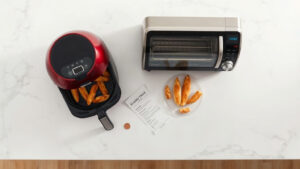
- Toaster ovens are a different animal — they run 1,200–1,800W but for much longer durations, so their energy cost adds up faster
Why Wattage Actually Matters (More Than You’d Think)
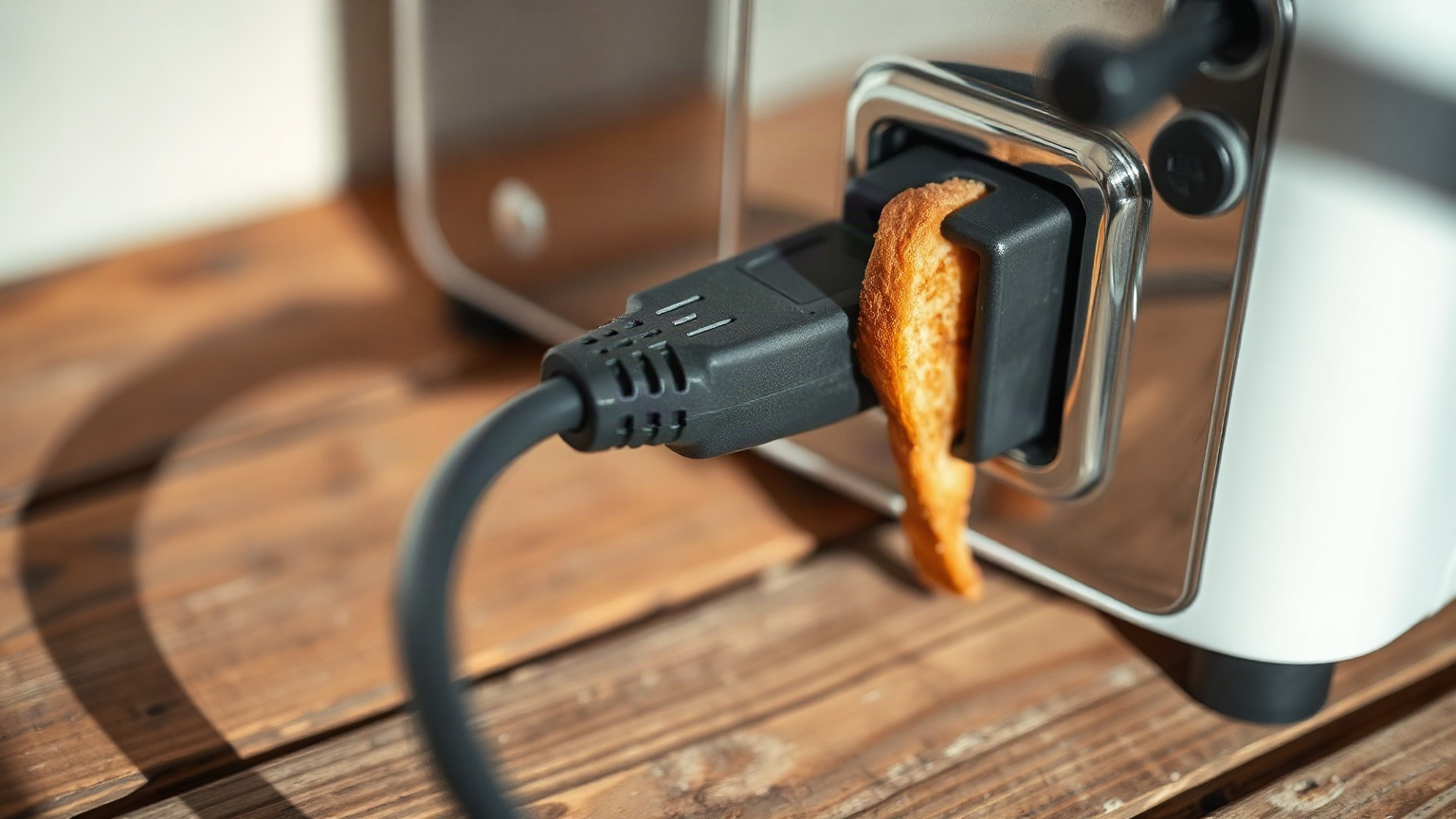
Most people buy a toaster without looking at wattage once. I get it — I did the same thing the first time. What tripped me up was pairing a 1,800-watt 4-slice toaster with my coffee maker on the same 15-amp kitchen circuit. Tripped the breaker on day two. Not a disaster, but annoying at 6:30 in the morning.
Here’s the practical math: a 15-amp, 120-volt circuit handles roughly 1,800 watts total before it trips. Your coffee maker might pull 1,000–1,200 watts on its own. Add a 1,800W toaster and you’re over the limit. The fix is simple — either use a dedicated circuit for the toaster (some kitchens have one near the counter specifically for this) or stagger when you run each appliance.
Wattage also tells you something about toasting speed. Higher watts means more heat delivered faster. A 1,200W 2-slice toaster will generally toast more evenly and quickly than an 800W budget unit at the same dial setting. That’s not a hard rule, but it holds often enough that I’d rather spend a bit more on a higher-wattage model than deal with pale, uneven toast every morning.
Wattage by Toaster Type: A Real Comparison
Let’s break down what each type actually uses, and what that means day-to-day.
| Toaster Type | Typical Wattage Range | Average Cycle Time | Est. Cost Per Use* | Best For |
|---|---|---|---|---|
| 2-Slice (compact) | 800–1,200W | 2–3 min | <$0.01 | Singles, small counters |
| 4-Slice (standard) | 1,400–1,800W | 2–4 min | ~$0.01 | Families, frequent toasting |
| Long-Slot / Sandwich | 1,500–1,800W | 3–5 min | ~$0.01–0.02 | Artisan bread, baguettes |
| Toaster Oven (basic) | 1,200–1,500W | 10–20 min | $0.03–0.08 | Reheating, small bakes |
| Toaster Oven (air fryer combo) | 1,700–1,800W | 10–25 min | $0.06–0.12 | Cooking, not just toasting |
2-Slice Toasters
These are your workhorse countertop units. Most land right around 900 watts — not the 800W floor or the 1,200W ceiling, but somewhere in the middle. Brands like Cuisinart and Breville tend to spec their 2-slice models at 1,000–1,100W. Budget options from Hamilton Beach or Black+Decker often come in at 850W.
Does that 250-watt difference matter? Honestly, a little. At 850W, I’ve noticed slightly more variation across the bread slice — the edges toast faster than the center on some models. At 1,000W and up, the heat tends to be more consistent. Not always, but enough that I’d consider it when buying.
4-Slice Toasters
Here’s where most households land, and where wattage jumps noticeably. A 4-slice toaster is basically two 2-slice toasters fused together, which is exactly how many of them are wired — two separate 700–900W heating elements. Combined, you’re at 1,400–1,800W.
The Cuisinart CPT-435 (a solid mid-range pick) runs at 1,800W. The KitchenAid 4-Slice is in the same neighborhood. If your circuit can handle it, the extra wattage is worth it for even browning. If you’re frequently making toast for a family of four, a high-wattage 4-slice toaster will get breakfast on the table faster than a lower-powered one.
Long-Slot Toasters
These are less common in American kitchens but genuinely useful if you eat a lot of sourdough, ciabatta, or anything that doesn’t fit in a standard-width slot. The slots run 1.5 to 2x the length of a standard toaster, and the wattage reflects that: typically 1,500–1,800W.
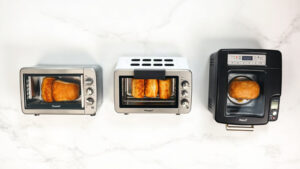
I tested one for a few months when I was going through a bread-baking phase. The Magimix Vision Toaster (pricey, but it has a glass side panel so you can actually see the bread toasting — which sounds gimmicky until you’ve used it) pulls around 1,450W. Useful for bagels, thick sandwich bread, anything taller than a standard slice. The extra wattage is mostly just covering the longer heating element, not making it toast faster.
Toaster Ovens: A Whole Different Wattage Conversation
Toaster ovens use similar wattage to a 4-slice toaster, but the usage pattern is completely different. A pop-up toaster runs for 3 minutes and stops. A toaster oven might run for 20–25 minutes. That changes the math significantly.
A basic toaster oven — think Oster or Hamilton Beach — pulls around 1,200–1,500W. Mid-range units like the Breville BOV450XL run closer to 1,500W. The bigger convection and air fryer combos (Breville Smart Oven Air Fryer, Ninja Foodi XL Pro) sit right at or above 1,800W.
For reheating food in a toaster oven, you’re typically running 5–10 minutes at lower wattage output (most toaster ovens cycle their elements on and off to maintain temp, so average draw is lower than peak wattage). Still adds up more than a pop-up toaster, but it’s still cheap — a dollar or two a month for daily use.
If you’re comparing models and want something efficient for daily cooking, check our guide to the best mini toaster ovens — I’ve ranked them partly on wattage efficiency relative to internal capacity.
Does More Wattage Mean Better Toast?
Not automatically. In a pop-up toaster, higher wattage means faster heat transfer, which can actually produce better Maillard reaction (that golden-brown crust) if the timing is right. But a poorly designed toaster at 1,200W can still under-toast or scorch unevenly.
In toaster ovens, wattage matters more for recovery time — how fast the oven returns to your set temperature after you open the door. A 1,800W unit recovers faster than a 1,200W one. For baking or air frying, that matters. For just making toast, it matters less.
And it’s worth being curious about how that heat actually interacts with your bread — I wrote more about how hot a toaster gets inside during a normal cycle, which surprised me when I actually measured it.
Real-World Energy Cost: What It Actually Adds Up To
People worry about toaster energy use more than they should. Let’s put it in perspective.
A 1,000W toaster running for 3 minutes uses 0.05 kWh. At $0.16/kWh (roughly the U.S. average), that’s $0.008 per use. Less than a cent. Even if you make toast twice a day, every day, for a year — you’re at about $5.84 annually. That is not where you optimize your electricity bill.
Toaster ovens cost a bit more because of run time, but even daily use of a 1,500W unit for 20 minutes comes out to about $0.08 per session — roughly $29 a year. Still not a bill-mover. According to the U.S. Department of Energy, small kitchen appliances like toasters represent a small fraction of home energy use compared to heating, cooling, and refrigeration.
Where it does matter: older toasters with degraded heating elements sometimes run longer cycles to achieve the same browning, which both wastes electricity and produces worse results. If your toaster is taking noticeably longer to brown bread than it used to, that’s usually a sign the elements are going. Time to replace it, not repair it.
How to Find Your Toaster’s Actual Wattage
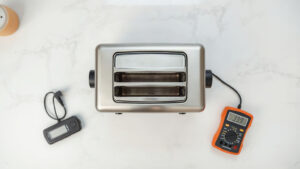
The rating is almost always on a sticker on the bottom of the unit. It’ll say something like “120V ~ 60Hz 1100W” in small print. That’s your peak draw. If you want to measure actual consumption (which varies by browning setting), a plug-in watt meter costs about $15 and is genuinely satisfying to use. You can see the wattage fluctuate as the element cycles.
On a lower browning setting, your toaster might only draw 60–70% of its rated wattage because the cycle time is shorter or the thermostat cuts the element sooner. On the darkest setting, you’ll see something closer to rated max.
One thing that catches people out: some 4-slice toasters let you use just two slots, which halves the effective wattage draw. Handy to know if you’re trying to run it alongside another high-draw appliance. The Breville Die-Cast 4-Slice, for example, has an independent slot selector — you can run slots 1–2 or 3–4 separately. More useful than it sounds.
Wrapping Up
The honest answer to “how much power does a toaster use” is: not much, and not for long. A 2-slice toaster at 900–1,100W running for 3 minutes is barely a blip on your electricity bill. The bigger concern is your kitchen circuit — particularly if you’re running a 1,800W 4-slice toaster and a full-power coffee maker at the same time on a 15-amp circuit.
If you’re shopping for a new toaster, don’t treat wattage as the only factor. A well-made 1,000W toaster beats a cheap 1,200W one. But within a brand’s lineup, higher wattage usually means faster, more even results. For a toaster oven specifically, look for something in the 1,500–1,800W range — it gives you the power headroom for convection and air frying without needing a dedicated circuit.
And if you’re still using a toaster that takes forever to produce pale, sad toast? The wattage rating on the bottom will tell you a lot about why. Sometimes the fix is just buying the better appliance. Pair it with a proper cleaning brush set so the thing lasts, and you’re set.
Frequently Asked Questions
How many watts does a 2-slice toaster use?
Most 2-slice toasters use between 800 and 1,200 watts, with the majority of mid-range models landing around 900–1,100W. Budget models tend to sit at the lower end (800–850W), while premium brands like Breville and Cuisinart typically spec their 2-slice units at 1,000W or above. The actual draw during a cycle depends on your browning setting.
Does a toaster use a lot of electricity?
No — a toaster is one of the cheapest appliances to run in your kitchen. A typical 1,000W toaster running for 3 minutes uses about 0.05 kWh, which costs less than a cent at average U.S. electricity rates. Even daily use over a full year adds up to only a few dollars. Toaster ovens cost a bit more due to longer run times, but they’re still minor compared to appliances that run continuously.
How many amps does a toaster draw?
A standard 120V toaster drawing 1,000W pulls about 8.3 amps (watts ÷ volts = amps). A 1,800W 4-slice model pulls around 15 amps — essentially the full capacity of a standard 15-amp kitchen circuit. That’s why pairing a large toaster with a coffee maker on the same circuit can trip the breaker; the combined draw exceeds what the circuit is rated for.
Is it safe to leave a toaster plugged in?
Leaving a toaster plugged in when not in use is generally low-risk, but not zero-risk. Toasters draw no power when idle, but crumb buildup in the tray can be a fire hazard if the toaster is ever activated accidentally or if crumbs contact a heating element. Most fire safety guidance recommends unplugging toasters when not in use, especially if they’re near a sink or if you have small children who might press the lever.
What is the wattage of a 4-slice toaster?
A 4-slice toaster typically uses 1,400 to 1,800 watts. Most popular models — including the Cuisinart CPT-435 and KitchenAid 4-Slice — run at around 1,800W. Some are wired as two independent 2-slice elements, which means you can sometimes run just one pair of slots and halve the wattage draw. Check the label on the bottom of the unit for your model’s exact rated wattage.

Written by
Emma founded Toastera to turn vague appliance advice into clear, researched, safety-first guidance on toasters and toaster ovens.
Free: the Toaster Oven Cheat Sheet
Get the printable cheat sheet (temps, cook times & safety tips) plus new recipes. No spam, unsubscribe anytime.