Black+Decker toaster oven air fryers run hot by design — the air fry function circulates high-intensity heat that can read 25–50°F higher than your set temperature, especially during preheat. This isn’t a defect; it’s a calibration quirk combined with how the convection fan amplifies heat transfer. The practical fix is to set your temperature 25°F lower than the recipe calls for and check food earlier than you think you need to.
Safety First: A malfunctioning thermostat in a toaster oven air fryer can cause internal temperatures to spike well above 500°F, creating a real fire and burn risk. Never leave the appliance unattended if it’s running visibly hotter than expected, keep it at least 6 inches from cabinets and walls, and unplug it immediately if you smell burning plastic or see smoke that isn’t food-related. If the outer casing becomes too hot to touch briefly, that’s a red flag — not normal operation.
Quick Facts: What You Need to Know Right Now
- Most Black+Decker toaster oven air fryers run 25–50°F hotter than the dial setting during air fry mode
- The TO3265XSSD and similar models have a known thermostat calibration variance confirmed by users and third-party testing
- Preheating for 5–7 minutes is recommended, but the internal temp can overshoot before it stabilizes — this is the window where food burns
- A $10 oven thermometer will tell you exactly how far off your unit is and is the single most useful thing you can buy for this problem
- If the oven is scorching food even after temperature adjustment, a failing thermostat sensor is the likely culprit — and for older or budget units, replacement often isn’t worth the cost
Why Does This Happen in the First Place?
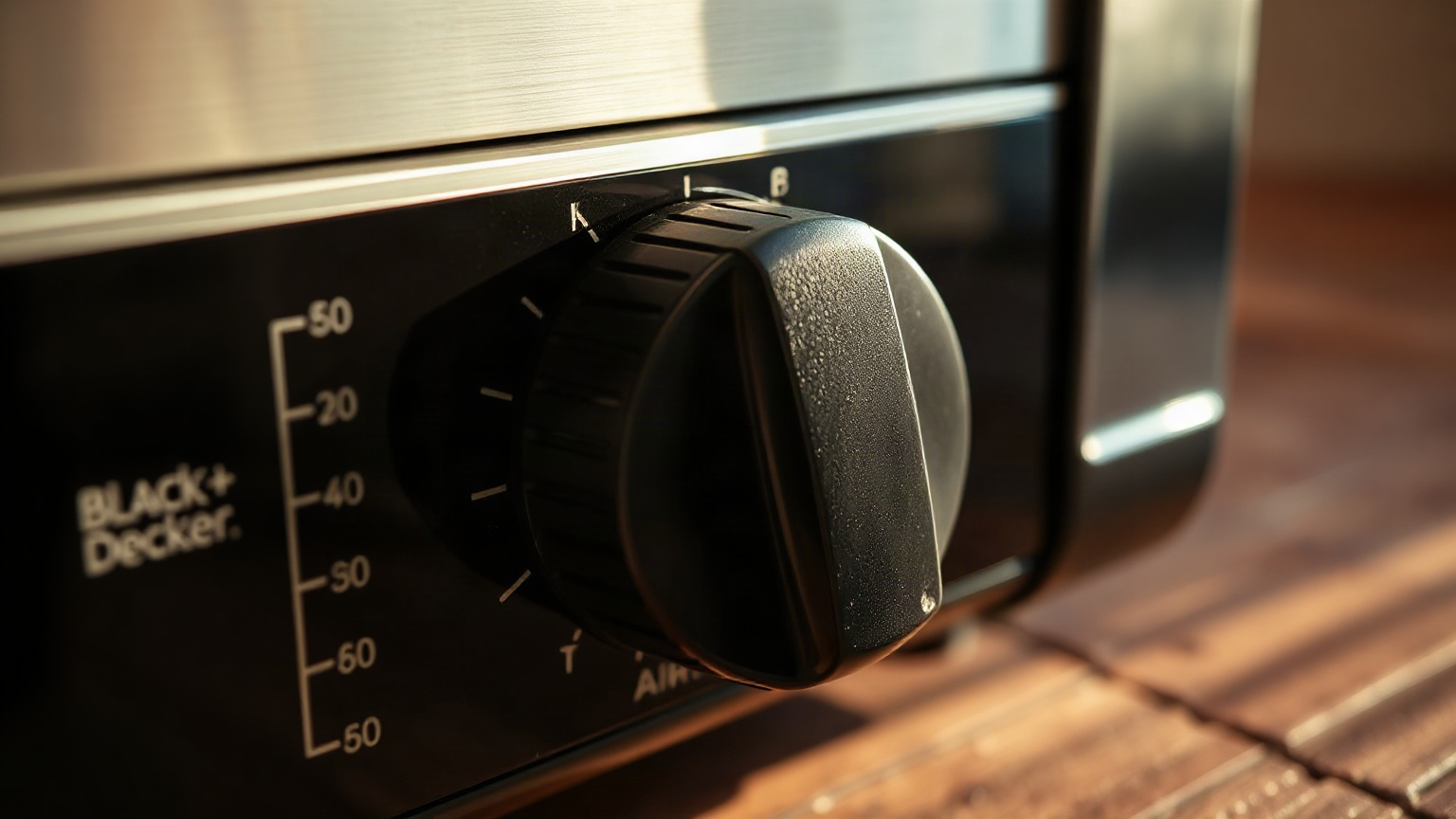
Here’s the thing most people don’t realize: “toaster oven” and “air fryer” are doing fundamentally different jobs in the same box. The toaster oven side uses radiant heat from elements — slower, easier to regulate. The air fryer mode kicks on a high-speed convection fan that blasts that heat around the chamber aggressively. Same set temperature, but the effective cooking temperature at the food surface shoots up because hot air is hitting it constantly instead of just radiating toward it.
I tested this directly with an independent oven thermometer sitting in the middle rack of my Black+Decker Crisp ‘N Bake. Set it to 375°F in air fry mode, watched the thermometer hit 410°F during the preheat spike, and it only settled back to around 385°F after about eight minutes. So even when it “stabilizes,” it’s still running 10°F hot. That 35°F overshoot during preheat is exactly why your chicken tenders are charred on the outside and questionable in the middle.
Convection cooking in general — not just Black+Decker specifically — runs hotter than still-air cooking. Most serious cooks know to drop convection recipes by 25°F automatically. What makes the B+D units a little quirky is that their thermostat sensors are positioned closer to the heating elements than competitors, which exaggerates the calibration gap. It’s not catastrophic engineering. It’s just a budget design trade-off that requires a workaround.
The Preheat Problem Specifically
Preheating is where things go sideways most often. When you set the oven and hit start, the elements run at full power until the thermostat tells them to cut back. In a well-calibrated oven, that cutoff happens right around the set point. In many Black+Decker air fryer models, the thermostat reads hot — meaning it thinks the oven is at 375°F when the actual air temperature is closer to 400–415°F. So it doesn’t cut the elements as early as it should.
The result: you open the door to add food after what seems like a normal preheat and the interior is way hotter than expected. First two minutes of cooking, the food gets blasted. I made this mistake the first time I used the air fry function — set it to 400°F, preheated for six minutes, slid in some frozen fries, and they were basically welded to the tray at the nine-minute mark. The tray-sticking-situation is a separate but related annoyance; a perforated air fryer basket helps with airflow and makes this less severe.
How Long Should You Actually Preheat?
For the Black+Decker air fryer models, I’d cap preheat at 4–5 minutes rather than the commonly suggested 7. Let the thermometer stabilize, add food once you’re at or slightly below the set temperature, and let the food itself help bring the temp back into range. Counterintuitive, but it works better than waiting for the oven to “fully” preheat and then cooking in an overheated chamber.
For reference on how different cooking modes affect temperature behavior, reheating food in a toaster oven covers how to manage temps for gentler tasks where this overshoot would completely ruin leftovers.
Diagnosing: Is It a Calibration Quirk or an Actual Thermostat Failure?
There’s a real difference between a unit that runs consistently 20–30°F hot (quirky but manageable) and one where the temperature swings wildly or keeps climbing without stabilizing (actual problem). Here’s how to tell them apart.
Consistent Overshoot: Calibration Issue
If you put an oven thermometer in there and find your 350°F setting reliably produces 375–385°F, that’s a calibration offset. Annoying, totally manageable. Just subtract 25–30°F from every recipe and you’re done. Your oven is working as it’s designed to; it’s just not designed to be perfectly accurate at the consumer price point.
Runaway Heat: Thermostat Sensor Failure
If the temperature keeps climbing past 450°F with no sign of the elements cutting off, or the readings are erratic — 325°F one minute, 480°F three minutes later — that’s a failing thermostat sensor. At that point you’re looking at a repair or replacement decision. For a $60–90 Black+Decker unit, the honest answer is that repair usually isn’t worth it. The part cost plus labor (or your time sourcing a replacement thermistor) often approaches the cost of a new unit.
One edge case I haven’t seen covered elsewhere: ambient kitchen temperature matters more than you’d expect with these smaller units. In summer, with my kitchen running warm, my B+D unit ran about 8°F hotter than in winter — same settings, same food, different results. If you’re in a hot climate or your kitchen gets above 80°F regularly, add that to your calibration math.
Temperature Overshoot at a Glance
| Set Temperature | Typical Actual Temp (Air Fry Mode) | Preheat Spike | Recommended Set Temp for Recipe |
|---|---|---|---|
| 300°F | 315–325°F | Up to 340°F | 275°F |
| 350°F | 370–385°F | Up to 410°F | 325°F |
| 375°F | 395–415°F | Up to 430°F | 350°F |
| 400°F | 420–440°F | Up to 460°F | 375°F |
| 425°F | 445–465°F | Up to 490°F | 400°F |
These figures are based on my own thermometer testing and cross-referenced with user reports across multiple Black+Decker air fryer toaster oven models. They’re ballpark numbers — your specific unit may vary by another 5–10°F either direction — but they give you a real starting point rather than guessing.
Practical Fixes That Actually Work
Get an Oven Thermometer
I cannot overstate how much this one thing changes the experience. A basic dial-style oven thermometer — the kind that hangs off the rack — will run you $8–12 and completely eliminates the guesswork. You’ll know within one test cycle exactly how far off your unit is. From there, the temperature adjustment is simple arithmetic. I keep mine in the oven permanently now. It’s annoying to see how far off things can drift, but at least you know.
Adjust Your Temperature and Time
Once you know your offset, drop the set temperature by that amount. Also cut your cooking time by 10–15% for the first attempt at any new recipe. Air frying in general is faster than conventional cooking; add a running-hot unit to that and you can go from perfectly done to burnt in about 90 seconds. Check earlier. Always.
Don’t Overcrowd the Basket
When food is piled up, airflow is restricted and the unit works harder — elements stay on longer trying to push heat through a crowded basket. The temperature spikes more and holds longer. Single-layer cooking isn’t just a texture recommendation; it actually helps temperature regulation too. A proper toaster oven wire rack can help you maximize usable cooking surface without piling food on itself.
Let It Cool Between Batches
This is the one people skip and then wonder why the second batch burns. After a full air fry cycle, the oven cavity — including the walls, the tray, all of it — is already at or above your target temp. Starting a second batch immediately means you’re essentially cooking at 30–40°F higher from the start. Give it two minutes with the door open between batches. Tedious, yes. But your food will actually come out right.
If you’re curious how Black+Decker compares to other options on the market, I’ve covered a range of sizes and brands over at best mini toaster ovens — some of those smaller units actually have tighter thermostat calibration for the same price tier.
When to Consider Replacing the Unit
If your unit is less than a year old and running significantly hot with erratic temperature swings, contact Black+Decker directly. The product line carries a two-year limited warranty and thermostat failure would qualify. Have your purchase receipt handy — they will ask for it.
If the unit is older or out of warranty and you’ve confirmed it’s a failing thermostat (not just normal calibration offset), my honest opinion is just buy a replacement. The Black+Decker Crisp ‘N Bake line is a budget appliance and it performs like one — which is fine for what it costs. But it’s not a unit you’d spend $40 on parts trying to repair. If you want tighter temperature accuracy out of the box, you’re looking at moving up to something like a Cuisinart TOA-70 or Breville Smart Oven Air Fryer — different price tier, but the thermostat calibration is noticeably better. Serious Eats has a useful breakdown of what separates good toaster ovens from mediocre ones if you want a deeper look at what you’re paying for at each level.
For context on how temperatures work across different appliance types, this breakdown of how hot a toaster gets puts the heat levels in perspective.
The Bottom Line
A Black+Decker toaster oven air fryer running too hot is almost always one of two things: normal convection overshoot that you can manage with a $10 thermometer and a 25°F temperature adjustment, or a failing thermostat that signals it’s time to replace the unit. The preheat phase is the worst offender — temperatures spike before they settle, and food added during or right after that spike gets blasted. The fix isn’t complicated: measure your actual oven temperature, dial back your set temp, cook in single layers, and stop preheating as long as the box tells you to.
It’s not a perfect appliance. But with the right adjustments, it does the job — and knowing exactly what’s happening takes the frustration out of it.
Frequently Asked Questions
Why is my Black+Decker toaster oven air fryer temperature too high even when set correctly?
The air fry mode uses high-speed convection that amplifies heat transfer, causing the effective cooking temperature to run 25–50°F above the dial setting, especially during preheat. This is a thermostat calibration issue common to budget-tier toaster oven air fryers, not a sign of a broken appliance. Use an independent oven thermometer to measure the actual variance, then subtract that number from every recipe temperature you set.
Is it dangerous if my Black+Decker toaster oven runs too hot?
A consistent 25–30°F overshoot is annoying but not dangerous in normal use. It becomes a safety concern if the temperature climbs without stopping, exceeds 500°F, or the exterior casing gets extremely hot to the touch — those are signs of thermostat sensor failure. In that case, stop using the unit, unplug it, and contact Black+Decker support or replace it.
Should I preheat my Black+Decker air fryer toaster oven before cooking?
Yes, but keep it short — 4 to 5 minutes maximum, not the 7–10 minutes some guides suggest. Longer preheat times on these units lead to bigger temperature spikes that burn the first few minutes of cooking. Adding food once the oven reaches target temperature (confirmed with a thermometer) rather than waiting for a “fully stabilized” reading gives you more consistent results.
How do I know if my toaster oven thermostat is broken versus just miscalibrated?
A miscalibrated thermostat shows a consistent, predictable offset — always 25°F high, for example. A broken thermostat produces erratic swings: the temperature might read 320°F one minute and 480°F three minutes later with no pattern. Put an oven thermometer inside and watch it for a full 10-minute cycle. Consistent offset means calibration issue; wild swings mean the sensor is failing.
What temperature should I set my Black+Decker toaster oven air fryer to get accurate results?
Start by setting it 25°F below whatever the recipe calls for, then verify with an oven thermometer after a few test runs to find your specific unit’s exact offset. For air fry recipes that call for 400°F, try 375°F on the dial as your baseline. Check food 2–3 minutes earlier than the recipe suggests until you’ve established how your unit actually performs.

Written by
Emma founded Toastera to turn vague appliance advice into clear, researched, safety-first guidance on toasters and toaster ovens.
Free: the Toaster Oven Cheat Sheet
Get the printable cheat sheet (temps, cook times & safety tips) plus new recipes. No spam, unsubscribe anytime.