Electronic Timer Circuits (Newer Method)
Electronic Timer Circuits (Newer Method)
More modern toasters use a simple RC circuit (resistor-capacitor) as a timer. When the lever is pushed down, the capacitor starts charging through the resistor. When the voltage reaches a set threshold, a transistor triggers and cuts the electromagnet holding the latch, releasing the spring. The shade dial adjusts the resistance in the circuit, which changes how quickly the capacitor charges, which changes the toast time.
Electronic timers are more consistent across multiple batches because they’re not affected by residual heat the way bimetallic strips are. But they’re also less intuitive to repair when something goes wrong. Tradeoffs everywhere.
The Electromagnet That Holds It All Together
Whether the toaster uses a bimetallic strip or an electronic timer, many designs include a small electromagnet that keeps the carriage latched down while current is flowing. When the timer trips, the electromagnet de-energizes, the mechanical latch releases, and the spring fires. It’s a cascade of tiny mechanical events happening in under a second.
Step 4: The Maillard Reaction — What’s Actually Happening to Your Bread
Step 4: The Maillard Reaction — What’s Actually Happening to Your Bread
The browning isn’t just drying out. It’s chemistry. The Maillard reaction is a chemical reaction between amino acids and reducing sugars in the bread’s surface, and it requires temperatures above roughly 280°F–330°F to get going properly. Below that threshold, you’re mostly just drying the bread out, which gives you pale, stiff toast with none of the flavor.
That nutty, slightly caramelized flavor in good toast? That’s hundreds of new flavor compounds being created in a few seconds of intense radiant heat. Go too far past 350°F on the bread surface and you start producing acrylamide, which is a compound formed in starchy foods at high heat. The FDA has guidance on acrylamide in food if you want to read more — the short version is that very dark toast isn’t a great habit, and light-to-medium is where you want to be most of the time anyway.
Toaster Wattage and Temperature: A Side-by-Side Look
Not all toasters heat the same. Here’s a rough breakdown of how wattage relates to toasting power and typical internal temperature range:
| Toaster Type | Typical Wattage | Internal Temp Range | Toast Time (Medium Setting) |
|---|---|---|---|
| Basic 2-slice pop-up | 800–1,000W | 300°F–400°F | 90–120 seconds |
| Standard 4-slice pop-up | 1,400–1,800W | 350°F–450°F | 75–100 seconds |
| Wide-slot bagel toaster | 1,000–1,200W | 300°F–420°F | 100–130 seconds |
| Toaster oven (toast mode) | 1,200–1,800W | 400°F–500°F | 4–6 minutes |
Toaster ovens in toast mode actually run hotter and longer than pop-up toasters, but the radiant source is farther from the bread. That distance matters — radiant intensity drops with the square of distance, so a 500°F element two inches away is more intense than a 500°F element four inches away. Pop-up toasters win on pure speed for a single slice; toaster ovens win on capacity and consistency for four or more slices at once.
If you’re doing more than just toast — reheating pizza, warming leftovers — then a toaster oven is worth the counter space. I use mine daily. Here’s more on reheating food in a toaster oven if that’s relevant to you. And if you’re short on counter space, my roundup of the best mini toaster ovens is worth a look.
For anyone shopping for a replacement, a wide-slot stainless steel pop-up toaster handles sourdough and bagels without the drama of cramming thick bread into a standard slot. And if you want to level up your toaster oven setup, a proper toaster oven wire rack makes a surprising difference for airflow and even browning.
The Edge Case Most Articles Miss: What Happens When the Toaster Jams
Here’s something I’ve never seen covered in the standard “how toasters work” explainers: what actually happens when the carriage jams partway down and won’t latch?
Usually it’s crumbs. The crumb tray gets so packed that debris physically blocks the spring mechanism from fully compressing, or worse, a chunk of crust gets wedged between the carriage and the side wall. In bimetallic strip models, this can mean the strip trips before the carriage fully descends — so it looks like it’s latching but then pops up almost immediately. People assume the thermostat is broken. Often it’s just a filthy crumb tray.
In electronic timer models, a partial latch is more dangerous — if the bread is sitting half-in and the elements are still energized, you’re running the heaters without the bread acting as a thermal sink. The internal temperature can spike faster than normal and trip a thermal fuse (if your toaster has one) or, in cheap models that lack one, potentially cause a problem. Unplug it, clean it out, then try again. Seriously, clean your crumb tray. I have a petty but firm opinion about this: a toaster that’s never had its crumb tray emptied is a fire hazard masquerading as a kitchen appliance.
Some better toasters include a thermal cutoff fuse as a failsafe — it’s a one-time-use device that permanently breaks the circuit if the internal temperature exceeds a safe threshold. If your toaster suddenly stops working entirely and won’t power on at all, a blown thermal fuse is the most likely culprit. Not worth repairing in a cheap model. Worth knowing about in a quality one.
The Bottom Line
A toaster is one of those appliances that seems trivially simple but has a surprisingly elegant set of systems working together: resistive heating wire, radiant heat transfer, a mechanical latch, and a timing mechanism that releases it all at the right moment. Understanding it won’t make your toast taste better, but it does explain why your second batch always burns, why thick bread toasts unevenly, and why you should really, actually empty the crumb tray.
If you want to get more out of your appliance — or you’re deciding between a pop-up toaster and a toaster oven — knowing how the heat actually works gives you a real leg up. A toaster oven baking pan is a small buy that opens up a lot of options once you understand the heat dynamics at play.
Frequently Asked Questions
How hot does a toaster get?
The nichrome wire elements inside a toaster can reach surface temperatures of 1,100°F–1,200°F, while the internal air temperature sits closer to 300°F–500°F depending on the shade setting. The bread’s surface typically hits 300°F–350°F during normal toasting, which is the range where the Maillard reaction produces browning and flavor. On a maximum setting, surface bread temperatures can push past 400°F, which is where you start getting char rather than toast.
Why does my second batch of toast always come out darker?
Toasters with bimetallic strip timers start warm on the second batch, so the strip bends to the trip point faster than it did when the toaster was cold. This shortens the effective toast time even though the dial hasn’t moved. Lower the shade setting by one notch for your second and subsequent batches. Electronic timer toasters are less susceptible to this, though not entirely immune if the internal temperature has climbed significantly.
Is it safe to leave a toaster plugged in?
A toaster that’s plugged in but not in use draws minimal standby power and isn’t actively dangerous, but fire safety organizations generally recommend unplugging small appliances when not in use, especially if you’re leaving the house. The bigger risk is a crumb-filled toaster that gets accidentally activated — by a child, a falling object, or a stuck lever. Unplug it when you’re not around, and clean the crumb tray regularly.
What is the nichrome wire in a toaster made of?
Nichrome wire is an alloy composed of approximately 80% nickel and 20% chromium. It’s used in toasters because it has high electrical resistance (which generates heat efficiently), a high melting point around 2,550°F, and excellent resistance to oxidation at high temperatures. Plain steel or copper wire would corrode and break relatively quickly under the same conditions.
Can a toaster catch fire?
Yes, and crumbs are the most common cause. Accumulated crumbs at the bottom of the toaster can ignite when they get close enough to the elements, especially if the crumb tray is full or missing. Other causes include toasting foods with high fat content (like buttered bread placed directly in a pop-up toaster), a jammed carriage that keeps elements energized without proper airflow, and operating the toaster under a cabinet or against a wall. Keep the crumb tray empty, give the toaster clearance on all sides, and never toast buttered bread in a pop-up model.
A toaster works by converting electrical energy into radiant heat through resistive wire coils, typically reaching internal temperatures between 300°F and 500°F (149°C–260°C) depending on the shade setting. The heat toasts bread through infrared radiation, not direct contact. Push the lever down, the circuit closes, the elements glow, a timer or thermostat cuts the power, and a spring-loaded mechanism pops your toast back up.
Safety First: Toasters run on household current (120V in North America) and internal temperatures can exceed 500°F. Never insert metal utensils into a toaster while it’s plugged in — even with the lever up, residual charge can be present. Always unplug before cleaning, and never operate a toaster near water or on a surface that blocks the bottom vents. If you smell burning plastic or see sparks, unplug immediately and don’t use it again until inspected.
Quick Facts: How a Toaster Works
- Most household toasters draw between 800 and 1,500 watts of power
- The heating elements are almost always made from nichrome wire — an alloy of nickel and chromium
- Internal air temperature near the elements can hit 300°F–500°F; the wire itself gets far hotter, closer to 1,100°F–1,200°F at its surface
- The pop-up mechanism is driven by a spring held in place by either a bimetallic strip (heat-based) or a simple electronic timer circuit
- Browning bread is a chemical process called the Maillard reaction, which kicks off around 280°F–330°F on the bread’s surface
Step 1: What Happens When You Push the Lever Down
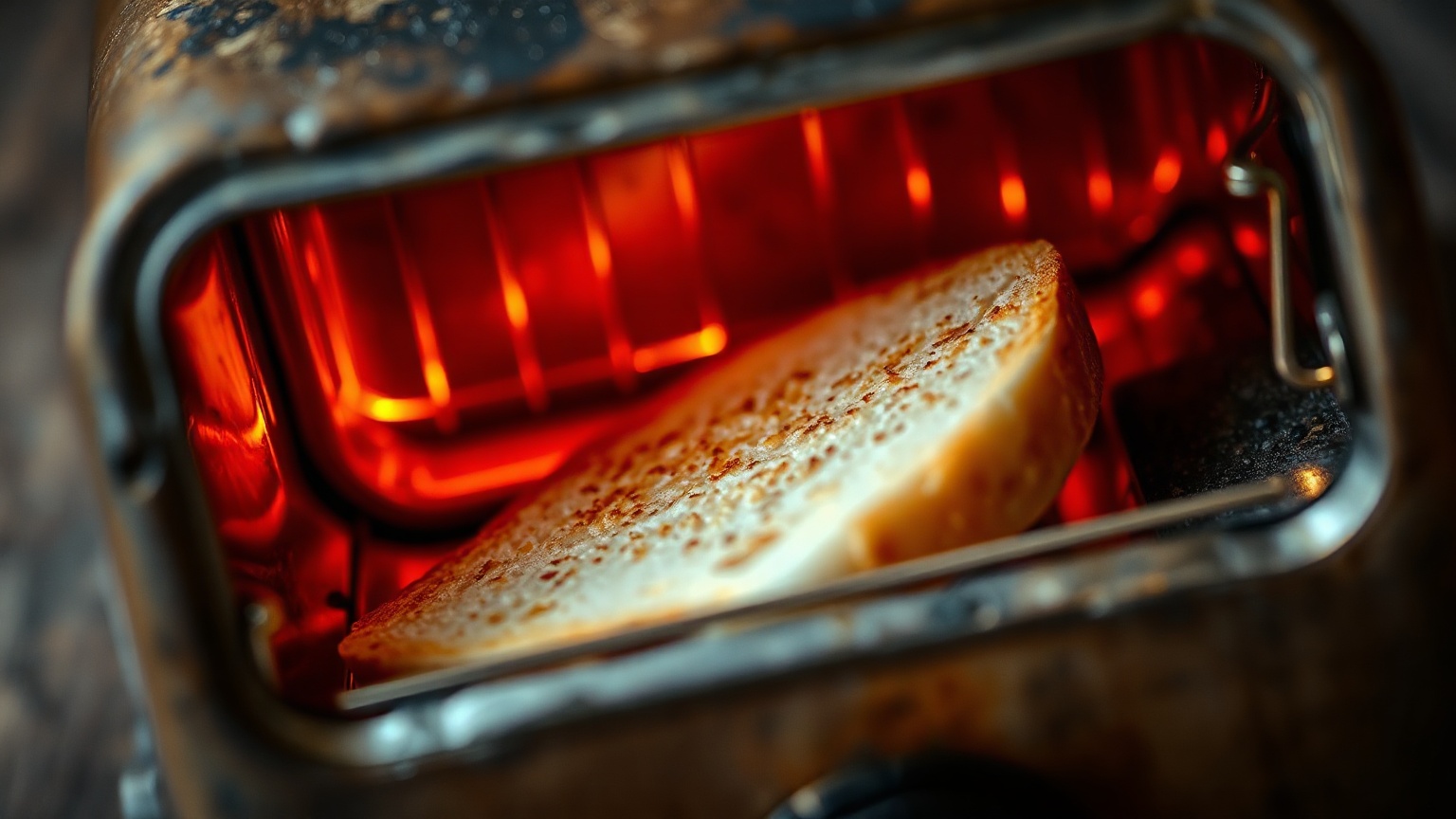
This is where it all starts. When you push the bread down, you’re not just lowering the bread into the toaster — you’re physically completing an electrical circuit. The lever is mechanically linked to a latch, usually a small catch that hooks onto a metal bar. That same motion closes a switch that allows current to flow from the wall outlet through the heating elements.
There’s also a spring underneath the carriage. It wants to push the bread back up immediately. The latch is what holds it down against that spring tension. The whole pop-up drama you see at the end? That’s just the spring finally getting its way.
First time I took apart an old two-slice toaster (a cheap Hamilton Beach I’d been using for years), I was genuinely surprised by how mechanical it all is. No circuit board, no microchip. Just a latch, a spring, and some very hot wire.
Step 2: The Heating Element — Nichrome Wire and Why It Glows
The heating element is the core of the whole operation. It’s almost always made from nichrome wire — sometimes spelled nichromium — which is an alloy of roughly 80% nickel and 20% chromium. Why nichrome? Because it has a high electrical resistance and doesn’t oxidize at high temperatures the way plain steel or copper would. Run current through copper and it’ll eventually corrode and break. Nichrome just keeps going.
The wire is wound into a tight coil or zigzag pattern and is usually wound around a thin piece of mica — a mineral that’s both heat-resistant and electrically insulating. That’s the pale, papery material you see if you look inside your toaster. The mica holds the wire in place without conducting electricity.
Why the Elements Glow Red
When current flows through the nichrome wire, resistance causes it to heat up. A lot. The wire’s surface temperature can reach somewhere around 1,100°F to 1,200°F — which is hot enough to emit visible light in the red-orange spectrum. That glow you see is real radiant heat, specifically near-infrared radiation. It’s the same physical principle as a campfire, just much more controlled.
This radiant heat travels across the air gap and hits the surface of your bread directly. It doesn’t need the bread to touch anything. That’s why uneven loading — say, a thin slice on one side and a thick bagel half on the other — can produce uneven toasting. The radiation hits whatever is closest and most exposed. I always use the bagel setting when I’m doing just one slice on one side; it cuts power to the outer element and concentrates heat inward. More toasters have this than people realize.
If you want to understand how hot a toaster gets at different shade settings, that’s a rabbit hole worth going down — the variance is bigger than you’d expect.
Step 3: The Timer or Thermostat — How the Toaster Knows When to Stop
This is the part that trips people up, because there are actually two different mechanisms used, and most people assume it’s always one or the other.
The Bimetallic Strip (Older Method)
Older and simpler toasters use a bimetallic strip as the timer. A bimetallic strip is exactly what it sounds like: two different metals bonded together in a thin strip. Because different metals expand at different rates when heated, the strip bends as the toaster heats up. Once the strip bends far enough, it trips the latch that’s holding the carriage down. Spring releases, toast pops up.
The shade dial? It physically adjusts how far the strip has to bend before it trips the latch. Lighter setting means less bending required, shorter toast time. Darker setting means more bending, longer time. Simple. Elegant, even.
One quirk of bimetallic strip toasters: the second round of toast always browns faster than the first. The strip is already warm at the start of round two, so it bends faster. My old Hamilton Beach did this constantly. I’d set it to 4 for the first batch and 3 for everything after. If you’ve ever wondered why your second batch burns when you didn’t change the dial, that’s why.
Electronic Timer Circuits (Newer Method)
Electronic Timer Circuits (Newer Method)
More modern toasters use a simple RC circuit (resistor-capacitor) as a timer. When the lever is pushed down, the capacitor starts charging through the resistor. When the voltage reaches a set threshold, a transistor triggers and cuts the electromagnet holding the latch, releasing the spring. The shade dial adjusts the resistance in the circuit, which changes how quickly the capacitor charges, which changes the toast time.
Electronic timers are more consistent across multiple batches because they’re not affected by residual heat the way bimetallic strips are. But they’re also less intuitive to repair when something goes wrong. Tradeoffs everywhere.
The Electromagnet That Holds It All Together
Whether the toaster uses a bimetallic strip or an electronic timer, many designs include a small electromagnet that keeps the carriage latched down while current is flowing. When the timer trips, the electromagnet de-energizes, the mechanical latch releases, and the spring fires. It’s a cascade of tiny mechanical events happening in under a second.
Step 4: The Maillard Reaction — What’s Actually Happening to Your Bread
Step 4: The Maillard Reaction — What’s Actually Happening to Your Bread
The browning isn’t just drying out. It’s chemistry. The Maillard reaction is a chemical reaction between amino acids and reducing sugars in the bread’s surface, and it requires temperatures above roughly 280°F–330°F to get going properly. Below that threshold, you’re mostly just drying the bread out, which gives you pale, stiff toast with none of the flavor.
That nutty, slightly caramelized flavor in good toast? That’s hundreds of new flavor compounds being created in a few seconds of intense radiant heat. Go too far past 350°F on the bread surface and you start producing acrylamide, which is a compound formed in starchy foods at high heat. The FDA has guidance on acrylamide in food if you want to read more — the short version is that very dark toast isn’t a great habit, and light-to-medium is where you want to be most of the time anyway.
Toaster Wattage and Temperature: A Side-by-Side Look
Not all toasters heat the same. Here’s a rough breakdown of how wattage relates to toasting power and typical internal temperature range:
| Toaster Type | Typical Wattage | Internal Temp Range | Toast Time (Medium Setting) |
|---|---|---|---|
| Basic 2-slice pop-up | 800–1,000W | 300°F–400°F | 90–120 seconds |
| Standard 4-slice pop-up | 1,400–1,800W | 350°F–450°F | 75–100 seconds |
| Wide-slot bagel toaster | 1,000–1,200W | 300°F–420°F | 100–130 seconds |
| Toaster oven (toast mode) | 1,200–1,800W | 400°F–500°F | 4–6 minutes |
Toaster ovens in toast mode actually run hotter and longer than pop-up toasters, but the radiant source is farther from the bread. That distance matters — radiant intensity drops with the square of distance, so a 500°F element two inches away is more intense than a 500°F element four inches away. Pop-up toasters win on pure speed for a single slice; toaster ovens win on capacity and consistency for four or more slices at once.
If you’re doing more than just toast — reheating pizza, warming leftovers — then a toaster oven is worth the counter space. I use mine daily. Here’s more on reheating food in a toaster oven if that’s relevant to you. And if you’re short on counter space, my roundup of the best mini toaster ovens is worth a look.
For anyone shopping for a replacement, a wide-slot stainless steel pop-up toaster handles sourdough and bagels without the drama of cramming thick bread into a standard slot. And if you want to level up your toaster oven setup, a proper toaster oven wire rack makes a surprising difference for airflow and even browning.
The Edge Case Most Articles Miss: What Happens When the Toaster Jams
Here’s something I’ve never seen covered in the standard “how toasters work” explainers: what actually happens when the carriage jams partway down and won’t latch?
Usually it’s crumbs. The crumb tray gets so packed that debris physically blocks the spring mechanism from fully compressing, or worse, a chunk of crust gets wedged between the carriage and the side wall. In bimetallic strip models, this can mean the strip trips before the carriage fully descends — so it looks like it’s latching but then pops up almost immediately. People assume the thermostat is broken. Often it’s just a filthy crumb tray.
In electronic timer models, a partial latch is more dangerous — if the bread is sitting half-in and the elements are still energized, you’re running the heaters without the bread acting as a thermal sink. The internal temperature can spike faster than normal and trip a thermal fuse (if your toaster has one) or, in cheap models that lack one, potentially cause a problem. Unplug it, clean it out, then try again. Seriously, clean your crumb tray. I have a petty but firm opinion about this: a toaster that’s never had its crumb tray emptied is a fire hazard masquerading as a kitchen appliance.
Some better toasters include a thermal cutoff fuse as a failsafe — it’s a one-time-use device that permanently breaks the circuit if the internal temperature exceeds a safe threshold. If your toaster suddenly stops working entirely and won’t power on at all, a blown thermal fuse is the most likely culprit. Not worth repairing in a cheap model. Worth knowing about in a quality one.
The Bottom Line
A toaster is one of those appliances that seems trivially simple but has a surprisingly elegant set of systems working together: resistive heating wire, radiant heat transfer, a mechanical latch, and a timing mechanism that releases it all at the right moment. Understanding it won’t make your toast taste better, but it does explain why your second batch always burns, why thick bread toasts unevenly, and why you should really, actually empty the crumb tray.
If you want to get more out of your appliance — or you’re deciding between a pop-up toaster and a toaster oven — knowing how the heat actually works gives you a real leg up. A toaster oven baking pan is a small buy that opens up a lot of options once you understand the heat dynamics at play.
Frequently Asked Questions
How hot does a toaster get?
The nichrome wire elements inside a toaster can reach surface temperatures of 1,100°F–1,200°F, while the internal air temperature sits closer to 300°F–500°F depending on the shade setting. The bread’s surface typically hits 300°F–350°F during normal toasting, which is the range where the Maillard reaction produces browning and flavor. On a maximum setting, surface bread temperatures can push past 400°F, which is where you start getting char rather than toast.
Why does my second batch of toast always come out darker?
Toasters with bimetallic strip timers start warm on the second batch, so the strip bends to the trip point faster than it did when the toaster was cold. This shortens the effective toast time even though the dial hasn’t moved. Lower the shade setting by one notch for your second and subsequent batches. Electronic timer toasters are less susceptible to this, though not entirely immune if the internal temperature has climbed significantly.
Is it safe to leave a toaster plugged in?
A toaster that’s plugged in but not in use draws minimal standby power and isn’t actively dangerous, but fire safety organizations generally recommend unplugging small appliances when not in use, especially if you’re leaving the house. The bigger risk is a crumb-filled toaster that gets accidentally activated — by a child, a falling object, or a stuck lever. Unplug it when you’re not around, and clean the crumb tray regularly.
What is the nichrome wire in a toaster made of?
Nichrome wire is an alloy composed of approximately 80% nickel and 20% chromium. It’s used in toasters because it has high electrical resistance (which generates heat efficiently), a high melting point around 2,550°F, and excellent resistance to oxidation at high temperatures. Plain steel or copper wire would corrode and break relatively quickly under the same conditions.
Can a toaster catch fire?
Yes, and crumbs are the most common cause. Accumulated crumbs at the bottom of the toaster can ignite when they get close enough to the elements, especially if the crumb tray is full or missing. Other causes include toasting foods with high fat content (like buttered bread placed directly in a pop-up toaster), a jammed carriage that keeps elements energized without proper airflow, and operating the toaster under a cabinet or against a wall. Keep the crumb tray empty, give the toaster clearance on all sides, and never toast buttered bread in a pop-up model.

Written by
Emma founded Toastera to turn vague appliance advice into clear, researched, safety-first guidance on toasters and toaster ovens.
Free: the Toaster Oven Cheat Sheet
Get the printable cheat sheet (temps, cook times & safety tips) plus new recipes. No spam, unsubscribe anytime.