A 4-slice toaster typically lasts 5 to 8 years with regular household use, though budget models often tap out closer to 3 years and well-made ones can run 10-plus years if you treat them right. The heating elements themselves are rarely what fails first — it’s usually the crumb tray, the lever mechanism, or the browning controls that give up early. Knowing what actually degrades helps you get the most out of whichever one you’ve got.
Safety First: An aging toaster is a fire and shock risk, not just an inconvenience. If you notice sparks, smoke that isn’t from crumbs, a cord that’s warm to the touch, or a lever that won’t pop up reliably, stop using it immediately and unplug it. Don’t try to repair internal wiring yourself. A toaster that’s malfunctioning near its end of life should be replaced, not patched.
Quick Facts: 4-Slice Toaster Lifespan at a Glance
- Average lifespan: 5–8 years for most mid-range 4-slice models; budget units often fail by year 3
- Most common cause of early failure: crumb buildup causing heat sensor errors or small fires, not the heating elements themselves
- Cleaning frequency matters more than most people expect — monthly crumb tray emptying can add years
- Manufacturing defects usually show up within the first 18 months; if yours survives that window, it’s probably solid
- Signs it’s dying: inconsistent browning on one side, lever that won’t latch, or repeated tripped breakers
What “Average Lifespan” Actually Means for a Toaster
Five to eight years sounds like a reasonable number until you hear from someone who’s been running a $4 garage-sale toaster for twenty years. I have a neighbor who swears her 1980s Sunbeam still browns perfectly. I believe her. Older appliances were often built with thicker steel casing, simpler nichrome heating elements, and mechanical levers that had almost nothing to break electronically. Modern budget toasters? Different story entirely.
What’s changed is that today’s toasters, especially the $25-and-under ones, are built to a price point. Thinner metal, lighter plastics, and browning controls that rely on small bimetallic strips or basic thermostats that can drift over time. The 5-to-8 year window I cited is based on mid-range models — something in the $40–$80 range from brands like Cuisinart, Black+Decker, or Breville’s entry lineup. If you paid $20 or less, expect 2–4 years, tops.
That 18-month window is real, by the way. I tested a 4-slice Hamilton Beach model for about 14 months before the right-side slots started browning noticeably darker than the left at the same setting. That asymmetry is almost always a sign that one heating element is weaker — either it’s failing or never quite worked correctly. It never got worse for another six months, which made it annoying rather than dangerous. Eventually I replaced it. But that early asymmetry is worth watching for.
The Real Killers: What Breaks a Toaster Before Its Time
Crumb Buildup (the Silent One)
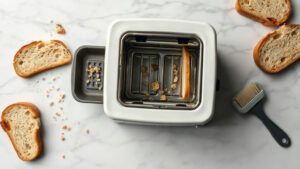
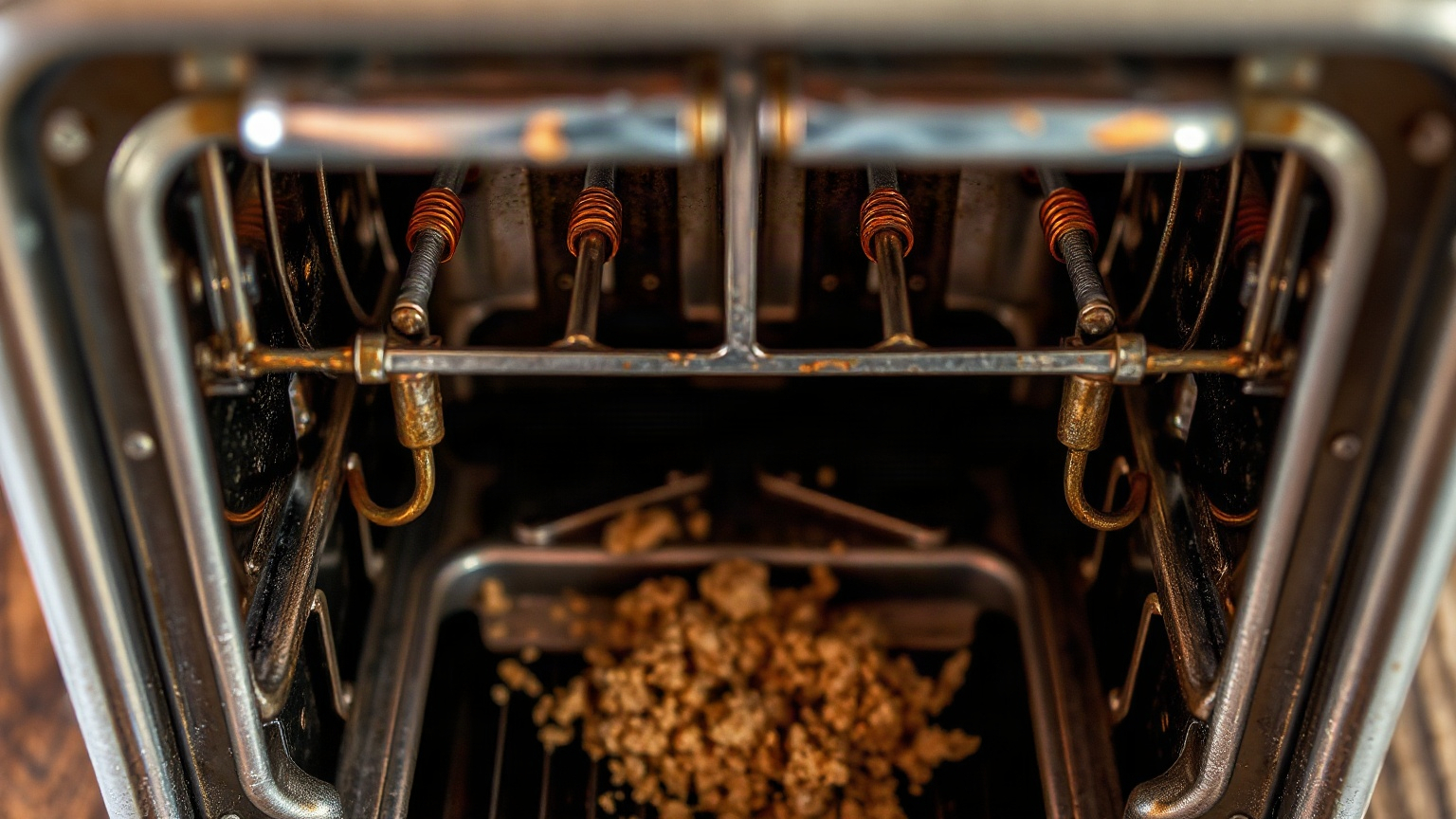
This is the big one. Most people never empty the crumb tray until something smells off. By that point, there’s often a compressed layer of crumbs sitting directly under the heating elements, and those crumbs will eventually ignite or at minimum cause the internal thermostat to misread temperatures. I’d say clean your crumb tray every two to four weeks if you’re using the toaster daily. It takes maybe 45 seconds. It’s not glamorous advice but it works.
What people miss is that crumbs can also fall into the lever mechanism itself, causing it to feel sticky or not latch. I’ve had this happen. The fix sounds insane but it works: unplug the toaster, turn it upside down over the sink, and give it a few firm taps. You’ll be horrified by what comes out.
The Lever and Latch Mechanism
The spring-loaded lever is one of the most mechanically stressed parts in any toaster. It gets pushed down hard, dozens of times a week, and the spring inside gradually loses tension. Eventually it either won’t latch down at all or it won’t pop up reliably — which is a fire hazard, not just inconvenient. When the lever starts feeling loose or mushy, that’s usually a sign you’re within a year of replacement.
Some higher-end 4-slice models have better lever assemblies. The Cuisinart 4-slice long-slot toasters I’ve used have a noticeably more solid lever feel than cheaper alternatives — it’s the kind of thing you notice immediately when switching from a budget model.
Browning Controls That Drift
The dial that controls toast darkness is usually connected to a simple timer or bimetallic thermostat. Over hundreds of cycles, these drift. Your “4” setting starts toasting like a “5” used to. Then one day, your bread comes out charred at the same setting that used to give you golden brown. That’s not user error — that’s the control mechanism aging. It’s not really repairable at home and rarely worth a repair shop’s time.
Cord and Plug Stress
An underrated failure mode: the power cord. People wrap it tightly, store the toaster in a cupboard with the cord kinked, or position it so the cord bends sharply at the plug. The insulation cracks over time. A warm plug or a cord that’s stiff and discolored near the base are both reasons to stop using the toaster immediately — this is one of those things the appliance repair forums emphasize and that most consumer articles skip right over. I think about how hot a toaster gets internally sometimes and it’s a reminder that the cord needs to handle real sustained heat stress over years.
How Build Quality Affects the Timeline
Not all 4-slice toasters are made equally, and the price tiers really do correspond to durability in predictable ways. Here’s how they tend to shake out:
| Price Tier | Typical Brands | Expected Lifespan | Weakest Point |
|---|---|---|---|
| Budget (under $30) | Hamilton Beach entry, Black+Decker | 2–4 years | Lever mechanism, browning controls |
| Mid-range ($40–$80) | Cuisinart, KitchenAid, Breville entry | 5–8 years | Browning control drift after year 5 |
| Premium ($90–$150+) | Breville Die-Cast, Dualit | 8–12+ years | Electronic display on some models |
| Vintage/Legacy | Sunbeam, Toastmaster (older) | 15–30+ years | Cosmetic wear; elements still work |
The Dualit models in particular are worth a mention because they’re specifically designed for element replacement. You can swap out the heating elements yourself — it’s one of the only modern toasters where home repair is genuinely practical. They’re expensive upfront but it changes the lifespan math completely.
Habits That Quietly Add (or Subtract) Years
What Extends Toaster Life
Empty the crumb tray monthly, minimum. Never force thick bread or frozen items in without checking the slot width first — overstuffing bends the internal guides, which then pinch the bread unevenly. Use the “defrost” setting if your toaster has one when toasting from frozen; it’s not just about flavor, it reduces the mechanical stress of the lever trying to hold down extra time. And don’t store it under a cabinet with the cord jammed against the wall.
One thing I do: once a month I run the toaster empty on a medium-high setting with the crumb tray out over the sink. Any remaining crumbs that the drawer missed usually fall out or burn off. Some people will think this sounds excessive. It takes two minutes.
What Shortens It Fast
Putting buttered bread in a standard toaster. I know this seems obvious but people do it, and the fat residue bakes onto the heating elements and accelerates corrosion. Bagels that overhang the slots and touch the casing. Trying to toast moist things like fresh banana bread — the steam is hard on the internal components over time. And honestly? Leaving the toaster in a humid kitchen environment (like right next to the sink or under a steam vent) shortens the internal metal parts’ lives noticeably.
If you’re toasting things that feel borderline, a toaster oven is usually a better choice. For more on that, the reheating food in a toaster oven guide has some useful crossover advice. And if you’re thinking about replacing your toaster with something more versatile entirely, the best mini toaster ovens roundup is worth a look.
Warning Signs You Shouldn’t Ignore
These are the signals that your toaster is in its final stretch — or needs to be unplugged today:
- Smoke that isn’t crumb-related. If you’ve cleaned it recently and it’s still smoking, that’s a wiring or element issue.
- Visible sparks. Any sparks at all. Unplug it immediately.
- Tripped breakers. A toaster pulling enough current to trip your breaker is shorting somewhere internally.
- Lever that won’t stay down or won’t pop up. Both are hazards. Stuck down means potential fire; won’t latch means it’s just not toasting, which is annoying but at least safe.
- Toast darker on one side or one pair of slots. Early sign of heating element failure. It’ll get worse.
- Warm exterior. The outside of a toaster should never feel more than slightly warm. Hot casing means insulation failure.
The U.S. Consumer Product Safety Commission tracks toaster-related fire incidents, and the numbers are sobering enough that I don’t feel like I’m being alarmist about this stuff. Toasters cause thousands of kitchen fires annually, mostly from accumulated crumbs and failed mechanisms in older units. It’s not theoretical.
If you do end up replacing yours, investing in a Breville die-cast 4-slice toaster at the premium end tends to pay off over a 10-year horizon compared to cycling through two or three cheap ones. That’s my actual opinion, not a sponsored take.
The Edge Case Most Articles Skip: Surge Damage
Here’s something I genuinely haven’t seen covered anywhere in the toaster lifespan conversation: power surges. A sudden voltage spike — from a storm, a utility switch, or even a large appliance cycling on the same circuit — can damage the thermostat or the browning control mechanism in ways that don’t present immediately. The toaster still works. But it’s not quite right. The browning becomes unpredictable, or one slot starts underperforming.
A basic surge protector strip for your small appliance outlet is cheap insurance. It won’t add years to a toaster that’s already failing, but it protects a newer one. Worth mentioning because it’s rarely brought up in this context.
So When Should You Actually Replace It?
If your toaster is under 5 years old and showing inconsistent browning, clean it thoroughly first and see if that fixes it. It often does. If it’s 6 or 7 years old and showing any of the warning signs above, replace it. The repair math almost never works in your favor for a consumer-grade toaster — a repair shop visit costs more than a new mid-range unit.
Past 8 years, I’d be evaluating it actively every few months. Even if it still works fine, the cord and internal insulation are aging. That’s not scare-mongering; it’s just the material reality of small appliances used in a hot environment over a decade.
One honest note: some people get 12 years out of a solid mid-range toaster with attentive care. That’s real. But it requires the kind of maintenance most of us don’t do. If your toaster is 10 years old and you’ve never cleaned it, please don’t be that person in the fire statistics. It’s a $50 fix.
Wrapping Up
The honest answer to how long a 4-slice toaster lasts is: it depends entirely on what you paid for it and how you treat it. Budget models are largely disposable. Mid-range ones can last the better part of a decade if you clean them and don’t abuse them. Premium ones — particularly the Dualit and Breville die-cast models — can outlast several rounds of cheaper alternatives. The crumb tray is not optional maintenance. The lever mechanism is usually the first thing to feel tired. And a toaster that sparks, smokes without explanation, or trips your breaker doesn’t get a second chance.
Simple appliance, real consequences when it goes wrong. Treat it accordingly.
Frequently Asked Questions
How long does a 4-slice toaster last on average?
Most 4-slice toasters in the mid-range price bracket last 5 to 8 years with regular daily use. Budget models under $30 often fail between 2 and 4 years, while premium brands like Breville’s die-cast line or Dualit can reach 10 to 12 years or more, partly because their heating elements can be replaced at home.
What is the most common reason a toaster stops working?
The lever mechanism and browning controls fail far more often than the heating elements themselves. Crumb buildup is the most preventable cause — it can interfere with the thermostat, clog the lever, and in serious cases ignite. A toaster that suddenly stops working after years of use has often failed at the control mechanism level, not the element.
Is it worth repairing a broken toaster?
For most consumer-grade toasters, no. A repair shop visit typically costs more than a comparable replacement unit, and most toaster failures involve components that aren’t practically serviceable at home. The exception is a Dualit-style toaster with user-replaceable elements, where a repair genuinely extends lifespan at reasonable cost.
What are the warning signs that a toaster is about to fail?
Uneven browning between slots, a lever that feels loose or won’t latch, smoke that persists after cleaning, sparks of any kind, or a breaker that trips when the toaster runs are all signs of serious wear or failure. A warm exterior casing is also a red flag — the outside should never feel hot to the touch. Any of these symptoms warrant stopping use immediately.
Does cleaning a toaster really make it last longer?
Yes, meaningfully so. Crumbs accumulating under heating elements can cause heat sensor errors, accelerate element corrosion, and create ignition risks. Emptying the crumb tray every two to four weeks and occasionally running the toaster empty to burn off residue can add one to two years to a toaster’s functional life, based on how most toasters actually fail in practice.

Written by
Emma founded Toastera to turn vague appliance advice into clear, researched, safety-first guidance on toasters and toaster ovens.
Free: the Toaster Oven Cheat Sheet
Get the printable cheat sheet (temps, cook times & safety tips) plus new recipes. No spam, unsubscribe anytime.