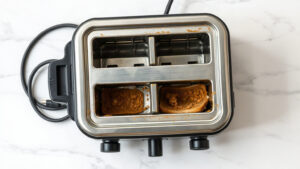
A 2-slice toaster should last between 6 and 10 years under normal daily use, though budget models often die in 2 to 3 years while well-built units from brands like Dualit or Breville regularly hit 15 years or more. The difference almost always comes down to build quality and how the toaster is maintained. If yours quit after 18 months, that’s not bad luck — it’s a pattern with certain brands, and it’s worth understanding why before you buy again.
Safety First: Never shake crumbs out over a sink or near water — toasters contain exposed heating elements and electrical components that can short-circuit if moisture gets inside. Always unplug your toaster before cleaning it, and never stick anything metal into the slots to free stuck bread. If your toaster sparks, smells of burning plastic, or the lever won’t stay down, stop using it immediately and unplug it from the wall.
Quick Facts: 2-Slice Toaster Lifespan
- Average lifespan: 6–10 years for mid-range models with regular use
- Budget toasters (under $25) often fail within 1–3 years
- Premium toasters (Dualit, Breville) can last 15–20+ years with basic care
- The most common cause of early failure: crumb buildup causing element damage or lever mechanism jams
- Most toasters are not repairable once the heating element fails — but some premium ones are
What “Normal” Toaster Lifespan Actually Looks Like
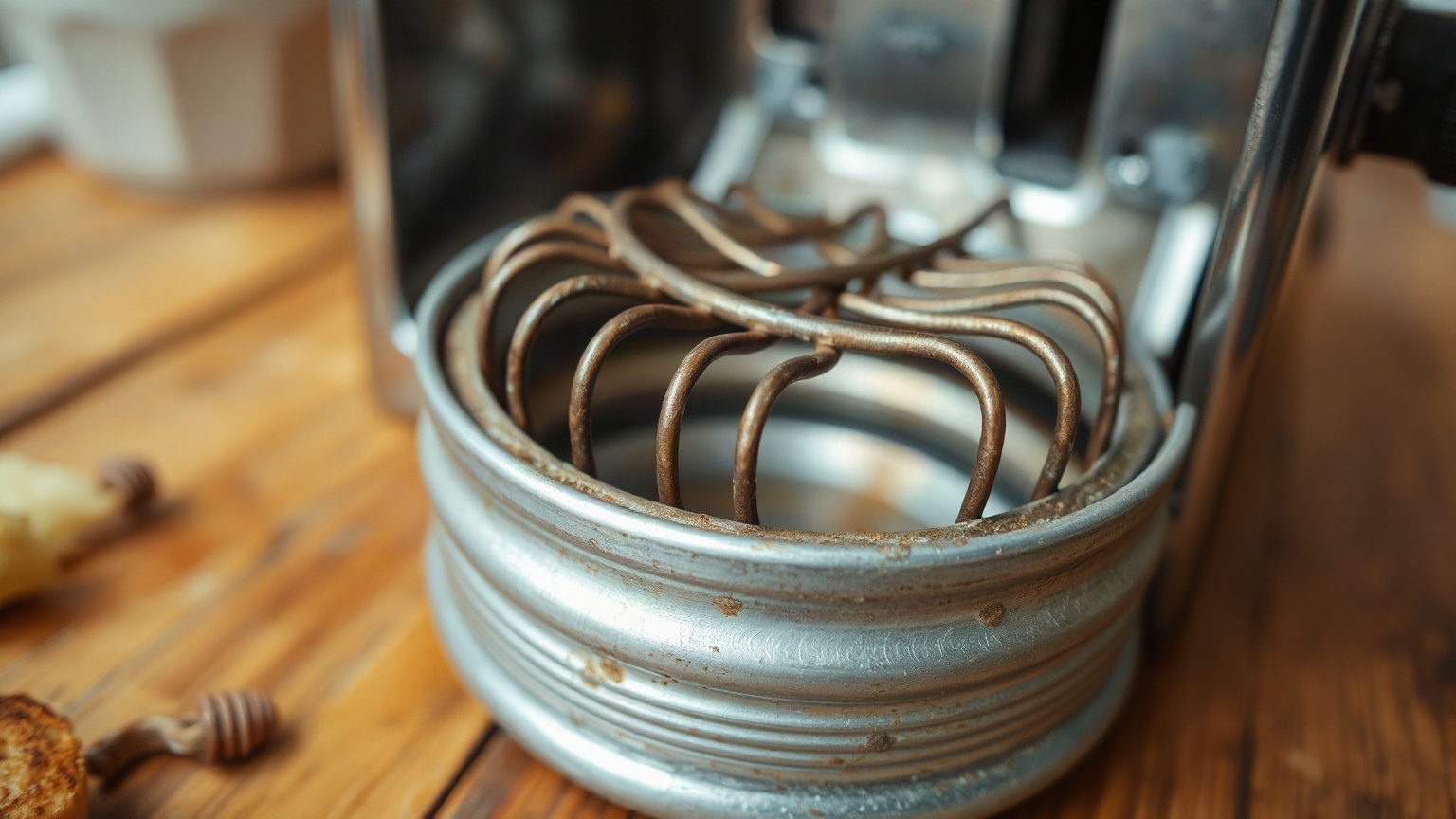
I’ve had four toasters in my kitchen over the years. One lasted 11 years. One lasted 14 months. The difference wasn’t brand loyalty or luck — it came down to what they were made of and how I used them.
The honest answer is that “6 to 8 years” is a reasonable middle-ground expectation, but that number hides a lot of variance. Consumer appliance data and repair forums consistently show a split: cheap toasters cluster around the 1–3 year mark, mid-range ones around 5–8 years, and genuinely well-made toasters — the ones with stainless steel bodies, replaceable elements, and solid lever mechanisms — routinely hit 15 years and beyond.
That Dualit people mention online? I’ve seen the same thing. Someone posts that their 17-year-old Dualit still works, asks if they should replace it, and the answer is basically: no. Dualit makes their elements replaceable. It’s genuinely repairable in a way that a $22 Hamilton Beach simply isn’t.
How Brand Tier Maps to Real-World Longevity
| Price Tier | Typical Brands | Expected Lifespan | Repairable? |
|---|---|---|---|
| Budget (under $30) | Hamilton Beach, Black+Decker, Oster | 1–3 years | No |
| Mid-range ($30–$80) | Cuisinart, KitchenAid, Dash | 4–8 years | Rarely |
| Premium ($80–$150+) | Breville, Smeg, Krups | 8–12 years | Sometimes |
| Pro/Heritage ($150+) | Dualit, Rowlett | 15–25+ years | Yes |
That table isn’t gospel — I’ve seen a cheap Oster survive 7 years in a light-use vacation home, and I’ve seen a Breville die in four. But as a general pattern, it holds up.
The Real Reasons Toasters Die Early
This is where most people get it wrong. They assume a toaster quit because it was cheap. Sometimes that’s true. But often it’s maintenance — or the lack of it.
1. Crumb Buildup (The Slow Killer)
Crumbs accumulate in the bottom of every toaster. That’s what the crumb tray is for. But here’s the thing — most people never empty it. I went about three months without emptying mine once and noticed the toast starting to smell slightly burned even on a medium setting. That’s crumbs scorching on the lower element.
When crumbs build up enough, they can actually contact the heating element and cause it to arc or burn out unevenly. They also create a fire risk. Empty the crumb tray every week if you use the toaster daily, or at minimum every couple of weeks. It takes about eight seconds.
2. Lever Mechanism Failure
The most common repair question I see — including one that popped up just last year from someone whose toaster “stopped after 3 years” — is the lever not staying down. The bread goes in, you press the lever, and it pops right back up without latching.
This is usually either a worn latch spring or a magnet that’s lost its hold. In cheaper toasters, that latch is plastic. It’s going to wear out. In older or better-made ones, the mechanism is metal and much more durable. When a cheap toaster’s lever fails, the toaster is essentially done — it’s not worth having it repaired.
3. Heating Element Degradation
Heating elements are thin wires — nichrome, usually — wound around a mica sheet. They get to temperatures between 300°F and 500°F every single time you toast. You can read more about how hot a toaster gets internally, but the short version is: that’s a lot of thermal stress over thousands of cycles.
Eventually elements fail. In Dualit-style toasters you can order a replacement element for around $15 and swap it yourself in about 20 minutes. In basically every other consumer toaster, the element is riveted inside a sealed assembly and you can’t get to it. Done.
4. Moisture and Steam
Toasting fresh bread — still slightly warm from the oven, or anything with high moisture content — introduces steam into the slots. Over time, moisture corrodes the internal components. This is especially true for frozen bread toasted frequently. The outside goes in cold, the ice melts, and water vapor gets into the mechanism.
Not saying don’t toast frozen bread. Just keep in mind it adds wear. If you do it daily, your toaster’s working harder than you think.
5. Physical Damage to the Cord
Underrated cause of early failure: the power cord. People push toasters against walls, let the cord get pinched under the base, or wrap it tightly around the unit for storage. The insulation cracks. That’s both a failure point and genuinely a fire hazard. Keep the cord loose and inspect it once a year.
Signs Your Toaster Is About to Give Up
There are usually warnings before a full failure. Here’s what to watch for:
- Uneven toasting: One side is golden, the other is pale. Usually means one element is partially failing.
- Toast taking longer than it used to: On the same setting you’ve used for years, the bread is coming out underdone. Element degradation.
- The lever doesn’t latch: As covered above — spring or magnet failure. Often terminal in budget models.
- Burning smell without obvious crumbs: Could be insulation on the element breaking down. Don’t ignore this one.
- Sparking or flickering: Stop. Unplug it. This isn’t a “wait and see” situation.
I’d add one more that people miss: if the toaster’s exterior gets unusually hot during normal use — hot enough that you can’t comfortably rest a hand near (not on) the side — that’s a sign that internal heat is not being managed properly. Could be insulation wearing down, could be crumb buildup affecting airflow.
How to Actually Make Your Toaster Last Longer
Maintenance is boring. I know. But it genuinely extends lifespan and I’ve seen the difference firsthand.
- Empty the crumb tray weekly if you toast daily — it’s the single highest-impact habit
- Keep it away from steam sources like the kettle or the stove
- Don’t store things on top of it — the heat venting from the top needs clearance
- Unplug it when not in use, especially if you’re away — it draws a small phantom load and there’s no reason to leave a heating appliance live on the counter
- Don’t force oversized bread in — thick bagel halves that scrape the elements leave crumbs on the wires and can cause uneven burning
One thing nobody mentions: if you toast a lot of high-moisture or heavily seeded bread, consider shaking the crumb tray out more frequently because seeds and dense crumbs accumulate faster than standard sandwich bread crumbs. I learned this after a brief period of making seeded rye toast every morning and finding the crumb tray absolutely full within a week.
The Edge Case Most Guides Don’t Mention: Toaster vs. Toaster Oven Lifespan
Here’s something the competing articles skip entirely. If you’re debating between a 2-slice toaster and a compact toaster oven, lifespan should actually factor into your decision.
A 2-slice toaster is a simpler machine with fewer moving parts (mostly just the lever, the elements, and the thermostat). That simplicity means there’s less to break — but when something does break, it’s usually not fixable.
A toaster oven is more complex: it has a door, multiple rack positions, a timer, often a convection fan, and more wiring. More failure points. But because it’s bigger, parts are more accessible and toaster ovens get used for a wider range of tasks which distributes the wear differently. Some people find their toaster oven outlasts three consecutive pop-up toasters because they maintain it better — it’s more “appliance-like” and gets treated that way.
If you mostly just want toast and nothing else, a good 2-slice toaster is simpler and easier to care for. But if you’re open to a small countertop oven doing double duty, check out the best mini toaster ovens — the lifespan math sometimes favors the oven over multiple cheap toaster replacements.
Also — and this is very specific — if you live in a hard-water area, consider that steam from your kettle or pot can deposit mineral residue inside a toaster over time. It’s slow. It’s annoying. It’s real. I noticed subtle corrosion on the inside of a slot on a toaster I’d kept right next to a frequently-boiled kettle for years. Moving the toaster fixed it. Simple fix I should have thought of earlier.
Should You Repair or Replace a Dead Toaster?
For anything under about $60: replace it. The cost of a service call, if you could even find someone willing to work on a toaster, would exceed the value of the appliance within minutes. Toasters are cheap enough that repair rarely makes financial sense — except for Dualit-style models where you can DIY the element swap yourself.
If you spent $100+ on a toaster and it’s under 5 years old, it might be worth contacting the manufacturer. Breville, for example, has a decent customer service reputation and may replace or repair under warranty. Keep your receipt.
The environmental calculus is real too. Replacing a toaster every 2–3 years because you bought cheap means more e-waste. Spending more upfront on a long-lasting 2-slice toaster built to last costs more once but less over a decade, and there’s something to be said for not contributing to landfill with a steady stream of dead cheap appliances.
If you do replace, look for a wide-slot stainless 2-slice toaster with a metal lever mechanism rather than plastic. That one spec alone will add years.
The Bottom Line
A 2-slice toaster should last you at minimum 5 to 6 years if you buy mid-range and take basic care of it. Buy cheap and ignore the crumb tray and you’ll be replacing it in 18 months. Buy well, maintain it properly, and you could genuinely have the same toaster for 15 years — I’ve seen it happen, and there’s something satisfying about an appliance that just quietly does its job for over a decade without complaint.
The lever failing is the most common cause of death in budget models. Crumb buildup is the most preventable. And if you want real longevity, the brands that let you replace elements — Dualit being the obvious one — are in a different category from everything else on the market. They cost more upfront. They’re worth it if you toast every single day.
Otherwise: empty that crumb tray, keep the cord loose, and move it away from the kettle. That’s genuinely most of the battle.
Frequently Asked Questions
How long does a 2-slice toaster last before it stops working?
A mid-range 2-slice toaster typically lasts 6 to 10 years with daily use and basic maintenance. Budget models often fail within 1 to 3 years due to lower-quality lever mechanisms and heating elements, while premium brands like Dualit can exceed 15 to 20 years because their parts are replaceable.
Why does my toaster lever not stay down anymore?
A lever that won’t latch is almost always a worn spring or a weakened magnet in the latch mechanism — both are common failure points, especially in plastic-bodied budget toasters. In most consumer toasters, this failure isn’t economically repairable; the toaster is effectively at end of life. In higher-end models with metal internals, the spring can sometimes be replaced.
Is it safe to leave a toaster plugged in when not in use?
It’s not dangerous in the immediate sense, but it’s not ideal either — a plugged-in toaster draws a small phantom load and remains a potential hazard if something goes wrong with the wiring or if crumbs ignite near a faulty element. Unplugging it after each use is a simple habit that reduces both fire risk and energy waste over time.
How often should I clean my toaster to make it last longer?
Empty the crumb tray at least once a week if you’re toasting daily — that’s the single most effective maintenance step. Wipe down the exterior with a damp cloth monthly, and do a more thorough internal shake-out (unplugged, over a bin) every few months to clear crumbs that fall past the tray and settle on the base plate near the elements.
Are expensive toasters actually worth the extra cost?
Yes, if you use a toaster every single day. A $150 Dualit that lasts 20 years costs significantly less per year than a $25 toaster you replace every 2 years — and produces far less waste. If you toast occasionally or just want something functional without spending much, a solid mid-range toaster in the $40–$60 range is the sweet spot for most households.
—
Written by
Emma founded Toastera to turn vague appliance advice into clear, researched, safety-first guidance on toasters and toaster ovens.
Free: the Toaster Oven Cheat Sheet
Get the printable cheat sheet (temps, cook times & safety tips) plus new recipes. No spam, unsubscribe anytime.