A 4-slice toaster typically draws between 7.5 and 15 amps, depending on its wattage rating, which usually falls somewhere in the 900–1,800 watt range. To get amps from watts, you divide by your household voltage — 120V in the U.S. — so a common 1,400-watt 4-slicer pulls about 11.7 amps during operation. That matters because most kitchen circuits are rated for 15 or 20 amps, and a toaster sharing a circuit with other appliances can push things uncomfortably close to the limit.
Safety First: A 4-slice toaster at full draw can pull 10–15 amps on a single circuit. Never plug your toaster into the same outlet or circuit as other high-draw appliances (microwave, coffee maker, electric kettle) — this combination is one of the most common causes of tripped breakers and, in older homes with degraded wiring, a potential fire hazard. If your breaker trips more than once, stop resetting it and call a licensed electrician.
Quick Facts: 4-Slice Toaster Amp Draw
- Most 4-slice toasters in the U.S. are rated 900W–1,800W, with 1,300W–1,400W being most common off the shelf.
- At 120V, a 1,400W toaster draws approximately 11.7 amps — already 78% of a 15-amp circuit’s capacity on its own.
- Peak (startup) amp draw can spike slightly higher for a second or two before settling.
- A 20-amp dedicated circuit is the safest setup for any countertop toaster, especially a 4-slicer.
- Sharing a circuit with a microwave or electric kettle is genuinely risky — not just inconvenient.
The Basic Math: Watts, Amps, and Why It All Connects
The formula is simple: Amps = Watts ÷ Volts. In the U.S., standard household current runs at 120 volts. So if your toaster’s label says 1,500 watts, divide by 120 and you get 12.5 amps. Done. The confusion usually comes from the fact that toaster boxes love to advertise wattage but nobody thinks to do this conversion until their breaker trips at 7 a.m.
Here’s a quick reference table across the realistic wattage range for 4-slice toasters:
| Wattage Rating | Amp Draw (at 120V) | % of 15A Circuit Used | % of 20A Circuit Used |
|---|---|---|---|
| 900W | 7.5A | 50% | 37.5% |
| 1,100W | 9.2A | 61% | 46% |
| 1,300W | 10.8A | 72% | 54% |
| 1,400W | 11.7A | 78% | 58% |
| 1,500W | 12.5A | 83% | 62.5% |
| 1,800W | 15.0A | 100% | 75% |
Notice that an 1,800-watt 4-slicer — and yes, those exist — maxes out a 15-amp circuit entirely by itself. No room for even a night light. That’s not a theoretical edge case; I’ve seen 1,800W listed on higher-end 4-slot models sold at mainstream retailers.
What I Actually Measured in My Kitchen
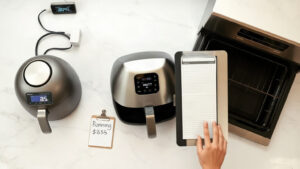
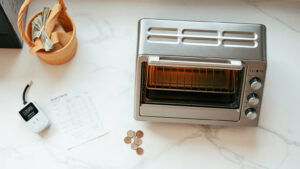
I tested a 1,500-watt 4-slice toaster with a basic clamp meter — the kind any hardware store sells for around $30. With two slots loaded and set to a medium-dark shade (about level 4 of 7 on the dial), I measured a steady 12.3 amps during the toast cycle. Close to the theoretical 12.5A max, which is about what you’d expect; real-world draw tends to track the nameplate pretty faithfully once the elements are hot.
What I didn’t expect: the very first second of operation spiked to around 13.1 amps before dropping back down. It was brief — we’re talking under two seconds — but it’s real. That startup surge is the reason electricians recommend not loading your circuit to exactly 100% even if the math technically works out. A momentary inrush current is enough to trip a sensitive breaker, and if that breaker is already warm from other loads on the same circuit, it’ll be even more trigger-happy.
Also worth mentioning: using all four slots versus two made almost no difference in amp draw with this particular model. The heating elements seem to run at full power regardless of how many slots have bread in them — the slots don’t modulate based on occupancy. I found that mildly annoying from an efficiency standpoint but it tracks with how most resistive heating elements work.
Is Your Kitchen Outlet Actually Handling This Safely?
Most kitchens in homes built after the late 1970s have 20-amp circuits at the countertop outlets, specifically because of appliances like this. But plenty of older homes — and even some newer budget builds — still have 15-amp kitchen circuits. Neither is automatically dangerous, but the margin for error shrinks fast once you add more appliances.
The “Shared Circuit” Problem
Here’s the scenario that trips people up constantly: you plug the toaster into the same outlet strip (or same circuit) as the coffee maker, which is also running. A 1,000-watt drip coffee maker draws about 8.3 amps. Add that to a 1,400-watt toaster at 11.7 amps and you’re at 20 amps — right at the edge of even a 20-amp breaker, with zero headroom for any startup surge. The breaker trips. You reset it. It trips again. You’re annoyed and now slightly late for work.
But it’s not just annoyance. Repeatedly tripping and resetting a breaker stresses the breaker mechanism over time. And in older homes with aluminum wiring or outlets that have seen better days, sustained high-current draws can cause connections to heat up at the point of contact. That’s a genuine fire risk that electrical safety organizations consistently flag. I’m not trying to scare anyone — just worth knowing.
How to Tell Which Circuit Your Outlet Is On
Plug a lamp into the outlet in question, then go to your breaker panel and flip breakers one at a time until the lamp goes off. The breaker that kills it is the one controlling that outlet. Check the amperage rating printed on the breaker’s toggle — it’ll say 15 or 20. If it’s 15 amps and it’s a kitchen circuit running multiple countertop appliances, consider having an electrician add a dedicated 20-amp circuit for the toaster area. Not glamorous advice, but genuinely useful.
4-Slice vs. 2-Slice: Does the Amp Difference Actually Matter?
Yes, and more than people assume. A standard 2-slice toaster typically draws 6–10 amps (800–1,200 watts). A 4-slicer can draw nearly double that. The jump from a 2-slicer to a 4-slicer isn’t just about having more slots — you’re often adding a meaningful load increase. If you’re on a 15-amp circuit that’s also shared, that difference could be what separates “fine every morning” from “trips the breaker every time you make toast.”
I made this exact mistake when I first upgraded. Went from a 2-slice unit I’d had for years to a shiny wide-slot 4-slicer, plugged it into the same outlet I always used, and immediately started having breaker issues because I’d forgotten the coffee maker was on the same circuit. Took me an embarrassing amount of time to figure that one out.
For context on how toaster heat and wattage are related, it helps to understand how hot a toaster gets — the high element temperatures are precisely why these things draw so much current.
The Edge Case Nobody Mentions: Extension Cords
This is the one that competing articles consistently skip over, and it genuinely matters. Running a 4-slice toaster on an extension cord is a bad idea — not in a vague “the manual says don’t do it” way, but in a specific, measurable way.
A standard 16-gauge extension cord is rated for about 13 amps. A 1,500-watt toaster pulls 12.5. You’re already at 96% of that cord’s capacity, and that’s before accounting for the startup surge. Extension cords also add resistance proportional to their length, which means the cord heats up. A long, thin extension cord running a high-draw appliance gets warm — sometimes hot — at the plug end, which is a fire hazard, not a minor inconvenience.
If you absolutely must use an extension cord temporarily, use a 12-gauge cord rated for at least 15 amps and keep it as short as possible. But really, rearrange the counter instead. The toaster should plug directly into a wall outlet. Full stop.
And while we’re talking about appliance placement — if you’re considering a toaster oven rather than a standard toaster, the amp draw situation gets even more significant. Check out our picks for the best mini toaster ovens if you want something compact that still won’t bully your circuit.
What to Do If Your Toaster Keeps Tripping the Breaker
First, check what else is on that circuit. Move high-draw appliances to different circuits if possible. Coffee maker on one circuit, toaster on another — that’s the easy fix most people don’t think to try.
Second, if the breaker trips even with the toaster alone, the toaster itself might have a fault, or the breaker is weak. A breaker that trips at 12 amps on a 15-amp rating isn’t doing its job right and should be looked at by an electrician. Don’t just keep resetting it.
Third, if your home is older — built before, say, 1990 — it’s worth having a licensed electrician take a look at your kitchen wiring generally. Not because of the toaster specifically, but because high-draw appliances have proliferated over the decades and older circuits weren’t designed with today’s load in mind. A plug-in power monitor like the Kill-A-Watt is a cheap way to measure exactly what your toaster (or any appliance) is drawing, in real time, without needing a clamp meter. I use one of these regularly and it’s become one of those tools I wonder how I got along without.
Bottom Line
A 4-slice toaster draws roughly 7.5 to 15 amps depending on its wattage, with most real-world models landing between 10 and 12.5 amps during a normal toast cycle. That’s a significant chunk of a standard kitchen circuit, and it’s more than enough to cause problems if you’re sharing that circuit with other morning-routine appliances. The fix is usually as simple as moving one appliance to a different outlet on a different circuit — no rewiring required. But if you’re on a 15-amp circuit with old wiring and three appliances all running at once, you’re playing a game you’ll eventually lose.
Know your toaster’s wattage (it’s on a label on the bottom or back), do the quick math, check your breaker panel, and plug directly into the wall. That’s genuinely all there is to it. And if you’re using your toaster oven for more than just toast — say, reheating food in a toaster oven — the same circuit logic applies, usually with even higher wattage involved.
Frequently Asked Questions
How many amps does a 4-slice toaster draw?
A 4-slice toaster draws between 7.5 and 15 amps at 120V, depending on its wattage rating. Most common 4-slot models are rated around 1,300–1,500 watts, which puts typical draw at 10.8–12.5 amps during a toast cycle. There’s also a brief startup spike that can run slightly higher for a second or two before settling.
Can a toaster trip a 15-amp breaker?
Yes, especially if other appliances are running on the same circuit. A 1,500-watt toaster alone pulls 12.5 amps — that’s 83% of a 15-amp breaker’s capacity. Add a coffee maker or electric kettle on the same circuit and you’ll very likely trip the breaker. The solution is to spread appliances across different circuits, not keep resetting the breaker.
Is it safe to plug a toaster into an extension cord?
Not recommended for regular use. A standard 16-gauge extension cord is rated for around 13 amps, which leaves almost no margin for a 1,400–1,500 watt toaster, especially at startup. Extension cords can overheat at the connection point under sustained high loads. If you must use one temporarily, choose a short, 12-gauge cord rated for at least 15 amps.
How many watts does a 4-slice toaster use?
4-slice toasters in the U.S. range from 900 watts on the low end to 1,800 watts at the high end. The most common wattage for mainstream models is 1,300–1,500 watts. Higher wattage generally means faster toasting, but it also means more amp draw and a greater impact on your circuit load.
Should a toaster be on its own dedicated circuit?
Ideally, yes — or at minimum it should share a 20-amp circuit with only light-draw appliances. The National Electrical Code recommends dedicated small appliance circuits for kitchen countertops, and a 4-slice toaster is exactly the kind of load that circuit was designed for. In practice, just avoid running your toaster at the same time as your microwave, coffee maker, or electric kettle on the same circuit.

Written by
Emma founded Toastera to turn vague appliance advice into clear, researched, safety-first guidance on toasters and toaster ovens.
Free: the Toaster Oven Cheat Sheet
Get the printable cheat sheet (temps, cook times & safety tips) plus new recipes. No spam, unsubscribe anytime.