A standard 2-slice toaster uses between 800 and 1,500 watts, with most mid-range models landing right around 1,200 watts. Because a typical toast cycle runs only 2–3 minutes, you’re not actually drawing a full hour’s worth of power — closer to 0.04–0.07 kWh per session. At the U.S. average electricity rate of about $0.16 per kWh, that works out to less than a cent per use, though it adds up if you’re toasting daily.
Safety First: Never leave a toaster unattended while in use, and always unplug it when you’re done — toasters draw a small standby current on some models and are a genuine fire risk if crumbs accumulate in the tray. Clear the crumb tray at least once a week, and keep the appliance at least 4 inches from cabinets or curtains while operating.
Quick Facts: 2-Slice Toaster Wattage at a Glance
- Typical 2-slice toaster wattage: 800W–1,500W (most hover near 1,100W–1,200W)
- Actual energy per toast cycle (2.5 min average): roughly 0.04–0.06 kWh
- Daily cost (one cycle, $0.16/kWh): about $0.006 — under one cent
- Monthly cost (one cycle per day): approximately $0.18–$0.29
- Standby draw when plugged in but idle: 0W–3W depending on model
What the Wattage Rating Actually Means
The wattage printed on the bottom of your toaster isn’t the energy it uses per hour of cooking. It’s the rate at which it consumes power while it’s actively running. A 1,200W toaster left running for a full hour would consume 1.2 kWh. But it never runs for a full hour. That’s the number that trips people up the most.
Think of wattage like a car’s horsepower. High horsepower doesn’t mean you’re always flooring it. A toaster fires up, heats the elements, does its thing in under three minutes, and clicks off. The high wattage is actually why it’s so fast — you need intense heat delivered quickly to brown bread without drying it out completely.
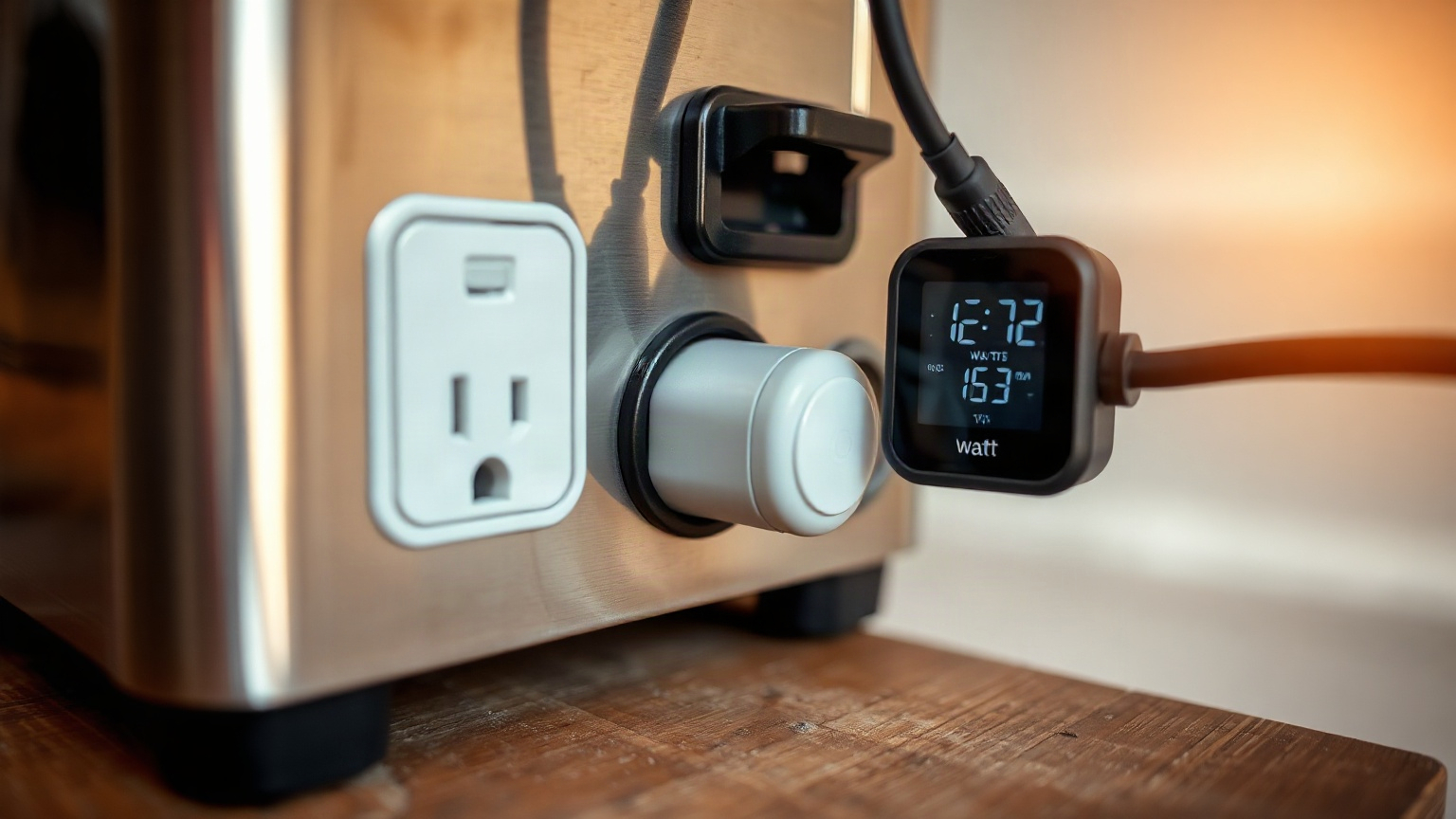
I’d also add that wattage ratings aren’t always perfectly accurate in practice. I tested my own Cuisinart CPT-122 (rated at 900W) with a plug-in power meter and it consistently pulled between 870W and 910W depending on the browning setting. Higher settings keep the elements on longer, which doesn’t change the wattage but does change the total energy consumed per cycle. A small but real distinction.
Real Wattage Numbers Across Different 2-Slice Toasters
Not all 2-slice toasters are created equal. Budget models from Hamilton Beach or Black+Decker tend to run lower — 750W to 900W. Mid-range models like the Cuisinart CPT-122 or KitchenAid KMT2115 are typically in the 900W–1,100W range. And premium toasters like the Breville BTA820XL or the Dualit Classic sit at 1,400W–1,500W. Dualit in particular is proud of its high wattage; it’s one reason those toasters brown so evenly and so fast.
| Toaster Model | Rated Wattage | Avg. Cycle Time | Energy Per Cycle (kWh) | Price Tier |
|---|---|---|---|---|
| Hamilton Beach 22633 | 850W | ~2.5 min | ~0.035 kWh | Budget |
| Cuisinart CPT-122 | 900W | ~2.5 min | ~0.038 kWh | Mid-range |
| KitchenAid KMT2115 | 1,100W | ~2 min | ~0.037 kWh | Mid-range |
| Breville BTA820XL | 1,800W | ~1.5 min | ~0.045 kWh | Premium |
| Dualit Classic 2-Slice | 1,500W | ~2 min | ~0.050 kWh | Premium |
Notice something? The premium high-wattage toasters don’t necessarily use dramatically more energy per slice — they just work faster. The total kWh per cycle is surprisingly similar across the range. The real differentiator is speed and browning consistency, not electricity cost. Worth keeping in mind if you’re buying a new one.
How to Calculate Your Exact Monthly Cost
Here’s the formula, and it’s simple. You’ll need three things: your toaster’s wattage (on the label on the bottom), your average toast cycle time in minutes, and your electricity rate per kWh (check your utility bill — the U.S. average is around $0.16/kWh as of 2024, but it ranges from about $0.10 in Louisiana to $0.30+ in California and Hawaii).
The Math, Step by Step
Let’s use a 1,200W toaster with a 2.5-minute cycle as the example.
- Convert minutes to hours: 2.5 ÷ 60 = 0.0417 hours
- Multiply by wattage: 1,200 × 0.0417 = 50 watt-hours, or 0.05 kWh per cycle
- Multiply by your rate: 0.05 × $0.16 = $0.008 per toast session
- Daily (once per day): $0.008
- Monthly (30 days): $0.24
- Annual: about $2.92
Honestly? It’s almost nothing. If you’re worried about toaster electricity costs, you’re looking in the wrong place. Your refrigerator runs 24/7 and consumes roughly 400–600 kWh per year. Your toaster, used daily, might hit 18 kWh annually. Not even close.
If You Toast More Than Once a Day
Households with kids, or anyone doing breakfast for a group, might run 3–4 cycles per morning. Scale that up and you’re looking at $0.75–$1.00 per month. Still low. But if you’re also using it for frozen waffles, English muffins, bagels — each of those cycles is typically longer than plain bread, sometimes 3.5–4.5 minutes depending on thickness. Bagels especially. That does nudge the monthly figure up a bit, though we’re still talking under $2/month at worst.
The Edge Cases Nobody Mentions
Most articles stop at “it’s cheap, don’t worry.” But there are a few situations where wattage actually matters more than the math suggests.
Older Homes With 15-Amp Circuits
If you’re in an older home with 15-amp kitchen circuits, running a 1,500W toaster alongside a coffee maker (roughly 1,000W) and a microwave on the same circuit is a recipe for a tripped breaker. Watts ÷ volts = amps. At 120V, a 1,500W toaster pulls 12.5 amps by itself. Add a coffee maker and you’ve exceeded 15 amps. I learned this the hard way the first winter I moved into a 1962 ranch house. The toaster wasn’t the problem — it was stacking appliances on the same outlet strip.
Toasters on Inverters or Solar Setups
This one almost never comes up in other articles. If you’re running a toaster off a portable power station or RV inverter, wattage matters enormously. A 1,200W toaster will drain a 500Wh battery in under 30 minutes of continuous use, and many budget inverters under 1,500W will struggle to handle the startup surge of a high-wattage toaster. For off-grid use, a lower-wattage toaster (650W–800W) is genuinely the smarter pick — not because of monthly cost, but because of what your system can handle. Worth knowing if you’re camping or doing any kind of van build.
Toaster vs. Toaster Oven for Energy Efficiency
A toaster oven uses 1,200–1,800W and takes 10–15 minutes to do what a pop-up toaster does in 2.5 minutes. So even though the wattage is similar, a toaster oven can consume 5–6x more energy per slice of toast. If toast is your primary goal, a pop-up toaster wins on efficiency every time. That said, toaster ovens are more versatile — you can check out our roundup of best mini toaster ovens if you’re weighing the tradeoff. For the energy numbers specifically, you’d also want to read about reheating food in a toaster oven since that’s where people tend to underestimate the run time.
Does Leaving a Toaster Plugged In Waste Electricity?
Most traditional 2-slice toasters draw zero standby power when idle. No clock, no display, no “smart” features — there’s nothing to power. You plug it in, the circuit completes when you push the lever down, and that’s it. A few newer models with digital displays or LED indicators might pull 1–3 watts at idle. That’s maybe $0.05 per month. Not a real concern.
That said, I still unplug mine when I’m done, and not for electricity reasons. The heating elements can get extremely hot — up to 1,100°F internally — and even a toaster that’s clicked off still has hot elements for a minute or two afterward. Keeping it unplugged when not in use is just good kitchen hygiene. And if you have kids, it removes one more variable. Not a lecture. Just habit.
The U.S. Department of Energy does track standby power waste in households, and while toasters are not a significant contributor, it’s worth knowing which appliances actually are — televisions, game consoles, and cable boxes are the real offenders. You can read more at energy.gov if you’re trying to audit your whole home’s draw.
What to Buy If Wattage Is a Factor
If you just want a reliable, efficient 2-slice toaster and you’re not in an edge-case situation (older wiring, inverter, etc.), wattage shouldn’t be your primary buying criterion. Look at slot width, browning evenness, and whether it handles frozen settings well. But if you do need a lower-wattage option, the low-wattage 2-slice toasters from Hamilton Beach and Black+Decker are reliable picks in the 750W–900W range. They’re slower. The browning is less even in my experience. But they work fine for anyone with limited electrical capacity.
For the best overall balance of speed, browning quality, and reasonable energy draw, I’d point you toward the Cuisinart CPT-122 or the KitchenAid KMT2115. The Cuisinart is my personal pick — it’s solid, the slots are wider than you’d expect for a 2-slice, and it handles English muffins without getting stuck. The KitchenAid is slightly prettier if that matters to you. Both are genuinely well-made without requiring you to spend Dualit money.
If you want to monitor your own toaster’s actual draw, a Kill-A-Watt energy monitor runs about $25 and is one of the more satisfying kitchen gadgets I’ve bought. You plug it between the wall and the toaster, run a few cycles, and get real numbers. The ratings on the label are often slightly off, and it’s weirdly satisfying to know exactly what you’re dealing with.
The Bottom Line
A 2-slice toaster uses 800–1,500 watts while running, but because cycles are short, actual energy consumption per use is tiny — typically 0.035–0.05 kWh. Monthly cost for daily use works out to about $0.20–$0.30 at average U.S. electricity rates. It’s one of the most energy-efficient appliances in your kitchen by a large margin. If you’re trying to cut your electricity bill, the toaster is not the place to start.
Where wattage does matter: if you’re on a limited electrical circuit, running off an inverter, or stacking appliances in an older home. In those cases, a lower-wattage model is a practical choice. For everyone else, buy the toaster that makes the best toast. That’s really the whole answer.
Frequently Asked Questions
How many watts does a 2-slice toaster use per hour?
A 2-slice toaster uses 800–1,500 watts while it’s actively running, but it never runs for a full hour — a typical cycle lasts 2–3 minutes. If you ran a 1,200W toaster continuously for an hour (which you wouldn’t), it would consume 1.2 kWh. In real use, it’s closer to 0.04–0.06 kWh per toast session.
How much does it cost to run a toaster every day?
At the U.S. average electricity rate of about $0.16 per kWh, one daily toast cycle costs roughly $0.006 — less than one cent. Over a full month, that’s about $0.18–$0.29. Even at California or Hawaii rates ($0.28–$0.40/kWh), you’re looking at under $0.60 per month for daily use.
Does a toaster use electricity when it’s plugged in but not in use?
Most standard 2-slice toasters draw zero standby power when idle — there’s no display or digital component to keep running. Some models with LED indicators may pull 1–3 watts at idle, which amounts to about $0.05 per month. It’s not a meaningful energy cost, though unplugging is still a good safety habit.
Is a higher-wattage toaster more expensive to run?
Not by as much as you’d think. Higher-wattage toasters finish cycles faster, so the total energy per slice is often similar to lower-wattage models. A 1,500W toaster that finishes in 1.5 minutes uses roughly the same energy as an 850W toaster that takes 2.5 minutes. The bigger cost difference is in how many cycles you run, not in the wattage rating.
How does a toaster’s energy use compare to a toaster oven?
A toaster oven uses 1,200–1,800W and typically runs 10–15 minutes per toast cycle, consuming roughly 5–6 times more energy than a pop-up toaster for the same task. For straight toast, a 2-slice pop-up toaster is significantly more efficient. Toaster ovens earn their keep on tasks like baking, broiling, and reheating — not basic toast.

Written by
Emma founded Toastera to turn vague appliance advice into clear, researched, safety-first guidance on toasters and toaster ovens.
Free: the Toaster Oven Cheat Sheet
Get the printable cheat sheet (temps, cook times & safety tips) plus new recipes. No spam, unsubscribe anytime.