Running a typical air fryer costs somewhere between $2 and $8 per month, depending on its wattage and how often you use it. A 1,500-watt model running 30 minutes a day at the U.S. average electricity rate of around $0.16 per kWh works out to roughly $3.60 a month — less than a single cup of coffee at most cafes. That said, the range is wide enough that it’s worth doing the actual math for your specific model.
Safety First: Air fryers draw significant electrical current — many models pull 1,500 to 1,800 watts. Always plug yours directly into a wall outlet rated for the load, never into an extension cord or power strip not rated for high-wattage appliances. A loose or undersized connection can overheat and become a fire hazard. If your outlet feels warm after use, stop using it and have an electrician check it.
Quick Facts: Air Fryer Running Costs at a Glance
- Most air fryers use between 800 and 1,800 watts — that’s the single biggest factor in your monthly bill.
- At the U.S. average of ~$0.16/kWh, a 1,500W air fryer run for 30 min/day costs about $3.60/month.
- Air fryers typically cook faster than conventional ovens, which partially offsets the wattage difference.
- Your local electricity rate matters enormously — Hawaii averages over $0.40/kWh, while Louisiana sits around $0.09/kWh.
- Small-basket air fryers (under 1,000W) can cost as little as $1–$2/month for daily use.
How to Calculate Your Air Fryer’s Actual Running Cost
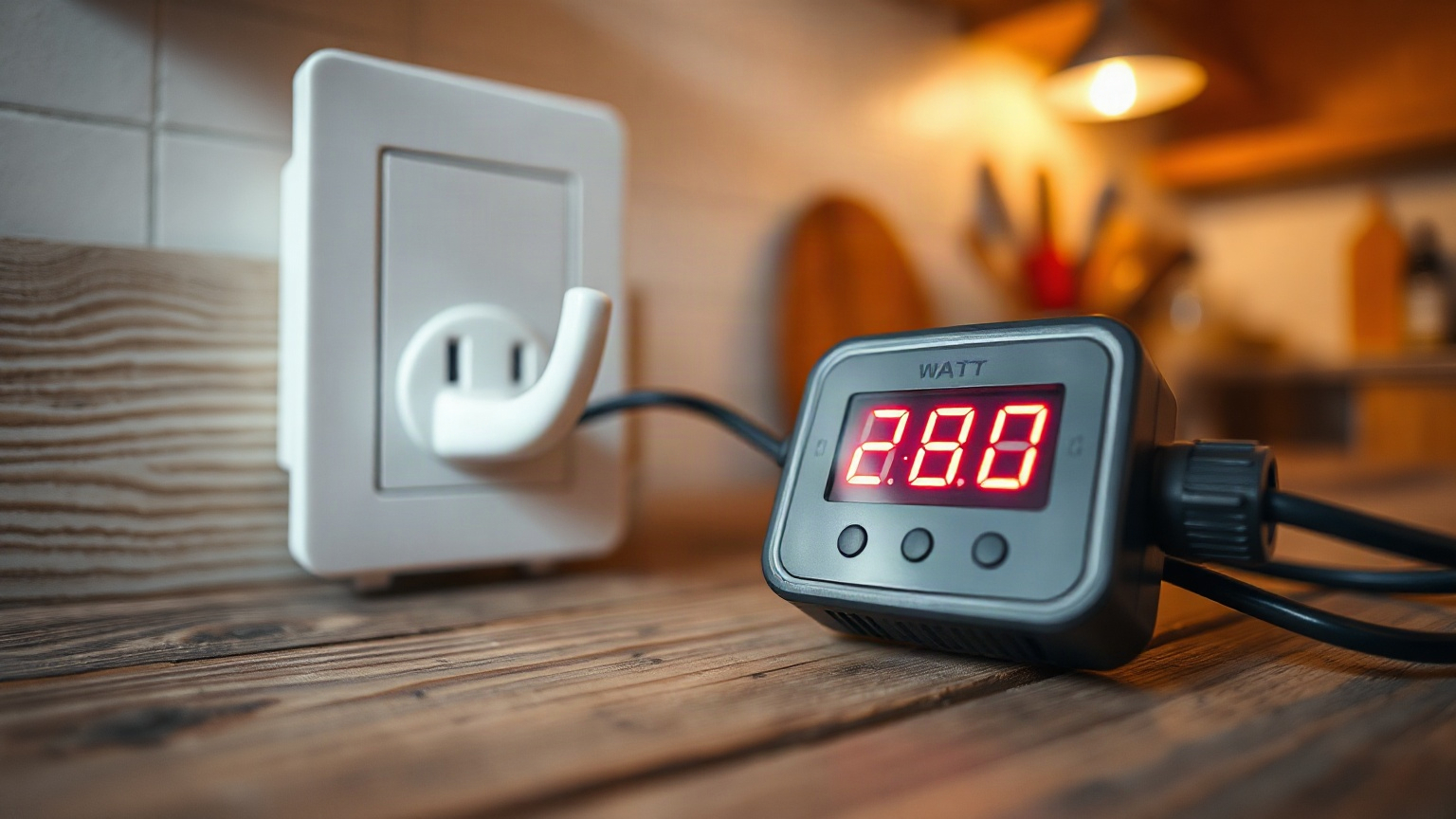
The formula is simple. You need three numbers: the wattage of your air fryer (it’s on the label on the bottom or back), your electricity rate in cents per kWh (it’s on your utility bill), and how many minutes per day you actually use it.
Here’s the math:
(Watts ÷ 1,000) × hours per day × days per month × cost per kWh = monthly cost
So a 1,700W Ninja Foodi running 45 minutes a day for 25 days a month at $0.16/kWh: (1.7) × 0.75 × 25 × 0.16 = $5.10/month. Not exactly terrifying. I ran this calculation on my own bill after I started air-frying chicken thighs almost every weeknight, half expecting some dramatic spike. There wasn’t one. My bill went up maybe $4.
One thing that tripped me up the first time: I assumed the air fryer runs at full wattage the entire time. It doesn’t. Like most heating appliances, it cycles on and off to hold temperature. So real-world consumption is usually 60–80% of the rated wattage over a cooking session. That 1,700W Ninja is effectively closer to 1,100–1,350W in practice. Good news for the bill.
Monthly Cost by Wattage: The Real Numbers
I put together this table assuming 30 minutes of daily use, 30 days a month, and the U.S. average electricity rate of $0.16/kWh. Adjust up or down based on where you live and how often you actually cook.
| Air Fryer Wattage | Typical Models | kWh Per Month | Est. Monthly Cost ($0.16/kWh) |
|---|---|---|---|
| 800W | Small personal/compact units | 12 kWh | ~$1.92 |
| 1,000W | Dash Compact, small Cosori | 15 kWh | ~$2.40 |
| 1,200W | Mid-size basket fryers | 18 kWh | ~$2.88 |
| 1,500W | Instant Vortex, Cosori 5.8qt | 22.5 kWh | ~$3.60 |
| 1,700W | Ninja Foodi, Ninja AF101 | 25.5 kWh | ~$4.08 |
| 1,800W | Large capacity, oven-style units | 27 kWh | ~$4.32 |
Those numbers assume continuous full-load operation, which doesn’t happen in practice. Real costs will be somewhat lower. But it’s a solid ceiling to plan around.
What If You Use It More Heavily?
Say you’re cooking two full meals a day in a 1,800W unit — that’s an hour of runtime daily. You’re looking at about $8.64/month at average rates. Still less than most people spend on streaming subscriptions. If you live somewhere with high electricity costs, like California at around $0.27/kWh or Hawaii at $0.40+, multiply those table figures by 1.7x or 2.5x respectively. That 1,800W unit in Hawaii at an hour a day is closer to $21–$22/month. That’s actually worth thinking about.
Air Fryer vs. Conventional Oven: Which Costs More to Run?
This is the comparison that actually matters for most people deciding whether an air fryer saves them money. A standard electric oven pulls around 2,000–2,500 watts per hour. But here’s the thing — ovens take 10–15 minutes just to preheat. Air fryers are ready in 2–3 minutes. That alone cuts cooking time substantially.
Cooking a batch of frozen fries in an oven: about 25–30 minutes at full heat. In an air fryer: 12–15 minutes. The air fryer uses less wattage and runs for less time. It wins on efficiency pretty clearly for smaller portions.
For large roasts or big sheet pan meals, a full oven still makes more sense — you’d be running the air fryer in multiple batches, which wipes out the savings. But for everyday single-serving or two-person cooking, the air fryer is genuinely cheaper to operate. This lines up with what Serious Eats found in their air fryer testing — the real efficiency gains come from shorter cook times, not magic.
If you’re also curious about how these appliances compare to toaster ovens for everyday reheating, I’ve written about reheating food in a toaster oven which covers some of that crossover territory.
Does Wattage Actually Affect How Well It Cooks?
Short answer: yes, but maybe not in the way you’d expect. Higher-wattage air fryers generally heat up faster and recover temperature more quickly when you open the basket. That matters for crispiness. If you’re cooking something that needs a sudden blast of hot air — chicken wings, say, or anything breaded — a 1,700W unit will do it better than an 800W one.
My personal preference leans toward the 1,500W sweet spot. Enough power to cook properly, not so much that I’m burning through electricity (or food, which I have done, at 400°F, with Brussels sprouts, once). I typically run chicken thighs at 380°F for 18–20 minutes and check at the 15-minute mark. That’s become my standard.
Lower-wattage compact units are fine for one person. If you’re mostly reheating or making small snacks, an 800–1,000W model is perfectly capable. You’ll save a bit on electricity and the units are usually smaller and cheaper to buy. Check out some of the options in our best mini toaster ovens roundup — several of those cross over into air fryer territory.
For accessories that help with bigger batches — like a proper rack to maximize airflow — a multi-layer air fryer rack makes a real difference and is worth the few dollars.
Tips to Actually Reduce Your Air Fryer’s Running Costs
None of these are revolutionary, but they add up.
Don’t preheat longer than needed. Most air fryers need 2–3 minutes, not 5. I see recipes calling for 5-minute preheats and I’m skeptical. Two minutes at 400°F is plenty for most things.
Batch cook when you can. Running the air fryer once for 30 minutes is cheaper than running it twice for 15. Cook extra chicken or veggies and refrigerate them. Reheating takes far less time than cooking from raw.
Match the size to your actual needs. A 6-quart air fryer cooking one chicken breast is inefficient. Small households genuinely benefit from smaller units — and those tend to be lower wattage too.
Don’t keep opening the basket. Every time you open it, heat escapes and the element has to work harder to recover. Trust the timer. Check once near the end, not every five minutes. (I’m guilty of this one.)
Use it instead of the oven, not in addition to it. If you’re running the full oven to cook side dishes while the air fryer handles the main, you’re not saving anything. Consolidate where possible.
For those who cook frequently, a set of air fryer parchment liners also helps with cleanup time, which means you’re less tempted to skip air frying just because it feels like a hassle.
The Bottom Line
An air fryer is not going to meaningfully hurt your electricity bill. Even a large, powerful unit used daily will add somewhere between $3 and $9 a month for most American households. The bigger variable is your local electricity rate, not the air fryer itself.
If you’re in a high-cost electricity state and using a big 1,800W model for an hour or more every day, it’s worth keeping an eye on. Otherwise, honestly, it’s a rounding error compared to what most kitchen appliances cost to run. The refrigerator running 24/7 is costing you far more than this.
What I’d actually spend more time thinking about is whether the wattage affects how well the unit cooks — because that directly affects whether you use it. A cheap 800W unit that cooks unevenly might sit unused after a month, which is the real waste. You can read more about heating elements and wattage in our piece on how hot a toaster gets, which covers some of the same underlying physics. And if you want an authoritative baseline on energy use across kitchen appliances, the U.S. Department of Energy’s appliance energy estimator is genuinely useful.
Buy the wattage that cooks well for your household size. The electricity cost difference between an 800W and a 1,800W unit is maybe $2–$3 a month. It’s not the thing to optimize on.
Frequently Asked Questions
How much does it cost to run an air fryer per month?
For most households, expect to pay between $2 and $8 per month to run an air fryer daily. The exact figure depends on your unit’s wattage (typically 800–1,800W), how long you use it each day, and your local electricity rate. At the U.S. average of $0.16/kWh with 30 minutes of daily use, a 1,500W air fryer costs roughly $3.60 per month.
Does an air fryer use a lot of electricity compared to an oven?
Air fryers use less electricity than conventional ovens for most everyday cooking tasks. A standard electric oven draws 2,000–2,500 watts and takes 10–15 minutes to preheat; an air fryer uses 800–1,800 watts and preheats in 2–3 minutes. For smaller portions and quicker meals, air fryers are clearly more efficient — the savings come from shorter cook times as much as lower wattage.
How many watts does a typical air fryer use?
Most air fryers fall between 1,000 and 1,800 watts. Compact, single-serving units often land around 800–1,000W, while larger basket or oven-style air fryers run 1,500–1,800W. The wattage is listed on a label on the bottom or back of the unit — it’s the most important number for calculating running costs.
Is it cheaper to use an air fryer or a microwave?
Microwaves are cheaper to run than air fryers for simple reheating tasks. A typical microwave uses 700–1,200 watts but cooks much faster, so the total energy per session is low. Air fryers take longer but produce better texture — crispiness that a microwave can’t replicate. For reheating leftovers quickly, the microwave wins on cost. For cooking from raw or crisping foods, the air fryer is worth the extra few cents.
How can I reduce how much electricity my air fryer uses?
The most effective way is to reduce unnecessary preheat time (2–3 minutes is enough for most air fryers), batch cook to avoid multiple short sessions, and match the appliance size to your actual portion sizes. Avoiding repeated lid or basket openings also helps, since temperature recovery draws extra power. These habits won’t transform your electricity bill, but they do add up over months of daily use.
—
Written by
Emma founded Toastera to turn vague appliance advice into clear, researched, safety-first guidance on toasters and toaster ovens.
Free: the Toaster Oven Cheat Sheet
Get the printable cheat sheet (temps, cook times & safety tips) plus new recipes. No spam, unsubscribe anytime.