To convert an air fryer recipe to a toaster oven, raise the temperature by 25°F and increase the cooking time by 20–25%. Air fryers circulate hot air in a tiny, sealed chamber, so they cook faster and crispier than a toaster oven’s more open environment. Knowing that gap — and adjusting for it — is the whole job.
Safety First: Toaster ovens run heating elements at very high temperatures. Never leave the oven unattended when cooking fatty foods or anything with a sugary glaze — grease drips and sugar residue can ignite on the bottom tray. Always use oven mitts rated for at least 450°F, keep the crumb tray clean, and make sure your toaster oven has at least six inches of clearance from cabinets or walls during use.
Key Takeaways
- Add 25°F to any air fryer temperature when moving to a toaster oven (e.g., 375°F in the air fryer → 400°F in the toaster oven)
- Add 20–25% more time — a 10-minute air fryer recipe typically needs 12–13 minutes in a toaster oven
- Use convection mode on your toaster oven if it has one; this closes the gap considerably and sometimes means only a 10°F bump is needed
- Thin, high-moisture foods (fish fillets, fresh veggies) need less extra time than dense foods (chicken thighs, frozen fries)
- Always start checking 3–4 minutes before the adjusted time ends — toaster ovens vary more than you’d expect between brands
Why Air Fryers and Toaster Ovens Cook So Differently
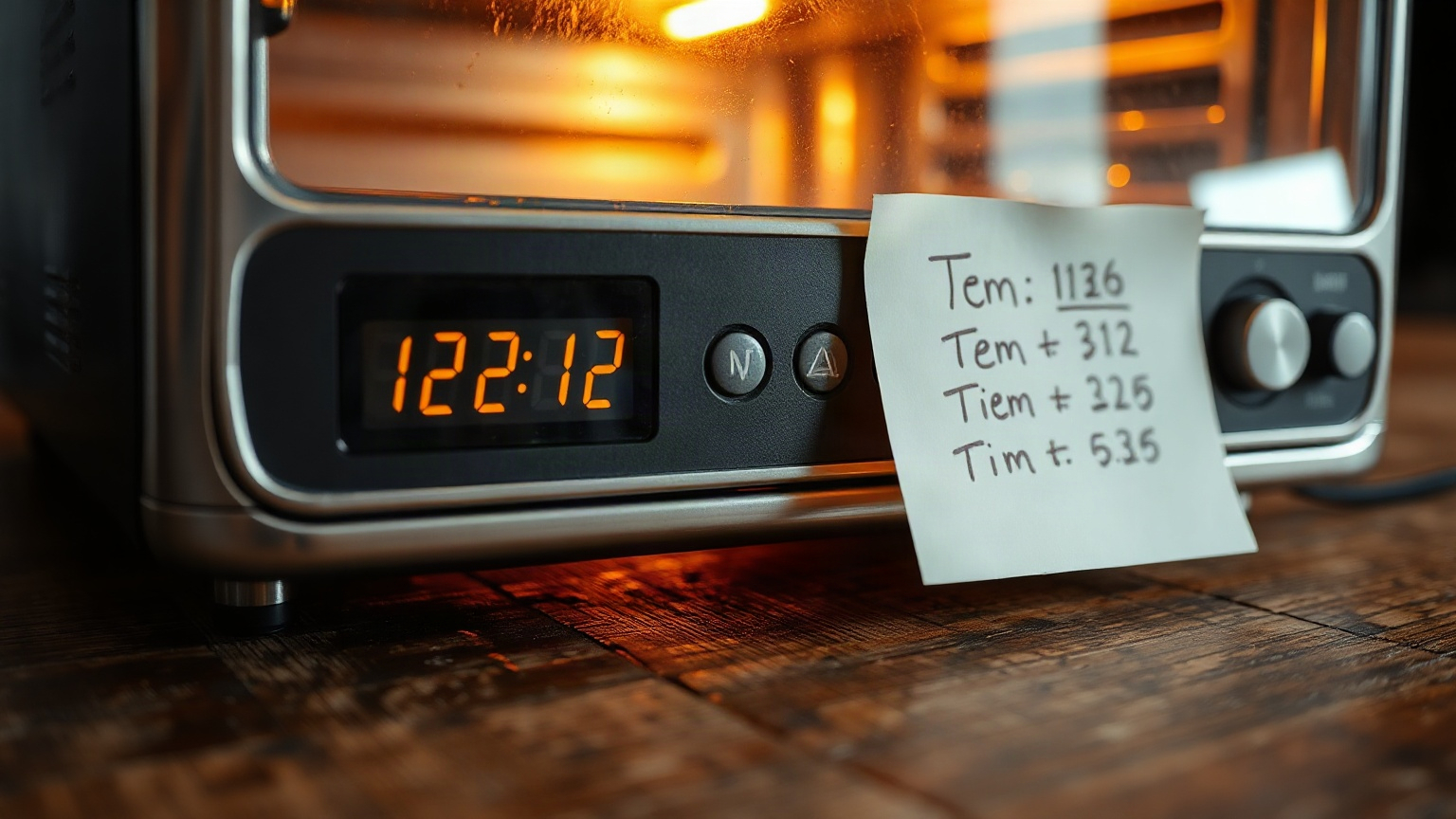
An air fryer is basically a compact convection oven with a very powerful fan jammed into a small basket. That combination — tiny cooking chamber plus aggressive airflow — strips moisture off food surfaces fast and creates the crust people love. It’s efficient in a way that feels almost unfair when you’re staring at a plate of crispy wings in 18 minutes.
A toaster oven, even one with a convection setting, has more internal volume, less aggressive fan speed, and a cooking rack that allows air to settle somewhat. That’s not a flaw, it’s just physics. More space means more air to heat, less surface contact with circulating heat, and a slightly longer path to browning.
The other thing nobody talks about: air fryer baskets have perforations on all sides and underneath. Hot air hits food from every angle simultaneously. A toaster oven rack does something similar, but the heat source is typically above and below, not all around. Moisture evaporation is slower. That’s why the time adjustment matters as much as the temperature one.
The Core Conversion Formula (And When to Bend It)
The Standard Rule
Here’s the baseline I use every single time:
- Temperature: Air fryer temp + 25°F
- Time: Air fryer time × 1.25 (so multiply by 1.25 or just add 25%)
So if a recipe says “400°F for 12 minutes in the air fryer,” you’d set your toaster oven to 425°F for about 15 minutes. That’s it. That’s the whole formula.
But there are wrinkles.
If Your Toaster Oven Has Convection
If you have a toaster oven with a convection fan — something like the Breville Smart Oven Air Fryer or the Cuisinart TOA-70 — the gap narrows. I’d drop the temperature adjustment to just 10–15°F and keep the time bump at around 15% instead of 25%. The fan does real work. I tested salmon fillets at 400°F convection in my Breville vs. the air fryer setting and the difference in total cook time was under two minutes.
That said, “convection” varies. Some toaster ovens have a genuinely powerful fan. Others have something that feels more decorative. If yours is in the second camp, stick with the standard formula regardless of what the label says.
Dense Foods vs. Thin Foods
This is the edge case most conversion charts skip over entirely. The 25% time rule works well for average-density foods — chicken pieces, frozen snacks, roasted vegetables. But it breaks down at the extremes.
For thin items (fish fillets under an inch thick, zucchini slices, shrimp), the extra time can easily overcook things. I’d add only 10–15% to the time for anything under about ¾ inch thick. For dense items — a whole chicken breast, a thick pork chop, frozen stuffed jalapeños — go closer to 30% extra. Those items have a thermal mass that the air fryer breezes through that your toaster oven needs more time with.
Conversion Chart: Air Fryer to Toaster Oven
Here’s a practical reference table. The convection column assumes a decent (not exceptional) convection fan.
| Air Fryer Setting | Toaster Oven (Standard) | Toaster Oven (Convection) | Time Adjustment |
|---|---|---|---|
| 350°F | 375°F | 360–365°F | +20–25% |
| 375°F | 400°F | 385–390°F | +20–25% |
| 390°F | 415°F | 400–405°F | +20–25% |
| 400°F | 425°F | 410–415°F | +20–25% |
| 425°F | 450°F | 435–440°F | +15–20% |
| 10 min (any temp) | 12–13 min | 11–12 min | — |
| 15 min (any temp) | 18–19 min | 17–18 min | — |
| 20 min (any temp) | 24–25 min | 22–23 min | — |
One thing I want to flag: most home toaster ovens max out at 450°F. So if an air fryer recipe calls for 450°F, you’re already at the ceiling — in that case, don’t try to add 25°F. Just add extra time and check frequently. You can read more about how toaster ovens handle high heat in this piece on how hot a toaster gets.
Specific Food Examples With Actual Numbers
Frozen French Fries
Air fryer: 400°F for 14 minutes, shaking halfway. Toaster oven: 425°F for 17–18 minutes, flipping once at the 10-minute mark. Use a toaster oven wire rack with a baking sheet underneath rather than a solid pan — airflow under the fries makes a noticeable difference in crispiness.
Chicken Wings
Air fryer: 380°F for 20 minutes, flipped once. Toaster oven: 400–405°F for 25 minutes, flipped at 12–13 minutes. Pat the wings very dry before cooking. This is non-negotiable. Without it, the toaster oven never gets the skin to that snap-when-you-bite-it texture.
Salmon Fillet (1-inch thick)
Air fryer: 390°F for 10 minutes. Toaster oven: 410°F for 12 minutes. Check it at 11. Salmon overcooks in a blink and a toaster oven has enough radiant heat from the top element that it can dry out the top of a fillet faster than you’d expect. If yours has a broil-assist option partway through, skip it for fish.
Frozen Mozzarella Sticks
Air fryer: 360°F for 7 minutes. Toaster oven: 385°F for 9 minutes. These are a classic edge case because the cheese melts and escapes before the coating fully crisps if the temperature goes too high. The 25°F bump actually matters a lot here — go higher and you’ll have hollow crusts with cheese pooled on the pan.
Roasted Broccoli
Air fryer: 375°F for 12 minutes. Toaster oven: 400°F for 14 minutes. Thin food, remember — so the time adjustment is on the lighter end. Toss in olive oil generously; toaster ovens dry out vegetables faster than you’d think. Serious Eats has a good note on moisture and why fat content matters for roasting.
Getting the Best Crispiness Without a Basket
The biggest complaint I hear from people switching from an air fryer to a toaster oven is “it’s just not as crispy.” True. But there are ways to close that gap.
First: don’t use the standard baking pan by itself. Place a wire rack on top of the pan so hot air can circulate under the food. It won’t replicate the full 360° airflow of a basket, but it’s genuinely better than a flat pan — I noticed a real difference in skin-on chicken thighs when I switched. Second, don’t crowd the rack. Air fryer recipes are written assuming the food fits in a single tight layer with airflow all around. In a toaster oven you have more horizontal space, but you still need breathing room between pieces. Third, pat everything dry. I keep a roll of paper towels next to my toaster oven specifically for this. Moisture is the enemy of browning.
If you’re shopping for accessories that actually help, look at a toaster oven air fryer basket insert — several brands make perforated pans designed to mimic an air fryer basket. They work better than you’d expect. And if you’re in the market for a new appliance, check out our picks for the best mini toaster ovens.
The One Conversion Mistake I Made That You Should Skip
When I first started doing this, I was so focused on temperature that I forgot about preheating. Air fryers get to temperature in about two minutes. Most toaster ovens need 8–12 minutes to properly preheat, and if you skip that, you’re starting your adjusted cook time in a cold oven. The food takes longer. The outside doesn’t set the same way. Everything is off. Always preheat. Set a timer, walk away, come back. It’s the dumbest mistake and I made it embarrassingly often before it clicked.
Also — if you’re reheating something that was originally air-fried (leftovers), that’s a different story than cooking from scratch. For that, check out the guide on reheating food in a toaster oven, because the rules shift quite a bit.
Wrapping It Up
The conversion really isn’t complicated once you’ve got the numbers in your head: plus 25°F, plus 25% time, preheat properly, and use a rack if you want any shot at crispiness. It’s the execution that trips people up, not the formula. After you’ve done it a handful of times with foods you cook regularly, you’ll stop measuring and just know. That’s the goal.
One last thought: if your recipes are frequently calling for temperatures above 425°F in the air fryer, it might be worth looking at a toaster oven that has a true air fry mode built in. The gap between the two cooking methods shrinks to almost nothing, and you get that crisping power without buying two appliances. The USDA’s food safety guidance for air fryers, by the way, applies equally to toaster oven air fry modes — always check internal temperatures for meat, especially poultry.
Frequently Asked Questions
How do I convert air fryer temperature to toaster oven temperature?
Add 25°F to the air fryer temperature when using a standard toaster oven, or 10–15°F if your toaster oven has a convection fan. For example, an air fryer recipe at 400°F becomes 425°F in a standard toaster oven. The gap exists because air fryers have more concentrated airflow and a smaller cooking chamber.
How much longer does a toaster oven take compared to an air fryer?
Plan on about 20–25% more time in a standard toaster oven — so a 10-minute air fryer recipe needs roughly 12–13 minutes. With a convection toaster oven, that extra time drops to around 15%. Always check a few minutes early the first time you make a recipe, since individual ovens vary.
Can I use my toaster oven instead of an air fryer?
Yes, with adjustments to both temperature and time. A toaster oven won’t produce identical crispiness to an air fryer on its own, but using a wire rack, patting food dry, and not crowding the rack gets you surprisingly close. Toaster ovens with a built-in convection or air fry setting close the gap even further.
Do I need to preheat my toaster oven when converting an air fryer recipe?
Yes, and this matters more for toaster oven conversions than for most other cooking because air fryer recipes assume instant heat. Toaster ovens typically need 8–12 minutes to fully preheat. Skipping this step is one of the most common reasons converted recipes turn out soggy or undercooked.
What temperature does an air fryer use compared to a toaster oven?
Most air fryer recipes run between 350°F and 425°F, which is the same range most toaster ovens cover. The difference isn’t the temperature range itself — it’s how efficiently each appliance delivers that heat to the food surface. An air fryer’s small, sealed, high-speed environment browns food faster at the same set temperature.

Written by
Emma founded Toastera to turn vague appliance advice into clear, researched, safety-first guidance on toasters and toaster ovens.
Free: the Toaster Oven Cheat Sheet
Get the printable cheat sheet (temps, cook times & safety tips) plus new recipes. No spam, unsubscribe anytime.