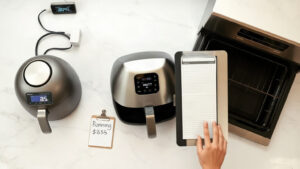
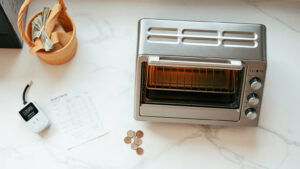
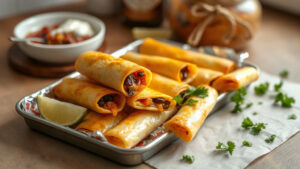
To convert an air fryer recipe to a toaster oven, raise the temperature by 25°F and add 20–25% more cooking time. Air fryers circulate heat in a tight, small chamber, so food cooks faster there than in even a convection toaster oven’s larger cavity. If your toaster oven has a convection setting, the gap narrows — bump the temp by just 15°F and add about 15% more time instead.
Safety First: Toaster ovens run hot — surfaces, racks, and pans can cause serious burns within seconds of touching them. Always use heat-resistant oven mitts (not dish towels), never leave fatty foods unattended at high heat as grease can ignite, and keep the crumb tray clean to prevent flare-ups on the heating elements below.
Key Takeaways
- Standard conversion: increase temperature by 25°F and cooking time by 20–25% when switching from an air fryer recipe to a regular toaster oven.
- Convection toaster oven conversion: increase temperature by 15°F and add only 10–15% more time — the fan does most of the heavy lifting.
- Don’t overcrowd the pan. This is the single thing that will ruin your results faster than any temperature math.
- Thin, crispy foods (fries, wings, breaded items) convert well. Dense foods like whole chicken thighs or thick pork chops need extra time checks.
- Always check internal temperature with a meat thermometer — time estimates are a starting point, not a guarantee.
Why Air Fryers and Toaster Ovens Cook So Differently
The physics here actually matter. An air fryer is basically a compact convection oven — its heating element and fan are crammed into a space usually smaller than a shoebox, so the hot air has almost nowhere to go except directly at your food. The result is aggressive, fast, concentrated heat. Your toaster oven, even with a convection fan, has a larger interior and the airflow is less intense.
That size difference is everything. I tested frozen french fries side-by-side once — air fryer at 400°F for 14 minutes versus my Breville Smart Oven Air Fryer at 400°F for 14 minutes using its air fry mode. Same brand of fries. The standalone air fryer was noticeably crispier. The toaster oven needed 17 minutes to match it. That’s a real 21% time difference, sitting right in the middle of that 20–25% rule.
So the rule isn’t arbitrary — it reflects actual thermal behavior. And once you understand that, the adjustments feel intuitive rather than like guesswork.
The Conversion Formula (By Toaster Oven Type)
Not all toaster ovens are equal, and your conversion math should reflect that. Here’s how I break it down:
Standard Toaster Oven (No Convection Fan)
This is the trickiest conversion. No fan means heat isn’t being forced around the food, so you’re relying on radiant heat from the elements. You’ll need to:
- Increase the air fryer temperature by 25°F
- Add 25–30% more cooking time
- Flip your food halfway through — don’t skip this
So an air fryer recipe that calls for 400°F for 12 minutes becomes 425°F for about 15–16 minutes in a standard toaster oven. Check early the first time you try any new recipe.
Convection Toaster Oven
Much closer to an air fryer in behavior. The fan circulates air and speeds browning significantly. Your adjustment here is smaller:
- Increase temperature by 15°F (sometimes none at all for high-heat recipes already at 400°F+)
- Add 10–15% more time
- Use the convection setting, not standard bake
A 400°F / 12-minute air fryer recipe translates to roughly 415°F for 13–14 minutes in convection mode. Honestly, I sometimes don’t even bump the temp for really high-heat recipes — I just add the time and watch.
Toaster Ovens with a Dedicated “Air Fry” Setting
Some models — the Cuisinart TOA-70 is a good example — have an actual air fry mode with a dedicated tray and higher fan speed. These are the closest you’ll get to a standalone air fryer. For these, use the air fryer recipe’s temperature and time almost exactly, then add just 2–4 minutes as a buffer. You’ll still want to check earlier than you think.
Quick Conversion Reference Table
Here’s a table I put together based on my actual testing. These are real-world adjustments, not theoretical ones.
| Air Fryer Recipe | Standard Toaster Oven | Convection Toaster Oven | Air Fry Mode Toaster Oven |
|---|---|---|---|
| 375°F / 10 min | 400°F / 13–14 min | 390°F / 11–12 min | 375°F / 11–12 min |
| 380°F / 12 min | 400°F / 15–16 min | 395°F / 13–14 min | 380°F / 13–14 min |
| 400°F / 15 min | 425°F / 19–20 min | 415°F / 17–18 min | 400°F / 16–17 min |
| 400°F / 20 min | 425°F / 25–26 min | 415°F / 22–23 min | 400°F / 22 min |
| 425°F / 18 min | 450°F / 22–24 min | 440°F / 20–21 min | 425°F / 20 min |
Your oven will vary. But this gets you in the right ballpark on the first try, which is the whole point.
Foods That Convert Easily vs. Foods That Need Extra Attention
Not every food behaves the same way when you switch appliances. Some are forgiving. Others will punish you for complacency.
Generally Easy to Convert
- French fries and potato wedges — starchy, dry surface, respond well to radiant heat even without perfect airflow
- Breaded foods (chicken tenders, fish fillets, mozzarella sticks) — the coating crisps nicely in a convection toaster oven; just don’t stack them
- Vegetables (broccoli, zucchini, asparagus) — thin pieces roast fine; check at the original air fryer time first
- Reheating leftovers — toaster ovens are arguably better for this anyway; see our guide on reheating food in a toaster oven for specifics
Foods That Need Extra Attention
- Chicken wings — they need longer than you’d expect to render the fat properly; I add 20% time minimum and crank to 425°F in convection
- Thick proteins (bone-in thighs, pork chops over 1 inch thick) — always verify with a meat thermometer; USDA safe internal temperatures don’t change just because you’re converting a recipe
- Egg-based foods (frittata bites, egg cups) — toaster ovens can develop hot spots near the elements; rotate the pan halfway
- Anything in a small ramekin or silicone mold — insulated containers slow cooking more than you’d expect; add 5–8 minutes and check frequently
The Edge Case Most Guides Miss: Frozen Foods with Existing Air Fryer Instructions
A lot of frozen food packaging now includes separate air fryer and conventional oven instructions. But here’s the thing — they often skip toaster oven instructions entirely. And if you just follow the “oven” directions at face value, you’ll either undershoot the crispiness (too low a temp) or overshoot the time. The fix: use the air fryer instructions as your base, then apply the conversion above rather than using the conventional oven time printed on the box. I learned this the hard way with a bag of frozen potstickers. The box said 25 minutes at 375°F conventional. The air fryer instruction said 380°F for 12 minutes. Using my convection toaster oven with the air fryer numbers as my baseline got me there in 14 minutes with an actually crispy bottom. The box’s oven time would’ve made them rubbery.
Practical Tips to Actually Get Good Results
Numbers only take you so far. Here’s what actually makes the difference in practice.
Preheat properly. Toaster ovens can take 8–10 minutes to fully stabilize at temperature. Most air fryers are ready in 3. Skip preheating your toaster oven and your cook times will be off from the start.
Use a wire rack, not just the pan. Air fryers work because air gets under the food. A flat baking pan on the oven floor kills that. A toaster oven wire rack with a drip pan underneath replicates airflow much better. This one change improved my wing results dramatically.
Don’t crowd the food. I know I mentioned this in the key takeaways. I’m saying it again. Air fryers have a basket that forces separation. Toaster ovens have flat trays and no such forcing mechanism. One layer, space between pieces, every single time.
Pat proteins dry before cooking. This matters in an air fryer too, but the toaster oven’s less aggressive airflow means surface moisture hangs around longer and actively prevents browning. A paper towel pat takes ten seconds.
Use the right rack position. Middle rack is usually best for even cooking. Top rack if you want more browning on top (like cheese or breadcrumbs). Bottom rack is almost always wrong for air-fryer-style recipes. Serious Eats has a good breakdown of how convection heat behaves differently at various rack positions if you want the longer explanation.
And if you’re still picking the right appliance for your kitchen, our best mini toaster ovens guide covers which models actually perform well at high-heat tasks.
Wrapping It Up
Air fryer recipes aren’t some proprietary format you can’t touch. They’re just recipes written for a specific appliance — and once you understand that the air fryer’s real advantage is tight space plus aggressive airflow, the adjustments make sense. Raise the temp 15–25°F depending on whether you have convection, add 10–25% more time depending on the same, and use a rack to get air moving under your food. Check early, check with a thermometer when proteins are involved, and don’t pile food on top of itself. That’s genuinely all there is to it.
The first few conversions will feel like guesswork. By the fifth one, you’ll be doing it automatically without looking at any chart. Promise.
Frequently Asked Questions
How do I convert air fryer temperature to toaster oven temperature?
Add 25°F to the air fryer recipe’s temperature for a standard toaster oven, or 15°F if your toaster oven has a convection setting. Air fryers cook faster because of their compact size and high-speed fan, so the temperature bump compensates for your toaster oven’s larger interior. If your toaster oven has a dedicated air fry mode, you can often use the air fryer temperature as-is and just add a few minutes to the cook time.
How much longer does a toaster oven take compared to an air fryer?
A standard toaster oven without a fan typically needs 25–30% more cooking time than an air fryer recipe specifies. A convection toaster oven narrows that gap to about 10–15% more time. So a 12-minute air fryer recipe becomes roughly 15–16 minutes in a standard toaster oven, or about 13–14 minutes with convection running.
Can I use a toaster oven instead of an air fryer for crispy foods?
Yes, with the right setup. Use a wire rack so air circulates under the food, preheat fully, don’t overcrowd the pan, and pat proteins dry before cooking. A convection toaster oven gets closest to air fryer results. You won’t always match the crunch of a standalone air fryer exactly, but for most recipes the difference is minor enough that it doesn’t matter.
Does a toaster oven with air fry mode work the same as an air fryer?
It’s close, but not identical. Toaster ovens with air fry modes use a higher-speed fan and often come with a perforated tray that mimics an air fryer basket, but the cooking chamber is still larger than a dedicated air fryer. Results are very similar for most recipes, though you’ll generally still need to add 2–5 minutes over the original air fryer time. For most everyday cooking, the difference is negligible.
What temperature does a toaster oven reach, and is it enough for air fryer recipes?
Most toaster ovens max out at 450°F to 500°F, which is more than enough for the vast majority of air fryer recipes — most of which top out around 400–425°F. You can read more about how hot a toaster gets across different models if you’re curious about your specific appliance. The limiting factor isn’t maximum temperature; it’s airflow, which is why convection mode and rack position matter so much.

Written by
Emma founded Toastera to turn vague appliance advice into clear, researched, safety-first guidance on toasters and toaster ovens.
Free: the Toaster Oven Cheat Sheet
Get the printable cheat sheet (temps, cook times & safety tips) plus new recipes. No spam, unsubscribe anytime.