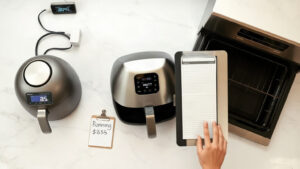
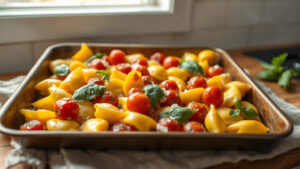
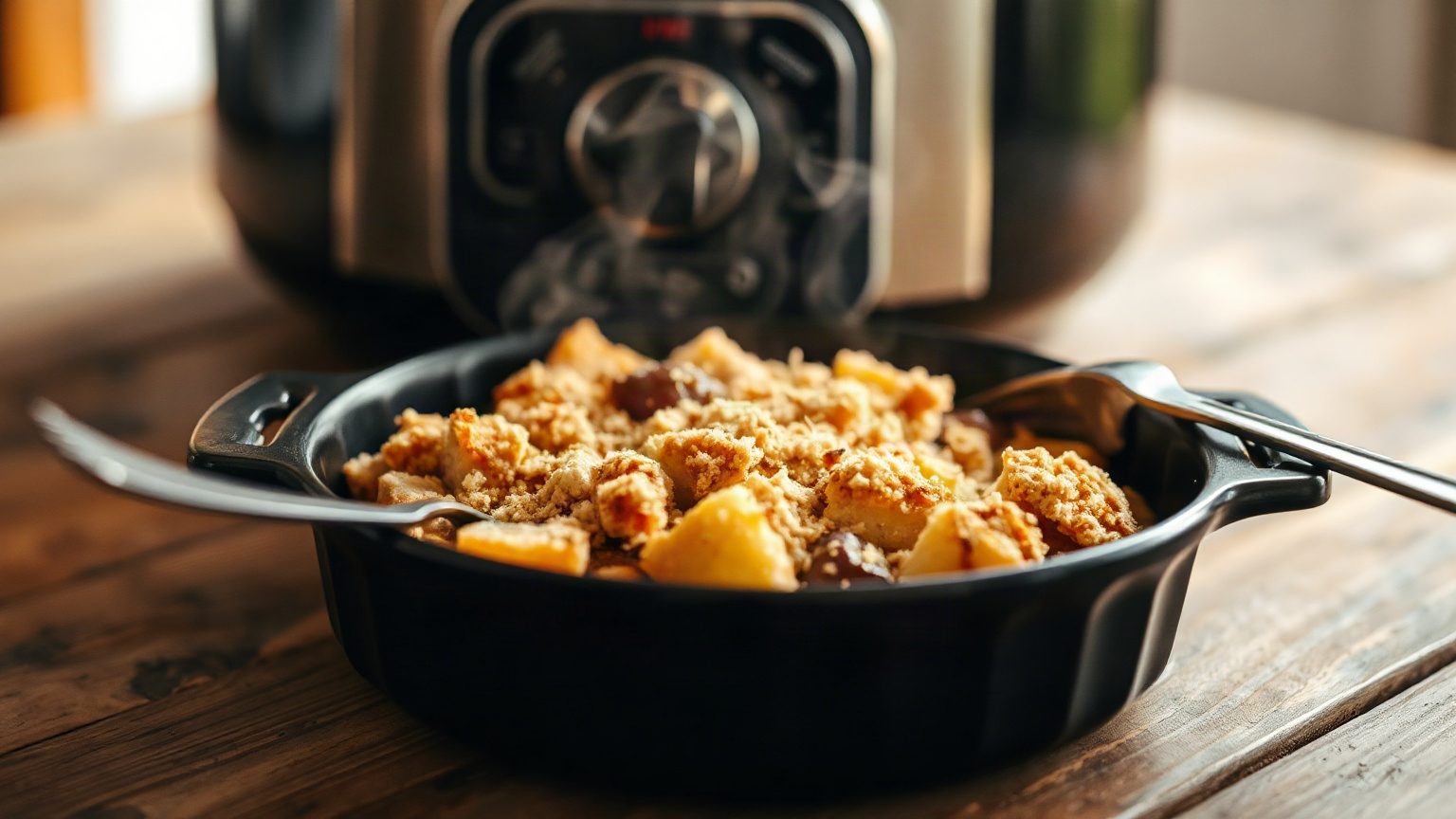
To convert an oven casserole recipe to the air fryer, reduce the temperature by 25°F and cut the cook time by roughly 20–25%. Air fryers circulate hot air aggressively around the food, so they cook faster and brown more intensely than a conventional oven. The practical result: a casserole that takes 60 minutes at 375°F in the oven will typically be done in 35–45 minutes at 350°F in the air fryer — but you’ll need to check it earlier than you think.
Safety First: Air fryers and toaster oven air fryers reach very high temperatures quickly. Always use oven mitts rated for high heat when removing dishes — the basket, tray, and any bakeware inside will be significantly hotter than you’d expect from a standard oven. Never place a cold glass or ceramic dish straight from the fridge into a preheated air fryer; thermal shock can crack it. Keep the appliance at least 5 inches from walls and cabinets during use.
Key Takeaways
- Reduce oven temperature by 25°F when converting any casserole recipe to the air fryer.
- Start checking your casserole at the 75% mark of the original cook time — air fryers are genuinely faster.
- Cover with foil for the first two-thirds of cooking to prevent the top from over-browning before the center is done.
- Dish size matters a lot. Most air fryer baskets max out around 8×8 inches, so you may need to halve your recipe.
- Dense casseroles (like a loaded potato bake) need a temp probe, not just a timer — the outside will look done before the inside is.
The Basic Conversion Formula (With Actual Numbers)
Here’s the rule most sites give you: drop the temp by 25°F, cut the time by 20%. That’s a solid starting point. But in practice, I’ve found that 20% is a little conservative for most casseroles. Something that bakes for an hour in the oven? I’d start checking at the 35-minute mark in the air fryer, not the 48-minute mark that 20% math gives you.
The reason is airflow. A conventional oven heats from the bottom and sides, and the air is relatively still. An air fryer is essentially a tiny convection oven with a much more powerful fan crammed into a small space. That concentrated hot air strips moisture from the surface and browns food significantly faster. Which is great for chicken wings. Less ideal for a cheesy potato casserole where you actually want the center to cook through before the top scorches.
| Oven Temperature | Air Fryer Temperature | Original Oven Time | Estimated Air Fryer Time | Check At |
|---|---|---|---|---|
| 325°F | 300°F | 60 min | 40–45 min | 35 min |
| 350°F | 325°F | 60 min | 38–42 min | 32 min |
| 375°F | 350°F | 60 min | 35–40 min | 30 min |
| 400°F | 375°F | 45 min | 28–33 min | 25 min |
| 425°F | 400°F | 30 min | 18–22 min | 16 min |
Save this table. It covers the temps you’ll actually hit with most casserole recipes. And for deeper background on how heat behaves differently at different wattages and sizes, Serious Eats has a solid breakdown of air fryer science if you want to go further down that rabbit hole.
What Actually Changes When You Air Fry a Casserole
Temperature and time are just the beginning. A few other things shift in ways the basic conversion guides don’t bother to mention.
Moisture Loss Is Much Higher
That powerful fan that speeds up cooking also dries things out faster. The first time I tried converting a chicken and rice casserole, the edges were dry and slightly chewy even though the center was perfect. The fix is dead simple: add about 10–15% more liquid to your recipe. If it calls for 1 cup of broth, use a generous cup and a bit. And cover the dish with foil for at least the first half of cooking.
The Top Browns Fast. Very Fast.
Cheese toppings, breadcrumbs, and crispy onion toppings will all brown in a fraction of the time. I’ve learned to keep the foil on until the last 5–8 minutes, then remove it to get that golden crust. Without the foil? You’ll have a beautiful-looking top and a cold, underdone middle. Not great.
Dish Size and Depth Change Everything
Standard casseroles are made in 9×13 pans. That does not fit in an air fryer. Full stop. You’re looking at a maximum of about 7×9 or 8×8 for most basket-style air fryers, and even that’s pushing it on many models. Deeper dishes also cook differently — a 3-inch-deep casserole takes noticeably longer than a 1.5-inch-deep one because the hot air can’t penetrate as effectively. Use a shallower dish when you can. Spreading the casserole out more gives you better results than piling it deep.
If you’re shopping for a casserole dish that fits an air fryer basket, look for ones specifically labeled as air fryer-compatible — usually 7-inch round or 8×6 rectangular.
Casserole Types and How Each Converts
Not all casseroles behave the same way. Here’s how I approach the major categories.
Pasta Casseroles (Mac and Cheese, Baked Ziti)
These work really well, actually. The pasta is already cooked, so you’re mostly just heating through and browning the top. Reduce temp by 25°F, start checking at the 25-minute mark for a recipe that calls for 40 minutes in the oven. Add a splash more sauce than usual — pasta absorbs moisture aggressively in the air fryer.
Meat-Based Casseroles (Ground Beef, Chicken)
If the meat is pre-cooked (like a leftover chicken casserole), follow the standard conversion. If the meat is raw, use a meat thermometer. Don’t rely on the timer alone. Ground beef casseroles need to hit 160°F internally; chicken needs 165°F. The outside can look done and feel done before the center of a thick, dense casserole reaches a safe temperature. I cannot stress the thermometer thing enough — it’s the one tool that makes this foolproof. The USDA’s recommended internal temperatures are the ones to follow here, not your instincts about how the top looks.
Potato and Vegetable Casseroles
Dense root vegetables are the trickiest. A scalloped potato casserole in a conventional oven at 350°F for 75 minutes will need around 55–60 minutes in the air fryer at 325°F. But that’s still a long time, and the edges will try to outrun the center. Foil is mandatory here. And honestly? I’d cut the potato slices thinner than the recipe calls for, maybe 1/8 inch instead of 1/4 inch, just to help the heat penetrate faster.
Casseroles with a Crunchy Topping
Green bean casserole, anything with panko or crushed crackers — hold the topping. Don’t add it at the start. Add it in the last 5 minutes without foil so it crisps but doesn’t burn. That simple timing shift saves the texture entirely.
The Edge Case Most Guides Miss: Frozen Casseroles
Converting a frozen casserole to the air fryer is a different animal. The standard 25°F / 20% time reduction doesn’t apply at all. You’re starting from frozen, and the math flips — you actually need more time than the oven instructions suggest, because air fryers are smaller and can’t maintain consistent heat as effectively when a large frozen mass is sitting in the basket.
My approach: thaw it in the fridge overnight when possible. If you can’t, add at least 15–20 minutes onto whatever the air fryer conversion would be, keep it covered with foil for the first two-thirds of cooking, and check the internal temperature in multiple spots. The edges of a frozen casserole will heat up fast while the center stays stubbornly cold. Pulling back the foil in the last 10 minutes and bumping the temp back up by 15°F helps finish it off without the center being a cold pocket.
For reheating previously cooked casseroles (not frozen), check out my notes on reheating food in a toaster oven — a lot of the same principles apply, and it covers the texture pitfalls better than I can here.
Tools That Make This Easier
You don’t need much, but a few things genuinely help. First, an instant-read thermometer. Already mentioned it, won’t apologize for repeating it. Second, a proper air fryer rack or wire rack set lets you position your dish at the right height and improves airflow underneath it. Third, aluminum foil. Obvious, but I’ve met people who try to air fry an uncovered casserole and wonder why it looks like volcanic crust.
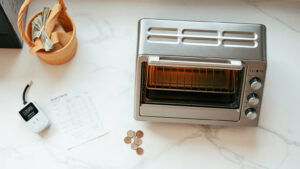
If you’re using a toaster oven with an air fryer setting rather than a standalone basket-style air fryer, note that toaster ovens tend to be slightly less intense with the airflow. You might land closer to the 15% time reduction instead of 25%, especially on the larger models. I’ve covered the best mini toaster ovens if you’re deciding which format makes more sense for your kitchen. And if you’re curious about the actual heat behavior inside these machines, my piece on how hot a toaster gets has context on why that fan makes such a difference.
A Few Last Thoughts
Converting casseroles to the air fryer isn’t complicated, but it does require paying attention the first time you try a specific recipe. The 25°F / 20–25% time formula gets you in the right ballpark. The foil trick protects your top. The thermometer protects you from serving cold centers. And halving your recipe to fit the basket is often unavoidable — not the end of the world for a weeknight dinner for two.
The first time I tried it, I skipped the foil and started checking too late. The cheese was basically a brick and the pasta underneath was fine. Second time: foil on, checked at 30 minutes, perfect. It really does come down to treating that first attempt as a test run, making a note of the actual time it took, and then it’s sorted forever after that.
Frequently Asked Questions
How do I convert oven casserole cook time to air fryer?
Reduce the oven temperature by 25°F and cut the cooking time by 20–25%. For a casserole that cooks at 375°F for 60 minutes in the oven, set the air fryer to 350°F and start checking at the 35-minute mark. Always use a thermometer for meat-based casseroles to confirm safe internal temperatures.
Can you cook a casserole in an air fryer?
Yes, with the right dish size. Most air fryers max out around 7–8 inches wide, so you’ll need to use a smaller baking dish and possibly halve your recipe. Covering with foil during most of the cook time prevents over-browning and keeps moisture in.
Do I need to cover a casserole in the air fryer?
Yes, for most casseroles you should cover with aluminum foil for at least the first half to two-thirds of cooking time. The air fryer’s fan will brown and dry the top much faster than a conventional oven would. Remove the foil in the last 5–10 minutes to get a properly golden top.
What temperature do I use to convert a 350°F oven casserole to air fryer?
Set the air fryer to 325°F. A casserole that takes 60 minutes at 350°F in a conventional oven will typically be done in approximately 38–42 minutes at 325°F in the air fryer. Start checking at the 32-minute mark to avoid overcooking.
Why does my casserole dry out in the air fryer?
The air fryer’s powerful fan removes moisture from the surface much faster than a regular oven. To compensate, add 10–15% more liquid than the original recipe calls for and cover the dish with foil during most of the cooking time. Using a shallower dish also helps heat distribute more evenly so you don’t over-cook the edges while waiting for the center.

Written by
Emma founded Toastera to turn vague appliance advice into clear, researched, safety-first guidance on toasters and toaster ovens.
Free: the Toaster Oven Cheat Sheet
Get the printable cheat sheet (temps, cook times & safety tips) plus new recipes. No spam, unsubscribe anytime.