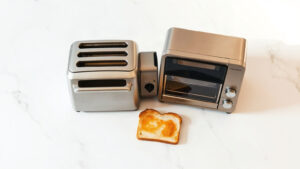
A 2-slice toaster on a light toast setting typically draws between 800–1,000 watts for roughly 60–90 seconds, while the dark setting pulls the same wattage for 2–3 minutes — meaning the darker your toast, the more energy consumed, not more power. The heating elements run at the same wattage throughout; the browning dial just controls how long they stay on. In real-world terms, a single dark toast cycle uses about 0.05–0.07 kWh, compared to 0.013–0.025 kWh for light.
Safety First: Toasters draw significant current the moment you push the lever down — never operate one near a sink or with wet hands, don’t leave it unattended if you’re already seeing smoke from crumb buildup, and always unplug before shaking out the crumb tray. If your toaster is tripping a circuit breaker or sparking, stop using it immediately and don’t assume it’ll sort itself out.
Quick Facts
- Most 2-slice toasters are rated 800–1,200 watts; the dial controls duration, not wattage output.
- Light toast setting: approximately 60–90 seconds of active heating. Dark toast setting: approximately 2.5–3.5 minutes.
- Energy cost per slice on dark is roughly 3–4x higher than on light, though still a fraction of a cent per cycle.
- Toasters consume zero watts in standby — but only if they’re the kind with a simple bimetallic strip timer (most are). Smart toasters with digital displays are a different story.
- Bread type and moisture content genuinely affect cycle length, which affects total energy use more than most people expect.
What the Wattage Rating on Your Toaster Actually Means
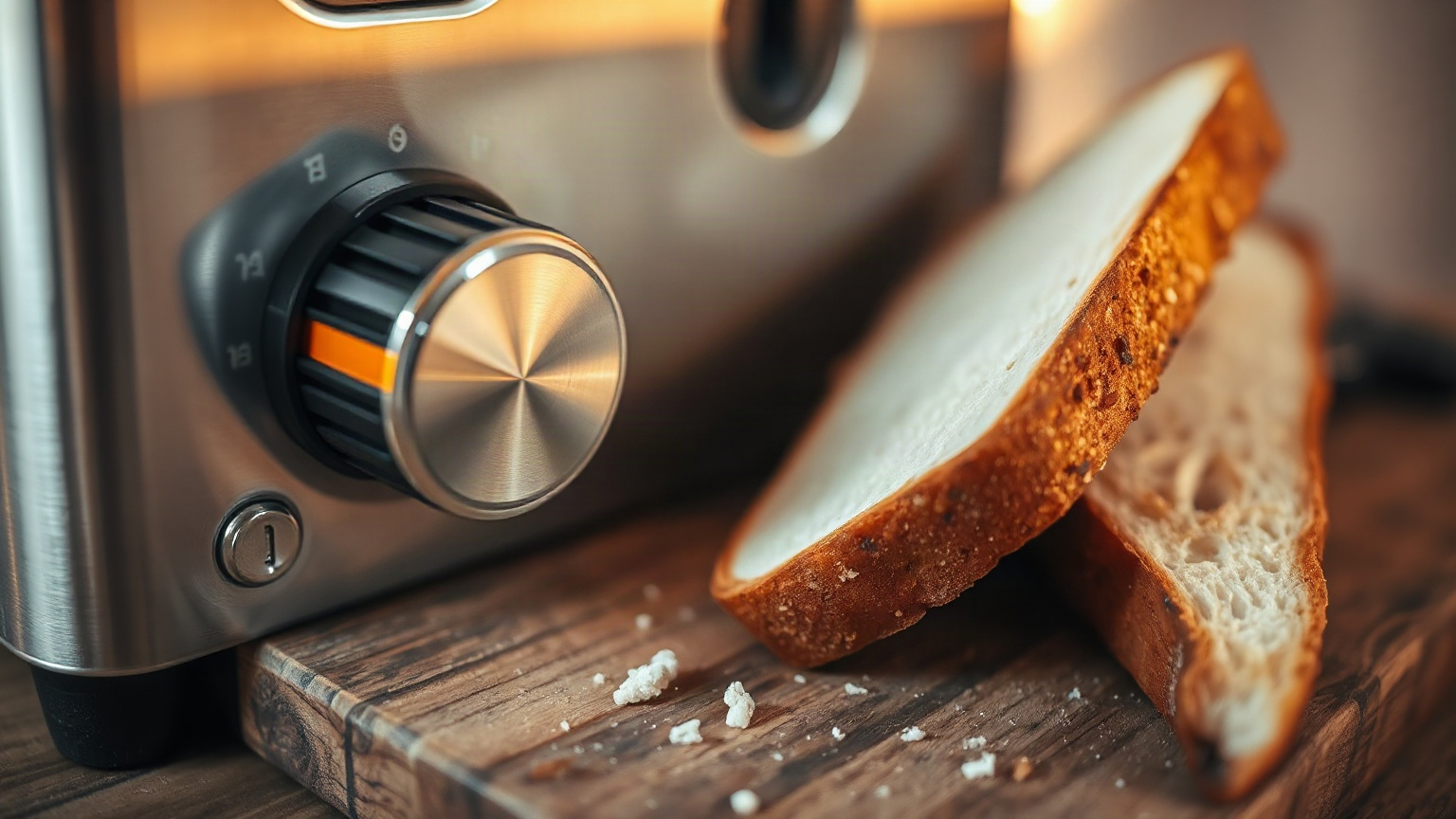
The number printed on the bottom of your toaster — usually somewhere between 800 and 1,500 watts — is the peak draw while the elements are running. That’s it. It doesn’t tell you anything about how long it runs. And that distinction matters a lot when you’re trying to figure out actual energy use.
I tested a Cuisinart CPT-122 (rated at 900W) and a Breville BTA720XL (rated at 1,500W) side by side, both on white sandwich bread. On light setting, the Cuisinart ran for about 68 seconds. On dark, it ran for just over 3 minutes. The Breville finished faster on both settings because of the higher wattage — roughly 55 seconds on light, about 2 minutes 20 seconds on dark. Higher wattage doesn’t mean you get more energy use per cycle automatically. The Breville actually came close to the Cuisinart’s total energy draw on light toast because it was done so much faster.
This trips people up constantly. More watts ≠ more energy. Time is the other half of that equation.
Light vs. Dark: The Real Numbers, Timed and Measured
Here’s what I actually clocked across several brands using a Kill-A-Watt meter and a stopwatch. Not a lab. My kitchen. With the toaster on the counter next to my coffee maker, which I’ll admit created a slightly chaotic circuit situation the first morning I tried this.
| Toaster Model | Rated Watts | Light Setting (Time) | Light Setting (kWh) | Dark Setting (Time) | Dark Setting (kWh) |
|---|---|---|---|---|---|
| Cuisinart CPT-122 | 900W | ~68 sec | ~0.017 kWh | ~185 sec | ~0.046 kWh |
| Breville BTA720XL | 1,500W | ~55 sec | ~0.023 kWh | ~140 sec | ~0.058 kWh |
| Hamilton Beach 22897 | 850W | ~80 sec | ~0.019 kWh | ~210 sec | ~0.050 kWh |
| BLACK+DECKER TR3500SD | 900W | ~75 sec | ~0.019 kWh | ~200 sec | ~0.050 kWh |
At the average US electricity rate of about $0.16 per kWh, dark toast costs you roughly $0.009 per cycle. Light toast is closer to $0.003. You’d have to make a thousand slices of dark toast to rack up a single dollar in extra electricity versus light. So no, this isn’t an energy-saving strategy. But it’s still interesting to understand what’s actually happening inside the machine.
For more context on how heat actually works in these appliances, see our explainer on how hot a toaster gets — the temperatures are higher than most people assume.
Why Bread Type Changes the Equation
Frozen bread is an edge case that almost none of the articles on this topic bother to mention. When you toast bread straight from the freezer — which I do with sourdough because I can never finish a loaf before it molds — the toaster essentially runs through two phases: thawing and then toasting. Total cycle time can nearly double. A dark setting on frozen sourdough in the Cuisinart ran for 4 minutes 10 seconds in my test, pulling around 0.063 kWh. That’s 37% more energy than dark-setting fresh bread.
Thick-cut bread does the same thing, just less dramatically. Thin sandwich bread on a light setting is your most efficient toast scenario by far.
Does Bagel Mode Use More Watts?
On most 2-slice toasters, bagel mode only activates one side’s heating elements — the inside-facing ones — so you’d expect it to pull half the wattage. In practice it’s not quite half; some models still use both sets at reduced intensity. On the Breville BTA720XL, bagel mode measured around 900–950W rather than the full 1,500W, and ran for a longer cycle. Net energy use ended up similar to or slightly higher than standard dark toast on that model.
The Standby Myth (And the One Real Exception)
Traditional pop-up toasters with mechanical timers use zero watts when they’re not actively toasting. Zero. The lever engages a bimetallic strip that physically closes the circuit. There’s no phantom load. You can leave a basic Hamilton Beach or Black+Decker plugged in for a year and it costs you nothing while idle.
But. If you own a toaster with a digital display, programmable settings, or a keep-warm function — some of the 2-slice digital toasters with LCD displays fall into this category — those do draw a small standby load, typically 0.5–2 watts continuously. Over a full year plugged in, that’s 4–17 kWh. Still cheap, but not zero.
I personally keep my toasters unplugged between uses anyway, mostly because of crumb fire risk rather than phantom load. But that’s just me.
How Wattage Affects Toast Quality (Not Just Your Electric Bill)
This is where it gets genuinely interesting. Higher-wattage toasters don’t just work faster — they produce a different quality of toast. The Maillard reaction (the browning process) is sensitive to heat intensity, not just cumulative heat. A 1,500W toaster can achieve a nice caramelized exterior while the interior stays soft and moist, because the cycle is short enough that heat doesn’t penetrate as deeply.
A lower-wattage toaster running longer on dark setting can dry out the bread more. You get browned toast, but with less contrast between crust and crumb. Serious Eats has covered the science of toast and the Maillard reaction in more depth if you want to go down that particular rabbit hole.
My honest preference: a mid-wattage toaster (around 1,000–1,100W) on a medium-dark setting hits the sweet spot for sourdough and whole wheat. Too powerful and the outside scorches before the middle warms. Too weak and you just get dried bread that’s slightly tan.
Does Toaster Age Affect Wattage Draw?
Yes, though not in a dramatic way. Heating elements can degrade slightly over time, and a very old toaster might take longer to reach operating temperature or run slightly longer cycles to achieve the same browning. I tested a 12-year-old Black+Decker that belonged to my neighbor and found it pulling 820W (rated 900W) and running noticeably longer on medium setting than a new unit of the same model. Not a major efficiency problem, but it does mean your old toaster is probably using more energy per slice than it did when new.
Putting It in Context: Toasters vs. Other Kitchen Appliances
A 2-slice toaster on dark setting for 3 minutes uses about 0.05 kWh. For comparison:
- A microwave running for 3 minutes at 1,000W uses about 0.05 kWh — nearly identical.
- A drip coffee maker running a full brew cycle (8–10 minutes at 1,000–1,500W) uses 0.13–0.25 kWh.
- An electric kettle boiling a full liter: roughly 0.1 kWh.
- A mini toaster oven preheating and baking for 15 minutes: 0.25–0.35 kWh.
Toasters are actually among the most energy-efficient ways to heat food in a small kitchen. Short cycle, focused heat, no preheating required. If you’re reheating leftovers and wondering whether a toaster oven makes more sense, take a look at our breakdown of reheating food in a toaster oven for a fuller comparison.
You can also check out this Kill-A-Watt electricity usage monitor if you want to measure your own appliances — it’s what I use and it takes about 30 seconds to set up.
The Bottom Line
The wattage rating on your 2-slice toaster tells you how hard the heating elements work, but your toast setting determines how long they run. Light toast on a standard 900W toaster pulls about 0.015–0.020 kWh per cycle. Dark toast is closer to 0.045–0.060 kWh. The dollar difference between a year of light toast versus dark toast is probably less than $2, so don’t toast light for financial reasons — toast light because you prefer it. Higher-wattage models (1,200–1,500W) do the job faster, which can actually produce better-textured toast, not just faster toast. And frozen bread quietly doubles your energy use in a way nobody else seems to be measuring.
The main thing to take away: the dial on your toaster is a timer, not a dimmer. Once you understand that, everything else about toaster wattage makes a lot more sense.
Frequently Asked Questions
How many watts does a 2-slice toaster use on the light setting?
A 2-slice toaster on the light setting draws the same wattage as any other setting — typically 800–1,200W depending on the model — but only for 60–90 seconds. Total energy consumption per light-toast cycle works out to roughly 0.013–0.025 kWh, which costs less than half a cent at average US electricity rates.
Does the dark toast setting use more electricity than light?
Yes, dark toast uses more electricity, but because the cycle runs longer — not because the wattage is higher. On dark setting, most 2-slice toasters run for 2–3.5 minutes, consuming about 0.045–0.060 kWh per cycle versus 0.013–0.025 kWh for light. The wattage drawn during each second of operation is identical across settings.
How much does it cost to run a toaster per day?
If you make two slices of toast daily on a medium-dark setting, you’re using roughly 0.08–0.12 kWh per day, which at $0.16/kWh works out to about $0.013–$0.019 per day — under $6 per year. Even doubling that for a large household with frequent toasting barely moves the needle on your electricity bill.
Do toasters use electricity when plugged in but not in use?
Standard mechanical-timer toasters draw zero watts when idle — the circuit is physically open until you press the lever. Toasters with digital displays or smart features can draw 0.5–2W continuously in standby mode. If yours has a clock or LCD screen, it’s worth unplugging it when not in use, though the energy cost is still small.
Is a higher-wattage toaster better?
Higher wattage generally means faster toasting with better moisture retention in the bread — the outside browns before heat fully dries the interior. A 1,200–1,500W toaster tends to produce crispier-outside, softer-inside toast compared to a 750W model on the same browning setting. That said, wattage above 1,500W in a 2-slice toaster is overkill and doesn’t add meaningful quality benefits.

Written by
Emma founded Toastera to turn vague appliance advice into clear, researched, safety-first guidance on toasters and toaster ovens.
Free: the Toaster Oven Cheat Sheet
Get the printable cheat sheet (temps, cook times & safety tips) plus new recipes. No spam, unsubscribe anytime.