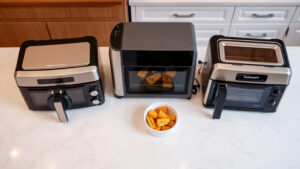
For most people, the Ninja Foodi Digital Air Fry Oven is the best all-around pick — it flips up to save counter space, handles air frying competently, and costs significantly less than the Breville. The Breville Smart Oven Air is genuinely better, but you’re paying a premium for a level of precision that casual home cooks rarely need. The Cuisinart TOA-60 sits in the middle and does most things adequately, which is both its appeal and its limitation.
Safety First: All three of these ovens run extremely hot — up to 450°F — and their exterior surfaces, door glass, and racks retain significant heat during and after cooking. Always use oven mitts when removing food or the crumb tray, keep the unit at least 4–6 inches from walls and cabinets, and never leave any of them unattended while broiling or air frying with fatty foods. Grease buildup in the drip tray is a real fire risk; clean it after every few uses.
Key Takeaways
- The Ninja Foodi Digital Air Fry Oven wins on value and footprint — its flip-up design is genuinely useful for smaller kitchens.
- The Breville Smart Oven Air produces the most consistent results across all cooking modes, but costs roughly 2–3x the Ninja’s price.
- The Cuisinart TOA-60 is a solid budget-friendly option but struggles with even heat distribution, especially on air fry mode.
- For counter space under 18 inches wide, the Ninja is the only one of these three that’s realistically practical.
- None of these replace a full-size oven for holiday cooking — but the Breville comes closest.
How I Tested These Three Ovens
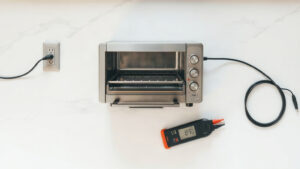
I ran all three side by side in my own kitchen over about six weeks. Same foods, same target temperatures, same amounts. Frozen french fries at 400°F for 18 minutes. A whole chicken (about 3.5 lbs) roasted at 375°F. Homemade pizza on a small toaster oven pizza stone. And a simple batch of chocolate chip cookies to see how evenly each one baked.
I timed preheat speeds, checked hot spots with an infrared thermometer, and noted how easy each oven was to actually clean. That last part sounds boring but it matters enormously if you’re using these things every day. I also ran each on air fry mode with chicken wings, which is probably the most common use case people are buying these for.
One thing none of the comparison articles I’ve read mention: I tested all three with the same crumb tray removed and reinserted several times, because that’s a real daily habit that gets annoying fast if the tray doesn’t slide cleanly. Spoiler — the Cuisinart’s tray is a bit of a pain.
The Comparison at a Glance
| Feature | Ninja Foodi Digital Air Fry Oven | Breville Smart Oven Air | Cuisinart TOA-60 |
|---|---|---|---|
| Price Tier | Budget-Mid | Premium | Budget-Mid |
| Capacity | ~0.6 cu ft (compact) | ~1.0 cu ft (large) | ~0.6 cu ft |
| Max Temp | 450°F | 450°F | 450°F |
| Wattage | 1800W | 1800W | 1800W |
| Footprint When Stored | Very small (flips up) | Large (permanent) | Medium |
| Air Fry Performance | Very good | Excellent | Good |
| Heat Evenness | Good | Excellent | Fair |
| Ease of Cleaning | Good | Very good | Adequate |
| Preset Functions | 8 | 13 | 7 |
The Ninja Foodi Digital Air Fry Oven: Best for Most Kitchens
Here’s what sold me on the Ninja: the flip-up storage design. When you’re done cooking, the whole unit rotates up against the wall and takes up about a third of its normal counter footprint. I live in an apartment with roughly 14 inches of usable counter space between my coffee maker and the wall, and the Ninja actually fits in that gap when stored. The other two don’t.
Air fry performance is strong. The 400°F, 18-minute frozen fry test came out genuinely crispy — not “pretty good for a toaster oven” crispy, actually good crispy. Chicken wings at 390°F for 25 minutes (flipped halfway) were excellent. The skin had real texture. My one gripe: the interior is on the smaller side, so a 3.5 lb chicken fit but it was tight, and I had to tuck the wings awkwardly. For a family of four doing a proper roast, you’ll feel the squeeze.
Preheat to 400°F took about 4 minutes 20 seconds on average across multiple tests. That’s competitive. The control panel is digital and responsive — I had no issues figuring it out, though first-timers might need a minute to find the air fry mode since it’s not the first button in the sequence.
Cookie baking revealed mild hot spots toward the back-right corner. Rotating the pan at the halfway point fixed it. Not a dealbreaker, just something to know. For more on how these ovens handle reheating food, it’s worth understanding the heating element layout first.
The Breville Smart Oven Air: The Best Oven, Full Stop
I’ll be honest — if price weren’t a factor, I’d own the Breville. It’s the most consistently excellent of the three by a noticeable margin. The Element IQ system, which distributes heat from different heating elements based on what you’re cooking, actually works. My cookies came out evenly browned across the entire sheet without rotating. The chicken roasted beautifully with no dry spots. The pizza had a crispy bottom that I genuinely wasn’t expecting from a countertop oven.
The 13 cooking presets aren’t gimmicks — the “Roast” setting specifically runs a different heat profile than “Bake,” and you can feel the difference in results. Serious Eats has noted Breville’s smart heat distribution as one of the more technically legitimate features in the countertop oven category, and I’d agree based on my own testing.
Preheat to 400°F: about 5 minutes 10 seconds. Slightly slower than the Ninja, slightly faster than the Cuisinart. The interior is genuinely large — a full 13×9 pan fits without any trimming or wedging. If you’re cooking for a family regularly or you entertain, that extra capacity matters.
The downsides? It’s big. It’ll take up a permanent spot on your counter; there’s no folding or tucking it away. And the price is real. For someone who uses a countertop oven maybe twice a week for frozen snacks and the occasional pizza, spending that much is hard to justify. But for daily, serious cooking? It earns its price.
The Cuisinart TOA-60: Decent, But It Shows Its Age
The Cuisinart TOA-60 has been around for years, and it was a genuinely strong option when it launched. Today, it’s been surpassed. That’s not a knock on Cuisinart — the appliance market just moved fast.
Air fry performance is acceptable. Fries came out crispy-ish at 400°F for 18 minutes, but noticeably less so than the Ninja or Breville. There’s a cold spot in the front-left corner of the interior that showed up in every single test — the infrared thermometer read about 25°F lower there than at the center. You can work around this by rotating food, but you shouldn’t have to with a $150-ish appliance.
The crumb tray, as I mentioned earlier, doesn’t slide as smoothly as the other two. It catches slightly on the rails. After cleaning and reinserting it a dozen times, it gets a bit annoying. Small thing. But every day small things add up. The dial-based controls feel dated compared to the digital interfaces on the other two, and the presets are more limited.
Where the Cuisinart still shines: it’s widely available, parts and accessories are easy to find (standard TOA-60 replacement racks and baskets are on Amazon), and it holds its value well on the used market if you decide to upgrade. For a first countertop oven purchase on a tight budget, it’s not a bad starting point. I just wouldn’t choose it over the Ninja at similar prices.
The Edge Case Nobody Talks About: Noise Levels
Every review I’ve read focuses on cooking performance and capacity. Fair. But here’s something that actually affected my daily experience: noise from the convection fan.
The Breville is the quietest of the three — it’s noticeable but unobtrusive, roughly like a quiet bathroom exhaust fan. The Ninja is slightly louder, with a bit of a higher pitch to the fan. The Cuisinart is the loudest, and on air fry mode specifically, it has a rattly quality at higher temperatures that I found genuinely distracting when working at my kitchen table nearby.
If you have an open kitchen layout or work from home near your kitchen, this is worth factoring in. It’s not a dealbreaker for any of them, but it’s the kind of detail that compounds over months of daily use. The USDA recommends cooking poultry to an internal temperature of 165°F regardless of which oven you’re using — and you’ll be running that fan long enough for noise to matter.
The Honest Verdict: Who Should Buy Which
Buy the Ninja Foodi Digital Air Fry Oven if you have limited counter space, cook for one to three people, and want strong air fry performance without spending a lot. It’s my pick for most people reading this — it solves real practical problems (counter space, price, air fry capability) without compromising on results for everyday cooking. Also check out our roundup of the best mini toaster ovens if the Ninja still feels too large for your kitchen.
Buy the Breville Smart Oven Air if you cook seriously, you cook frequently, you have the counter space, and budget isn’t a hard constraint. It’s the best-performing oven of the three by a real margin. No hesitation recommending it to someone who will actually use it hard.
Buy the Cuisinart TOA-60 if you find it on sale, if you specifically need a replacement for a TOA-60 you already own and love, or if you’re buying a first countertop oven for a college kitchen where expectations are modest. Otherwise, the Ninja beats it at a similar price point with fewer frustrations.
The answer isn’t glamorous, but it’s real: the Ninja wins for most kitchens, the Breville wins for the best kitchen, and the Cuisinart wins for the most particular budget circumstances. Pick accordingly.
Frequently Asked Questions
Is the Ninja Foodi Digital Air Fry Oven worth it compared to the Breville Smart Oven Air?
Yes, for most people the Ninja is worth it. It delivers very good air fry results and genuine counter space savings at a fraction of the Breville’s price. The Breville outperforms it in heat evenness and cooking precision, but unless you’re cooking elaborate meals daily, you likely won’t notice the gap in real-world use.
Can the Cuisinart TOA-60 replace a regular oven?
For small batches and everyday cooking, yes — the TOA-60 handles baking, roasting, and toasting adequately. It won’t replace a full-size oven for large roasts or multiple-rack baking, and its uneven heat distribution means you’ll want to rotate food mid-cook. It’s a supplement, not a true substitute.
How hot does the Breville Smart Oven Air get?
The Breville Smart Oven Air reaches a maximum of 450°F, the same as both the Ninja and Cuisinart. What sets it apart isn’t the maximum temperature but how evenly it maintains and distributes that heat throughout the interior, thanks to its multi-element heating system. You can read more about how hot countertop ovens get and why it matters for cooking results.
Which air fryer toaster oven is easiest to clean?
The Breville is the easiest to clean thanks to its non-stick interior coating and smoothly sliding crumb tray. The Ninja is a close second — the interior wipes down well and the basket is dishwasher safe. The Cuisinart’s crumb tray is the most awkward of the three to remove and reinsert, which makes daily cleaning slightly more tedious.
What size air fryer toaster oven do I need for a family of four?
A family of four should look for at least 0.8–1.0 cubic feet of interior capacity. That makes the Breville Smart Oven Air (approximately 1.0 cu ft) the most practical choice from these three. The Ninja and Cuisinart at roughly 0.6 cu ft will feel cramped for family-sized meals, though they handle smaller portions and snacks without issue.

Written by
Emma founded Toastera to turn vague appliance advice into clear, researched, safety-first guidance on toasters and toaster ovens.
Free: the Toaster Oven Cheat Sheet
Get the printable cheat sheet (temps, cook times & safety tips) plus new recipes. No spam, unsubscribe anytime.