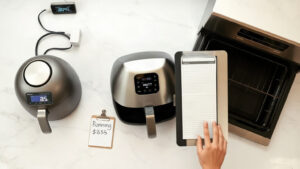
The convection bake setting on a toaster oven adds a small internal fan that circulates hot air continuously around your food, rather than letting it sit in static heat. That moving air strips away the cool, moist boundary layer clinging to your food’s surface, which speeds up cooking by roughly 25% and browns things more evenly. In practice, that means you’ll either drop your temperature by about 25°F or shave 20–25% off your cook time — sometimes both.
Safety First: Toaster ovens run extremely hot on convection settings — exterior walls, the door glass, and especially the rack can reach temperatures that cause serious burns in under a second. Always use oven mitts rated for at least 450°F when reaching inside, keep the oven at least four inches from any wall or cabinet, and never leave it unattended on high heat with fatty or oily foods — grease splatter near a heating element is a real fire risk.
Quick Facts: Convection Bake in a Toaster Oven
- Convection bake uses a fan to circulate hot air — standard bake does not.
- Reduce your recipe temperature by 25°F or your cook time by 20–25% when switching to convection. Doing both at once usually overcooks things.
- Best uses: roasted vegetables, cookies, sheet-pan proteins, reheating leftovers with crunch.
- Worst uses: delicate custards, soufflés, quick breads that need a slow rise before the crust sets.
- Most toaster oven convection fans are much smaller than full-size oven fans — so the effect is real but slightly less dramatic than you’d expect from a full oven.
What’s Actually Happening Inside When You Hit “Convection Bake”
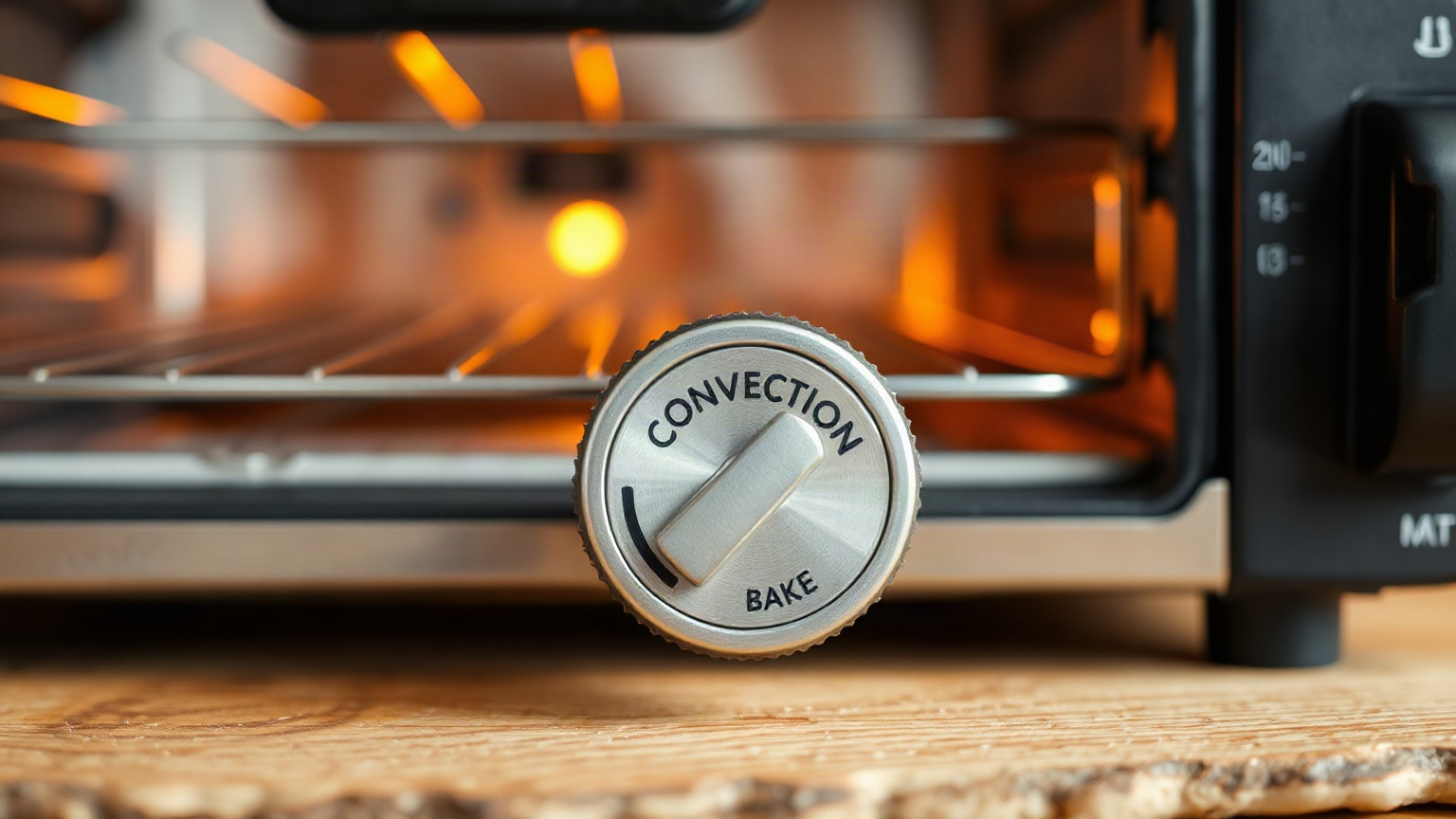
Regular bake mode heats the air in the chamber, and that hot air just… sits there. Your food cooks from radiant heat coming off the elements and from the ambient hot air around it. It works fine. But because the air is static, the food is essentially insulated by a thin layer of cooler, moister air right against its surface. That’s why a standard-baked cookie can come out pale on the bottom even when the oven reads 375°F.
Flip to convection bake, and a small fan — usually mounted on the back wall — starts spinning. It pushes that hot air all around the food constantly, disrupting that cool boundary layer. Heat reaches the surface faster, moisture evaporates quicker, and you get browning. Real, actual browning, not just “cooked through.”
Here’s the part most articles skip: the fan in a toaster oven is tiny. We’re talking maybe 4–5 inches in diameter on most mid-range units. It doesn’t move nearly the same volume of air as a full-size convection oven fan, so the adjustment you make doesn’t always need to be as aggressive. I’ve found that in most compact toaster ovens, reducing temperature by 15–20°F is plenty. Going the full 25°F sometimes undershoots.
Convection Bake vs. Standard Bake: A Side-by-Side Look
| Feature | Standard Bake | Convection Bake |
|---|---|---|
| Air movement | None (static) | Fan-circulated |
| Browning | Slower, less even | Faster, more even |
| Moisture loss | Lower | Higher (crisp results) |
| Typical temp adjustment | Use recipe temp as-is | Drop 15–25°F |
| Cook time | Use recipe time as-is | Check 20% earlier |
| Best for | Cakes, soufflés, custards | Cookies, roasts, veggies, reheating |
| Worst for | Crispy textures | Delicate, eggy bakes |
When You Should Actually Use It (And When to Leave It Off)
Foods That Genuinely Benefit
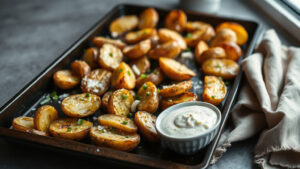
Roasted vegetables are probably the best argument for convection bake in a toaster oven. Broccoli at 400°F convection for 14 minutes comes out with those slightly charred, crispy edges that make it actually worth eating. Same thing on standard bake at the same temp takes closer to 20 minutes and you still get steamy, soft florets instead. That’s not a subtle difference.
Cookies also do well. Chocolate chip cookies at 325°F convection bake for 10 minutes spread evenly, get golden across the whole bottom, and don’t have that underdone pale ring around the edges. I tested a batch back-to-back on the same afternoon — standard bake at 350°F for 12 minutes versus convection at 325°F for 10 — and the convection batch was more consistent, full stop.
Reheating is another strong case. If you’re warming up pizza, fries, or anything fried the night before, convection bake at 350°F for 5–7 minutes does what a microwave could never do. Check out our guide on reheating food in a toaster oven for more on that.
Thin proteins — chicken thighs, salmon fillets, pork chops — all come out with better skin and exterior texture on convection. Sheet-pan dinners are just better. That’s my blanket opinion and I’m sticking with it.
When to Skip Convection Bake
Anything with a delicate structure that needs to set slowly before the outside firms up. Cheesecake. Bread pudding. A soufflé, obviously, though if you’re making a soufflé in a toaster oven you’ve already committed to a certain level of chaos. Quick breads — banana bread, zucchini bread — can get a thick, hard crust on the outside before the center has cooked through. That’s not fun to discover after 45 minutes.
Meringues. Don’t do it. The moving air will crack them before they’ve dried out properly. I learned this the annoying way.
Also worth knowing: if you’re using a very light pan — thin aluminum foil pans especially — the fan can actually shift the pan slightly on the rack, or blow light parchment paper up against the heating element. Not ideal. Use a heavier toaster oven baking pan and clip or tuck parchment paper so it can’t lift.
How to Actually Use the Convection Bake Setting: Step by Step
It’s less complicated than people make it out to be.
Step 1: Preheat properly. Toaster ovens on convection preheat faster than standard mode — typically 5–7 minutes to reach 375°F versus 8–10 minutes. But you still need to preheat. Putting food into a cold oven on convection means the fan runs while the temperature climbs, which dries the surface before the interior even starts cooking. Not great.
Step 2: Adjust your temperature. Take the recipe’s listed temperature and drop it by 15–25°F. I usually start at 20°F less and adjust from there. If you’re cooking something you’ve made many times and you know your unit, you might skip this and just check early instead.
Step 3: Set your rack position. The middle rack position works for most things on convection bake. Because the air is moving, you don’t need to chase the hotspot like you might on standard bake. For things you want extra-crispy on the bottom (like pizza), one position lower is worth trying.
Step 4: Check early. I set a timer for about 75–80% of the recipe’s stated time the first time I make anything on convection. A 20-minute recipe, I check at 15. It’s surprising how often that’s actually enough.
Step 5: Don’t overcrowd the pan. This is even more important on convection than standard bake. The fan moves air around your food — if you’ve piled vegetables three layers deep, the air can’t get to most of them. Single layer. Every time. A good toaster oven wire rack can help if you want to do two layers — elevating the second layer above the first actually helps airflow.
The Edge Case Nobody Mentions: Altitude and Humidity
Most convection guides act like your kitchen is in a climate-controlled vacuum. It’s not. If you’re baking in a humid environment — coastal, summer, Pacific Northwest — your convection results are going to be slightly less crispy than the recipe suggests, because there’s more moisture in the ambient air that the fan circulates. You might need to add a few degrees or a few minutes.
High altitude adds a whole other layer. At elevations above 3,500 feet, moisture evaporates from food faster, and convection speeds that up even more. Baked goods can come out dry or over-browned before they’ve set internally. If you’re above 5,000 feet and using convection, I’d recommend going even lower on the temp — try 30°F below the recipe — and keeping a close eye after the halfway mark. The USDA has some guidance on high-altitude cooking adjustments that’s worth bookmarking if you live there.
A Few Things That Tripped Me Up Early On
First time I used convection bake on my toaster oven, I followed the “reduce temp by 25°F and time by 25%” rule for a whole chicken breast. Pulled it out at the adjusted time and it was perfect on the outside — beautiful golden color. Still slightly underdone in the center. Lesson: the fan helps the outside, but the interior still needs time to cook through. For thick cuts of meat, reduce the time but still verify internal temperature with a thermometer. Always.
Second mistake: I put a square of parchment paper down, didn’t tuck it, and the fan blew one corner up against the top heating element. It scorched but didn’t ignite. Still, it reminded me that convection isn’t passive — there’s moving air in there and anything loose will feel it.
And honestly, the biggest adjustment is just trusting yourself to check early. Most people — including past me — are trained to leave food alone and trust the timer. Convection punishes that habit.
If you want to know more about how toaster ovens handle different heat modes and what temperatures they actually reach internally, we’ve got a detailed breakdown of how hot a toaster gets that covers some of the same physics.
For more on choosing a unit that actually has a reliable convection setting, our guide to the best mini toaster ovens covers several models worth considering. Serious Eats also has a solid breakdown of convection cooking principles if you want to go deeper on the science.
The Bottom Line
Convection bake isn’t magic, but it’s legitimately better for a lot of everyday cooking. Crisper, faster, more even — those are real outcomes, not marketing copy. The adjustments are small and you’ll get a feel for your specific unit within two or three uses. Start with roasted vegetables or cookies if you want an easy win. Skip it for anything eggy or structurally delicate. And tuck your parchment paper.
Frequently Asked Questions
Should I use convection bake or regular bake for cookies in a toaster oven?
Convection bake is better for cookies in almost every case. The circulating air browns the bottoms and edges more evenly, so you don’t get that frustrating pale ring around the outside. Drop the temperature by 15–20°F from your recipe and start checking about 2 minutes early.
Do I need to adjust the temperature when using convection bake on a toaster oven?
Yes. Reduce the recipe temperature by 15–25°F, or reduce the cook time by about 20%, or do a small combination of both. Because toaster oven convection fans are smaller than full-size oven fans, the 25°F rule can sometimes overshoot — start at 20°F less and learn your unit.
Can you use convection bake for frozen foods in a toaster oven?
Yes, and it works really well. Frozen fries, frozen pizza rolls, anything breaded or fried — convection bake at 375–400°F gets them crispy in a way that standard bake rarely does. Reduce the time on the package instructions by about 15–20% and check before the timer goes off.
What’s the difference between convection bake and convection roast on a toaster oven?
Convection roast typically runs the fan at higher power and may cycle the broil element on periodically to add more direct top heat — it’s designed for proteins and things you want extra-browned on the outside. Convection bake uses the fan with more even, consistent heat from both elements. For most baked goods, use convection bake; for whole chicken or a pork tenderloin, convection roast gives better crust.
Is convection bake in a toaster oven the same as an air fryer?
They use the same basic principle — a fan circulating hot air — but an air fryer runs a much faster, more powerful fan and often at higher temperatures, which is why it gets things crispier than standard convection bake. Some toaster ovens now include a dedicated air fry setting that runs the fan at full speed; that’s closer to a true air fryer. Regular convection bake is gentler and better for baking.

Written by
Emma founded Toastera to turn vague appliance advice into clear, researched, safety-first guidance on toasters and toaster ovens.
Free: the Toaster Oven Cheat Sheet
Get the printable cheat sheet (temps, cook times & safety tips) plus new recipes. No spam, unsubscribe anytime.