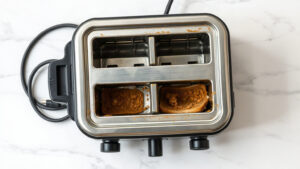
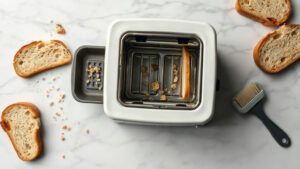
The numbers on a toaster dial represent time, not intensity — most standard toasters run on a fixed heating element, so turning the dial higher simply keeps the heat on longer. That said, in a toaster oven, the dial works differently: those numbers are actual temperature settings in degrees Fahrenheit (or Celsius, depending on where you bought it). Knowing which type of appliance you’re working with changes everything about how you get consistent results.
Safety First: Toaster ovens run at temperatures up to 450–500°F and their outer surfaces, racks, and pans get dangerously hot. Always use oven mitts when removing food or adjusting racks, keep the appliance at least 4 inches from walls and cabinets, and never leave it unattended at high heat settings. If you smell burning or see smoke, switch it off at the wall — don’t just press the dial.
Quick Facts: Toaster Dial Numbers at a Glance
- On a pop-up toaster, the dial numbers (typically 1–6 or 1–7) control how long the heating elements stay on — not a heat level.
- On a toaster oven, the temperature dial is a real thermostat — usually ranging from about 150°F up to 450°F or 500°F.
- The “1 = minutes” viral claim is mostly false — the numbers don’t map cleanly to exact minutes on most modern toasters.
- Bread type, moisture content, and even altitude affect how your toast actually turns out at any given setting.
- Most toaster ovens need a 5-minute preheat before the dial setting means anything reliable.
Pop-Up Toasters vs. Toaster Ovens: Two Completely Different Dials
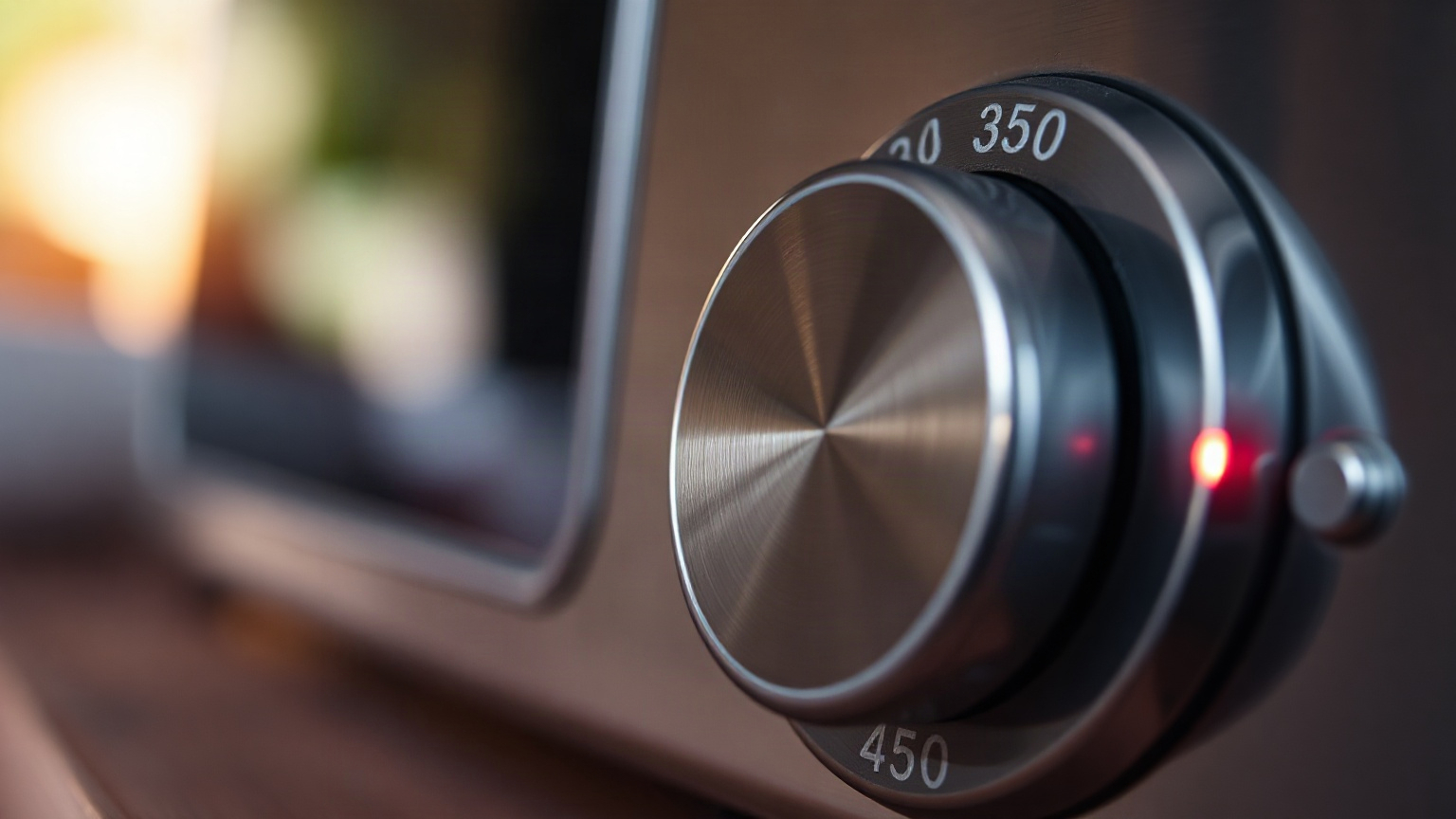
This is where most of the confusion lives, and honestly, I didn’t think about it clearly myself until I started testing both side by side. A pop-up toaster doesn’t have a thermostat. Its heating elements run at a fixed wattage — roughly 800 to 1,500 watts — from the moment you push the lever down. The dial controls a timer or a bimetallic strip that determines when the toast pops up. So “setting 3” on a 2-slot toaster doesn’t mean medium heat. It means the elements run a bit longer than “setting 2.” That’s it.
A toaster oven is a different beast. It has an actual thermostat with a temperature sensor, and the dial — or digital display — corresponds to a real target temperature. Set it to 350°F and the oven cycles its elements on and off to hold that temperature. It’s the same basic principle as your full-size oven, just smaller and faster to preheat.
I’ve seen people set their toaster oven to the lowest number and wonder why their garlic bread came out pale and sad. They thought “low number = gentle heat.” The oven was actually trying to hold somewhere around 150–200°F. Perfectly logical if you understand the dial; baffling if you don’t.
The “Minutes” Myth — What the Internet Got Wrong
A few years back, a claim went viral: the numbers on a pop-up toaster represent the number of minutes of toasting time. Sounds neat. It’s also not really true, at least not in any universal sense.
I actually timed this. Using a mid-range 2-slice toaster with a dial that goes from 1 to 6, I ran plain white sandwich bread at each setting and measured the cycle time with a stopwatch. Here’s what I got:
| Dial Setting | Approximate Cycle Time | Result on White Bread |
|---|---|---|
| 1 | ~45 seconds | Barely warm, no color |
| 2 | ~1 min 10 sec | Lightly golden on edges |
| 3 | ~1 min 45 sec | Even golden, what I’d call “normal” toast |
| 4 | ~2 min 20 sec | Darker, slightly chewy center |
| 5 | ~3 min 05 sec | Dark brown, borderline burnt edges |
| 6 | ~3 min 50 sec | Burnt. Genuinely unpleasant. |
Notice that setting 6 landed at roughly 3:50 — close to the 3:45 figure that gets quoted online for that setting. So there’s a kernel of truth there. But on a different toaster I tested (a cheaper single-slot model), setting 6 ran for barely 2 minutes and still managed to char the bread. The timer mechanism varied completely between brands. So “the numbers are minutes” is more of a rough approximation on some specific models, not a rule.
Snopes-style fact-checkers have rated this claim false for good reason. Serious Eats has covered how toast quality depends on a whole cluster of variables the dial can’t account for — bread density, moisture, even how recently you toasted something else (a warm toaster toasts faster).
How Toaster Oven Temperature Dials Actually Work
The Temperature Range
Most toaster ovens span from about 150°F on the low end up to 450°F, and some go to 500°F. The low settings — 150 to 200°F — are for warming food or proofing dough, not browning anything. The 325–375°F range is your everyday workhorse for baking, reheating pizza, roasting vegetables. Above 400°F you’re getting into broil-adjacent territory: good for finishing off a steak or crisping the top of a casserole. You can read more about how hot a toaster gets in this breakdown I put together separately.
Why the Dial Isn’t Always Accurate
Here’s something that surprised me the first time I used an oven thermometer in a toaster oven: the actual internal temperature was 25–40°F lower than what the dial said. This isn’t unique to cheap models — I saw it on a mid-range Cuisinart unit too. The thermostat overshoots and undershoots as it cycles, and the dial is calibrated to an average, not a constant. If you’re baking anything precise — cookies, a small cake — an inexpensive oven-safe thermometer inside the cavity will tell you what’s actually happening.
I’d also say: always preheat. Five minutes minimum. Some toaster ovens need closer to eight. The dial setting means very little if you’ve just switched the appliance on and immediately put food inside — the air temperature in there is still basically room temperature no matter what number you’ve chosen.
Toast Mode Is Different
Many toaster ovens have a dedicated “Toast” function with its own dial or settings — usually numbered 1 through 6 or Light/Medium/Dark. In this mode, the oven ignores the temperature dial and behaves more like a pop-up toaster: fixed high heat, timer-controlled. The shade settings on that separate toast dial are purely about duration, not temperature. This is exactly the kind of thing that trips people up, and I’ll admit it confused me the first time I used a Breville Smart Oven. I had both dials going and got… very aggressively dark bread.
The Edge Cases Nobody Talks About
Frozen Bread and the “Frozen” Setting
Some pop-up toasters have a “Frozen” button. Press that alongside your shade setting and the toaster adds extra time to account for the frozen bread needing to thaw before it can brown. It’s not a temperature change — just a longer cycle. I always use setting 3 with the Frozen button for frozen English muffins and it’s the most reliable thing my toaster does.
Bagels, Thick Bread, and the Moisture Variable
Fresh bread with higher moisture content needs more time at the same setting than dry, day-old bread. Same number on the dial, wildly different results. If you’ve ever wondered why your toast comes out perfect on day two of a loaf but a bit pale the day you bring it home from the bakery — this is why. The dial hasn’t changed. The bread has.
Bagels are thicker and denser, obviously. Most toasters have a bagel setting that only activates the inner-facing elements to toast the cut sides without over-crisping the outside. The shade dial still controls duration. Worth knowing.
Convection Mode Changes the Math
If your toaster oven has a convection setting, the fan circulates hot air and effectively raises the cooking efficiency — meaning food cooks faster and browns more than the temperature dial alone would suggest. Standard advice is to drop the temperature by 25°F or reduce cooking time by about 20% when switching to convection. The dial number stays the same; the result doesn’t. This catches a lot of people out when they’re reheating food in a toaster oven and suddenly their leftovers are overdone.
Practical Settings Guide: What Numbers to Actually Use
For pop-up toasters, I’d suggest starting at 3 for white bread and going from there. Whole grain or seeded bread? Try 3.5 or 4 — denser, more moisture. Bagels on a standard dial (no bagel setting): I go to 4. Frozen items: add one full setting to whatever you’d normally use, or use the Frozen button if you have it.
For toaster ovens, here’s how I personally use the temperature dial:
- 150–200°F: Keeping food warm, proofing bread dough (yes, really — it works)
- 250–300°F: Slow warming, dehydrating herbs, low-and-slow reheating
- 325–350°F: Baking cookies, muffins, reheating pizza without rubber-izing the crust
- 375–400°F: Roasted vegetables, chicken thighs, most savory baking
- 425–450°F: Crisping, browning, anything that needs a proper crust
If you’re shopping for a toaster oven with reliable temperature control, the options in our best mini toaster ovens guide all have thermostats I’ve actually tested against an oven thermometer. And for getting the most out of whatever rack position you’re using, a decent toaster oven wire rack at the right height matters more than most people realize — middle rack for most things, top rack only for the last few minutes of browning. The USDA’s recommended internal temperatures for meat apply just as much in a toaster oven as a full-size one, by the way.
The Bottom Line
The numbers on a pop-up toaster dial control time, not temperature — and they don’t map neatly to exact minutes, whatever you might have seen online. The numbers on a toaster oven dial are actual temperature targets in degrees, with the same caveats any oven has: it’ll drift a bit, it needs preheating, and convection mode changes everything. Once you understand the difference, using either appliance becomes a lot less guesswork. I still start at 3 on a pop-up toaster and 350°F on a toaster oven as my default baselines, then adjust from there. Works 90% of the time.
Frequently Asked Questions
Do the numbers on a toaster represent minutes of toasting time?
No — not in any reliable, universal way. The numbers on a pop-up toaster control how long the heating cycle runs, which loosely correlates to time, but the actual minutes vary significantly between brands and models. The viral claim that “setting 6 = 3:45 minutes” applies to some specific toasters but isn’t a rule you can count on.
What temperature does a toaster oven dial refer to?
Toaster oven dials show temperature in degrees Fahrenheit (or Celsius on some models), typically ranging from 150°F at the low end up to 450–500°F at the high end. These are real thermostat targets, though the actual internal temperature can run 15–40°F lower than the dial shows — an oven thermometer will tell you for sure.
What setting should I use on my toaster for normal toast?
Setting 3 on a standard 1–6 dial produces even golden toast on most white sandwich bread. For denser or whole grain bread, try setting 3.5 to 4. Adjust from there based on how your specific toaster performs — they all run a bit differently.
Why does my toaster oven not reach the temperature on the dial?
Toaster ovens commonly run 15–40°F cooler than the dial setting because the thermostat cycles the elements on and off and averages out to the target temperature. This is normal but worth knowing if you’re baking anything precise. Place an oven-safe thermometer inside to see your actual temperature, and add a few extra degrees to your dial setting to compensate.
Does the toaster dial setting change if I use the frozen bread button?
The Frozen button extends the toasting cycle to account for the extra time needed to thaw and then brown frozen bread — it doesn’t change the heat level. Use your normal shade setting alongside the Frozen button, or manually increase the dial by one setting if your toaster doesn’t have that feature.

Written by
Emma founded Toastera to turn vague appliance advice into clear, researched, safety-first guidance on toasters and toaster ovens.
Free: the Toaster Oven Cheat Sheet
Get the printable cheat sheet (temps, cook times & safety tips) plus new recipes. No spam, unsubscribe anytime.