Toaster sparks when bread pops up are almost always caused by a small electrical arc between the heating elements and either crumbs, food debris, or a worn mechanical contact inside the carriage mechanism — and in most cases, a single small blue flash is harmless. That said, repeated sparking, sparks accompanied by smoke, or any burning smell is a different story entirely. Knowing which situation you’re in takes about 30 seconds to figure out, and I’ll walk you through exactly how.
Safety First: If your toaster sparks repeatedly, produces smoke, smells like burning plastic or wiring, or trips a circuit breaker — unplug it immediately and do not use it again until you’ve inspected it or replaced it. Electrical arcing near crumbs or accumulated grease is a genuine fire risk. Never insert metal objects to remove debris, and never operate a toaster over a fabric surface or near flammable materials.
Quick Facts: Toaster Sparking at a Glance
- A standard pop-up toaster’s heating elements reach between 300°F and 480°F during normal operation — learn more about how hot a toaster gets and why that matters for safety.
- A single, brief blue flash as toast pops up is usually just electrical arc discharge and is not automatically dangerous.
- Repeated or large sparks almost always mean crumb buildup, a damaged heating element, or a failing electromagnetic latch — all fixable or replaceable.
- Most toasters have a lifespan of 6–8 years; sparking in an older unit is often a sign it’s time to replace it rather than diagnose it.
- Unplugging your toaster between uses isn’t paranoia — it genuinely reduces the risk of arcing from a slow mechanical failure going unnoticed.
Why Your Toaster Sparks When the Bread Pops Up
There are a handful of distinct reasons this happens, and they’re not all equal in terms of danger. Let me break them down in plain terms.
The Electromagnetic Latch Releasing
Most pop-up toasters use an electromagnet to hold the bread carriage down during toasting. When the toasting cycle completes — either by a bimetal strip warping from heat or a timer running out, depending on your model — the electromagnet de-energizes. That sudden drop in current through an electromagnetic circuit can produce a tiny arc. Blue. Brief. Almost like a camera flash you catch from the corner of your eye.
This is physics, not a malfunction. I noticed it the first time I used a secondhand Dualit I picked up at an estate sale — nearly threw the thing out before I realized what it actually was. Older toasters with heavier electromagnetic latches tend to produce more visible arcs than newer budget models with lighter springs. It’s more pronounced, not more dangerous.
Crumb Buildup — The Most Common Real Problem
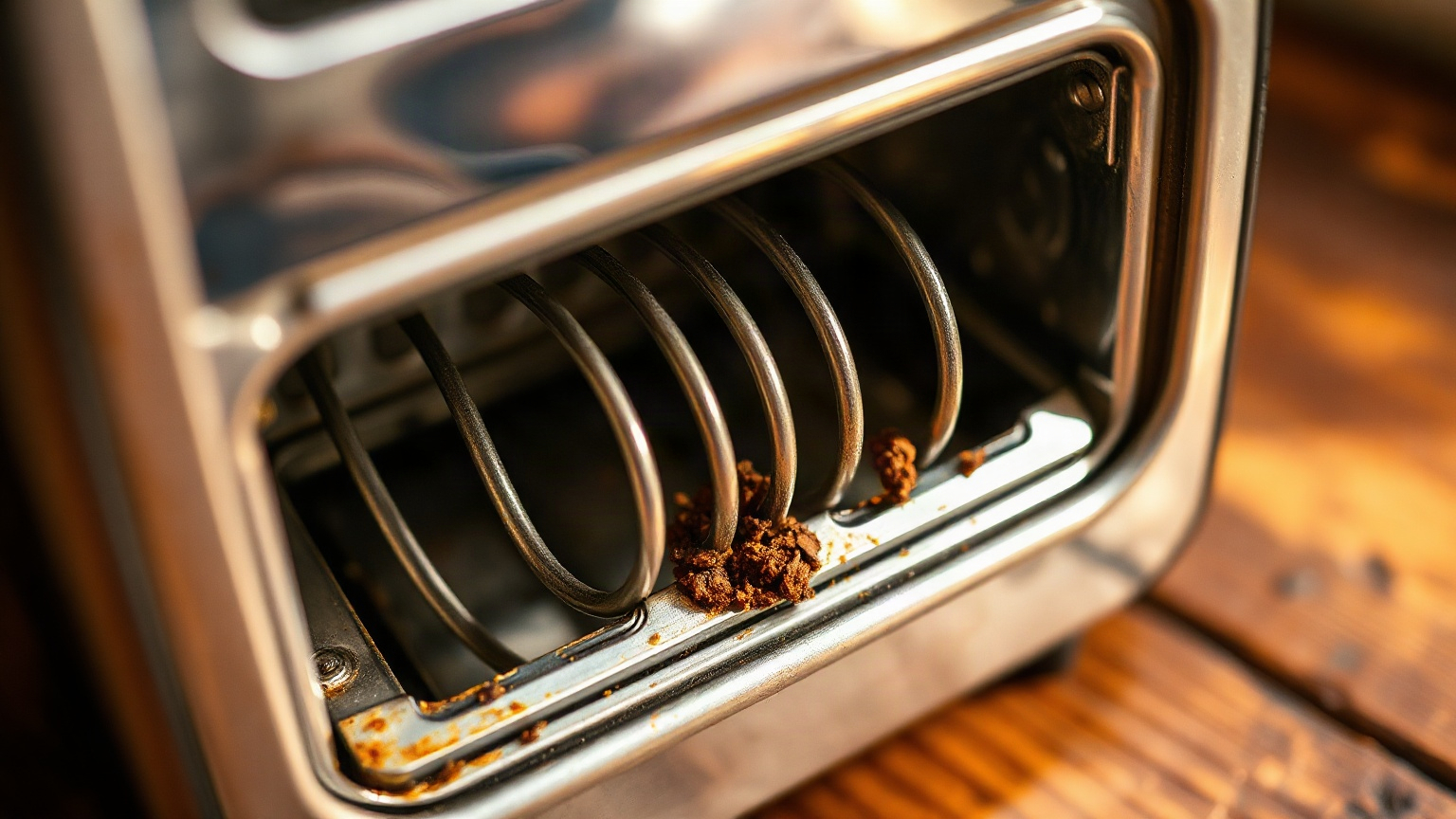
This is where it gets less benign. Crumbs accumulate at the bottom of the toaster, and some lodge between or near the heating elements. When an element is live at 400°F+ and a crumb is close enough, you can get sustained arcing or small flames — not just a flash. Bagels are the worst offenders. Their dense, irregular texture drops significantly more debris than standard sandwich bread. Same goes for crumpets, seeded loaves, and anything with a coating.
The USDA recommends cleaning small appliances regularly to prevent fire hazards, and honestly, most people clean their toaster crumb tray far less often than they should. The tray catches maybe 60–70% of crumbs; the rest find their way into the body of the toaster. A toaster used daily should have its crumb tray emptied at least once a week and a full inversion-and-shake cleaning monthly.
A Damaged or Degraded Heating Element
Heating elements are nichrome wire coils or strips wound around a mica sheet. Over years of thermal cycling — heating up, cooling down, thousands of times — that mica can crack, and the nichrome can develop hot spots or even small breaks. A wire with an internal weakness will arc across the gap when current flows, especially at the moment the circuit opens (which is exactly when the toast pops up). This kind of spark is persistent. It happens every single cycle and often gets worse over time.
You can sometimes see this if you look down into an unplugged, cooled toaster with a flashlight — look for discoloration on the mica panels or any element that looks kinked or partially broken. Don’t poke around with anything metal.
Foil, Twist Ties, or Metal Making Contact
Obvious in retrospect, embarrassing in practice. A forgotten twist tie from a bread bag, a small piece of foil from a toaster pastry, or even metallic food packaging that got carried in with the bread can cause dramatic sparking. Not a blue flash — more like a sustained spit and crackle. This is genuinely dangerous and you should unplug the toaster immediately if it happens.
How to Tell If Your Specific Spark Is Normal or Not
Here’s how I’d actually diagnose it in the kitchen, not in theory.
First, look at the frequency. A single blue flash, happens maybe one out of every three or four cycles, no smoke, no smell — that’s almost certainly the electromagnetic latch or a tiny static arc. It’s annoying but it’s not a crisis.
Second, check for smell. Any burning odor that isn’t just “toast smell” — something acrid, chemical, or like hot plastic — means something is wrong. Unplug it.
Third, look at timing. Does the spark happen every single cycle without fail? That points to a structural issue with the element or latch, not random crumb contact. Consistent and repeatable means mechanical or electrical, not debris.
Fourth — and this is the one I didn’t think to do until I’d been testing toasters for a couple of years — try toasting plain white bread with a freshly cleaned crumb tray. If the spark goes away, it was debris. If it’s still there, it’s the toaster itself.
| Spark Type | Likely Cause | Danger Level | What To Do |
|---|---|---|---|
| Single brief blue flash, infrequent | Electromagnetic latch arc | Low | Monitor; clean crumb tray |
| Flash every single cycle | Worn element or failing latch | Medium | Inspect element; consider replacing |
| Crackle or spit with smoke | Crumb contact with live element | High | Clean thoroughly; if it persists, replace |
| Sustained arcing, burning smell | Metal contact or element failure | Very High | Unplug immediately; do not reuse |
| Spark + tripped breaker | Short circuit | Critical | Discard toaster; inspect wiring |
What To Actually Do About It
Clean It Properly
Unplug first. Always unplug first. Then remove the crumb tray, dump it, and rinse it if it’s got greasy residue. Hold the toaster upside down over the sink and give it a firm shake — you’ll be mildly horrified by what falls out. For stuck crumbs near the elements, a soft-bristle appliance cleaning brush works well; never use water inside the toaster body and never use metal tools near the elements.
Let it sit unplugged for at least 30 minutes before using it after cleaning, just to make sure any moisture from breath or proximity to a sink has fully dissipated.
Inspect the Heating Elements
With the toaster unplugged and cooled, look down the slots with a flashlight. You’re looking for any element that looks visibly broken, shows unusual dark discoloration in one spot (not even heat distribution, but a single black mark), or shows a mica panel that’s flaking or cracked. If you see any of that, the toaster needs replacing. Heating element repair on a standard pop-up toaster isn’t really worth attempting — parts are scarce and the labor-to-appliance-cost ratio is absurd.
The Edge Case Most Articles Miss: Humidity and Condensation
Here’s something I haven’t seen covered elsewhere: if you store your toaster near a dishwasher, sink, or in a kitchen with high humidity, condensation can form on the cold metal components and mica sheets overnight. The first toast of the morning then runs current through slightly damp internal surfaces, which dramatically increases the likelihood of small arcs. This is especially common in coastal climates or older kitchens without great ventilation.
The fix is simple but non-obvious: run the toaster empty for one 30-second cycle before putting bread in, letting it warm up and evaporate any surface moisture. I started doing this after noticing my toaster sparked consistently on damp mornings but almost never on dry ones. It’s not a guaranteed cure, but it’s made a real difference for me and I’ve never seen another guide mention it.
When To Just Replace It
If your toaster is over six years old and sparking regularly, buy a new one. Full stop. A decent two-slice stainless toaster costs $25–$60, and the peace of mind is worth every cent. The alternative is continuing to use an appliance with degrading insulation near flammable food material. That’s not a trade-off that makes sense.
For anyone considering a step up to a toaster oven — which gives you more control and better visibility into what’s happening during cooking — check out our picks for the best mini toaster ovens that work well as a toaster replacement.
Is It Actually a Fire Risk?
Yes, under the right conditions. Crumbs are combustible. A heating element that’s arcing onto crumbs in a confined metal box is, functionally, a slow ignition scenario. According to the U.S. Fire Administration, toasters and toaster ovens account for roughly 700 structure fires per year in the United States — most of them traced back to leaving the appliance unattended and crumb buildup near the heating elements. That number sounds small until it’s your kitchen.
The sparks themselves aren’t usually the direct ignition point. It’s more that a toaster with compromised elements or heavy crumb load running unattended — on a linen placemat, say, or a wooden cutting board — can sustain heat long enough to cause a problem even without visible sparking. Don’t leave any toaster running in a room you’re not in. It seems like overkill until it isn’t.
For a broader perspective on appliance safety, the USDA has general guidance on kitchen appliance hygiene that’s worth a quick read if you’ve never thought about it.
The Bottom Line
A small blue flash when your toast pops up is usually nothing alarming — it’s physics, specifically the electromagnetic latch releasing and causing a brief arc. Clean your crumb tray more than you think you need to, don’t use a toaster older than six or seven years that’s showing new symptoms, and pay attention to whether sparks are getting more frequent rather than staying the same. If they’re escalating, that’s your cue to replace it.
And if you’re shopping for something new anyway, a toaster oven gives you a whole lot more versatility — including the ability to see inside while things are cooking. Check out how reheating food in a toaster oven compares to a standard toaster if you’re on the fence about making the switch.
Frequently Asked Questions
Is it normal to see a spark when toast pops up?
A small, brief blue flash is normal in many pop-up toasters and is caused by the electromagnetic latch releasing at the end of the toasting cycle. It’s a product of basic electrical arc physics, not a sign of damage. If it’s happening every single cycle or getting larger and more sustained, that’s when you should investigate further.
Why does my toaster spark when I push the lever down?
Sparking when you push the lever down, rather than when it pops up, typically points to a problem with the contact points inside the toaster’s mechanical trigger or a short in the heating element circuit. This is distinct from the electromagnetic release arc and is more likely to indicate a fault. Unplug the toaster and inspect the slots for debris first — if the sparking continues after a thorough cleaning, replace the unit.
How do I stop my toaster from sparking?
Start by emptying and cleaning the crumb tray, then invert the toaster and shake out accumulated debris from the body. Run it empty for 30 seconds before your first use of the day to warm off any moisture. If sparking persists after cleaning, the issue is likely internal — a worn element or failing latch — and the safest option is to replace the toaster rather than continue using it.
Can a sparking toaster cause a fire?
Yes, it can — particularly if the sparking is caused by crumb contact with live heating elements rather than a simple latch arc. Crumbs are combustible, and sustained arcing in a crumb-heavy toaster is a real ignition risk. The U.S. Fire Administration attributes roughly 700 kitchen fires per year to toasters and toaster ovens, mostly from neglected crumb buildup and unattended operation.
How hot does a toaster get inside?
The heating elements in a standard pop-up toaster reach between 300°F and 480°F during a normal toasting cycle, depending on the browning setting and the wattage of the model. The internal air temperature is somewhat lower, but surfaces near the elements get extremely hot. This is exactly why crumbs near those elements are a fire hazard — they’re sitting close to a surface that’s hot enough to ignite dry organic material.

Written by
Emma founded Toastera to turn vague appliance advice into clear, researched, safety-first guidance on toasters and toaster ovens.
Free: the Toaster Oven Cheat Sheet
Get the printable cheat sheet (temps, cook times & safety tips) plus new recipes. No spam, unsubscribe anytime.