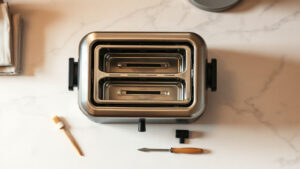
A toaster trips the breaker because it draws a high surge of current the moment the heating elements switch on — typically between 800 and 1,500 watts — and if that circuit is already loaded, already weak, or the toaster itself has a fault, the breaker cuts power to protect the wiring. Most of the time it’s one of three things: a shared circuit that’s overloaded, a worn-out toaster with a short, or a GFCI outlet doing exactly what it’s supposed to do. Knowing which one you’re dealing with takes about five minutes to figure out.
Safety First: If your toaster is tripping the breaker repeatedly, do not keep resetting and retrying. A breaker that trips is a protection device — forcing it back on repeatedly while the fault persists can overheat wiring, damage the panel, or in a worst case start a fire inside the wall. Unplug the toaster before resetting the breaker, and don’t use the appliance again until you’ve identified and resolved the cause. If you smell burning from the wall outlet or panel, call a licensed electrician — do not attempt to DIY that situation.
Quick Facts: Toaster Tripping the Breaker
- Standard pop-up toasters draw 800–1,200 watts; toaster ovens run 1,200–1,800 watts — high enough to trip a 15-amp circuit if other appliances are on it
- A tripped breaker is a symptom, not the problem — the breaker itself is working correctly by tripping
- GFCI outlets and breakers trip for a different reason than standard breakers — they detect ground faults, not just overloads
- Crumb buildup is a surprisingly common cause of nuisance trips — a partial short from accumulated debris can do it
- If a brand new toaster trips the breaker on first use, it’s almost always a circuit issue, not a defective toaster
The Real Reason Your Toaster Is Tripping the Breaker
Let’s be precise here, because most articles lump all trips together and they really shouldn’t. There are three completely different types of breaker trips, and they point to three different problems.
Overload Trips
This is the most common. A standard kitchen circuit is 15 or 20 amps. At 120 volts, a 15-amp circuit can theoretically handle 1,800 watts continuously — but breakers are designed to trip at around 80% of their rated capacity for sustained loads. So in practice, you’ve got roughly 1,440 watts to work with before things get dicey. A toaster oven pulling 1,500 watts, a microwave running simultaneously at 1,200 watts, and the refrigerator kicking its compressor on? That’s a trip waiting to happen.
The fix for this type is simple but not always fun: get the toaster onto a less loaded circuit, or stop running other high-draw appliances at the same time. I know that’s annoying to hear when your coffee maker and toaster are both on the same counter — but that’s genuinely the answer.
Short Circuit Trips
These are instantaneous. The moment you push the lever down, the breaker pops. No hesitation. That pattern almost always means a fault inside the toaster itself — a broken heating element touching the chassis, a wire with degraded insulation, or in older units, accumulated grease and debris that’s carbonized and become conductive. This kind of trip is not a circuit problem. The breaker is doing its job perfectly.
If your toaster is more than five or six years old and this is happening, I’d honestly just replace it. Repair isn’t worth it — the parts cost more than a decent new unit, and there’s no way to guarantee you’ve found every degraded wire. Check out the best mini toaster ovens if you want an upgrade that won’t have you dealing with this again for years.
GFCI Trips
This one trips people up — pun not intended. GFCI outlets and GFCI breakers trip when they detect even a tiny current leak to ground, as small as 4–6 milliamps. That’s a much lower threshold than a standard breaker. So a toaster that has perfectly normal operation on a standard outlet will sometimes trip a GFCI because of minor leakage current through its heating elements, especially in humid kitchens or when the unit is cold on a damp morning.
This happened to me with a Breville toaster oven I’d used for two years without issue. Moved kitchen, new outlet happened to be a GFCI — suddenly it was tripping every third use. The toaster wasn’t broken. The GFCI was just more sensitive than my old setup. Worth knowing: if it trips the GFCI but works fine on a standard outlet elsewhere in the house, the toaster is probably fine.
Wattage Is the Thing Most People Ignore
Here’s a table that actually makes the numbers concrete. These are real typical wattage ranges for common kitchen appliances — which matters a lot when you’re trying to figure out whether your circuit is overloaded.
| Appliance | Typical Wattage | Amps Drawn (120V) |
|---|---|---|
| Pop-up toaster (2-slice) | 800–1,200W | 6.7–10A |
| Pop-up toaster (4-slice) | 1,400–1,800W | 11.7–15A |
| Toaster oven (compact) | 1,200–1,400W | 10–11.7A |
| Toaster oven (full-size) | 1,500–1,800W | 12.5–15A |
| Drip coffee maker | 600–1,200W | 5–10A |
| Microwave (countertop) | 900–1,600W | 7.5–13.3A |
| Refrigerator (compressor) | 100–400W surge | 1–3A (surge higher) |
You can see the problem. A 4-slice toaster alone can eat up 15 amps on a 15-amp circuit. Add a coffee maker doing its heating cycle at the same moment and you’ve blown right past what the breaker will tolerate. Even on a 20-amp circuit, you’re playing close to the edge if two high-draw appliances fire up simultaneously.
For more context on how hot a toaster gets and how that correlates with power draw, that’s worth a read — the temperatures and wattage are connected in ways that aren’t always obvious.
Step-by-Step: How to Actually Diagnose the Problem
Don’t just reset the breaker and hope for the best. Work through this in order.
Step 1: Identify What Type of Trip It Is
Check the outlet. Is it a GFCI (those are the ones with the little TEST and RESET buttons on them)? Or is the trip happening at the main panel? If it’s a GFCI, you’re dealing with a potential ground fault or leakage issue. If it’s at the panel, you’re looking at overload or a dead short. This distinction matters before you do anything else.
Step 2: Unplug Everything Else on That Circuit
Reset the breaker, unplug every other appliance on the kitchen circuit, and run just the toaster. If it doesn’t trip now, the circuit was overloaded — not the toaster’s fault. If it still trips with nothing else running, the fault is in the toaster itself.
Step 3: Clean the Toaster Thoroughly
Before concluding the toaster is broken, clean it. Pull the crumb tray and empty it. Turn the toaster upside down over the sink and shake it gently — you’ll be shocked what falls out sometimes. If you’ve got a toaster oven, wipe down the interior walls and the area around the heating elements carefully (unplugged, obviously). Carbon buildup from burnt crumbs can become slightly conductive over time and cause intermittent partial shorts. I’ve personally seen a Cuisinart toaster oven that was tripping a GFCI almost every morning, and after a proper clean-out, the problem stopped entirely. Three weeks of frustration, fixed in twenty minutes with a damp cloth and a soft brush.
Step 4: Test on a Different Circuit
Plug the toaster into an outlet in a different room — somewhere that’s clearly on a different circuit. A bedroom outlet works fine for this test. Run it. If it works without tripping, your kitchen circuit is the problem. If it still trips, the toaster has a fault.
Step 5: Check the Toaster’s Cord and Plug
Look at the power cord closely, especially near the plug end and where it enters the toaster body. These are the wear points. Any cracking, scorch marks, fraying, or discoloration is a sign of a fault. If the plug feels warm to the touch after a trip, that’s not normal. Warm is a red flag. A toaster with a damaged cord should not be used — period.
The Edge Case Nobody Mentions: Moisture
Here’s one that the other articles skip entirely. If your toaster sits near the sink, or if you live somewhere humid, moisture can cause nuisance trips — especially on GFCI outlets. Condensation inside a cold toaster that then fires up heating elements can create enough of a current leak to trip a GFCI. This is more likely first thing in the morning in a humid kitchen, or if the toaster was near steam from a kettle.
The fix: move the toaster away from the sink and steam sources. Let it sit in a drier spot for a day and try again. Some people solve this permanently by moving to a dedicated countertop spot with better airflow. Also worth noting — a toaster or toaster oven with a fan (convection models) tends to dry out its interior better between uses, which can reduce moisture-related trips.
For the record, the U.S. Consumer Product Safety Commission recommends keeping all countertop appliances away from water sources precisely because of shock and trip risks — not just because of obvious splash hazards.
When to Replace vs. When to Fix
Honestly? Most of the time, replace. A basic 2-slice toaster costs $25–50. A decent toaster oven runs $60–150. The cost of having an electrician look at a wiring fault in the appliance itself — or worse, inside your wall — is going to exceed that quickly. And the safety math doesn’t favor repair for a toaster with a known internal fault.
If the issue is the circuit (not the toaster), that’s a different calculation. A licensed electrician can add a dedicated 20-amp kitchen circuit for a few hundred dollars, and if you use a toaster oven daily for cooking and reheating food, it’s actually worth doing. You’ll stop the trips, get better performance from high-wattage appliances, and avoid overloading shared circuits indefinitely.
If you do decide to replace, look for a unit with a good cord strain relief and a clear wattage rating you can cross-reference with your circuit. A compact 1,500-watt toaster oven is a better fit for a shared 15-amp circuit than a full-size 1,800-watt model. And if you want to keep things even simpler, a low-wattage 2-slice toaster in the 800-watt range is going to be much friendlier to an already-loaded circuit.
What to Do About the Breaker Itself
Breakers do wear out. A breaker that’s been tripped many times over many years can develop a lower effective threshold — it starts tripping at loads it used to handle without issue. If your panel is old, and the breaker trips even when the toaster is the only thing running and the toaster tests fine on other circuits, the breaker itself may be the weak link. That’s an electrician call, not a DIY fix. Replacing a breaker isn’t complicated if you’re trained, but inside a live panel is genuinely dangerous territory for anyone who isn’t.
One thing you can check yourself: is the breaker fully in the OFF position when it trips, or does it land somewhere in the middle? A breaker that lands in the middle position (not fully ON, not fully OFF) is called a “tripped” state and is normal. But a breaker that feels loose, won’t reset firmly, or makes a buzzing sound after resetting should be looked at by a professional. That’s not a toaster problem anymore.
The Bottom Line
A toaster that trips the breaker every time you use it is almost always explained by one of three things: the circuit is already pulling too many amps, the toaster has an internal fault (a short, damaged wiring, or heavy crumb buildup), or a GFCI is detecting legitimate leakage current. Work through the diagnostic steps above in order before assuming the worst. Clean the toaster first — you’d be surprised how often that’s the actual answer. Test it on another circuit before deciding it’s broken. And if the problem is definitely the circuit, either shift the toaster to a dedicated outlet or get a lower-wattage model that’s better suited to a shared kitchen circuit. The breaker tripping isn’t the problem — it’s the warning sign. Pay attention to it.
Frequently Asked Questions
Why does my toaster trip the breaker but not my microwave?
Microwaves are often on dedicated circuits in modern kitchens, while toasters typically share a general-purpose kitchen circuit with other appliances. Your toaster’s startup surge — that initial spike of current when the elements heat up — may be enough to push a shared 15-amp circuit over its limit, even if the microwave alone doesn’t. Try unplugging other appliances from that circuit when using the toaster.
Is it safe to keep resetting the breaker when the toaster trips it?
No. Resetting a breaker that keeps tripping without finding the cause can damage the breaker, overheat wiring, and in serious cases create a fire risk inside the wall. Always unplug the toaster before resetting, identify the cause first, and don’t reset more than once or twice without investigating. If the cause is a short inside the toaster, continued resets won’t fix anything — they’ll just create more risk.
Why is my brand new toaster tripping the breaker?
A new toaster tripping on first use almost always points to a circuit problem, not a defective appliance. New toasters can draw slightly higher wattage than older ones and may push an already-loaded 15-amp circuit past its comfort zone. Plug it in alone, with nothing else running on that circuit, to confirm — if it works fine that way, your circuit is the issue, not the toaster.
How many watts does a toaster use, and is that enough to trip a 15-amp breaker?
A standard 2-slice toaster uses 800–1,200 watts; a 4-slice model runs 1,400–1,800 watts. On a 15-amp, 120-volt circuit, you’ve got roughly 1,440 usable watts before the breaker starts getting uncomfortable. So a 4-slice toaster alone can max out a 15-amp circuit, and any additional load on that same circuit will cause a trip. A toaster oven is even more likely to hit that ceiling.
Can crumbs really cause a toaster to trip the breaker?
Yes — and it’s more common than most people expect. Heavy crumb buildup at the base of the heating elements can carbonize over time, and carbon is a weak but real conductor. This can create a partial short between the element and the chassis, causing the breaker to trip or a GFCI to detect leakage current. Emptying the crumb tray regularly and doing a full clean every few months is genuinely worth it, not just for fire safety but for electrical reliability too.

Written by
Emma founded Toastera to turn vague appliance advice into clear, researched, safety-first guidance on toasters and toaster ovens.
Free: the Toaster Oven Cheat Sheet
Get the printable cheat sheet (temps, cook times & safety tips) plus new recipes. No spam, unsubscribe anytime.