A toaster trips a circuit breaker because it’s drawing more current than the circuit can handle — usually due to a damaged heating element, a short circuit inside the appliance, or crumb buildup creating an electrical fault. Most standard toasters pull between 800 and 1,500 watts, and a single tripped breaker is often the first sign something has gone wrong internally. If it happens consistently, the toaster is telling you it needs attention — or replacement.
Safety First: Never use a toaster that repeatedly trips your circuit breaker. Repeated tripping indicates a live electrical fault that can cause electric shock, arcing, or fire. Unplug the toaster immediately after the first trip, and do not plug it back in until you’ve identified and resolved the cause. Do not attempt to inspect internal components while the appliance is plugged in — ever.
Quick Facts: Toaster Tripping the Breaker
- Most toasters operate between 800W and 1,500W — a faulty heating element can cause sudden current spikes well above that range, which is what triggers a breaker.
- Toast crumbs bridging the heating element to the metal chassis are one of the most common (and least obvious) causes of tripping — especially in toasters that haven’t been cleaned in months.
- A 15-amp kitchen circuit can theoretically support around 1,800 watts — but if other appliances are running at the same time, that headroom disappears fast.
- A brand-new toaster tripping the breaker on its first use is almost always a manufacturing defect or a pre-existing wiring issue in your home — not user error.
- If your toaster trips an RCD (residual current device) rather than a standard breaker, it’s detecting a ground fault — a more serious issue that almost always means the toaster itself is faulty.
The Six Most Common Reasons Your Toaster Is Tripping the Breaker
I’ve gone through this exact troubleshooting process twice — once with a six-year-old two-slice toaster and once with a cheaper four-slice model I picked up on sale. The causes were completely different, which is why it’s worth going through each possibility rather than assuming the worst right away.
1. A Damaged or Shorted Heating Element
This is the most common culprit. The heating element in a toaster is a long, coiled nichrome wire that heats up rapidly — we’re talking anywhere from 300°F to over 1,000°F depending on the toaster and setting (more on that in our article on how hot a toaster gets). Over time, that wire can develop a break or a spot where the insulation fails, causing a direct short to the chassis. When that happens, the current spike is immediate and significant enough to trip even a healthy breaker.
You usually can’t see this without disassembly. But the timing is a giveaway — if the breaker trips within the first 5 to 10 seconds of toasting, almost every time, a shorted element is the most likely explanation.
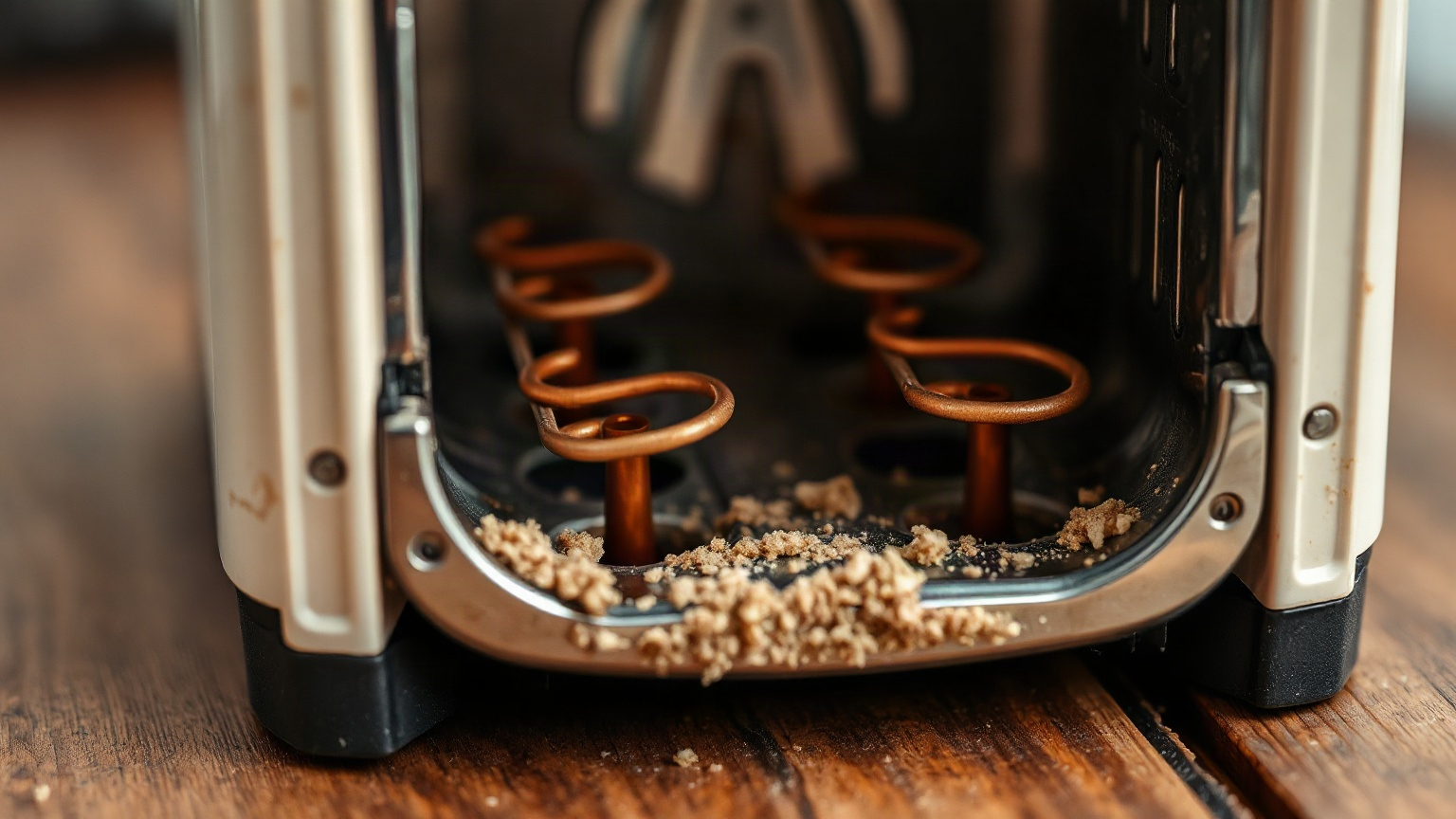
2. Crumb Buildup Bridging the Element to the Case
Burnt crumbs. I cannot stress this enough. A thick enough layer of crumbs at the bottom of a toaster can conduct electricity from a live heating element straight to the metal chassis. The element sits very close to the tray — sometimes less than half an inch. Carbonized bread crumbs are actually decent conductors, and when they’re moist (say, from toasting something with a bit of water content), the conductivity gets worse.
The fix here is simple: unplug the toaster, remove the crumb tray, and clean it out thoroughly. Tip the whole unit upside down over a sink and give it a gentle shake. If you haven’t done this in over three months and you’re toasting daily, that’s your first move before anything else.
3. A Faulty Power Cord or Loose Internal Wiring
Power cords take a beating. Repeated coiling, storing the toaster under a cabinet, and the thermal cycling from constant heating and cooling can cause the internal wiring to crack or fray — especially right at the point where the cord enters the toaster’s body. A loose internal connection can cause intermittent shorts that trip breakers unpredictably, sometimes not at the same point in the toasting cycle each time.
Run your fingers along the full length of the cord while it’s unplugged. Feel for any kinks, soft spots, or places where the outer sheath is cracked. If you find any, don’t use the toaster. Full stop.
4. The Outlet or Circuit Is Overloaded
Not every tripping scenario is the toaster’s fault. Kitchen circuits often serve multiple outlets, and if you’re running a toaster, a coffee maker, and a microwave on the same 15-amp circuit, you’re flirting with 3,000+ watts on a circuit rated for 1,800 max. That’s a recipe for a tripped breaker that has nothing to do with the toaster being defective.
Try plugging the toaster into a different outlet — ideally one on a different circuit, like a bathroom outlet or an extension to a living room circuit temporarily. If it runs fine there, the problem is your kitchen circuit, not the toaster. An electrician can tell you whether you need a dedicated circuit for high-draw appliances, which honestly is worth it in a kitchen with modern gear.
5. A Failing Thermostat or Control Board
Toasters have a thermostat — or in more modern units, a simple electronic timer/control board — that regulates when the heating element turns off. If that component fails and the element runs continuously without shutting off, the sustained current draw can exceed what the circuit expects. It can also cause the element to overheat to the point of physical damage. This failure mode is less common but tends to affect older toasters or cheaper models where component quality is inconsistent.
6. The Toaster Is Simply Past Its Lifespan
This one’s a bit unpopular to say but — toasters don’t last forever. The average lifespan of a toaster is roughly 6 to 8 years with regular use. Past that point, insulation degrades, elements weaken, and the odds of an intermittent fault climb. I’ve held onto toasters longer than I should have because they still technically worked most of the time. That’s a mistake. If yours is old and tripping the breaker, the honest answer is probably to replace it rather than chase an intermittent fault in aging hardware.
Wattage and Circuit Load: What the Numbers Actually Mean
This table is worth bookmarking. A lot of people don’t know how much a toaster actually draws compared to other common kitchen appliances, and it explains a lot about why certain outlet combinations cause problems.
| Appliance | Typical Wattage | Amps on 120V Circuit | Tripping Risk (Shared Circuit) |
|---|---|---|---|
| 2-slice toaster | 800–1,000W | 6.7–8.3A | Low (alone), High (shared) |
| 4-slice toaster | 1,200–1,800W | 10–15A | Medium–High |
| Toaster oven | 1,200–1,800W | 10–15A | Medium–High |
| Coffee maker | 800–1,200W | 6.7–10A | Medium |
| Microwave | 900–1,500W | 7.5–12.5A | High |
| Kettle | 1,000–1,500W | 8.3–12.5A | High |
A standard 15-amp kitchen circuit has a safe load limit of around 1,800 watts (80% of 2,250W capacity, per NEC guidelines). Running a 1,500W four-slice toaster and a 1,000W coffee maker simultaneously is 2,500W — 700 watts over that safe limit. Something will give, and it’s usually the breaker.
How to Actually Diagnose the Problem (Step by Step)
Don’t jump straight to buying a new toaster. Here’s the sequence I’d follow, in order.
Step 1: Unplug and Clean First
Unplug the toaster. Pull the crumb tray out and clean it. Invert the toaster over a trash can and tap it a few times to dislodge anything packed around the elements. Use a dry pastry brush or a can of compressed air to get into the slots — never water inside the body. Plug it back in and test. You’d be surprised how often this is all it takes.
Step 2: Test on an Isolated Outlet
Plug the toaster into a different outlet on a different circuit — nothing else running on that circuit. If it works without tripping, your original circuit is overloaded or has a wiring fault. Call an electrician for the latter.
Step 3: Inspect the Cord and Plug
With the toaster unplugged, check the cord end to end. Look at the plug prongs — any discoloration or pitting means there’s been arcing. That’s a fire hazard, not just an inconvenience. If you see that, the toaster goes in the bin.
Step 4: Note When the Breaker Trips
This is the diagnostic detail most people miss. Does it trip the instant you push the lever down? That’s almost certainly a short in the element or wiring — the load spike is immediate. Does it trip midway through toasting? That points more toward a thermostat fault or a thermal issue. Does it only trip when the toaster is fully loaded (all four slots)? Could be a capacity issue on your circuit, or a partially shorted element that only draws problem-level current at full load.
Step 5: Accept the Verdict
If cleaning didn’t help, a separate circuit didn’t help, and the cord looks fine — the toaster has an internal fault. For most standard toasters priced under $60, repair isn’t economically rational. The parts and labor cost more than replacement. Check out our picks for the best mini toaster ovens if you’re considering an upgrade; a toaster oven gives you a lot more versatility and often a longer lifespan for a modest price increase.
The Edge Case Nobody Mentions: Brand-New Toasters That Trip Immediately
This one caught me off guard the first time it happened. A brand-new toaster — still in the box, first use — tripped the breaker within three seconds of the first toast cycle. My first instinct was that I’d gotten a defective unit. And I had. But not in the obvious way.
New heating elements sometimes have a thin protective coating from the manufacturing process that burns off during the first few uses. This can cause a small current spike and, in some cases, a brief arc that trips a sensitive RCD. In most kitchens this isn’t an issue. But if your home has an older electrical panel with a finicky breaker — one that’s already close to its trip threshold from age — a new toaster’s first burn-in can push it over.
The fix: try the new toaster on a different circuit for its first two or three uses. After the initial burn-in (you’ll probably notice a slight smell and some light smoke on the first use — completely normal), it usually settles down. If it still trips after three or four uses, return it. That’s a manufacturing defect.
Also worth knowing: if your toaster is tripping an RCD specifically (rather than a standard breaker), take that seriously. RCDs trip when current is leaking to ground — meaning part of the electrical current is going somewhere it shouldn’t, which is a shock hazard. Don’t reset the RCD and keep toasting. That’s not a recoverable situation without repair. For more context on electrical safety with kitchen appliances, the National Fire Protection Association’s kitchen safety guidelines are worth reading.
When to Repair vs. Replace
Short answer: almost always replace. A basic quality two-slice toaster costs $25 to $50. Professional appliance repair for an internal electrical fault will run $50 to $100 just for the diagnosis visit in most areas, before any parts. The math doesn’t work.
The exception is a high-end toaster — something like a Dualit or a Breville that cost $100 to $200 new. Those are worth evaluating for repair because replacement parts (especially Dualit heating elements, which are sold separately) are actually available and priced reasonably. Dualit in particular is famous for their service-by-design philosophy, which is genuinely rare in small appliances.
If you’re upgrading and want something with more versatility, a toaster oven handles everything a pop-up toaster does plus reheating, baking, and broiling. Read our guide on reheating food in a toaster oven to see what you’d be gaining. For a solid mid-range replacement, the Breville compact toaster oven range is consistently reliable and worth the step up in price if you’re replacing anyway.
One more thing: if you do buy a new toaster, plug it into a dedicated kitchen outlet and don’t share it with other high-draw appliances. It’s a small habit change that extends the life of both the appliance and the breaker. The U.S. Consumer Product Safety Commission consistently lists overloaded circuits as a leading cause of kitchen fires — it’s not a hypothetical risk.
The Bottom Line
A toaster that keeps tripping the circuit breaker is not a quirk to work around. It’s a signal. Start with the simple stuff: clean out the crumbs, try a different outlet, check the cord. If none of that fixes it, the appliance has an internal fault that isn’t going to get better on its own. For most toasters, replacement is faster and cheaper than repair — and honestly, if yours has been running for more than six or seven years, a fresh start isn’t a bad idea anyway. The new units run cleaner, more efficiently, and some of the mid-range options have actually gotten quite good.
Don’t keep resetting the breaker and hoping for the best. That’s the one thing I’d push back on harder than anything else in this article. A repeatedly tripping breaker is the circuit doing its job — protecting you. Let it.
Frequently Asked Questions
Why does my toaster trip the circuit breaker but only sometimes?
Intermittent tripping usually points to a loose internal connection or a partially damaged heating element that shorts only under certain conditions — like when it’s fully heated. It can also happen if your circuit is right at its load limit and the toaster’s start-up current spike pushes it over occasionally. Track when it trips (immediately, mid-cycle, or only with other appliances running) to narrow it down.
Is it safe to keep resetting the breaker and using the toaster?
No. Resetting the breaker and continuing to use a toaster that keeps tripping it is genuinely dangerous. The breaker is interrupting a fault — a real electrical problem that could cause overheating, arcing, or fire if left unchecked. Unplug the toaster and troubleshoot or replace it before using it again.
Can crumbs really cause a toaster to trip the breaker?
Yes, absolutely. Carbonized bread crumbs can conduct electricity, and when they accumulate enough to bridge the gap between a live heating element and the metal chassis, it creates a short circuit. This is especially common in toasters that haven’t had the crumb tray cleaned in months. It’s also one of the easiest fixes — unplug, clean thoroughly, and test.
Why is my brand new toaster tripping the circuit breaker?
A new toaster tripping on its first few uses can be caused by the heating element’s manufacturing coating burning off, which creates a brief current spike. If your breaker or RCD is sensitive, that can be enough to trip it. Try the toaster on a different circuit for the first two or three uses. If it still trips consistently after that, it’s a manufacturing defect and should be returned.
How many watts does a toaster use, and can it overload a circuit?
Most two-slice toasters use 800 to 1,000 watts; four-slice models run 1,200 to 1,800 watts. A standard 15-amp kitchen circuit has a safe usable capacity of around 1,800 watts. Running a toaster alongside a coffee maker or microwave on the same circuit can easily exceed that limit and trip the breaker — even if the toaster itself is working perfectly.

Written by
Emma founded Toastera to turn vague appliance advice into clear, researched, safety-first guidance on toasters and toaster ovens.
Free: the Toaster Oven Cheat Sheet
Get the printable cheat sheet (temps, cook times & safety tips) plus new recipes. No spam, unsubscribe anytime.