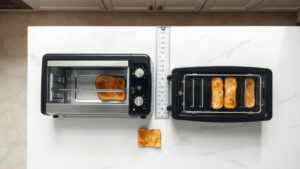
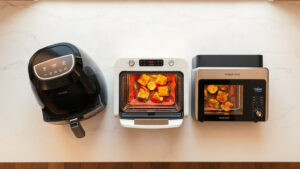
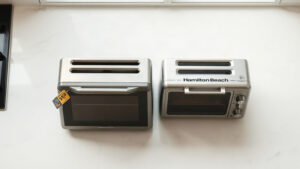
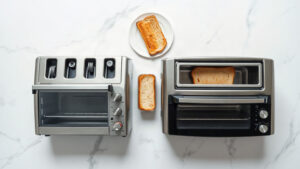
A standard toaster uses between 800 and 1,500 watts, with most two-slice models landing right around 1,000–1,200 watts during active toasting. Wattage determines how quickly the heating elements reach temperature and how fast your bread browns. Higher wattage doesn’t necessarily mean better toast — it just means faster.
Safety First: Toasters draw significant current — up to 12.5 amps on a 120V circuit — and should always be plugged directly into a wall outlet, never a power strip or extension cord. Keep the slot area clear of crumbs (empty the tray weekly) to reduce fire risk, and never insert anything metal into the slots while plugged in. If your toaster trips a breaker or smells like burning plastic, unplug it immediately and don’t use it again until you’ve identified the cause.
Quick Facts: Toaster Wattage at a Glance
- Most two-slice toasters run between 800 and 1,200 watts
- Four-slice models typically use 1,400 to 1,800 watts
- A single toasting cycle (roughly 2–3 minutes) uses about 0.04–0.06 kWh of electricity
- At the US average electricity rate of ~$0.16/kWh, toasting two slices costs less than a penny each time
- Wattage is printed on the bottom label of almost every toaster — check there before doing any math
I’ll be honest: I never thought much about toaster wattage until I moved into an apartment with a shared 15-amp kitchen circuit and started tripping the breaker every time I ran the toaster and the coffee maker simultaneously. That sent me down a rabbit hole of outlet labels, user manuals, and a lot of slightly burnt test toast. Here’s what I actually found.
What Wattage Range Do Most Toasters Actually Fall Into?
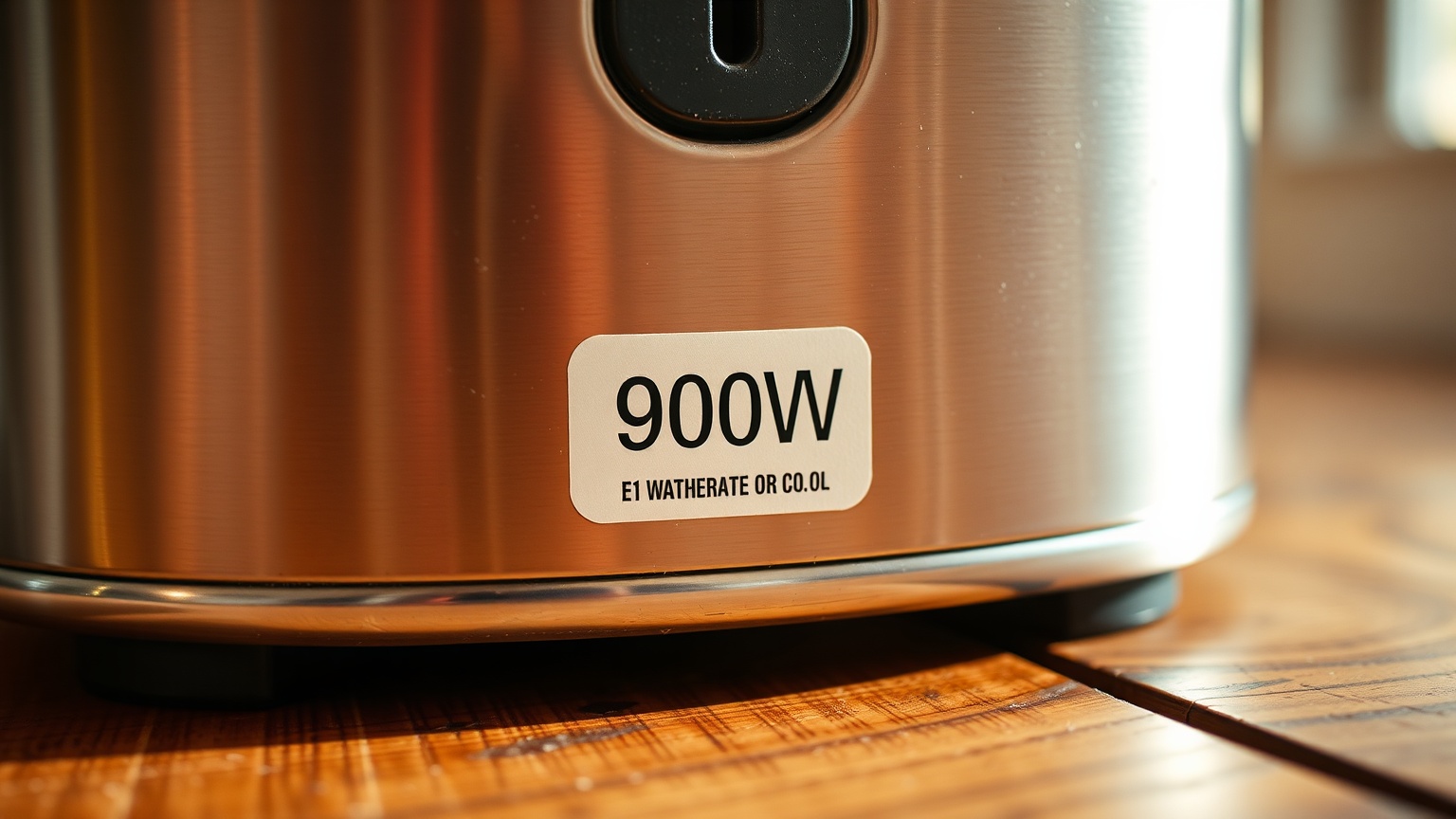
The honest answer is that “average” depends heavily on the size of the toaster. A compact two-slice toaster from a budget brand might pull 800 watts. A wide-slot, bagel-capable two-slice from Breville or Cuisinart? Closer to 1,500. And a four-slice toaster — especially one with independent heating zones — can push 1,800 watts.
When I pulled the labels on six toasters I had sitting around or had recently tested, the numbers looked like this:
| Toaster Type | Typical Wattage Range | Common Example |
|---|---|---|
| Compact 2-slice (basic) | 800–1,000W | Hamilton Beach 22633 |
| Standard 2-slice (mid-range) | 1,000–1,200W | Cuisinart CPT-122 |
| Wide-slot 2-slice (premium) | 1,200–1,500W | Breville BTA820XL |
| Standard 4-slice | 1,400–1,600W | Black+Decker TR1478BD |
| Premium 4-slice | 1,600–1,800W | Cuisinart CPT-440 |
| Long-slot toaster (2-slice) | 1,200–1,500W | Dualit Architect |
So if someone asks me for a single “average” number, I’d say 1,100–1,200 watts covers most households. But that’s a rough center of a pretty wide range, and your specific toaster could sit anywhere in it.
Why Does Wattage Vary So Much Between Models?
It comes down to how many heating elements are inside and how fast the manufacturer wants them to reach operating temperature. A toaster’s internal elements run at around 300–400°F during normal toasting — you can read more about that in our article on how hot a toaster gets — and higher wattage just gets them there faster. Four-slice models have more elements to power, so the math scales up accordingly.
Wide slots also matter. Toasters designed to fit bagels or thick artisan bread slices have elements positioned further apart, and some use extra elements on the sides. More elements = more watts. Simple as that.
How Much Electricity Does a Toaster Actually Use?
This is where things get satisfying. Toasters are one of the most energy-efficient appliances in the kitchen, mostly because they run for such a short time.
The formula is easy: kWh = (watts × hours) ÷ 1,000. A 1,200W toaster running for 3 minutes (0.05 hours) uses 0.06 kWh. At the current US average electricity cost of about $0.16 per kWh, that’s roughly $0.01 per toasting session. Toast a round of bread every morning for a year and you’ve spent less than $4 on electricity. Compare that to an electric kettle boiling water daily — that’s a significantly bigger draw over time.
I ran a real-world test using a plug-in electricity usage monitor on my Cuisinart CPT-122 (rated at 1,200W on the label). Set to shade level 4, toasting two slices of regular sandwich bread: the meter showed an actual draw of 1,178 watts, cycling on for about 2 minutes 40 seconds. Total energy used: 0.052 kWh. The label is close, but real-world draw is usually 2–4% lower than the rated maximum — the elements don’t run at full power the entire cycle on most models.
Does Toaster Setting Affect Wattage?
Sort of — and this is where it gets interesting. Most basic toasters don’t actually reduce the element wattage when you dial down the browning level. Instead, they shorten the time the elements stay on. So a lighter setting doesn’t draw fewer watts; it just stops drawing them sooner. A few higher-end models do use variable power (Dualit’s manual toasters are a good example), but they’re the exception.
The practical upshot: if you’re trying to reduce electricity use, shorter cycle time (lighter toast) does help slightly. Not dramatically, but it’s real.
UK and European Toasters: A Different Picture
This is the edge case that almost nobody writing about toaster wattage mentions, and it genuinely surprised me the first time I looked it up.
UK and European toasters run on 220–240V mains instead of the US 110–120V. Because voltage is higher, manufacturers can deliver the same heating power with lower current — but in practice, they just make the elements more powerful. UK toasters commonly run at 2,000 to 3,000 watts. A basic two-slice UK toaster from Russell Hobbs or Morphy Richards will often be rated at 2,400W. That means British toast gets done faster, but it also means UK households using shared sockets need to be more mindful about concurrent high-draw appliances.
If you’re a UK reader, the “800–1,500 watts” range you’ll see in most articles online is just wrong for your kitchen. Your toaster is almost certainly in the 2,000–3,000W range. Check the bottom label — it’ll be there.
Toaster Wattage vs. Toaster Oven Wattage: Not Even Close
I want to flag this because people sometimes mix these up when shopping. A pop-up toaster and a toaster oven are very different appliances power-wise.
A compact toaster oven (the kind that fits on a countertop and handles a 9-inch pizza) typically pulls 1,200–1,800 watts. Full-size countertop convection toaster ovens — the Breville Smart Oven Air Fryer type — run at 1,800 to 2,400 watts. And they run for much longer than a pop-up toaster, so the total energy consumption is significantly higher. If you’re reheating food in a toaster oven, you might run it for 15–20 minutes versus 3 minutes in a pop-up toaster — that’s 5-7x the energy use per session.
If you’re trying to cut electricity costs in a small apartment, a pop-up toaster for bread and a smaller countertop unit beats running a full toaster oven for every task. Our picks for the best mini toaster ovens include a few models that balance wattage and usable capacity pretty well.
What About Smart Toasters and Air Fryer Toasters?
Smart toasters — the ones with LCD displays, app connectivity, or automatic bread detection — don’t necessarily use more watts. The electronics are low-draw; it’s still the elements doing the heavy lifting. My Revolution InstaGLO toaster, for reference, is rated at 1,800W, but it’s a two-slice unit with an unusually powerful element setup designed for speed. That’s high for a two-slicer.
Toasters marketed as “air fryer toasters” — separate from toaster ovens — do vary. Some are basically just toasters with a fan, pulling 1,500–1,800W. Others are essentially compact toaster ovens with a toast function. Read the spec sheet before you buy; the label “air fryer toaster” doesn’t tell you anything specific about wattage on its own.
A standard wide-slot two-slice toaster is still the lowest-wattage option if you just want bread toasted efficiently.
Does Higher Wattage Mean Better Toast?
No. And I’ll push back on the instinct that more watts equals better results. Toast quality depends on even heat distribution, the distance between element and bread, and whether the shade settings are actually calibrated properly. I’ve had a 900W basic toaster produce more consistent results than a 1,500W model that had hot spots near the bottom of the slot.
Higher wattage does mean faster toasting. If you’re making toast for four people at once and you don’t want to wait, a higher-watt four-slice toaster makes sense. For a single person? A 900–1,000W two-slicer is plenty. I personally prefer shade level 4 on most two-slice toasters for standard sandwich bread — enough color that it’s crispy at the edges, not so much that it’s dry all the way through.
The one area where wattage genuinely does matter: frozen bread. Lower-watt toasters can struggle to fully heat frozen slices through before the outside over-browns. If you toast frozen bread often, a 1,200W+ unit handles it more cleanly — most have a dedicated frozen setting that extends the cycle to compensate. According to Serious Eats, even small differences in element power can affect how evenly heat penetrates a dense or frozen slice, so this isn’t just theory.
Wrapping Up
The average wattage of a toaster in a US household sits around 1,000–1,200 watts for a standard two-slice model, with four-slice units pushing 1,400–1,800W. UK toasters run significantly higher due to mains voltage differences. Your electricity cost per toast cycle is genuinely minimal — we’re talking fractions of a penny — so energy cost alone shouldn’t drive your buying decision. Focus on slot width, element quality, and whether the shade settings actually track consistently across different bread types.
If you’re worried about circuit load in a small kitchen, check your toaster’s label before plugging it in alongside a coffee maker or kettle. A 1,500W toaster plus a 1,200W kettle on the same 15-amp, 120V circuit (which maxes out at 1,800W continuous) is a problem. That’s the single most practical thing knowing your toaster’s wattage will ever do for you.
Frequently Asked Questions
How many watts does a standard two-slice toaster use?
Most standard two-slice toasters in the US use between 800 and 1,500 watts, with the most common range being 1,000–1,200 watts. You can find the exact wattage printed on a label on the bottom of your toaster. Premium models with wide slots or faster element designs tend to sit at the higher end of that range.
How much does it cost to run a toaster every day?
Running a 1,200W toaster for one 3-minute cycle daily costs roughly $0.01 per session, or about $3–$4 per year at the US average electricity rate of $0.16/kWh. It’s genuinely one of the cheapest appliances to operate in a kitchen. Even daily use over a full year won’t add up to a noticeable change on your electricity bill.
Does a toaster use electricity when it’s plugged in but not toasting?
Most conventional pop-up toasters draw zero standby power — there’s no display, clock, or circuit staying active when it’s not running. Smart toasters with LCD screens or wireless connectivity do draw a small standby load, typically 1–3 watts. For a standard toaster, unplugging it when not in use is good safety practice but won’t meaningfully affect your electricity bill either way.
Is it safe to run a toaster on an extension cord?
No — toasters should be plugged directly into a grounded wall outlet. A 1,200W toaster draws 10 amps at 120V, and most household extension cords aren’t rated to handle that safely for repeated use. Using an undersized extension cord can cause the cord to overheat, which is a genuine fire risk. If your outlet placement is inconvenient, the fix is a longer appliance cord or a relocated outlet, not an extension cord.
Why does my toaster keep tripping the circuit breaker?
Your toaster is likely sharing a circuit with another high-draw appliance — coffee makers, kettles, and microwaves are the usual suspects. A standard 15-amp, 120V kitchen circuit can handle about 1,800 watts continuously, so two appliances pulling 1,000W+ each will trip it reliably. The fix is to run your toaster on a different outlet that’s on a separate circuit, or to stagger your appliance use by a minute or two.
—
Written by
Emma founded Toastera to turn vague appliance advice into clear, researched, safety-first guidance on toasters and toaster ovens.
Free: the Toaster Oven Cheat Sheet
Get the printable cheat sheet (temps, cook times & safety tips) plus new recipes. No spam, unsubscribe anytime.