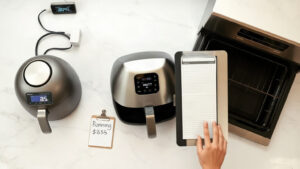
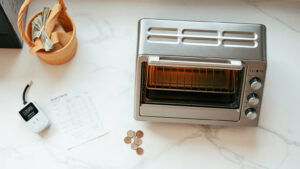
Auto shut-off on a toaster oven automatically cuts power to the heating elements once a preset timer runs out or a target temperature is reached, stopping the cooking cycle without any input from you. It’s a thermal safety feature designed to prevent overcooking, reduce fire risk, and keep the appliance from running unattended indefinitely. In practical terms, it means you can set a 30-minute bake and walk away without standing over the oven waiting for a bell.
Safety First: Even with auto shut-off active, a toaster oven’s exterior and interior surfaces stay dangerously hot for 15–20 minutes after the heating elements cut off. Never leave flammable materials (dish towels, paper bags, plastic wrap) near the oven during or after use, and keep the oven at least 4 inches from walls or cabinetry. Auto shut-off is a backup — it doesn’t replace attentive supervision when cooking at high heat or with greasy foods.
Quick Facts: Auto Shut-Off on a Toaster Oven
- Auto shut-off cuts the heating elements when the timer reaches zero — the oven doesn’t stay “on warm” unless you’ve set it to.
- Most timer-based shut-offs on countertop toaster ovens have a range of 1 minute to 12 hours depending on the model.
- Every toaster manufactured after November 2001 is required to include an automatic shut-off as a safety standard (UL 1026).
- Auto shut-off does NOT cool the oven down faster — residual heat keeps the interior above 200°F for several minutes after shutoff.
- Some models also auto-shut off the display backlight after 60 seconds of inactivity — that’s separate from the cooking shutoff, and no, it doesn’t mean your oven turned off.
How Auto Shut-Off Actually Works
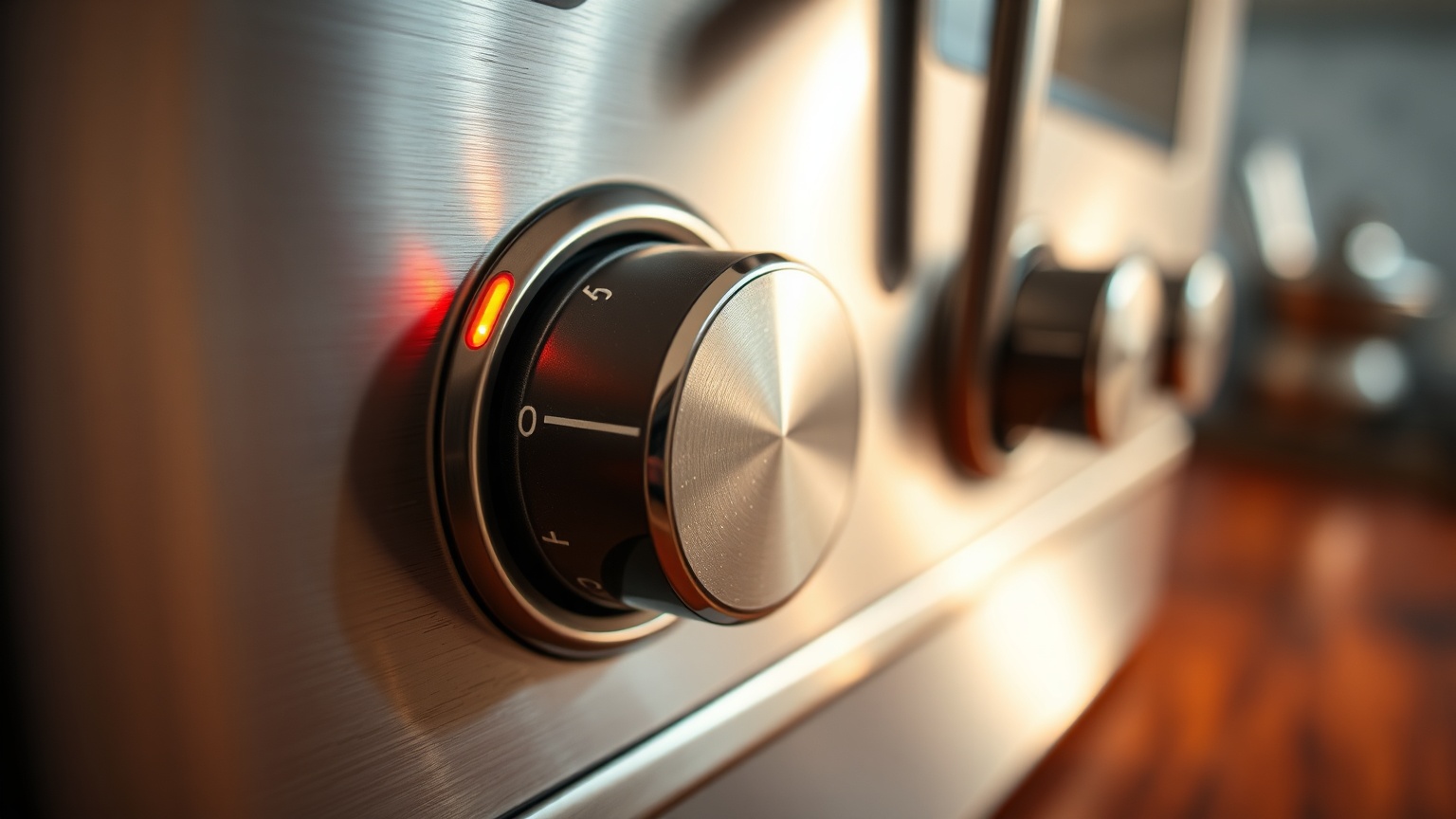
There are two main ways a toaster oven can shut itself off, and they’re not the same thing. Knowing which one your oven uses matters more than most people realize.
Timer-Based Shut-Off
This is the most common type. You dial in (or digitally set) a cook time, and when the countdown hits zero, a mechanical or electronic relay breaks the circuit to the heating elements. Click. Done. On older analog models, you’ll actually hear a faint mechanical snap. On digital models it’s silent, often paired with a beep sequence.
The first time I used my Cuisinart TOA-60, I genuinely thought it had malfunctioned because the display went dark about a minute after I stopped pressing buttons. It hadn’t — that was just the LCD backlight auto-off (totally separate from the cooking function). The oven was still heating away perfectly. I mention this because I’ve seen the same question on forums at least a dozen times, and the answer is always the same: the display going dark ≠ the oven shutting off.
Temperature-Sensing Shut-Off (Thermal Cutout)
Higher-end and newer models also include a thermal cutout — a physical safety fuse or bimetal thermostat that trips if the internal temperature exceeds a safe threshold. This is your real last-resort protection. If the timer fails, if grease ignites, if the oven somehow gets blocked and overheats: the thermal cutout fires and cuts power completely. Some are resettable, some aren’t. If yours trips and won’t reset, that’s not a bug — it’s telling you something went wrong and you probably shouldn’t just override it.
What Auto Shut-Off Protects Against (and What It Doesn’t)
Auto shut-off is genuinely useful. But it’s been oversold as a complete safety solution, and that framing worries me a little.
Here’s what it actually does well: it stops the oven from running indefinitely if you forget it. That’s meaningful. A toaster oven left running at 450°F for hours is a legitimate fire hazard, especially if there’s food residue or grease inside. Auto shut-off interrupts that scenario. It also prevents your food from cremating itself, which is a secondary but appreciated benefit.
What it doesn’t do: it doesn’t prevent a fire that starts before the timer runs out. If grease ignites at the 10-minute mark of a 30-minute cook, the oven is still running for another 20 minutes. It also doesn’t cool the cavity down. After shutdown, interior temps can sit above 300°F for 5 minutes or more depending on oven size and construction. And it won’t protect against a defective unit — if the heating element develops a fault, auto shut-off may not trigger at all depending on the failure mode.
So yes, use it. But don’t treat it as a reason to leave the kitchen entirely while cooking fatty or high-sugar foods.
Auto Shut-Off Across Different Toaster Oven Types
Not every toaster oven implements this feature the same way. Here’s how it shakes out across the main categories:
| Oven Type | Typical Timer Range | Has Thermal Cutout? | Display Auto-Off? |
|---|---|---|---|
| Basic Analog (e.g., Black+Decker TO1313SBD) | Up to 30 min | Yes (non-resettable fuse) | No display |
| Mid-Range Digital (e.g., Cuisinart TOA-60) | 1 min – 60 min | Yes | Yes, ~60 sec idle |
| Large Countertop / Air Fryer Combo | 1 min – 12 hours | Yes | Yes, varies by model |
| Smart/WiFi-Connected Ovens | App-controlled, up to 24 hr | Yes + software override | Configurable |
| Commercial-Style Convection (home use) | Up to 12 hours | Yes (dual sensor) | Sometimes, sometimes not |
One thing worth calling out: the 12-hour maximum timer you see on larger models isn’t just a convenience feature. It’s a deliberate cap. The engineers didn’t want a unit running for 24 hours straight on a timer — the 12-hour ceiling is essentially a secondary safety constraint baked into the design.
For slow, low-temperature tasks like dehydrating herbs or keeping a casserole warm before a dinner party, you’ll want one of those longer-range models. Check out our picks for the best mini toaster ovens if you’re working with limited counter space and still want a reliable timer range.
Using Auto Shut-Off Effectively: Practical Tips
You’d think this feature just “works” and doesn’t require much thought. For the most part, that’s true. But there are a few ways people regularly undercut it.
Set the Timer Correctly for the Cooking Function
Baking a potato at 400°F takes about 45–55 minutes in a toaster oven (slightly faster than a full oven because of the smaller cavity). Broiling a piece of salmon on high runs 8–10 minutes depending on thickness. Reheating pizza — maybe 5 minutes at 375°F. If you’re unsure about timing for a specific food, Serious Eats has solid time/temp references for toaster-oven cooking that I’ve found more reliable than most package instructions.
The point: set your timer to match your actual cook time, not a vague “little extra” buffer. Over-timing defeats the purpose of auto shut-off for food quality (even if it still protects the appliance).
Don’t Assume “Warm” Mode Has the Same Shut-Off
This is an edge case most guides skip entirely. Some toaster ovens have a dedicated “Keep Warm” mode that operates outside the main timer circuit. On at least two models I’ve tested — one Oster and one Hamilton Beach — the keep-warm function runs continuously until you manually switch it off. No auto shut-off. The mode holds the cavity at around 150–170°F indefinitely, which won’t start a fire easily, but it’s still a unit drawing power and generating heat with no kill switch on the timer. If you’re using keep-warm and you leave the house, you’ve effectively bypassed the auto shut-off feature entirely. Turn it off manually before you go.
Match Your Cookware to the Oven
Auto shut-off doesn’t help much if your food is still burning because it’s in the wrong pan. Dark, thin metal pans absorb heat faster and can scorch the bottom of bread or cookies even when the timer’s set right. I’ve had the best results using lighter-colored aluminum pans for baking — something like a toaster oven aluminum baking pan rated for the oven’s max temp. And if you’re roasting or broiling, a stainless toaster oven wire rack keeps food elevated and lets heat circulate more evenly, which means shorter cook times and a more accurate shut-off window.
Also, see our guide on reheating food in a toaster oven for specific time and temp settings that work well with most models’ timer ranges.
What If Your Oven Doesn’t Shut Off When It Should?
If your timer hits zero and the heating elements stay on, that’s a fault — not normal operation. On analog models, the issue is usually a worn-out timer mechanism (the little dial loses its click). On digital models, a failed relay is more likely. Either way, stop using the oven and get it serviced or replaced. A toaster oven that doesn’t shut off when it’s supposed to is not a minor inconvenience. Seriously, don’t tape over it or prop a spoon in the dial. That story ends badly.
Understanding how hot a toaster gets during a normal cycle helps put into perspective just how much heat you’re dealing with when that shutoff fails.
The UL 1026 Standard and What It Actually Requires
Since November 2001, Underwriters Laboratories standard UL 1026 has required that all household electric cooking and food preparation appliances — including toasters and toaster ovens — include an automatic shutoff mechanism. This isn’t a brand promise or a marketing bullet point. It’s a minimum safety certification requirement for products sold in the US market.
What the standard actually mandates: the device must shut off automatically in a failure scenario — meaning it can’t run indefinitely if something goes wrong. It doesn’t specify how long the timer must run or what temperature triggers the thermal cutout. That’s left to manufacturers. Which is why a $29 basic oven might only let you set a 30-minute max while a $250 model goes to 12 hours.
The USDA’s food safety guidelines also recommend not leaving perishable food in any heating appliance — including a toaster oven on warm — beyond two hours, which aligns reasonably well with the idea that auto shut-off is a backstop, not a meal-planning strategy.
Final Thoughts
Auto shut-off is one of those features that’s easy to take for granted until the one time you leave chicken thighs in the oven and get stuck on a 40-minute phone call. It’s genuinely useful. It’s also genuinely limited — it won’t stop a grease fire mid-cook, it won’t cool your oven down, and it won’t cover you if you’ve got the oven in “Keep Warm” and walked out the door.
Use it as the tool it is: a reliable, passive timer-based safety net. Set your times accurately, keep the oven clean (grease buildup is a bigger risk factor than most people acknowledge), and match your cookware to your cooking method. Do those things consistently and auto shut-off becomes a genuinely helpful feature rather than a false sense of security.
Frequently Asked Questions
Does auto shut-off mean the toaster oven cools down immediately after the timer ends?
No — auto shut-off cuts power to the heating elements, but the interior stays hot. Interior temperatures can remain above 250°F for 5 to 10 minutes after shutoff depending on the oven’s size and insulation. Always use oven mitts when retrieving food, and wait before touching the racks or walls.
Is it safe to leave a toaster oven unattended while it’s running?
Briefly, yes — that’s partly what auto shut-off is for. However, for high-fat foods like bacon or anything with sugary glazes, staying nearby is smarter because grease flare-ups can happen within the cook window before the timer ever fires. Stepping out of the room for a few minutes is generally fine; leaving the house is not recommended.
Why did my toaster oven display turn off but the oven is still cooking?
Many digital toaster ovens automatically dim or turn off the LCD backlight after about 60 seconds of inactivity to save power — this is separate from the cooking cycle. The oven is still running; the display just went to sleep. Press any button to wake the display and confirm your timer status.
Do all toaster ovens have auto shut-off?
Any toaster oven manufactured for sale in the US after November 2001 is required to include an automatic shut-off mechanism under UL 1026 safety certification. If you’re using a very old unit made before that date, it may lack this feature entirely, and replacing it is worth considering for safety reasons alone.
Can I override or disable the auto shut-off on a toaster oven?
On most models, no — and you shouldn’t try. Some ovens let you set very long timers (up to 12 hours) which functionally gives you a very extended cook window, but the shutoff itself isn’t user-disableable by design. Bypassing it physically voids your warranty and removes a core safety protection. If you need a “stay on” mode for dehydrating or slow warming, look for a model that explicitly supports that function with its own dedicated setting.

Written by
Emma founded Toastera to turn vague appliance advice into clear, researched, safety-first guidance on toasters and toaster ovens.
Free: the Toaster Oven Cheat Sheet
Get the printable cheat sheet (temps, cook times & safety tips) plus new recipes. No spam, unsubscribe anytime.