The best toaster oven for RV living is a compact convection model under 18 inches wide, drawing no more than 1,200–1,500 watts, with a cavity large enough for a 9-inch pan. Counter space in an RV is genuinely brutal — we’re talking maybe 24 inches of usable surface on a good day — so dimensions matter as much as features. Get the wattage wrong and you’ll trip your rig’s circuit breaker every time you try to toast a bagel.
Safety First: Toaster ovens in RVs draw significant current and generate substantial heat in a confined space. Always plug directly into a dedicated 15-amp outlet — never into a power strip or extension cord. Keep at least 4 inches of clearance on all sides, including above, to prevent fire risk to low RV ceilings and cabinets. Never leave the unit unattended while in use and let it cool fully before storing it inside a cabinet.
Quick Facts: RV Toaster Oven Basics
- Most RV-friendly toaster ovens run between 1,000 and 1,500 watts — anything above that risks tripping a 15-amp breaker on shore power.
- Ideal footprint: under 18 inches wide, under 16 inches deep. The Breville BOV650XL, for instance, hits 16.5″ × 14.5″ — tight but doable on most RV counters.
- Convection fans cut cook time by roughly 25%, which means less sustained heat pumping into a small living space.
- A cavity that fits a 9-inch round pan is the sweet spot — big enough to bake, small enough to actually fit.
- Look for a cool-touch exterior or insulated glass door. In an RV, you’re standing two feet from the thing the entire time it’s running.
Why RV Counter Space Changes Everything
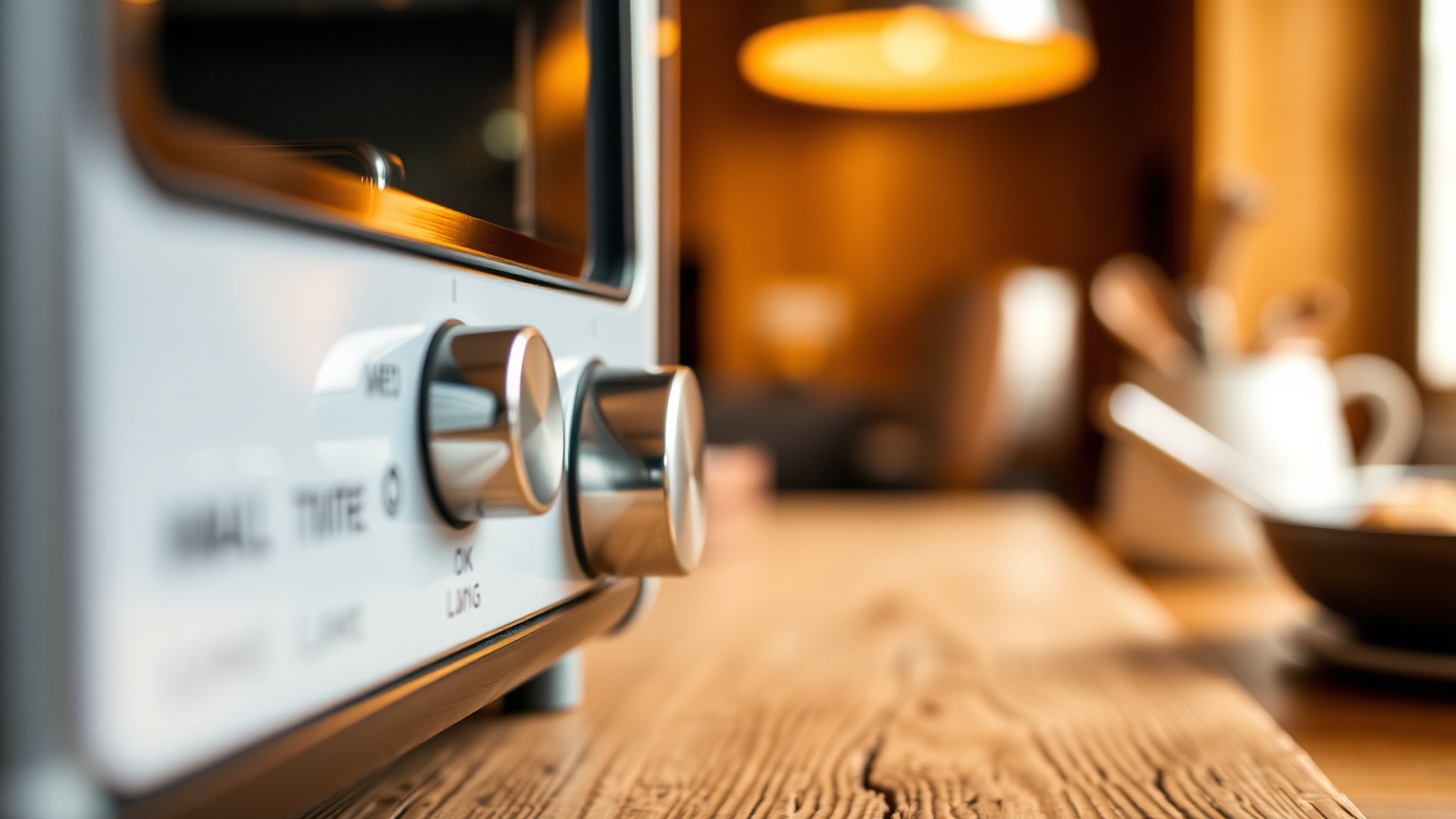
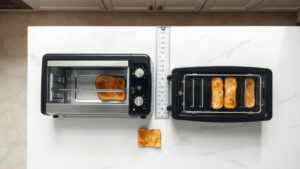
I tested six toaster ovens over one summer while parked at campgrounds across the Southwest. The single biggest lesson? Spec sheets lie by omission. A manufacturer will tell you the oven is 18 inches wide and leave out the part where the door handle adds another 2 inches when it swings open, or the fact that the crumb tray sticks out the back by an inch and a half. I measured every unit front-to-back with the door closed and open, because in a galley kitchen that distinction is everything.
Standard RV countertops run about 16–18 inches deep, which means a unit that’s 15 inches deep on paper might actually sit flush against the backsplash with no airflow clearance. That’s a fire hazard, not just an inconvenience. The depth spec is the one I’d prioritize above almost everything else.
The Wattage Problem Nobody Mentions
Shore power at most campgrounds is 30-amp service split between multiple circuits. Run the AC, the microwave, and a 1,800-watt toaster oven simultaneously and you’ll hear that breaker click. The magic number for RV use is 1,500 watts or below. Most compact models land between 1,100 and 1,400 watts, which is comfortable. I’ve run a 1,300-watt Cuisinart alongside a small fan and a laptop charger without any issues at 30-amp sites. 50-amp hookups give you more room to breathe, but don’t count on them being available everywhere.
If you’re boondocking on battery or solar, the calculus changes completely. A 1,200-watt oven running for 20 minutes pulls 400 watt-hours — a non-trivial chunk of a 100Ah lithium battery bank. Short cook times and convection mode become your best friends.
What Actually Matters in an RV Toaster Oven
Size and Footprint
Here’s my actual cutoff: 18 inches wide maximum, 15 inches deep maximum, 12 inches tall maximum. Those numbers will fit on the counter of every Class C and most Class B rigs I’ve been in, with enough overhead clearance to avoid scorching the cabinet above. Go check your specific counter depth before you order anything — I cannot stress this enough. I made the mistake of buying a unit that was technically 14.5 inches deep but had a rear vent that needed an extra 2 inches behind it. Back it went.
Convection vs. No Convection
Convection is worth it in an RV for one specific reason: speed. The faster your food cooks, the less time the oven is generating heat in a 200-square-foot living space. On a 95-degree day in the Arizona desert, that difference between 25 minutes and 18 minutes of cooking time is real. Convection models also tend to cook more evenly, which matters when you’ve only got one small rack and you’re trying to cook chicken thighs without burning the outside before the inside is done.
You can find more detail on temperatures and heat output in my piece on how hot a toaster gets, but for RV purposes, just know that a convection setting running at 375°F will outperform a standard setting at 400°F for most tasks.
Interior Capacity
The minimum I’d accept is 0.6 cubic feet. That’s enough for a 9-inch pizza, four slices of toast, or a small roasting pan. Some of the truly tiny “personal” ovens advertise 0.2–0.4 cubic feet and honestly, they’re frustrating to cook real meals in. I tried one for a week. Made a lot of toast. That was about it.
The Breville BOV650XL sits at about 0.45 cubic feet, which sounds small but is actually well-designed inside — it fits a 9-inch toaster oven baking pan with a little room to spare. The interior layout matters as much as the raw cubic footage number.
Top Picks for RV Use
I’m not going to pretend I’ve tested every model on the market. These are the ones I’ve actually used, or that I’ve handled in person and can make honest assessments about.
Breville BOV650XL Compact Smart Oven
This is the one I kept. It’s 16.5 inches wide, which is on the bigger end for an RV, but the cooking performance is so good that I adjusted my counter layout to make it fit. It runs at 1,800 watts on paper — technically above my 1,500-watt recommendation — but it uses an “Element IQ” system that rarely runs all elements simultaneously, and in practice I never tripped a 30-amp breaker. I wouldn’t bank on that at a sketchy campground with old wiring, though. Eight preset functions, fits a 9×13 if you leave the door slightly cracked (not ideal). The interior light is a small thing that I appreciate every single time I use it.
Cuisinart TOB-40N
This is what I’d call the sensible choice. 1,500 watts, about 15.5 inches wide, and genuinely easy to clean. The interior is non-stick, which in an RV — where you’re not always parked level and drips happen — is actually meaningful. It’s not as fast as the Breville and the toast function is mediocre. But it’s reliable, draws a safe wattage, and it’s usually under $80. For most full-time RVers, that value proposition makes a lot of sense. You can find tips on reheating food in a toaster oven that apply directly to this kind of cooking in small spaces.
Hamilton Beach 31123D
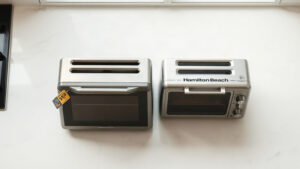
The budget pick. About 14 inches wide, 1,200 watts, and it fits on even cramped RV counters. The cooking quality is adequate — it runs a little hot at the top, so I always position food on the lower rack — but for the price it’s hard to argue against. If you’re weekend camping, not full-timing, this is perfectly fine. It’s also the easiest to store: flat enough to slide under a bed or into a cabinet when you’re driving.
Wattage and Size Comparison
| Model | Wattage | Width | Depth | Interior (cu ft) | RV-Friendly? |
|---|---|---|---|---|---|
| Breville BOV650XL | 1,800W (variable) | 16.5″ | 14.5″ | 0.45 | Mostly yes* |
| Cuisinart TOB-40N | 1,500W | 15.5″ | 13.5″ | 0.6 | Yes |
| Hamilton Beach 31123D | 1,200W | 14.0″ | 12.0″ | 0.35 | Yes |
| Cuisinart TOB-260N1 | 1,800W | 20.8″ | 17.4″ | 0.95 | No — too wide |
The Edge Case Nobody Talks About: Ventilation in a Moving Vehicle
Every review I’ve read focuses on static use — parked, hooked up, cooking dinner. But here’s the thing: some RVers cook while the vehicle is running. Or they store the toaster oven in a cabinet while driving, and a unit that wasn’t fully cooled gets jostled around with grease residue inside. Both of these situations matter.
For storage while driving: always remove the crumb tray, let it fully cool, and ideally lock the door with a small bungee or travel latch. I watched a toaster oven slide off a counter and land face-down during a hard brake — not catastrophic, but messy and scary. A model with a removable door (some Cuisinart models have this) is worth considering if you drive often.
For toasters with top-mounted vents — common on budget models — that vent is positioned directly under your cabinet. At 450°F, that steam and heat output will warp cheap RV cabinet laminate over time. I’ve seen it. Look for models with rear venting instead.
Also worth mentioning: if you’re cooking in cold weather and your RV is poorly insulated, the condensation from a hot oven can cause moisture issues in tight spaces. Crack a window. A small detail but a real one.
For more compact options at varying sizes, see the full guide to best mini toaster ovens — some of those picks overlap with what works well in an RV context.
Accessories Worth Having in an RV Setup
Most toaster ovens come with a rack and a basic pan. In an RV, I’d add two things. First, a toaster oven wire rack that fits your specific model — the stock rack often wobbles, and you don’t want a casserole dish sliding when you’re parked on a slight incline. Second, a silicone baking mat. Skip the parchment paper; it can blow against the heating element if the convection fan kicks on hard. I learned that one the interesting way.
Serious Eats has a solid rundown of toaster oven cooking techniques that translates well to RV use, particularly their advice on rack positioning for convection cooking.
Final Thoughts
If I had to pick one recommendation for most RV situations, it’d be the Cuisinart TOB-40N. It hits the right wattage, it’s reasonably compact, it’s easy to live with. The Breville is better — genuinely better — but it’s bigger and technically over the conservative wattage threshold. Worth it if you’ve confirmed your setup can handle it.
Don’t buy the biggest oven you can theoretically squeeze onto your counter. Living with a toaster oven in a small space means living with the heat, the smell, and the footprint every single day. Err smaller than you think you need. You can always cook in batches.
Frequently Asked Questions
What wattage toaster oven is safe for RV use?
1,500 watts or under is the safe ceiling for most 30-amp RV setups. At 1,500 watts, you’re drawing 12.5 amps on a 120V circuit, which leaves headroom on a 15-amp breaker. If you’re on 50-amp service with modern wiring, you have more flexibility, but it’s still good practice to stay conservative and not run the oven alongside other high-draw appliances.
What size toaster oven fits on an RV counter?
Most RV counters are 16–18 inches deep, so you need a unit no deeper than 14–15 inches to leave clearance for rear ventilation. Width-wise, under 18 inches is the practical limit for most galley kitchens. Always measure your specific counter and check both depth and width before ordering — door handle clearance adds width that specs don’t always include.
Can I use a toaster oven while boondocking on battery power?
Yes, but it’s power-intensive. A 1,200-watt oven running for 20 minutes consumes about 400 watt-hours, which is a significant draw on a typical 100Ah lithium battery bank. Use convection mode to cut cook times, keep sessions short, and make sure your inverter is rated for at least 1,500 watts continuous output. Solar supplementation helps a lot if you’re doing this regularly.
Is a convection toaster oven worth it for RV cooking?
Yes — convection is especially useful in an RV because it cooks about 25% faster, which means less heat building up in a confined living space. The fan also improves evenness, which matters when you’re cooking on a single small rack. The price premium over non-convection models is usually minor, around $20–40, and worth it.
How do I store a toaster oven safely while driving in an RV?
Let it cool completely, remove and empty the crumb tray, and secure the door so it doesn’t swing open in transit. If you store it on the counter while driving, use non-slip matting underneath and a bungee cord or cabinet latch to prevent it from sliding during braking. Some RVers store it in a lower cabinet or under a bed — just make sure it’s fully cooled before you enclose it anywhere.

Written by
Emma founded Toastera to turn vague appliance advice into clear, researched, safety-first guidance on toasters and toaster ovens.
Free: the Toaster Oven Cheat Sheet
Get the printable cheat sheet (temps, cook times & safety tips) plus new recipes. No spam, unsubscribe anytime.