An air fryer that won’t turn on is almost always caused by one of seven things: a tripped outlet, a loose or faulty power cord, an overheated internal thermal cutoff, a basket that isn’t seated correctly, a blown fuse inside the unit, a fried control board, or a dead heating element. Most of these you can diagnose and fix yourself in under ten minutes. A few of them mean the machine is done and it’s time to move on.
Safety First: Before you touch any internal components, unplug the air fryer and let it sit for at least 30 minutes. Air fryers run at temperatures up to 400°F and store heat in the element and housing long after you switch them off. Never probe internal wiring with your fingers or a metal tool while the unit is plugged in — even a small countertop air fryer runs on a 120V circuit that can cause a serious shock.
Quick Facts: Air Fryer Won’t Turn On
- Over 60% of “dead” air fryers are actually caused by a tripped GFCI outlet or circuit breaker — fix takes about 30 seconds.
- Most air fryers have a thermal cutoff that trips automatically if the unit overheats; it resets on its own after 20–30 minutes of cool-down.
- A misaligned or improperly seated basket will prevent the unit from powering on entirely — this is by design, not a defect.
- Air fryer control boards are often repairable under warranty; units less than 12 months old should go back to the manufacturer before you attempt anything else.
- If the unit is dead after fewer than 5 uses and is out of warranty, parts cost often exceeds the price of a new budget unit — factor that in before spending money on repairs.
Start Here: The 2-Minute Check Before You Do Anything Else
I’ll be honest — the first time my Cosori quit on me mid-cook, I spent 20 minutes convinced the heating element had burned out. It was a tripped GFCI outlet. Two seconds to reset it. So before you take anything apart or assume the worst, run through this list fast.
Plug something else into the same outlet. A phone charger works fine. If that also doesn’t work, the problem isn’t the air fryer at all — it’s the outlet. Most kitchen outlets near the sink are GFCI-protected and have a small reset button (usually black or red) on the face of the outlet itself. Press it firmly until you feel a click. Then try the air fryer again.
If the outlet is fine, check your breaker panel. Air fryers draw anywhere from 1,200 to 1,800 watts. Running one on the same circuit as a microwave or an electric kettle will trip a standard 15-amp breaker every single time. Flip the breaker fully off, then back on. Done.
The 7 Real Reasons Your Air Fryer Won’t Turn On
1. Tripped GFCI Outlet or Circuit Breaker
Already covered above, but worth being explicit: this is cause number one, by a wide margin. GFCI outlets are required by code in kitchens and they trip fast when they detect even a small current imbalance. An air fryer with a tiny amount of grease moisture near the heating element can cause exactly that. Reset the outlet. If it trips again immediately, then you’ve got a different problem — probably the unit itself is faulting.
2. The Basket Isn’t Properly Seated
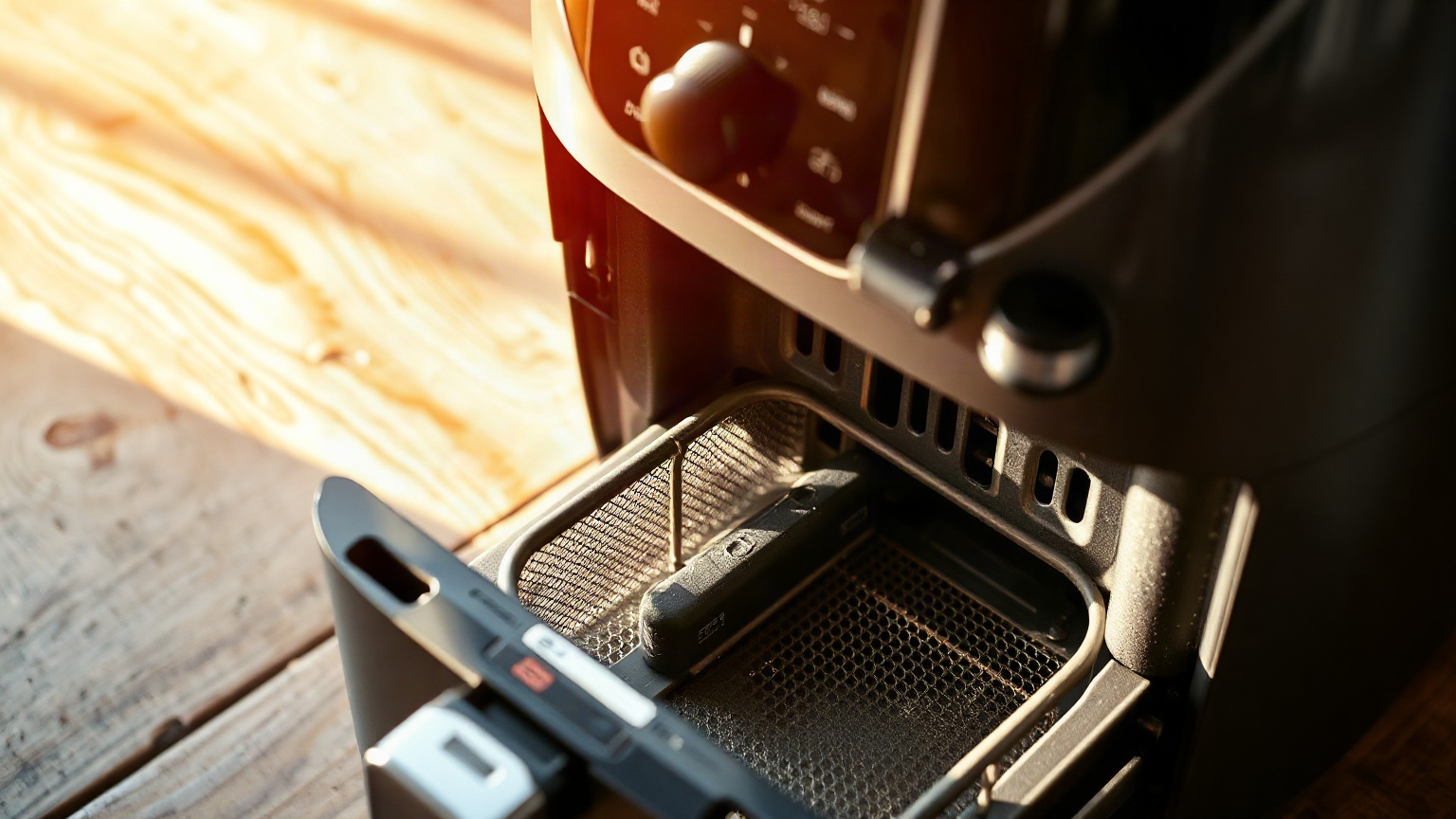
This one trips people up constantly, and it’s actually a safety feature. Nearly every air fryer on the market has a microswitch or magnetic sensor that prevents the unit from powering on unless the basket or drawer is fully closed and locked in. If you can hear the unit click on for a half-second then immediately cut out, or if it does nothing at all, pull the basket completely out and push it back in with a firm, deliberate push until you hear or feel it click.
Check whether the basket handle is fully engaged. On some models — the Ninja AF101 is a good example — the handle has to be pressed down before the drawer latches. Also look for warped or bent basket edges; if the basket took a drop or was forced in at an angle, it may not be triggering the sensor properly.
3. Overheated Thermal Cutoff (Thermal Fuse)
Every air fryer has a thermal cutoff — a safety device that interrupts power if the internal temperature exceeds a set threshold, usually around 320–356°F (160–180°C) at the component level. If you ran the unit at maximum temperature for an extended session, or if the vents were partially blocked, this may have tripped.
The fix: unplug the unit, move it somewhere with good airflow, and wait 30 minutes. That’s genuinely all you need to do in most cases. Then plug it back in and try again. If it fires right up, make sure the vents on the back and bottom of the unit aren’t against a wall or cabinet — air fryers need at least 5 inches of clearance on all sides.
If the thermal fuse has blown permanently (some are one-time-use), the unit won’t reset no matter how long you wait. At that point you need a replacement fuse, which usually costs $3–$8 online and requires opening the housing. On older units that are out of warranty, it’s worth it. On a brand-new unit — contact the manufacturer first.
4. Faulty Power Cord or Loose Connection
Power cords on countertop appliances take abuse. Yanked at angles, pinched under the unit, bent repeatedly near the plug head. Inspect the cord carefully along its entire length. Look for kinking, cracking in the insulation, or scorch marks near either end. Wiggle the cord gently where it enters the air fryer housing while the unit is plugged in — if the display flickers or the unit briefly comes to life, the cord connection is failing internally.
Don’t use the unit in that condition. On most air fryers, the power cord is hardwired and not a simple user-replaceable part. But some brands will send a replacement unit or cover a cord failure under warranty, so it’s worth calling.
5. Blown Internal Fuse
Some air fryers have a small glass or ceramic fuse inside the housing, separate from the thermal cutoff, that protects the circuit board from power surges. These are common on Instant Pot and some Philips models. If you had a power surge or the unit was plugged in during a brownout, this fuse may have blown.
You’ll need to open the base of the unit to find it. If you’re comfortable with basic appliance repair, look for a small cylindrical glass tube — usually 5A or 10A rated — in a fuse holder near the power input. Replacements cost under $5 for a pack of ten on Amazon. Check your model’s wiring diagram online first; many manufacturers post these as PDFs in their support sections.
6. Failed Control Board
If the unit gets power (you can confirm this with an outlet tester or by checking if the display shows anything at all, even briefly), but buttons do nothing and the fan doesn’t spin, the control board may have failed. This is more common than people realize on lower-end units under $50. Signs include: display lights up but touch controls are unresponsive, or the unit beeps once and cuts out immediately.
Control board replacements exist for popular models — the Cosori Pro II and Ninja AF series both have aftermarket boards available — but they typically run $25–$60, which only makes sense if the original unit was a premium model. For a best mini toaster ovens-tier unit that cost $60 new, a new machine is almost always the smarter call.
7. Dead Heating Element
Here’s the edge case most troubleshooting guides skip: it’s possible for an air fryer to appear completely dead not because of the power system, but because the heating element failed in a way that tripped the thermal protection circuit as a safety measure. The element isn’t just for heat — in many designs, the control circuit monitors element resistance, and an open-circuit element (one that’s burned through) causes the system to shut down entirely rather than run the fan without heat.
You can confirm a bad element with a multimeter set to resistance (Ohms). Unplug the unit, access the element leads, and check resistance across them. A working element usually reads 10–30 ohms. An open circuit (infinite resistance) means it’s gone. Replacement elements for popular models like the Ninja Foodi and Cosori replacement parts are available online, though installation is not beginner-friendly.
Quick Diagnosis Table: Match Your Symptom to the Cause
| What You’re Seeing | Most Likely Cause | DIY Fix Difficulty |
|---|---|---|
| Completely dead — nothing happens | Tripped outlet / breaker | Very easy (30 seconds) |
| Clicks on for a second, then off | Basket not fully seated | Easy (reseat basket) |
| Was working, stopped mid-session | Thermal cutoff tripped | Easy (cool down 30 min) |
| Worked fine, dead after power outage | Blown internal fuse | Moderate (open housing) |
| Display on, buttons do nothing | Failed control board | Hard (or replace unit) |
| Cord feels warm, flickers | Faulty power cord | Hard (contact manufacturer) |
| Fan won’t spin, element won’t heat | Dead heating element | Hard (multimeter needed) |
When to Repair vs. When to Replace
My personal threshold: if the repair costs more than 40% of a new equivalent unit, replace it. A replacement basket or drawer for a Ninja or Cosori? Usually worth it. A control board for a no-name brand that cost $45? Absolutely not.
Units under 12 months old should always go back to the manufacturer before you spend a cent. Ninja offers a one-year warranty on most models. Cosori offers two years on some. Philips covers some models for two years as well. If you have the receipt, use it.
And if you’re in the market for something new, it helps to know what you’re actually getting in each price tier. Air fryer technology has genuinely gotten better — even budget units now have decent thermal cutoffs and basket sensors that were only on premium models three years ago. For a solid comparison of current options that also function as toaster ovens, the best mini toaster ovens guide is a reasonable starting point. You can also check what the folks at Serious Eats have tested for kitchen appliance performance — they’re thorough about real-world cooking results.
Preventing This From Happening Again
A few habits that genuinely help. Give the unit its own dedicated circuit if possible — or at minimum, don’t run it at the same time as the microwave or kettle. Clean the basket after every use; grease buildup near the element is the number one cause of thermal cutoff trips. And don’t block the vents. That last one sounds obvious until you’ve watched someone shove an air fryer against a backsplash tile in a tight kitchen.
Also: don’t use extension cords. Air fryers draw enough wattage that a cheap extension cord creates real heat at the connection point. Use a short, heavy-gauge surge protector at most — but a direct wall outlet is always better. For more on how heat management works in countertop appliances, the piece on how hot a toaster gets covers some of the same thermal principles in a useful way.
The Bottom Line
Most air fryers that won’t turn on aren’t broken — they’re reacting to something fixable. A tripped outlet, a basket that didn’t click in, or an overheated thermal cutoff covers probably 70–80% of cases. Work through the diagnosis table above in order. If you hit cause 6 or 7 on a unit that’s under warranty, stop and call the manufacturer. If it’s out of warranty and older than 2 years, be realistic about repair costs versus replacement. The replacement parts market for popular brands is genuinely decent now, but you have to crunch the numbers honestly before you commit.
Frequently Asked Questions
Why is my air fryer not turning on even when plugged in?
The most common reason is a tripped GFCI outlet — press the reset button on the outlet face and try again. If the outlet is fine, check whether the basket or drawer is fully seated, since most air fryers won’t power on unless the basket is properly clicked into position. A tripped internal thermal cutoff (caused by overheating) is the third most likely cause and resolves itself after 20–30 minutes of unplugged cool-down time.
Can an air fryer be fixed if it won’t turn on?
Yes, in most cases. GFCI resets, basket reseating, and thermal cutoff cool-downs are all zero-cost fixes you can do yourself in minutes. Blown internal fuses cost $3–$8 to replace. Control board failures and dead heating elements are harder — repair makes sense only on premium units; budget models are usually better replaced than repaired at that point.
Why did my air fryer suddenly stop working in the middle of cooking?
Mid-session shutoffs are almost always caused by the thermal cutoff tripping due to overheating — either from blocked vents, an extended high-temperature cook, or grease buildup near the element. Unplug the unit, let it cool for 30 minutes with the basket pulled out to allow airflow, then try again. If it trips repeatedly during normal use, check that the vents aren’t obstructed and that you’re not overloading the basket.
How do I reset my air fryer when it won’t turn on?
Most air fryers don’t have a dedicated reset button — the “reset” is simply unplugging the unit for 60 seconds, then plugging it back in. For GFCI outlet trips, press the reset button on the outlet itself. If the unit has overheated, the reset is just time: unplug it and let it cool for at least 30 minutes before attempting to power it on again.
Is it worth repairing an air fryer that won’t turn on?
It depends on the repair cost relative to the unit’s value. Simple fixes (outlet reset, basket reseating, thermal cool-down, fuse replacement) are always worth doing. If the control board or heating element has failed, the repair cost typically runs $25–$60+ in parts alone — which only makes sense if the unit originally cost $150 or more. Units under 12 months old should be returned or warranty-claimed before any out-of-pocket repair is attempted.

Written by
Emma founded Toastera to turn vague appliance advice into clear, researched, safety-first guidance on toasters and toaster ovens.
Free: the Toaster Oven Cheat Sheet
Get the printable cheat sheet (temps, cook times & safety tips) plus new recipes. No spam, unsubscribe anytime.