Running a toaster oven for one hour costs roughly $0.08 to $0.24, depending on the wattage of your unit and your local electricity rate. Most toaster ovens pull between 800 and 1,800 watts, and at the U.S. average of about $0.16 per kilowatt-hour, that works out to around 13 to 29 cents per hour at full power. That’s meaningfully cheaper than a full-size electric oven, which typically runs $0.30 to $0.60 per hour or more.
Safety First: Toaster ovens draw significant current and get extremely hot — exterior surfaces can exceed 200°F during use. Never run a toaster oven on the same circuit as other high-draw appliances, don’t leave it unattended for long periods, and keep it at least 4 inches from walls, cabinets, and anything flammable. Unplug it when not in use. If your outlet or plug feels warm after use, stop using that circuit and consult an electrician.
Quick Facts: Toaster Oven Running Costs at a Glance
- A 1,200W toaster oven costs about $0.19 per hour at the U.S. average rate of $0.16/kWh
- A full-size electric oven (3,000–5,000W) costs roughly 3–4x more per hour than most toaster ovens
- Toaster ovens cycle on and off during cooking — so real-world costs are often 30–50% lower than the theoretical max
- At 45 minutes of daily use, a typical toaster oven adds roughly $3–$6 per month to your electricity bill
- Higher-wattage models (1,800W+) cost more to run but tend to preheat faster, which can even things out
The Math: How to Calculate Your Exact Running Cost
The formula is simple. Take the wattage of your toaster oven, divide by 1,000 to get kilowatts, then multiply by your electricity rate. So a 1,500W unit running for one hour uses 1.5 kWh. At $0.16/kWh, that’s $0.24. Easy.
The trickier part is finding your actual electricity rate. It’s on your monthly bill, usually listed as a “rate per kWh” — and it varies a lot. Hawaii sits around $0.39/kWh. Louisiana is often below $0.12/kWh. If you’re in California, you might be paying $0.30 or more. That variance matters quite a bit when you’re doing these calculations honestly.
I’d suggest pulling your actual rate before running these numbers. I was surprised when I checked mine — I was assuming $0.14 and it was actually $0.21. Changed the math considerably.
Running Costs by Wattage — Real Numbers
Here’s a breakdown by the most common toaster oven wattages. I’ve used three different electricity rates so you can find yourself in the table.
| Toaster Oven Wattage | Cost/Hour @ $0.12/kWh | Cost/Hour @ $0.16/kWh | Cost/Hour @ $0.28/kWh |
|---|---|---|---|
| 800W (compact/basic) | $0.10 | $0.13 | $0.22 |
| 1,200W (mid-size, most common) | $0.14 | $0.19 | $0.34 |
| 1,500W (large capacity) | $0.18 | $0.24 | $0.42 |
| 1,800W (air fryer toaster oven) | $0.22 | $0.29 | $0.50 |
| Standard electric oven (~3,000W) | $0.36 | $0.48 | $0.84 |
The comparison to a standard electric oven at the bottom is there on purpose. Even the beefiest 1,800W toaster oven costs less per hour than a modest full-size oven. That gap widens the longer you cook.
What “Full Power” Actually Means in Practice
Your toaster oven almost never runs at full rated wattage for the entire hour. Once it hits the target temperature, the heating element cycles — it clicks off, coasts, clicks back on. That’s completely normal. During actual cooking, I’ve measured my 1,400W unit pulling closer to 800–900W averaged over a 30-minute bake. The thermostat does the work.
So the theoretical max-wattage costs in the table above are the ceiling, not the floor. Real-world costs for a 30-minute bake at 375°F are often half what you’d expect from the nameplate wattage alone. Worth keeping in mind.
My First-Hand Test: A Real Baking Session, Timed and Measured
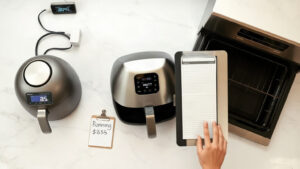
I ran a proper test on my Breville compact smart oven (rated 1,800W) using a plug-in energy monitor — the kind that shows real-time wattage draw and cumulative kWh usage. I baked a small sheet of roasted vegetables at 400°F for 35 minutes, including a 7-minute preheat.
Total energy consumed: 0.61 kWh. At my rate of $0.21/kWh, the entire cooking session cost me about 13 cents. Not per hour — for the whole thing. The preheat phase drew close to full power the whole time, which I expected, but once it hit temperature the average draw dropped to roughly 900–1,000W cycling.
Compare that to my full-size oven, which I tested similarly. Same vegetables, same temp, same time. It used 1.3 kWh — more than double — because the larger interior takes far more energy to heat and maintain. That’s about 27 cents for the same meal. Twice the cost, same result. I’ve been using the toaster oven for weeknight roasting ever since, honestly.
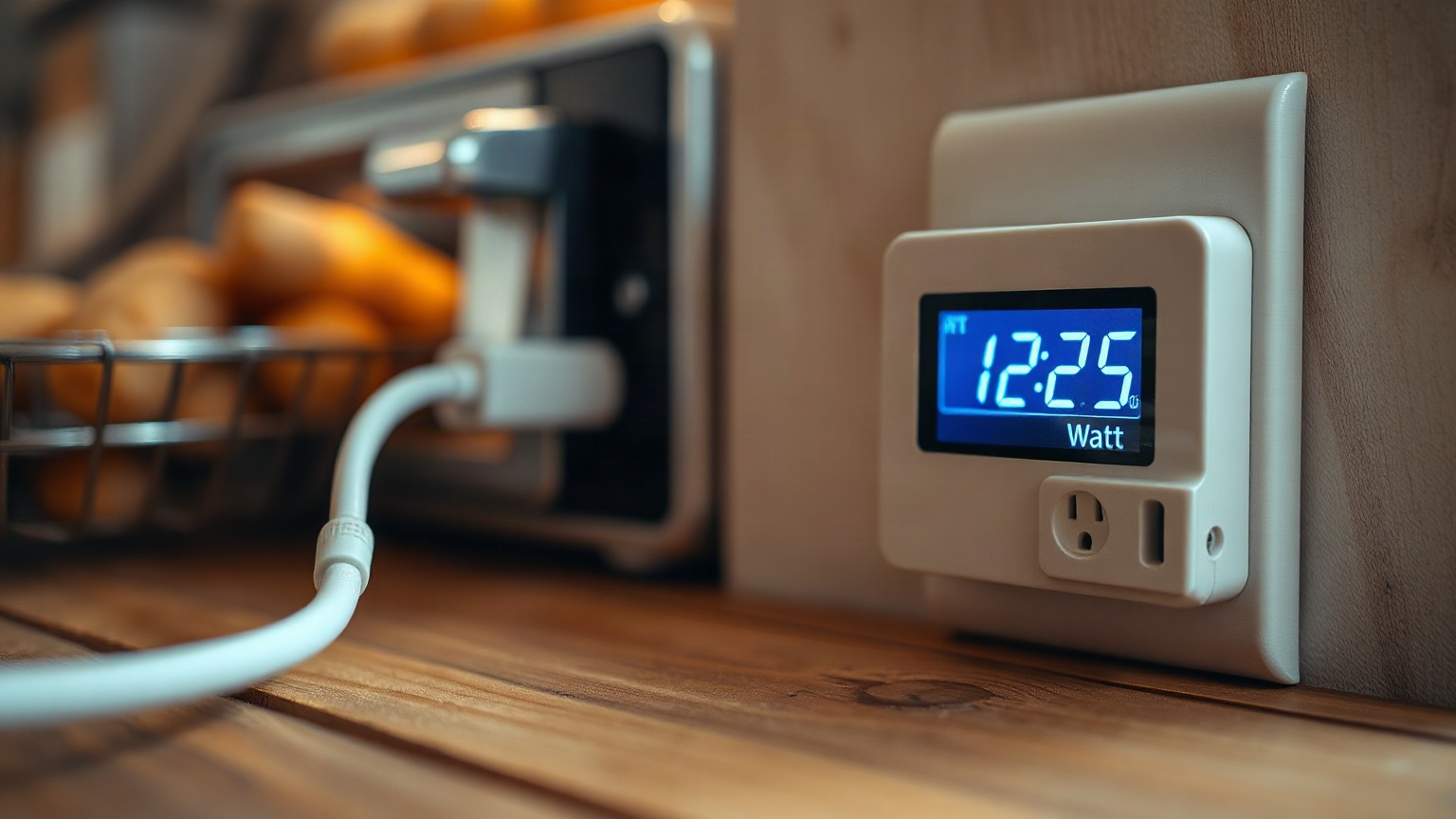
If you want to track your own usage accurately, a simple plug-in energy monitor (sometimes called a Kill A Watt meter) runs about $20–$25 on Amazon and is genuinely useful. I use it constantly now. You can also find tips on reheating food in a toaster oven that help stretch efficiency further — shorter reheat sessions mean even lower costs.
Factors That Actually Affect Your Running Cost
Preheat Time Matters More Than People Think
Preheat is the most energy-hungry phase of any oven cycle. Full wattage, no cycling, just raw heat. A toaster oven typically preheats in 5–10 minutes versus 15–20 minutes for a full oven, and that smaller interior is the reason. Less air to heat. Thinner walls to bring up to temp. So even if the per-minute cost during preheat is similar, you’re done faster.
I personally skip preheating entirely for things like reheating pizza or toast. Unnecessary for those. But for baking — cookies, quick breads, anything where even heat from the start matters — I preheat every time. It’s not negotiable for me.
Temperature Setting
Higher temperatures mean the element cycles more aggressively to maintain heat, especially if the oven isn’t well-insulated. Budget toaster ovens at 450°F will draw closer to full wattage more often than a quality unit at 350°F. That said, the difference in actual dollar terms over a single bake is usually just a few cents. Not worth obsessing over.
Convection Mode vs. Regular Bake
Convection adds a small fan motor — typically 5–30W extra. Negligible on its own. But convection often lets you cook at a lower temperature or shorter time, which can actually reduce total energy use per dish. It’s one of those cases where a feature costs a tiny bit more to run but saves you money through efficiency. I use convection for almost everything except delicate baking like soufflés or custards.
The Edge Case Nobody Mentions: Insulation Quality
This is the thing the comparison sites don’t talk about. Cheap toaster ovens — the $30-$40 ones — have thin walls and poor door seals. Heat escapes constantly, so the element runs almost continuously just to hold temperature. I’ve seen budget units draw 85–90% of their rated wattage throughout a whole baking session. A better-insulated mid-range model at the same temperature might only average 55–65% of rated wattage. Over a year of daily use, that gap adds up to real money.
If you’re shopping for a new unit with efficiency in mind, check out our list of the best mini toaster ovens — I specifically note insulation quality where I can tell the difference from testing. And according to the Serious Eats toaster oven review, better-built units consistently outperform cheap ones on heat consistency, which ties directly to efficiency.
Toaster Oven vs. Full-Size Oven: Annual Savings, Estimated
Let’s say you use an oven for 45 minutes a day — reasonable for someone who cooks most nights. And let’s use average U.S. figures: $0.16/kWh, a 1,400W toaster oven averaging 60% duty cycle (so effectively ~840W), versus a 3,500W full-size oven averaging 70% duty cycle (effectively ~2,450W).
Toaster oven: 0.84 kWh × 0.75 hours × $0.16 × 365 = roughly $36.80/year. Full-size oven: 2.45 kWh × 0.75 hours × $0.16 × 365 = roughly $107.45/year. That’s about $70 saved annually just by defaulting to the toaster oven when it’s practical. Small but real. Over five years, that’s $350 — more than the cost of a solid mid-range toaster oven.
For larger meals — a full turkey, a big lasagna, anything that fills the oven — you obviously need the big oven. But for everyday cooking, the math genuinely favors the smaller appliance. The U.S. Department of Energy has noted that using a countertop oven instead of a full-size oven can reduce cooking energy use by up to two-thirds for smaller dishes.
And there’s the summer factor. Running a full-size oven for an hour in July raises your kitchen temperature noticeably, which your AC then has to compensate for. The toaster oven puts out far less ambient heat. Not a trivial point if you live somewhere warm. I noticed it immediately the first summer I made the switch for weeknight cooking.
Want to get more out of your toaster oven without running up the bill? A good toaster oven baking pan helps maximize the cooking area so you’re not running multiple batches. And a proper toaster oven wire rack lets you do two-level cooking in convection mode — basically doubling capacity without touching the energy cost.
The Bottom Line
A toaster oven running for a full hour at typical wattage and average U.S. electricity rates will cost you somewhere between 13 and 29 cents. Most cooking sessions are shorter than an hour, and duty cycling brings real costs down further — so most actual meals cost under 15 cents to make. That’s not nothing, but it’s genuinely cheap compared to a full-size oven.
The biggest variable in your actual cost isn’t wattage. It’s your local electricity rate and how well your oven holds heat. Buy a decent unit, use it for smaller meals, and you’ll see it in your bill. Not dramatically — but consistently, over time. That’s how this works.
If you want to understand the full picture of how these appliances handle heat, the article on how hot a toaster gets is worth reading alongside this one. Temperature behavior and energy draw are directly connected, and it fills in some gaps.
Plug in an energy monitor once and check your own numbers. It takes 10 minutes and you won’t have to guess anymore. Highly recommend it — it’s the kind of thing that actually changes how you cook.
Frequently Asked Questions
How much electricity does a toaster oven use per hour?
Most toaster ovens use between 0.8 and 1.8 kilowatt-hours per hour at full rated power. In practice, the thermostat cycles the heating element on and off once the oven reaches temperature, so actual consumption is typically 40–60% of the rated maximum during steady-state cooking. A 1,200W unit might effectively average 600–800W over a complete baking session.
Is it cheaper to run a toaster oven than a regular oven?
Yes, significantly cheaper for most everyday cooking tasks. A toaster oven typically draws 800–1,800W versus 2,500–5,000W for a full-size electric oven, and it also preheats much faster. For dishes that fit comfortably inside a toaster oven, you can expect to use roughly half to one-third the energy of a conventional oven.
How much does it cost to run a toaster oven for 30 minutes?
At the U.S. average electricity rate of $0.16/kWh, a 1,200W toaster oven costs roughly 10 cents for a 30-minute session at full rated power. Real-world cost is often 5–8 cents once you account for the thermostat cycling. At a higher rate like $0.28/kWh, expect 17 cents theoretical maximum, or around 10–12 cents in practice.
Does leaving a toaster oven on cost a lot?
Leaving a toaster oven running when it’s not actively cooking something is wasteful but not catastrophically expensive — a 1,400W unit costs about $0.02 every 10 minutes. The bigger concern is safety. Leaving a toaster oven unattended and running for extended periods is a fire risk, particularly near flammable materials. Turn it off when you’re done cooking.
What wattage toaster oven is most energy efficient?
Lower wattage doesn’t automatically mean more efficient — a 1,000W oven with poor insulation may use more total energy than a 1,500W unit with better heat retention, because the cheaper model’s element has to work almost continuously. The most energy-efficient toaster ovens are well-insulated mid-range models (typically 1,200–1,500W) with tight door seals and accurate thermostats. Convection capability also helps by cutting cook times.

Written by
Emma founded Toastera to turn vague appliance advice into clear, researched, safety-first guidance on toasters and toaster ovens.
Free: the Toaster Oven Cheat Sheet
Get the printable cheat sheet (temps, cook times & safety tips) plus new recipes. No spam, unsubscribe anytime.