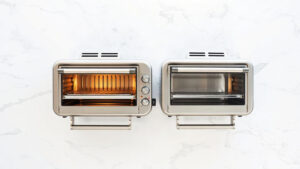
For most people, the Ninja Foodi Digital Air Fry Oven is the one to buy — it hits a genuinely sweet spot of performance, capacity, and price that the other two can’t quite match at the same tier. The Breville Smart Oven Air Fryer Pro is better in specific ways, but you’re paying a significant premium for those differences. Cuisinart has its place, but it’s a distant third in this particular comparison.
Safety First: Countertop ovens run hot — surfaces can reach temperatures that cause serious burns within seconds of contact. Always place your unit at least 4–6 inches from walls and cabinets, never operate on or near flammable materials, and use oven mitts specifically rated for high heat when pulling racks or pans. Keep children away from the unit during and immediately after use. If you notice any sparking, unusual smells, or the appliance gets far hotter than expected on the exterior, unplug it immediately and don’t use it again until it’s been inspected.
Quick Facts: Ninja vs Breville vs Cuisinart
- The Ninja Foodi Digital Air Fry Oven (SP101 / SP301 series) consistently beats its price tier in air frying and toast evenness.
- Breville’s Smart Oven Air Fryer Pro runs hotter more accurately — it holds its set temperature within roughly ±5°F, which matters for baking.
- Cuisinart TOB-260N1 is a capable, no-fuss oven but its air fry results lag noticeably behind both competitors.
- All three sit in different price tiers: Ninja is mid-range, Breville is premium, Cuisinart floats between the two depending on sales.
- Footprint matters a lot on a real countertop — Ninja flips up vertically to save space; Breville and Cuisinart do not.
What These Three Ovens Actually Are

Let’s get specific, because these brands each sell multiple countertop ovens and the conversation gets muddled fast.
The Ninja I’m comparing here is the Foodi Digital Air Fry Oven — specifically the SP301 (the larger “XL” version) and its close sibling the SP101. They’re the same basic machine, different capacities. The Breville in question is the Smart Oven Air Fryer Pro (BOV900BSS), which is their flagship and the one that shows up in every serious review. For Cuisinart, it’s the TOB-260N1 Chef’s Convection Toaster Oven. Not the smaller TOB-240 or the air fryer-specific models — the 260 is the one Cuisinart positions as a full-featured oven replacement.
I’ve cooked in all three. The Ninja lives on my counter. The Breville I tested for about three months at a friend’s place while I was helping her set up a new kitchen (long story). The Cuisinart I used extensively before switching. So this isn’t theoretical.
Side-by-Side Comparison
| Feature | Ninja Foodi SP301 | Breville BOV900BSS | Cuisinart TOB-260N1 |
|---|---|---|---|
| Capacity (interior) | ~0.9 cu ft (XL) | ~0.9 cu ft | ~0.95 cu ft |
| Max Temperature | 450°F | 480°F | 450°F |
| Air Fry Performance | Excellent | Very Good | Decent |
| Toast Evenness | Good | Excellent | Good |
| Baking Accuracy | Good (~±15°F) | Excellent (~±5°F) | Good (~±15°F) |
| Footprint / Storage | Flips vertical — saves counter space | Standard horizontal | Standard horizontal |
| Price Tier | Mid-range | Premium | Mid-range / Upper-mid |
| Preset Functions | 8 | 13 | 15 |
| Interior Light | No (SP101), Yes (SP301) | Yes | Yes |
| Best For | Air frying, everyday use, smaller kitchens | Baking, serious cooks, precision | Versatility without air fry priority |
Performance Where It Actually Counts
Air Frying
The Ninja wins here, and it’s not close. I’ve made frozen fries, chicken wings, and brussels sprouts in all three, and the Ninja consistently produces crispier results faster. Specifically, wings at 400°F for 22 minutes come out genuinely crispy-skinned in the Ninja. The Breville gets close — maybe 90% of the way there — but typically needs 3–5 more minutes to hit the same result. The Cuisinart just doesn’t circulate air as aggressively; wings come out cooked but noticeably less crispy on the underside unless you flip halfway through, which, fine, but it’s an extra step.
Part of why Ninja dominates here is the flip-up design. When you open it the way it’s built to air fry, the heating elements and fan are arranged to hit food from the right angle. It’s not magic — it’s just good engineering for that specific task.
Baking and Roasting
This is Breville’s territory. The temperature accuracy is genuinely better — I confirmed this with an oven thermometer left inside for a 30-minute preheat at 375°F. The Breville held at 373–378°F the entire time. The Ninja drifted between 360–390°F in cycles, which is normal convection behavior but wider than Breville’s swing. For cookies and cakes, that variance can matter. My chocolate chip cookies came out fine in the Ninja but they browned unevenly on one batch — I had to rotate the pan halfway through. In the Breville, same recipe, no rotation needed.
The Cuisinart held temperature reasonably well too, and actually its larger interior cavity is a small advantage for roasting a chicken or a full 9×13 pan. But the cooking results on roasted chicken weren’t as consistently crispy-skinned as the Breville.
For serious baking — Serious Eats has made this point well — temperature consistency separates good countertop ovens from great ones. If baking is why you want a countertop oven, spend the money on the Breville.
Toasting
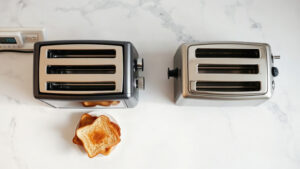
Breville’s “Element IQ” system (their term for smart heating element control) produces the most even toast I’ve gotten from a countertop oven. Dead honest. The Ninja toasts fine — a solid 7/10 — but if you put four slices in and check them, the slices near the edges tend to be slightly lighter. Cuisinart’s toasting is similar to Ninja’s. Not bad. Not remarkable.
If toast quality is genuinely your top priority, you might want to look at a dedicated toaster alongside a different countertop oven, or just get the Breville. Check out our thoughts on how hot a toaster gets if you’re thinking about the dedicated toaster route.
The Countertop Space Problem (An Edge Case Everyone Ignores)
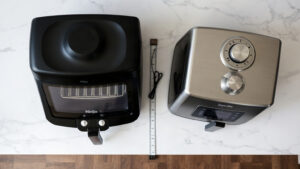
This doesn’t come up much in standard reviews but it came up for me immediately. The Breville BOV900BSS is large. Its footprint on a counter is roughly 21.5 x 17 inches, and it needs clearance on all sides. In a smaller kitchen, that’s real estate you might not have.
The Ninja’s flip-up design is genuinely clever for this reason. When you’re not using it for air frying, you can store it vertically against a wall, which takes up a fraction of the horizontal space. I kept mine tucked between the microwave and the wall and it worked fine. Breville and Cuisinart don’t offer anything like that — they’re horizontal boxes, full stop.
If your kitchen has 18 inches or less of usable counter depth, the Ninja makes a lot more practical sense regardless of Breville’s performance advantages. That’s the honest truth.
Ease of Use and Cleaning
None of these are hard to use, but they have different personalities.
Ninja’s interface is simple. Dial for function, buttons for temperature and time. You figure it out in about two minutes. The first time I used it I accidentally set it to “dehydrate” instead of “air fry” and just… didn’t notice until nothing was crisping. Minor issue. The presets are genuinely useful and not just a gimmick.
Breville’s interface is more involved. Thirteen functions with a smart dial — there’s a small learning curve, and the manual is actually worth reading, which I say rarely. Once you’re past day two it becomes intuitive. The display is clearer and gives you more real-time feedback, which I appreciate.
Cuisinart’s fifteen presets sound impressive but several of them are fairly redundant (Bake, Broil, and Convection Bake are three separate options that overlap in obvious ways). The dial controls feel a little cheaper than either competitor.
Cleaning: Breville’s interior is non-stick coated and wipes down well. Ninja’s crumb tray is easy to pull and clean, but the interior has some corners that trap grease. Get yourself a non-stick toaster oven cleaning brush for any of these — it’ll save you. Cuisinart’s removable crumb tray is larger and genuinely easier to access than the Ninja’s.
For general reheating day to day, all three work well. I have a full breakdown on reheating food in a toaster oven if that’s a big part of why you want one.
Who Should Buy Which One
Here’s the honest, opinionated version.
Buy the Ninja Foodi if: You want excellent air frying, a solid all-around oven, and you’re not spending Breville money. Also if space is an issue. This is the right call for probably 70% of the people asking this question. It’s not perfect — the temperature accuracy lags behind Breville, and I miss the interior light on the base SP101 model — but the value proposition is hard to argue with.
Buy the Breville Smart Oven Air Fryer Pro if: You bake regularly and temperature precision genuinely matters to you. Or if you’re replacing a full-size oven and need the best possible countertop substitute. Or if toast quality is a genuine daily priority. The price hurts but the build quality and cooking accuracy justify it for people who use it heavily. It also just feels more solid — heavier, better-built door, higher-quality rack. Check it out: Breville Smart Oven Air Fryer Pro.
Buy the Cuisinart TOB-260N1 if: You find it significantly cheaper than the Ninja during a sale, or if you specifically want a larger interior cavity for a full roasting pan. Otherwise, it’s not my first recommendation. The air frying results are just underwhelming for what it costs, and that’s the feature driving most people to upgrade their countertop oven in 2025.
If you’re in a dorm or a really small space, none of these is the answer — check the best mini toaster ovens instead.
The Bottom Line
Most people should buy the Ninja Foodi. Full stop. It air fries better than anything in its price tier, handles everyday cooking well, and solves the counter space problem in a way neither competitor does. It’s not the best at baking or toasting — Breville takes those — but those are narrower use cases than air frying and general reheating.
Breville is genuinely excellent and worth the money if you know you’ll use it hard and you care about baking accuracy. But paying premium pricing for features most people underuse isn’t a smart buy for most people.
Cuisinart is fine. Just not the first choice here. The Food Network’s roundups have historically been kind to Cuisinart for value, and that’s fair, but the air fry gap is real in 2025.
Pick your winner, put a good toaster oven baking pan inside it, and actually use the thing.
Frequently Asked Questions
Is the Ninja Foodi countertop oven actually worth it compared to Breville?
Yes, for most people — the Ninja Foodi delivers excellent air frying and solid all-around performance at a significantly lower price than the Breville Smart Oven Air Fryer Pro. The Breville is better at precise baking and toasting, but if those aren’t your primary uses, you’re paying a premium for features you won’t fully leverage. The Ninja wins on value and air fry performance consistently.
Can a Cuisinart toaster oven replace a regular oven?
The Cuisinart TOB-260N1 can handle most everyday cooking tasks you’d use a full oven for — roasting, baking, broiling — especially for smaller quantities. It struggles compared to a full oven with large batches or when you need precise temperature control for delicate baking. For a true oven replacement, Breville’s BOV900 is the more reliable choice among countertop options.
Which countertop oven is best for air frying specifically?
The Ninja Foodi Digital Air Fry Oven is the best of these three for air frying — its fan and heating element arrangement produces crispier results faster than either Breville or Cuisinart at comparable settings. Chicken wings, frozen fries, and vegetables all come out noticeably crisper compared to the Cuisinart, and slightly better than the Breville despite both using convection. If air frying is your main reason for buying, get the Ninja.
How much counter space does the Breville Smart Oven Air Fryer Pro take up?
The Breville BOV900BSS footprint is approximately 21.5 x 17 inches, and it needs 4–6 inches of clearance on all sides for safe ventilation — so realistically it occupies a significant chunk of counter space. Unlike the Ninja Foodi, it can’t be stored vertically, so what you see is what you’re committing to permanently. Measure your counter before ordering.
What’s the best countertop oven for someone who bakes regularly?
The Breville Smart Oven Air Fryer Pro is the best choice for regular bakers among these three — it holds its set temperature within roughly ±5°F, which produces more consistent results with cookies, cakes, and bread than the Ninja or Cuisinart. Both of those two drift ±15°F or more during a bake cycle, which can cause uneven browning. If baking is your primary use, the Breville’s price premium is genuinely justified.

Written by
Emma founded Toastera to turn vague appliance advice into clear, researched, safety-first guidance on toasters and toaster ovens.
Free: the Toaster Oven Cheat Sheet
Get the printable cheat sheet (temps, cook times & safety tips) plus new recipes. No spam, unsubscribe anytime.