A convection toaster oven is worth the extra money for most home cooks — but not all of them. The fan-driven hot air circulation cooks food 20–30% faster and produces noticeably crispier results than a standard radiant-heat model, which matters a lot if you roast vegetables, bake cookies, or reheat pizza regularly. If you mostly make toast and the occasional frozen waffle, a standard model will do the job just fine.
Safety First: Convection toaster ovens run hot — many reach 450°F or higher — and the exterior walls can get scorching during long roasting sessions. Keep at least 4 inches of clearance on all sides, never line the bottom with foil (it can trap heat and warp heating elements), and always use oven mitts when pulling racks. Don’t leave the unit unattended with high-fat foods like bacon, which can splatter and ignite.
Quick Facts: Convection vs Regular Toaster Oven
- Convection toaster ovens circulate hot air with a fan, typically cutting cook time by 20–25% compared to radiant-only models.
- Standard toaster ovens top out around 450°F; convection models often match that but cook more evenly throughout the cavity.
- The price gap between a decent standard model and a decent convection model runs roughly $40–$100 at retail — sometimes less on sale.
- Convection is especially worth it for roasting, baking, and air frying; it’s mostly irrelevant for reheating soup or making toast.
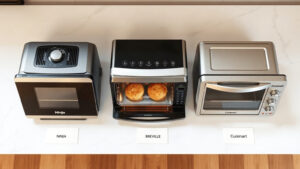
- Premium convection models (Breville, Cuisinart, Ninja) add smart sensors, multiple fan speeds, and air fry modes that standard ovens can’t replicate.
What Actually Happens Inside a Convection Toaster Oven
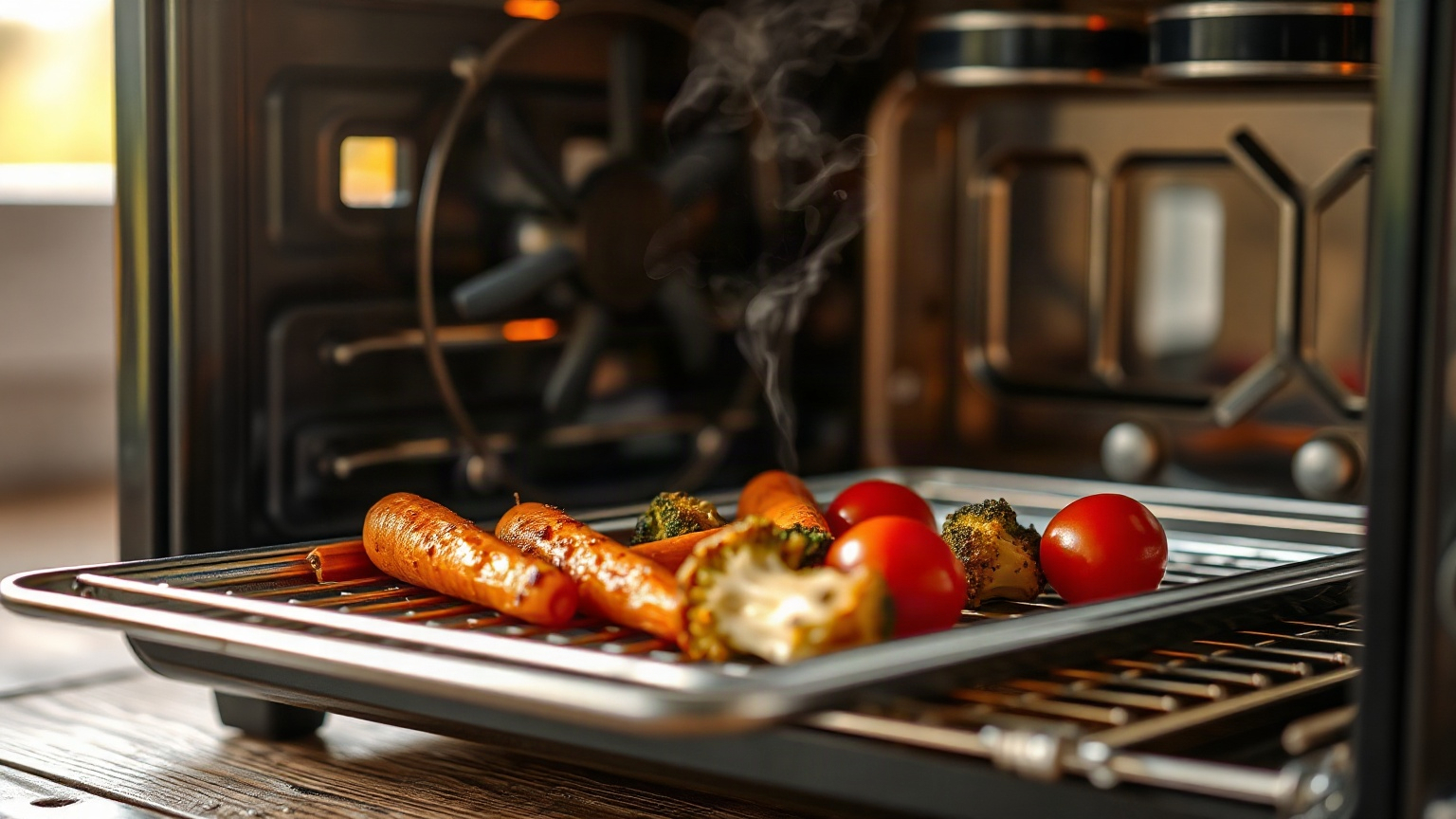
Regular toaster ovens use heating elements — usually quartz or nichrome coils — positioned at the top and bottom of the cavity. Heat radiates outward and eventually warms the food through a combination of radiant heat and the hot air sitting around it. The problem is that hot air doesn’t sit still evenly. It stratifies. The top of your chicken thigh gets blasted while the underside struggles.
Convection adds a fan (and usually a third heating element behind it) that keeps air moving constantly across the food’s surface. That moving air strips away the cool, moisture-laden layer that naturally forms around food as it cooks. Strip that layer away and you get faster browning, crisper skin, and more even results across the whole rack. It’s the same principle behind why a 70°F day with wind feels colder than a 70°F day that’s calm.
I noticed this clearly the first time I roasted Brussels sprouts in a convection model at 400°F for 18 minutes versus 25 minutes in my old basic unit — same sprouts, same sheet pan, same oil and seasoning. The convection batch had actual caramelization on the cut sides. The radiant batch was cooked through, sure, but kind of pale and a little steamy. That difference stuck with me.
Side-by-Side Comparison: Popular Models Worth Considering
Here’s where things get practical. There are dozens of toaster ovens out there, but a handful of models keep coming up in testing because they actually deliver on their claims. I’ll be honest about what I think of each.
| Model | Type | Capacity | Key Functions | Price Tier | Best For |
|---|---|---|---|---|---|
| Breville Smart Oven Air Fryer Pro | Convection + Air Fry | Large (fits 13″ pizza) | 13 functions, 2 fan speeds, slow cook | Premium ($$$) | Serious home cooks who want one appliance to do everything |
| Cuisinart TOA-70 | Convection + Air Fry | Medium-large | 7 functions, air fry basket included | Mid-range ($$) | Everyday cooks who want air fry without spending Breville money |
| Ninja Foodi XL Pro | Convection + Air Fry | Extra-large | 10 functions, flip-up design | Mid-range ($$) | Families who cook large batches and don’t mind counter space |
| Hamilton Beach Easy Reach | Standard radiant | Small-medium | Bake, broil, toast, keep warm | Budget ($) | Toast-first households who rarely roast or bake |
| Black+Decker Crisp ‘N Bake | Convection (basic) | Small-medium | Convection bake/broil, toast | Budget-mid ($) | First-time convection buyers who don’t want to commit big money |
My honest take on the Breville
It’s expensive. No getting around it. But it’s also the only toaster oven I’ve used where the results genuinely rival a full-size oven for baking — including cakes, which I was skeptical about. The dual fan speeds matter more than I expected; the lower setting is better for delicate things like croissants that you don’t want to blow around. My one pet peeve is the exterior gets uncomfortably hot to the touch during long roasts, so placement matters.
The Cuisinart TOA-70 sweet spot
This is probably the one I’d recommend to most people. The air fry function works well, the footprint isn’t absurd, and the price doesn’t hurt as much. It’s not as precise as the Breville — the dial controls feel a little approximate compared to digital — but for roasting chicken pieces, baking sheet-pan dinners, and crisping leftovers, it’s excellent. If you’re on the fence about convection and don’t want to gamble big money, this is the safer bet.
Where Convection Actually Earns Its Keep (and Where It Doesn’t)
Tasks where convection makes a real difference
Roasting vegetables. Chicken thighs and drumsticks. Baked potatoes (so much faster). Cookies, especially when you want that slightly crisp edge and chewy center. Anything you’d describe as “crisping up.” Reheating pizza — this is where I’ll say convection is almost mandatory; standard radiant heat can’t reliably crisp the bottom crust without burning the top. For more on that, see my notes on reheating food in a toaster oven.
Air frying, which is really just high-speed convection with a basket, is only available on convection models. If that’s on your list, the decision is already made for you.
Tasks where it barely matters
Toast. Melting cheese on a sandwich. Warming a slice of leftover casserole. Heating up soup or a bowl of leftovers. For these things, whether your oven has a fan running or not isn’t going to change your Tuesday night. Standard models handle these perfectly well and cost less.
The edge case most reviews miss: delicate baked goods
Here’s something I haven’t seen covered elsewhere. Convection can actually hurt you with certain recipes. Custards, soufflés, very light cakes — anything that rises gently or has a fragile structure — can be disrupted by the fan airflow. A delicate sponge cake can bake unevenly because one side gets more air than the other. Choux pastry (cream puffs, éclairs) can dry out too fast on the outside before the inside has set. If you bake a lot of this type of thing, you want a model with a convection-off option, which better units have. Not all budget convection models let you disable the fan. Check before you buy.
Temperature, Timing, and the Adjustment Curve
One thing nobody warns new convection users about: your existing recipes won’t work exactly as written. Standard recipe temperatures assume a radiant-heat environment. With convection, the general rule is to drop the temperature by 25°F or reduce the cook time by about 20% — not both, usually just one. I tend to reduce temperature for baked goods and reduce time for roasted things. It takes a couple of tries to calibrate, and I definitely burned a batch of dinner rolls my first week with a convection oven before I figured this out.
Serious Eats has a good breakdown of convection vs conventional adjustments if you want to get into the science, but the practical version is: start checking food earlier than the recipe says and go from there.
Standard toaster oven heating elements can reach up to 450–500°F (check out our deeper look at how hot a toaster gets). Convection models hit the same temperature ceiling, but the circulating air means the actual food surface experiences more aggressive heat transfer. That’s why convection-cooked food browns faster even when you set the same temperature.
Who Should Buy a Convection Model (And Who Shouldn’t Bother)
Get a convection toaster oven if you cook actual meals in it — not just breakfast. If you roast, bake, or want to replace your full-size oven for weeknight dinners, the extra cost pays off fast in energy savings alone. Convection toaster ovens use significantly less electricity than a full-size oven for equivalent tasks. The Department of Energy notes that toaster ovens can use up to 50% less energy than a conventional oven for small-batch cooking — and convection makes that advantage even more pronounced because cook times are shorter.
Skip convection if you live alone, mostly make toast and reheated takeout, have limited counter space, and aren’t willing to spend more than $50 or $60. The basic Hamilton Beach models do those jobs reliably without the premium. Check out our best mini toaster ovens roundup for compact options that won’t eat your counter.
There’s also a middle-ground buyer: someone who wants the option to roast occasionally but doesn’t do it weekly. For that person, the Black+Decker Crisp ‘N Bake or similar budget-convection models are probably the right call. Not as capable as the Cuisinart or Breville, but you get convection for significantly less money and can decide from there whether you want to upgrade.
My clear pick for most people? The Cuisinart TOA-70. It’s not the flashiest thing on the counter and the interface takes a session to learn, but it cooks well, it’s durable, and it does what it promises. See the Cuisinart TOA-70 on Amazon. If money isn’t the constraint, the Breville Smart Oven Air Fryer Pro is genuinely excellent and I’ve yet to find something it can’t handle. But it’s a different category of purchase and not everyone needs that.
The Bottom Line
The price difference between a standard and a convection toaster oven is real, but so is the performance gap. If you’re a regular home cook who actually uses your countertop oven for meals, the convection model will pay for itself in better food, faster cook times, and lower energy use. If you mostly make toast — honestly, just get the cheaper one. Don’t let anyone talk you into features you won’t use.
And if you’re buying your first convection model, budget a few extra cooking sessions to adjust your timing and temperatures. That learning curve is real but short. After two or three weeks it becomes second nature, and you’ll stop thinking about it entirely. The food will just keep coming out better.
Frequently Asked Questions
Does a convection toaster oven cook faster than a regular one?
Yes — convection toaster ovens typically reduce cook time by 20–25% compared to standard radiant models. The circulating fan strips away the cool air layer around food, which accelerates browning and heat penetration. For something like roasted chicken thighs, that can mean 35 minutes instead of 45.
Is a convection toaster oven the same as an air fryer?
Not exactly, but they use the same basic principle. Air fryers circulate hot air at very high speed in a compact space, which produces an intense crisping effect. Convection toaster ovens do the same thing but in a larger cavity, which means slightly less aggressive crisping unless the model has a dedicated high-speed air fry mode and basket. Many current convection toaster ovens include air fry functionality.
Can I use regular recipes in a convection toaster oven?
You can, but you’ll need to adjust either temperature or time — not usually both. The standard approach is to reduce the oven temperature by 25°F or start checking for doneness about 20% earlier than the recipe says. Recipes written for conventional ovens assume still air, so convection cooks them faster. Delicate items like soufflés or light cakes should use convection-off mode if available.
How much more electricity does a convection toaster oven use than a standard model?
Convection toaster ovens often draw slightly more wattage than basic models — roughly 1,500–1,800 watts versus 1,200–1,500 watts for standard units — but they cook faster, so the total energy consumed per meal is usually similar or lower. Both types use considerably less electricity than a full-size oven, which can draw 2,400–5,000 watts depending on the model.
Is a convection toaster oven worth it for a small apartment kitchen?
Often yes, especially if the apartment doesn’t have a full-size oven or if the oven is undersized or slow. A convection toaster oven can handle most everyday cooking tasks — roasting, baking, broiling — in a fraction of the space and often produces better results for single-rack cooking than a large oven that isn’t fully preheated. Compact convection models like the Cuisinart TOA-70 fit reasonably well on most kitchen counters.

Written by
Emma founded Toastera to turn vague appliance advice into clear, researched, safety-first guidance on toasters and toaster ovens.
Free: the Toaster Oven Cheat Sheet
Get the printable cheat sheet (temps, cook times & safety tips) plus new recipes. No spam, unsubscribe anytime.