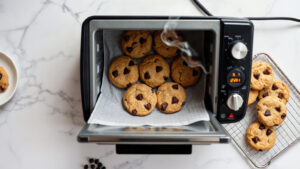
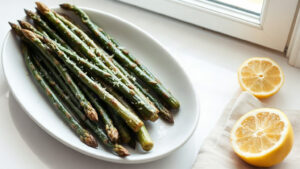
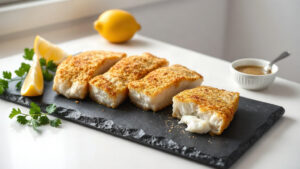
A toaster oven can reach temperatures between 200°F and 450°F, which is more than enough to cook real food — not just toast. Without a microwave, you’re not stuck eating cold cereal and sad granola bars; a compact toaster oven handles everything from roasted vegetables to baked pasta. The meals below are things I’ve actually made (or watched a college student make in a genuinely tiny room), and they work.
Safety First: Toaster ovens get extremely hot on the outside surfaces — don’t place them inside a cabinet, under a shelf, or within 6 inches of anything flammable (including paper towels and curtains). Always pull the plug when you leave the room, never use aluminum foil to line the bottom tray (it can cause a fire), and keep a clear path to the door. Check your dorm’s appliance policy before you plug anything in — some buildings require UL-listed appliances only.
Quick Takeaways
- Toaster ovens cook at 200°F–450°F and can bake, broil, toast, and roast — no microwave needed.
- Most compact toaster ovens (6-slice and under) draw 1,200–1,500 watts, which is within the limit of most dorm outlets — but confirm with your RA.
- The seven meals below require minimal prep, one or two pans, and ingredients you can keep in a mini fridge.
- Cooking your own food in a dorm can cut food costs by $150–$300 a month compared to eating out daily.
- Silicone mitts and a small toaster oven baking pan are the two accessories worth buying before anything else.
First, Check Your Dorm’s Rules (Seriously)
Some residence halls ban hot plates and full-size appliances but allow toaster ovens. Others prohibit toaster ovens entirely. A few only allow them in shared kitchen areas. It varies wildly, even building to building on the same campus.
Before you order anything, email your housing office and ask specifically about toaster ovens and wattage limits. Get it in writing. I’ve seen students haul a $90 oven back home after a surprise room check, which is a miserable way to start a semester. If your dorm allows them, you’re in good shape. If not, some of these recipes still work with an electric kettle and a small skillet — but that’s a separate article.
If you’re shopping for a unit, check out our picks for the best mini toaster ovens — compact footprint matters a lot when your desk is also your dining table.
7 Real Meals to Cook in a Dorm Toaster Oven
1. Sheet Pan Eggs and Vegetables
Crack two eggs into a small greased baking pan, throw in whatever chopped vegetables you have — frozen bell peppers work fine straight from the bag — and bake at 375°F for 12–15 minutes. The yolks will be set but not rubbery at 13 minutes, which is where I land personally. Season with salt, hot sauce, done.
The first time I tried this, I forgot to grease the pan and spent ten minutes scraping egg off the metal. Don’t do that. A thin layer of cooking spray makes cleanup a non-event.
2. Mini Pizzas on English Muffins
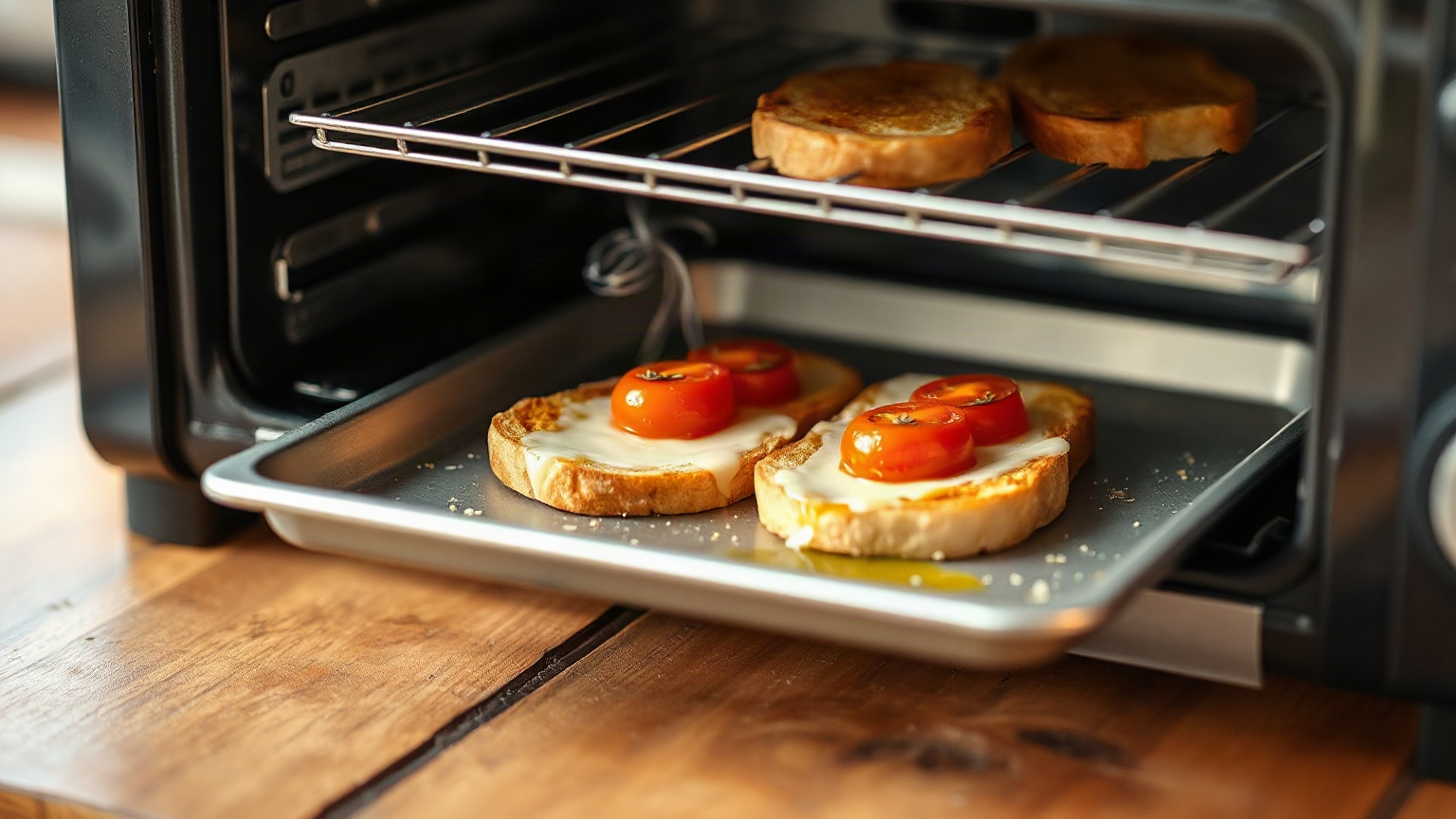
Split an English muffin, spread on a spoonful of canned tomato sauce, add shredded mozzarella (the pre-shredded bag from a convenience store is fine), and broil at 425°F for 5–7 minutes. Watch it. Broil cycles in small toaster ovens are aggressive, and cheese goes from melted to scorched faster than you’d expect.
Add pepperoni, canned olives, or whatever you have. It’s not exactly artisan pizza, but it’s hot and satisfying at 11 PM, which is really what matters.
3. Baked Chicken Thighs
This is the one people are most surprised about. Chicken thighs — bone-in, skin-on — bake at 400°F for 35–40 minutes in a toaster oven and come out legitimately good. Season generously with garlic powder, paprika, salt, and pepper. The skin crisps up because toaster ovens use radiant heat from both top and bottom elements, which is actually great for browning.
The USDA recommends an internal temperature of 165°F for poultry. Spend $10 on an instant-read thermometer — it’s the kind of thing that pays for itself the first time you use it. You can find a decent one with a compact instant-read thermometer search and get something reliable for under $15.
4. Baked Pasta (Mug-Portion Method)
Cook a small handful of penne or rotini in a kettle-boiled water situation (electric kettles are almost universally allowed in dorms) or in a shared kitchen pot. Combine the cooked pasta with a few spoonfuls of jarred marinara and some shredded cheese in a small oven-safe dish. Bake at 375°F for 15 minutes until the top is bubbly and slightly browned. It’s basically a miniature baked ziti, and it reheats well the next day — you can read more about reheating food in a toaster oven if you want to do it properly rather than just guessing.
5. Roasted Vegetables
Broccoli florets, cherry tomatoes, cubed sweet potato, zucchini — almost any vegetable roasts well at 400°F for 20–25 minutes. Toss them in a little olive oil and salt. Spread them on a toaster oven wire rack or the pan that came with your unit, and don’t crowd them. Crowded vegetables steam instead of roast, and you get mushy instead of caramelized.
Sweet potatoes take longer — closer to 30–35 minutes if cubed to 1-inch pieces. Broccoli goes faster, 18–20 minutes, and it gets these slightly crispy edges that are genuinely good.
6. Quesadillas
Lay a flour tortilla flat on the toaster oven rack or pan, add cheese and any fillings on one half, fold it over, and toast at 375°F for 8–10 minutes, flipping once at the halfway point. The result is crispier than a skillet version and you don’t have to stand over it. Canned black beans, salsa, and pre-shredded cheddar is my go-to combination. Takes about 3 minutes of prep.
7. Baked Oatmeal Cups
This one’s worth making in a batch. Mix rolled oats with a mashed banana, a splash of milk (dairy or non-dairy, either works), a pinch of salt, and whatever add-ins you want — frozen blueberries, peanut butter, chocolate chips. Press the mixture into a greased muffin tin or small ramekins, and bake at 350°F for 20–22 minutes. They keep for four or five days in a mini fridge, and you’ve got breakfast covered without thinking about it. Way better than the instant packets, and not much harder.
Toaster Oven Cooking at a Glance
Here’s a quick reference for temperature and timing so you’re not guessing every time:
| Food | Temp (°F) | Time | Notes |
|---|---|---|---|
| Sheet pan eggs | 375°F | 12–15 min | Grease the pan first |
| English muffin pizza | 425°F broil | 5–7 min | Watch closely — broil burns fast |
| Chicken thighs (bone-in) | 400°F | 35–40 min | Check internal temp: 165°F |
| Baked pasta | 375°F | 15 min | Pre-cook pasta first |
| Roasted vegetables | 400°F | 20–35 min | Varies by vegetable size |
| Quesadillas | 375°F | 8–10 min | Flip once at 4–5 min |
| Baked oatmeal cups | 350°F | 20–22 min | Batch cook for the week |
The Edge Case: What If You Only Have a Mini Toaster Oven?
Some dorms only permit 2-slice or 4-slice compact units, not the larger countertop models. At that size, you’re working with a very small interior cavity — often just 9 inches wide — and a single rack position. A few things change.
Chicken thighs become harder because you may only fit two pieces, and the heating element is so close to the food that the top can burn before the inside is cooked through. The fix: start at 375°F for the first 20 minutes with a small piece of foil tented over the top, then remove it for the last 15–20 minutes to crisp up. It adds a step, but it works.
Baked oatmeal cups work perfectly in mini units since ramekins fit easily. Same with quesadillas, eggs, and English muffin pizzas. The baked pasta gets trickier — use a small loaf pan or a single oven-safe mug, and reduce the quantity.
Also: smaller toaster ovens tend to run hotter than their dials suggest. If your food is consistently over-browning, drop the temperature 25°F from whatever a recipe calls for and check earlier than the stated time. That advice applies to how hot a toaster gets in practice versus what the dial says — worth understanding before you char your first batch of vegetables.
Supplies Worth Having
You don’t need much. But a few specific things make dorm toaster oven cooking a lot less frustrating:
- A small metal baking pan that fits your specific oven (measure before buying)
- Silicone oven mitts — the toaster oven door and rack get genuinely hot
- Cooking spray (the store-brand aerosol kind works fine)
- An instant-read thermometer for chicken and anything else you’re not sure about
- A couple of small oven-safe ramekins for single-serving bakes
You can see Serious Eats’ essential kitchen equipment guide for broader advice on what actually earns counter space. Most of it scales down to a dorm situation better than you’d think.
Final Thoughts
Not having a microwave isn’t the hardship it sounds like. A toaster oven is genuinely more useful for real cooking — it browns things, it crisps things, it bakes things. The microwave just reheats. If you’re stuck in a dorm and trying to eat something that doesn’t come from a vending machine, the seven meals above are a solid starting point. Start with the English muffin pizza (easiest, fastest, hardest to mess up), then work your way toward the chicken thighs when you’re feeling confident. You’ll figure out your specific oven’s hot spots and quirks after a week or two. And once you do, you’ll use it almost every day.
Frequently Asked Questions
Can you cook raw chicken in a dorm toaster oven?
Yes, you can cook raw chicken in a toaster oven as long as it reaches an internal temperature of 165°F — the USDA’s minimum safe temperature for poultry. Bone-in thighs at 400°F for 35–40 minutes will get there reliably. Use an instant-read thermometer rather than guessing by color or timing alone.
Are toaster ovens allowed in dorm rooms?
It depends entirely on your specific university’s housing policy, and policies differ even within the same school. Some dorms allow toaster ovens under a certain wattage (often 1,200 watts), while others prohibit them entirely or restrict cooking to shared kitchen areas. Always check with your housing office before bringing one to campus.
What can I make in a toaster oven without a microwave for a dorm?
You can make sheet pan eggs, baked pasta, mini pizzas, roasted vegetables, quesadillas, chicken thighs, and baked oatmeal — none of which require a microwave at any stage. A toaster oven handles baking, broiling, and toasting, which covers most of what a microwave does (except reheating liquids quickly). For batch cooking on a budget, roasted vegetables and baked oatmeal cups are the two highest-value options.
How much does it cost to run a toaster oven in a dorm?
A 1,200-watt toaster oven running for one hour costs roughly 15–18 cents at the average U.S. electricity rate of about 13–15 cents per kilowatt-hour. Most dorm meals take 15–40 minutes, so you’re looking at 4–12 cents per cooking session. In practice, the electricity cost is negligible compared to what you save by not ordering takeout.
Is it safe to leave a toaster oven unattended while cooking?
It’s safer than a stovetop burner, but you still shouldn’t leave a toaster oven completely unattended, especially on a broil setting or when cooking anything high in fat. Keep it somewhere with at least 6 inches of clearance on all sides, never line the bottom tray with foil, and always unplug it when you leave the room for more than a few minutes. A smoke detector in good working order is non-negotiable.

Written by
Emma founded Toastera to turn vague appliance advice into clear, researched, safety-first guidance on toasters and toaster ovens.
Free: the Toaster Oven Cheat Sheet
Get the printable cheat sheet (temps, cook times & safety tips) plus new recipes. No spam, unsubscribe anytime.