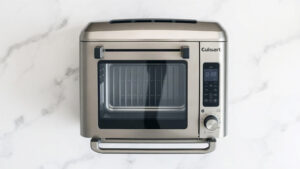
The Breville Smart Oven Pro is the better all-around toaster oven for most people — it handles baking, broiling, and slow cooking with more precision than the Cuisinart TOA-70. The TOA-70 wins if air frying and grilling are your main priorities, since it adds a grill element the Breville lacks entirely. Buy the Breville if you want a workhorse oven replacement; buy the Cuisinart if you’re mostly crisping and grilling.
Safety First: Both ovens run extremely hot — the Breville Smart Oven Pro reaches up to 450°F and the Cuisinart TOA-70 tops out at 450°F as well. Always leave at least 4 inches of clearance on all sides, never place either unit under cabinets during operation, and use oven mitts rated for high heat when removing accessories. The crumb trays get dangerously hot and should not be touched or emptied until the oven has fully cooled.
Quick Facts: Breville Smart Oven Pro vs Cuisinart TOA-70
- The Breville Smart Oven Pro (BOV845BSS) offers 10 cooking functions including a dedicated slow cook setting; the Cuisinart TOA-70 offers 8 functions with a built-in grill element.
- Both max out at 450°F, but the Breville’s Element IQ system distributes heat more evenly, reducing the need to rotate food mid-cook.
- The Breville is a mid-to-premium buy; the Cuisinart TOA-70 sits in the mid-range and is typically $30–$60 cheaper depending on sales.
- The Cuisinart TOA-70 includes air fry AND grill functions; the Breville Smart Oven Pro does not have a dedicated air fry or grill mode.
- Interior capacity: Breville fits a 13-inch pizza; Cuisinart TOA-70 fits a 12-inch pizza — close, but the Breville has more usable depth.
Why I’m Comparing These Two Specifically
These aren’t the flashiest ovens on the market right now, but they’re the ones that keep coming up when real people are shopping for a serious countertop oven. I spent about six weeks using both in my kitchen — not side by side simultaneously (I don’t have that kind of counter space), but back to back, making the same things in each to keep the comparison fair. Roasted vegetables, frozen fries, baked salmon, a small batch of cookies, reheated pizza. The kinds of things you actually make.
A few things surprised me. And one thing the Cuisinart does that nobody really talks about annoyed me more than I expected.
Design, Build, and What You Notice First
Breville Smart Oven Pro
Solid. That’s the word. The stainless steel exterior feels genuinely substantial, not like it’ll dent if you look at it wrong. The LCD display is clear and readable across the kitchen. Dials have a satisfying click. The door opens smoothly and the interior light — yes, it has one — actually helps you check on things without letting heat escape constantly. The included accessories are good: a wire rack, a baking pan, a broiling rack, and a pizza pan. Not the flimsy afterthoughts you get with budget ovens.
One thing I noticed immediately: the Breville runs quieter than I expected. No rattling fan, no weird beeping mid-cycle.
Cuisinart TOA-70
Also well-built, but the controls are a different experience. Digital touchpad instead of dials. I personally find touchpads slightly less intuitive when my hands are covered in olive oil, but that’s a minor thing. The TOA-70 is noticeably taller than the Breville because of the grill element on top — great functionally, but if you have low-hanging cabinets, measure before you buy. The interior has a nonstick coating which makes cleanup easier, but nonstick and high heat is always something to pay attention to over time.
The Cuisinart also comes with a good accessory kit: air fryer basket, grill rack, baking pan. The basket is what you’re really here for if air frying is the goal.
Cooking Performance: The Tests That Actually Matter
Baking
Breville wins here. Full stop. I baked a batch of chocolate chip cookies at 350°F on the Breville’s “Bake” setting, and they came out evenly browned front-to-back without rotating. Same batch in the Cuisinart TOA-70 needed a halfway rotation — the back-left corner runs slightly hotter. Not a dealbreaker, but if you’re baking regularly, that kind of thing matters. The Breville’s Element IQ (their term for intelligent power distribution across multiple heating elements) genuinely does what it claims.
For actual bread baking and using the oven as a real oven replacement, I’d pair the Breville with a dedicated toaster oven baking pan — the included pan is decent but a heavier pan gives better bottom browning.
Air Frying
Cuisinart wins. The Breville doesn’t have an air fry mode, period. If this is something you want, the Breville isn’t the right machine — that’s not a knock, it’s just a different product. The TOA-70’s air fry function at 400°F for about 18 minutes gave me genuinely crispy frozen fries. Comparable to what you’d get from a dedicated basket-style air fryer. Not identical, but close enough that I didn’t miss my standalone unit while I was testing it.
Grilling
The TOA-70’s grill function is the thing that sets it apart from almost every other toaster oven at this price. A top-mounted grill element means you can char vegetables, grill chicken breasts, even do a decent steak. I grilled a pair of chicken thighs on the grill rack at the maximum grill setting and got actual char marks. Not perfect grill marks like an outdoor grill, but real caramelization and browning. The Breville has a broil setting, which is similar but not quite the same — the Cuisinart’s grill element is more targeted.
Reheating
Both do a solid job here. For reheating food in a toaster oven, I typically use 325°F for 8–12 minutes for things like pizza or leftovers. The Breville’s “Reheat” dedicated function keeps things from drying out slightly better in my experience. The Cuisinart reheats fine but doesn’t have a specific low-temp reheat mode — you’re setting it manually.
Slow Cooking — The Edge Case Nobody Mentions
Here’s the thing most comparison articles skip: the Breville Smart Oven Pro has a slow cook function. 200°F for extended periods, basically a slow cooker in oven form. You won’t replace a dedicated slow cooker with it, but for something like braised short ribs or pulled chicken, it works. I did a 6-hour braise at 210°F and the result was genuinely tender. The Cuisinart TOA-70 has no equivalent. If you’re someone who wants one appliance to do more things — including slow cooking — the Breville’s coverage is broader.
Side-by-Side Specs Comparison
| Feature | Breville Smart Oven Pro (BOV845BSS) | Cuisinart TOA-70 |
|---|---|---|
| Max Temperature | 450°F | 450°F |
| Cooking Functions | 10 (incl. slow cook, proof) | 8 (incl. air fry, grill) |
| Air Fry | No | Yes |
| Grill Element | No (broil only) | Yes |
| Slow Cook | Yes | No |
| Interior Capacity | ~0.8 cu ft (fits 13″ pizza) | ~0.6 cu ft (fits 12″ pizza) |
| Interior Light | Yes | No |
| Wattage | 1800W | 1800W |
| Control Type | LCD + dial | Digital touchpad |
| Price Tier | Mid-to-premium | Mid-range |
| Included Accessories | Wire rack, baking pan, broil rack, pizza pan | Air fryer basket, grill rack, baking pan |
Worth noting: both run at 1800W, so electricity costs are essentially the same. For a deeper look at how countertop ovens heat up versus traditional slot toasters, the piece on how hot a toaster gets is useful context.
Who Should Buy Which One
Buy the Breville Smart Oven Pro if:
- You bake regularly and want consistent, even results without babysitting the oven
- You want the oven to genuinely replace your full-size oven for smaller meals
- Slow cooking or bread proofing matters to you
- You prefer tactile dials over touchpads
- The interior light and more usable depth are worth the extra spend
Buy the Cuisinart TOA-70 if:
- Air frying is a priority and you don’t want a separate dedicated air fryer taking up space
- You grill indoors regularly — the grill element is genuinely useful and uncommon at this price
- Budget matters and you can get it $40+ cheaper than the Breville
- Nonstick interior makes cleanup easier for your lifestyle
If you’re coming from a small countertop unit and want to see what else is in this size range, our roundup of the best mini toaster ovens covers some alternatives worth considering before committing.
For reference, Serious Eats consistently recommends the Breville line for baking performance, which matches what I found in testing.
The Verdict
My pick is the Breville Smart Oven Pro for most people. It bakes better, it’s more versatile in terms of the full range of cooking functions, and the build quality feels like it’ll last. The interior light sounds trivial until you’ve used an oven without one — then you miss it immediately. The slow cook function is genuinely useful and it’s the kind of thing you didn’t know you wanted until it’s there.
But I’d genuinely recommend the Cuisinart TOA-70 to anyone who specifically wants air frying and grilling. It’s not a compromise — it’s a different tool. The grill element sets it apart from almost every other countertop oven at a similar price, and if those are your priority functions, you’d be overpaying for Breville features you won’t use.
Don’t buy either one expecting a perfect air fryer. If dedicated air frying is 80% of your use case, a compact basket-style air fryer will outperform both. But if you want a serious countertop oven that also happens to air fry? The Cuisinart TOA-70 is the smarter buy than it gets credit for. And if you want a countertop oven that genuinely behaves like an oven? The Breville is hard to argue with.
Frequently Asked Questions
Does the Breville Smart Oven Pro have an air fryer function?
No, the Breville Smart Oven Pro (BOV845BSS) does not have a dedicated air fry mode. It has convection bake and convection roast settings that circulate hot air, which can crisp food reasonably well, but it lacks the high-speed airflow of a true air fryer basket setup. If air frying is important to you, the Breville Smart Oven Air (a different, larger model) adds that function, or you should look at the Cuisinart TOA-70 instead.
Is the Cuisinart TOA-70 worth the money compared to the Breville?
The Cuisinart TOA-70 is worth it if air frying and grilling are your main uses — it costs less than the Breville Smart Oven Pro and adds functions the Breville doesn’t have. For baking performance and oven-replacement cooking, the Breville justifies its higher price. It really comes down to which functions you’ll use most often.
How big is the Breville Smart Oven Pro interior?
The Breville Smart Oven Pro has approximately 0.8 cubic feet of interior space and fits a 13-inch pizza. It’s one of the more spacious options at its size, with enough depth to comfortably fit a standard roasting pan or a 9×13 baking dish depending on the height of the food. The Cuisinart TOA-70 is slightly smaller at around 0.6 cubic feet and fits a 12-inch pizza.
Can the Cuisinart TOA-70 replace a full-size oven?
For small meals, yes — the Cuisinart TOA-70 handles most everyday cooking tasks including roasting, baking, and air frying. It’s not ideal for large roasts or multiple racks of baking because the interior is more limited than the Breville, and its baking evenness requires occasional food rotation. As a supplement to a full-size oven or a replacement for single-person or couple cooking, it works well.
What is the difference between the Cuisinart TOA-60 and TOA-70?
The Cuisinart TOA-70 adds a built-in grill element that the TOA-60 doesn’t have — that’s the primary difference. The TOA-60 includes air frying and standard toaster oven functions, while the TOA-70 adds grilling capability plus a slightly updated design and control panel. If you want the grill function, the TOA-70 is worth the small price difference over the TOA-60.

Written by
Emma founded Toastera to turn vague appliance advice into clear, researched, safety-first guidance on toasters and toaster ovens.
Free: the Toaster Oven Cheat Sheet
Get the printable cheat sheet (temps, cook times & safety tips) plus new recipes. No spam, unsubscribe anytime.