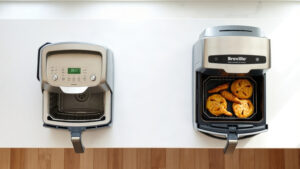
A standard pop-up toaster uses roughly 800–1,500 watts and toasts two slices in about 2–3 minutes, making it significantly cheaper to run for basic bread toasting than a toaster oven. A toaster oven draws 1,200–1,800 watts but takes 5–8 minutes to preheat before it even starts cooking, which adds up fast if you’re only making breakfast. That said, the toaster oven wins on versatility — and for small cooking tasks that would otherwise fire up a full-size oven, it can actually save you money overall.
Safety First: Both toasters and toaster ovens reach surface temperatures that can cause serious burns — never touch the exterior slots or oven walls during or immediately after use. Keep both appliances at least 4 inches from cabinets, curtains, or paper towels. Never leave a toaster oven unattended on the broil setting, and always unplug your pop-up toaster before attempting to clear a stuck piece of bread.
Quick Facts: Toaster vs Toaster Oven Running Costs
- A pop-up toaster costs roughly $0.01–$0.02 per toasting session at average U.S. electricity rates (~$0.16/kWh).
- A toaster oven running 30 minutes daily costs approximately $0.04–$0.06 per day, or around $1.50–$1.80 per month.
- For bread only, a pop-up toaster is 2–3x cheaper to operate than a toaster oven.
- A toaster oven replaces a full-size oven for small meals, which can save significantly more than its extra wattage costs.
- Preheat time is the hidden cost of toaster ovens — it’s where most of the extra electricity goes.
The Real Numbers: How Much Does Each Actually Cost Per Day?

Let’s get into specifics, because vague answers about “it depends on your usage” don’t help anyone budget. I ran both appliances in my own kitchen with a basic plug-in watt meter — the kind that costs about $15 on Amazon and is absolutely worth owning if you’re curious about this stuff.
My pop-up toaster (a basic 2-slice model, 900 watts) toasted two slices on setting 4 in 2 minutes and 20 seconds. Total energy used: about 0.035 kWh. At $0.16/kWh, that’s roughly half a cent per session. Toast every morning for a month? About $0.15. Basically nothing.
My toaster oven (a mid-range 1,500-watt model) took 6 minutes to preheat to 375°F, then another 8 minutes to toast a batch of bread. Total: about 14 minutes of draw at 1,500 watts, or 0.35 kWh per session. That’s $0.056 per session — roughly 11 times more expensive than the pop-up toaster for the exact same result.
But here’s what the other articles don’t tell you: if you’re using the toaster oven to bake four chicken thighs instead of heating your 5,000-watt full-size oven, you’re saving roughly 0.8 kWh per session. The toaster oven pays for its extra running cost pretty quickly in that scenario.
| Appliance | Typical Wattage | Time for Toast | Energy per Session | Cost per Session* | Monthly Cost (daily use)* |
|---|---|---|---|---|---|
| Pop-up toaster (2-slice) | 800–1,500W | 2–3 min | 0.03–0.06 kWh | ~$0.005–$0.01 | ~$0.15–$0.30 |
| Toaster oven (basic) | 1,200–1,500W | 12–16 min (inc. preheat) | 0.25–0.40 kWh | ~$0.04–$0.06 | ~$1.20–$1.80 |
| Toaster oven (large/premium) | 1,500–1,800W | 14–20 min (inc. preheat) | 0.35–0.60 kWh | ~$0.06–$0.10 | ~$1.80–$3.00 |
| Full-size oven (for context) | 2,400–5,000W | 20–30 min preheat alone | 1.0–2.5 kWh | ~$0.16–$0.40 | ~$5–$12 |
Speed: Which One Actually Gets You Breakfast Faster?
The pop-up toaster wins here. No contest. There’s no preheat, no waiting for a cavity to come up to temperature — you drop the bread, push the lever, walk away. For white or sourdough toast, 2.5 minutes is realistic. For a thick bagel on a 4-slice wide-slot toaster, maybe 3.5 minutes.
A toaster oven, even on a “toast” mode, takes longer. The first time I tried using mine on the dedicated toast setting (no preheat required, supposedly), my sourdough came out warm and barely colored on one side. I had to flip it manually. That was annoying. I’ve since learned to use the broil setting for actual toast — 4 minutes, rack in the upper position — and it works much better. But it’s still slower than a pop-up.
One edge case worth mentioning: frozen waffles and thick frozen bagels. A toaster oven handles these far better. A pop-up toaster tends to burn the edges before the center is properly thawed. If your household goes through a lot of frozen breakfast items, that’s a real argument for the toaster oven, speed disadvantage notwithstanding. You can learn more about how hot a toaster gets compared to other methods if you want to understand why frozen items behave differently.
Versatility vs. Simplicity: What Do You Actually Need?
This is where the toaster oven genuinely earns its keep. A pop-up toaster does one thing. It toasts. Occasionally it does it really well. That’s it.
A toaster oven can roast vegetables, reheat pizza so the crust stays crispy (not the sad soggy microwave version), bake a small batch of cookies, broil salmon, and melt cheese on an open-faced sandwich. Serious Eats has noted that a good toaster oven can functionally replace your full-size oven for meals serving 1–3 people — and I genuinely agree. I’ve used mine for reheating food in a toaster oven far more than I expected to when I first bought it.
The trade-off is counter space and complexity. A decent toaster oven is bulky. My mid-range model takes up roughly the same footprint as a microwave. If your kitchen is small, that matters.
Specific Models Worth Considering
If you’re choosing between getting a toaster oven or sticking with a pop-up, here are some concrete options rather than just abstract advice:
Budget pop-up toaster: The Hamilton Beach 2-Slice is consistently reliable, around $25, and genuinely does the job without fuss. No frills. It’s what I’d buy for a college dorm. Hamilton Beach 2-slice toasters on Amazon.
Mid-range toaster oven: The Cuisinart TOA-70 (air fryer toaster oven combo) is genuinely excellent for the price tier. It preheats faster than most competitors, the air fry function actually works, and it’s not absurdly large. My main gripe is the crumb tray is slightly awkward to remove. But the cooking quality is solid. Cuisinart TOA-70 toaster oven.
Premium option: The Breville Smart Oven Air Fryer is the one that food people rave about, and it’s earned the reputation. It’s more expensive (premium price tier), but the preheat is genuinely faster and the even heat distribution is noticeably better than budget models. If you cook actual meals in your toaster oven regularly, the Breville is worth the price. Check the best mini toaster ovens roundup for a broader comparison of sizes and features.
Mid-range versatile: The Ninja Foodi Digital Air Fry Oven is a solid alternative if you want something that also flips up to save counter space. Genuinely clever design. Gets very hot, very fast.
| Model | Type | Capacity | Key Functions | Footprint | Price Tier |
|---|---|---|---|---|---|
| Hamilton Beach 2-Slice | Pop-up toaster | 2 slices | Toast only | Very small | Budget |
| Cuisinart TOA-70 | Toaster oven + air fryer | 6-slice / 12″ pizza | Toast, bake, broil, air fry | Medium | Mid-range |
| Ninja Foodi Digital Air Fry | Toaster oven + air fryer | Large sheet pan | Toast, roast, dehydrate, air fry | Medium (folds up) | Mid-range |
| Breville Smart Oven Air Fryer | Smart toaster oven | 13″ pizza / 9-slice | 13 cooking functions, IQ element | Large | Premium |
The Edge Case No One Mentions: Small Households and Electricity Rates
If you live alone or with one other person and you never cook anything more elaborate than toast and the occasional reheated slice of pizza, a pop-up toaster is unambiguously cheaper and faster. Full stop.
But if you live in a state like Hawaii or California where electricity rates are well above the national average — sometimes $0.30–$0.40/kWh — the calculus shifts. Every time you avoid firing up your 4,000-watt full-size oven and use the toaster oven instead, you’re saving a meaningful amount. Running a 1,500-watt toaster oven for 25 minutes instead of a 4,000-watt wall oven for 45 minutes saves roughly 0.9 kWh. At $0.35/kWh, that’s $0.31 per meal. Small per instance, but it adds up across a month of cooking.
There’s also the summer heat factor, which I’ve never seen covered properly elsewhere. Running a full-size oven for 45 minutes in July raises your kitchen temperature noticeably, which then costs you more in air conditioning. A toaster oven generates far less ambient heat. If you’re in a warm climate with AC running most of the summer, that indirect savings is real. Not dramatic, but real. The U.S. Energy Information Administration notes that cooking and appliance use account for a meaningful share of residential electricity consumption, particularly in warmer months.
My Honest Verdict: Which Should You Actually Buy?
Get the pop-up toaster if: you mostly make toast, you have a small kitchen, and you already own a decent full-size oven you’re comfortable using for everything else. A good 2-slice toaster is cheap to buy, cheap to run, and does one thing well. Don’t overcomplicate it.
Get the toaster oven if: you cook for yourself or a small household regularly, you hate waiting for a big oven to preheat for a small meal, or you don’t have a full-size oven at all (studio apartments, I see you). The Cuisinart TOA-70 is my go-to recommendation for most people — it’s the right size, it air fries reasonably well, and it doesn’t cost a fortune. Pair it with a good nonstick toaster oven baking pan and you’ll be surprised how much you use it.
Get both if you have the counter space and budget. I have both. My pop-up toaster gets used every single morning for bread. My toaster oven gets used 4–5 times a week for everything else. They’re not really competing — they serve different purposes.
The Bottom Line
For pure toast, the pop-up toaster is cheaper to run — by a lot. We’re talking $0.15/month vs. $1.50–$1.80/month for the same task. But that framing misses the point of what a toaster oven actually is. It’s not a fancy toaster. It’s a small secondary oven that happens to also toast bread. If you use it as one, the math flips entirely in its favor. The right question isn’t which is cheaper to run — it’s which one you’ll actually use more, and for what. Answer that honestly, and the choice is easy.
Frequently Asked Questions
Is a toaster or toaster oven cheaper to run daily?
A pop-up toaster is significantly cheaper for daily toast — roughly $0.005–$0.01 per session vs. $0.04–$0.06 for a toaster oven doing the same job. Over a month, that’s about $0.15 vs. $1.50–$1.80. If you’re using the toaster oven to replace a full-size oven for small meals, it can save money compared to that alternative.
How much electricity does a toaster oven use per month?
A typical 1,500-watt toaster oven used for 30 minutes daily consumes about 22–23 kWh per month, costing roughly $1.50–$1.80 at the U.S. average electricity rate. High-wattage models (1,800W) or longer daily use will push that figure higher. Using it to replace a full-size oven offsets the cost considerably.
Does a toaster oven use more electricity than a microwave?
Yes, generally. A microwave typically draws 700–1,200 watts and heats food in 1–3 minutes, while a toaster oven draws 1,200–1,800 watts and takes longer due to preheat time. For reheating moist foods, the microwave is more efficient. For anything where you want crispiness or browning, the toaster oven produces far better results worth the extra wattage.
How hot does a toaster oven get compared to a regular toaster?
A toaster oven typically reaches 150°F–500°F depending on the setting, with broil settings going up to 500°F or beyond. A pop-up toaster’s heating elements reach much higher surface temperatures (over 1,100°F on the element itself) but the food only reaches about 300–400°F in contact time. See our full breakdown of how hot a toaster gets for more detail.
Can a toaster oven completely replace a regular toaster?
Technically yes, but most people find it annoying in practice. Toaster ovens take longer for basic toast and use more electricity doing it. If counter space and budget allow, keeping both is the most practical setup. If you have to choose one, a toaster oven offers far more cooking flexibility, though your morning toast routine will take an extra 5–6 minutes.

Written by
Emma founded Toastera to turn vague appliance advice into clear, researched, safety-first guidance on toasters and toaster ovens.
Free: the Toaster Oven Cheat Sheet
Get the printable cheat sheet (temps, cook times & safety tips) plus new recipes. No spam, unsubscribe anytime.