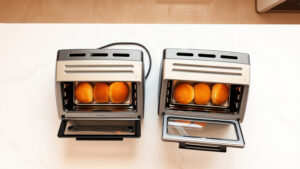
A typical toaster oven draws between 9 and 12 amps on a standard 120V household circuit, with most mid-size models landing right around 1,200–1,440 watts (10–12 amps). A 15-amp circuit can technically handle that load, but only if nothing else significant is running on the same circuit. Share that circuit with a microwave or coffee maker and you’re almost certainly going to trip the breaker.
Safety First: Never plug a toaster oven into an extension cord or power strip — these appliances draw sustained high current and can overheat inadequately rated wiring, creating a real fire risk. Always plug directly into a grounded wall outlet, and if your breaker trips repeatedly, stop using that circuit for the toaster oven and have an electrician check the load before continuing.
Quick Facts: Toaster Oven Amps at a Glance
- Most toaster ovens are rated 1,200–1,800 watts, which translates to 10–15 amps on a 120V circuit
- A 15-amp circuit is technically safe for a toaster oven running alone — but the NEC 80% rule means your usable limit is really 12 amps continuous
- Compact toaster ovens (4-slice, ~1,000W) draw about 8.3 amps — the safest bet for a shared kitchen circuit
- Large countertop convection models with air fryer functions can hit 1,800W (15 amps) — dangerously close to, or exactly at, the circuit limit on their own
- Surge current at startup can spike briefly above rated draw, which is often what actually trips the breaker
The Basic Math: Watts, Amps, and Why Your Breaker Doesn’t Care About Your Dinner Plans
Amps = Watts ÷ Volts. That’s really the whole formula. In North America, standard outlets run at 120 volts, so dividing your toaster oven’s wattage by 120 gives you the amp draw. Easy enough.
A 1,200-watt oven pulls 10 amps. A 1,500-watt model pulls 12.5 amps. And a bigger 1,800-watt unit — common in air fryer combos — draws exactly 15 amps, which is literally the maximum rating of that circuit before the breaker is supposed to trip. The first time I ran a full-size convection toaster oven at max broil while my coffee maker finished its cycle, the breaker flipped before I even finished setting the timer. Annoying, but it was the circuit doing its job correctly.
The piece most people skip: the NEC (National Electrical Code) continuous load rule. Any load running longer than three minutes is considered “continuous,” and continuous loads should not exceed 80% of the circuit’s rated ampacity. On a 15-amp circuit, that’s 12 amps. So even though your 1,500-watt oven is technically under 15 amps, it’s pulling 12.5 amps continuously — which is already over the safe working limit for that circuit under sustained use.
How Different Toaster Oven Sizes Actually Compare
Not all toaster ovens are created equal, and wattage varies a lot more than the marketing suggests. Here’s a realistic breakdown of what different categories actually draw:
| Toaster Oven Type | Typical Wattage | Amp Draw (120V) | Safe on 15A Circuit Alone? |
|---|---|---|---|
| 2-slice compact | 700–900W | 5.8–7.5A | Yes, easily |
| 4-slice standard | 1,000–1,200W | 8.3–10A | Yes |
| 6-slice mid-size | 1,400–1,500W | 11.7–12.5A | Marginally (nothing else on circuit) |
| Large convection/air fryer combo | 1,700–1,800W | 14.2–15A | No — dedicated circuit strongly recommended |
The best mini toaster ovens sit comfortably in that compact category, usually well under 1,000 watts, and they’re genuinely the right call if your kitchen only has shared circuits. I’ve used a small 900-watt model for years without a single tripped breaker, even when the range hood fan was running.
What About Air Fryer Toaster Ovens Specifically?
These are the ones to watch. Models like the Breville Smart Oven Air Fryer (1,800W), the Breville BOV900BSS, and the Ninja Foodi XL all sit at or near 1,800 watts. That’s 15 amps — the full rating of the circuit, before any continuous-load headroom is factored in. If you have one of these, it really needs its own dedicated 20-amp circuit ideally, or at minimum a 15-amp circuit with zero other loads. I know that’s not what people want to hear, but I’ve seen too many nuisance trips from people expecting their giant air fryer oven to share a circuit with the coffee maker without consequence.
The Circuit Itself: 15-Amp vs. 20-Amp and What’s Actually in Your Kitchen
Most kitchen countertop receptacles in homes built before the 1990s are on 15-amp circuits. Homes built or renovated more recently typically have 20-amp small appliance circuits in the kitchen (look for the outlet with a horizontal T-slot on one side — that’s a 20-amp receptacle). A 20-amp circuit gives you 2,400 watts to work with, and 80% of that (the continuous limit) is 1,920 watts. That changes things meaningfully for high-wattage toaster ovens.
But here’s the thing nobody mentions: even on a 20-amp kitchen circuit, you’re usually sharing it with every other outlet along that counter run. The refrigerator typically has its own circuit, but the microwave, blender, and toaster oven might all share one or two 20-amp circuits depending on when your house was wired. The NEC actually requires at least two 20-amp small appliance circuits in kitchen countertop areas for this exact reason — but older homes weren’t built to that standard.
Practically speaking: if your breaker panel shows 15A breakers for the kitchen countertop outlets, treat your usable limit as 12 amps continuous and plan accordingly. That rules out 1,500W+ toaster ovens being used while anything else is on.
How to Find Out What Circuit Your Outlet Is On
Plug a lamp into the outlet, then flip breakers one at a time until it goes off. Label the breaker. Done. It takes about four minutes and you only need to do it once. You can also buy a circuit breaker finder for around $20 that does it without repeatedly walking to the panel — genuinely useful if your home has unlabeled breakers (which, honestly, most do).
What Actually Causes the Breaker to Trip (It’s Not Always What You Think)
There are three distinct scenarios that flip a kitchen breaker, and knowing which one you’re dealing with changes what you do about it.
Sustained Overload
This is the classic case. The total continuous draw on the circuit exceeds the breaker’s rating. The breaker heats up slowly and trips after a few minutes of running. If your toaster oven is at 400°F on bake and your microwave just finished reheating something — and they’re on the same circuit — this is likely what happened. Solution: either use them one at a time, or get a dedicated circuit run to the toaster oven location. For reheating food in a toaster oven instead of a microwave, you’re at least keeping it to one appliance, which helps.
Startup Surge
Heating elements draw a brief spike of current when they first energize — sometimes 20–30% above rated draw for a fraction of a second. Usually breakers tolerate this without issue. But if the circuit is already loaded close to its limit, that spike can push the breaker over. This is the edge case most guides don’t discuss: your toaster oven might run fine for ten minutes, then trip the breaker the moment a second appliance cycles on and both have startup surges simultaneously. The fix is the same as above — reduce concurrent loads.
A Failing or Undersized Breaker
Breakers age. A 30-year-old 15-amp breaker might trip at 11 amps because the thermal element has drifted. If your toaster oven is tripping a breaker that should handle its draw with room to spare, that’s worth flagging to an electrician — not just an inconvenience, but potentially a sign the breaker itself needs replacing. This is the scenario people most often diagnose wrong (they assume the appliance is faulty when it’s actually the breaker).
Practical Tips for Running a Toaster Oven Without Nuisance Trips
Here’s what I actually do, for what it’s worth. I keep the toaster oven on the outlet farthest from the microwave on the counter, because on my circuit layout those two outlets happen to be on different breakers. Took about 10 minutes with the breaker-flip method to figure that out. Total game-… worth it. (I refuse to say the other thing.)
- Never run the toaster oven and microwave at the same time if they share a circuit
- If you’re baking at high temps (425°F+), turn off or unplug other counter appliances as a precaution
- Use convection mode when possible — it reaches temp faster at lower wattage draw than brute-force heating at max power
- If you’re running a 1,800W model regularly, seriously consider having an electrician add a dedicated 20-amp circuit — it’s usually a half-day job and costs a few hundred dollars, far cheaper than dealing with a tripped breaker mid-roast
- Use quality accessories like a proper toaster oven baking pan to maximize cooking efficiency at lower temperatures
Also: check Serious Eats’ toaster oven reviews if you’re shopping for a new unit — they test real cooking performance which indirectly helps you choose a wattage that fits your circuit. And understanding how hot a toaster gets gives you useful context on why these appliances need so much power in the first place.
Bottom Line
A toaster oven on a 15-amp circuit is fine — with conditions. If it’s under 1,440 watts and running alone, you’re within safe limits. Push that to 1,500W or beyond, add a concurrent load, and you’re gambling with the breaker. The math is honest and simple: amps = watts ÷ 120, and your real ceiling for continuous use on a 15-amp circuit is 12 amps (1,440 watts). Know your model’s wattage, know your circuit, and decide from there. It’s not complicated, it’s just physics.
If you’re shopping for a new toaster oven and circuit capacity is a real constraint in your kitchen, that compact 4-slice range in the 1,000–1,200W neighborhood is legitimately the right choice for most households — not a compromise. For everything bigger, plan your circuit accordingly or expect the occasional annoyed trip to the breaker panel.
Frequently Asked Questions
How many amps does a toaster oven draw on a 15 amp circuit?
Most toaster ovens draw between 8.3 and 15 amps at 120V, depending on their wattage (1,000W to 1,800W). A 15-amp circuit can handle this, but the NEC continuous load rule limits practical safe use to 12 amps — meaning only toaster ovens rated at 1,440 watts or less should run continuously on a 15-amp circuit without other loads present.
Will a toaster oven trip a 15-amp breaker?
Yes, it can — especially if another appliance is running on the same circuit. A 1,500W toaster oven pulls 12.5 amps alone, leaving only 2.5 amps of headroom before the breaker trips. Adding a coffee maker, microwave, or even a countertop blender at the same time will push the total above 15 amps and trip the breaker almost immediately.
Does a toaster oven need a dedicated circuit?
Strictly speaking, the NEC doesn’t require a dedicated circuit for a toaster oven the way it does for a range or dishwasher. But high-wattage models at 1,700–1,800W are safest on a dedicated 20-amp circuit, particularly if you use them daily or for extended cooking sessions. Smaller models under 1,200W are generally fine on a shared kitchen circuit.
What is the wattage of a typical toaster oven?
A typical mid-size toaster oven runs between 1,200 and 1,500 watts. Compact 2-slice models can be as low as 700–900 watts, while large air fryer toaster oven combos commonly hit 1,800 watts. The wattage is almost always printed on the label on the bottom or back of the unit.
Can I plug a toaster oven into a regular outlet?
Yes — toaster ovens run on standard 120V household outlets and don’t require any special plug type. The key requirement is that the outlet be a grounded three-prong receptacle (not an old two-prong ungrounded outlet), and that it be plugged directly into the wall rather than through an extension cord or power strip, both of which are fire hazards for high-draw appliances.

Written by
Emma founded Toastera to turn vague appliance advice into clear, researched, safety-first guidance on toasters and toaster ovens.
Free: the Toaster Oven Cheat Sheet
Get the printable cheat sheet (temps, cook times & safety tips) plus new recipes. No spam, unsubscribe anytime.